Overview
- The Milky Way is a barred spiral galaxy containing approximately 100 to 400 billion stars, with a total mass of roughly 1.3 trillion solar masses dominated by a dark matter halo extending far beyond the visible disk of stars, gas, and dust.
- Its structure comprises a thin disk rich in young stars and interstellar gas, a thicker disk of older stars, a central bar and peanut-shaped bulge, at least four major spiral arms traced by high-mass star-forming regions, and an extended stellar halo built largely from the debris of accreted dwarf galaxies.
- The supermassive black hole Sagittarius A* at the galactic center, with a mass of approximately four million solar masses confirmed by decades of stellar orbit monitoring and the Event Horizon Telescope's direct imaging, anchors the Galaxy and participates in the co-evolutionary relationship between black holes and their host galaxies observed throughout the universe.
The Milky Way is the galaxy in which the Solar System resides. Viewed from within, it appears as a luminous band of light arching across the night sky, a perspective that led ancient observers to name it the "milky circle" (Greek galaxias kyklos) and that obscured its true nature as a vast, flattened system of stars for millennia. Modern observations have revealed it to be a barred spiral galaxy of intermediate mass, containing between 100 and 400 billion stars bound together with interstellar gas and dust, threaded through an invisible dark matter halo that extends far beyond the visible disk, and anchored at its center by a supermassive black hole of approximately four million solar masses.1, 2 With a total virial mass of approximately 1.3 trillion solar masses, the Milky Way ranks among the larger galaxies in the Local Group, the gravitationally bound collection of more than 80 galaxies that also includes the Andromeda Galaxy (M31) and the Triangulum Galaxy (M33).2
The Milky Way is the only galaxy whose individual stars, gas clouds, and stellar streams can be studied in exquisite detail, making it the benchmark against which all models of disk galaxy formation and evolution are tested. The Gaia space observatory, launched by the European Space Agency in 2013, has measured the positions, motions, and distances of more than a billion stars with unprecedented precision, transforming the study of the Galaxy from a largely statistical exercise into a field where the assembly history of the Milky Way can be reconstructed star by star.1, 6
Overall structure and dimensions
The Milky Way is organized into several distinct structural components, each with characteristic dimensions, stellar populations, and kinematics. The most prominent visible component is the thin disk, a flattened, rotating structure approximately 25 to 30 kiloparsecs (roughly 80,000 to 100,000 light-years) in diameter and only about 300 parsecs (approximately 1,000 light-years) in vertical scale height. The thin disk contains most of the Galaxy's young stars, interstellar gas, and dust, and it is the site of virtually all ongoing star formation.1, 5
Surrounding the thin disk is the thick disk, first identified by Gilmore and Reid in 1983 as an excess of stars at heights of one to five kiloparsecs above the galactic midplane. The thick disk has a vertical scale height of approximately 0.9 to 1.1 kiloparsecs, roughly three to four times that of the thin disk, and comprises a kinematically hotter (higher velocity dispersion), older, and more metal-poor stellar population. Stars in the thick disk are enriched in alpha elements (such as magnesium, silicon, and calcium) relative to iron, a chemical signature indicating rapid formation from gas enriched primarily by core-collapse supernovae before Type Ia supernovae had time to contribute significant amounts of iron.1, 5, 13
The stellar halo extends to roughly 100 kiloparsecs or more from the galactic center and consists of old, metal-poor stars, globular clusters, and the tidal debris of disrupted satellite galaxies. Although the halo contains less than two percent of the Galaxy's total stellar mass, it preserves the most direct record of the Milky Way's accretion history. The dark matter halo, which dominates the Galaxy's total mass, extends well beyond the stellar halo to a virial radius of approximately 250 kiloparsecs.1, 2
The Sun is located within the thin disk at a distance of approximately 8.2 kiloparsecs from the galactic center, as determined by the gravitational potential model of McMillan and confirmed with 0.3 percent precision by the GRAVITY Collaboration's measurement of stellar orbits around Sagittarius A*.2, 8 The Sun orbits the galactic center at a circular velocity of approximately 233 kilometres per second, completing one orbit in roughly 220 million years, a period sometimes called the galactic year.2
The central bar and bulge
At the center of the Milky Way lies a complex structure that was once thought to be a classical bulge, a spheroidal concentration of old stars formed early in the Galaxy's history through rapid gravitational collapse or mergers. Infrared surveys, which can penetrate the dense dust that obscures the galactic center at optical wavelengths, have revealed that this central structure is not a classical bulge at all but rather the inner, vertically thickened portion of a rotating stellar bar.1, 3
The Milky Way's bar is oriented at an angle of approximately 28 to 33 degrees from the line of sight between the Sun and the galactic center. When viewed from above the galactic plane, the bar would appear as an elongated structure extending roughly five kiloparsecs in half-length from the galactic center. The inner portion of the bar has buckled vertically to form a peanut-shaped or X-shaped structure, a morphology observed in many external barred galaxies and reproduced in N-body simulations of bar instabilities in stellar disks. This boxy or peanut-shaped bulge rises approximately 1.5 kiloparsecs above and below the galactic midplane and contains an estimated 30 to 40 percent of the Galaxy's total stellar mass.3
Beyond the peanut-shaped inner region, the bar extends as a thinner, flatter structure to a total half-length of approximately five kiloparsecs. The bar rotates as a rigid body with a pattern speed of approximately 35 to 40 kilometres per second per kiloparsec, corresponding to a rotation period of roughly 160 to 180 million years. The co-rotation radius, where the bar's pattern speed matches the circular orbital velocity of stars in the disk, lies at approximately 5.5 to 6.5 kiloparsecs from the galactic center, placing the Sun well outside the bar region.1, 3
The recognition that the Milky Way's bulge is a pseudo-bulge formed through internal secular evolution of the disk, rather than a classical bulge formed through violent mergers, has had significant implications for understanding the Galaxy's assembly history. It suggests that the Milky Way has not experienced a major merger since the formation of its disk, consistent with evidence from the stellar halo discussed below.1, 6
Spiral arms
Mapping the Milky Way's spiral structure from within is one of the most challenging problems in galactic astronomy, because the observer is embedded in the disk and must look through layers of gas and dust at various distances. Despite this difficulty, a combination of radio observations of hydrogen gas, surveys of molecular clouds, and, most recently, trigonometric parallax measurements of high-mass star-forming regions have established that the Milky Way possesses at least four major spiral arms.4, 11
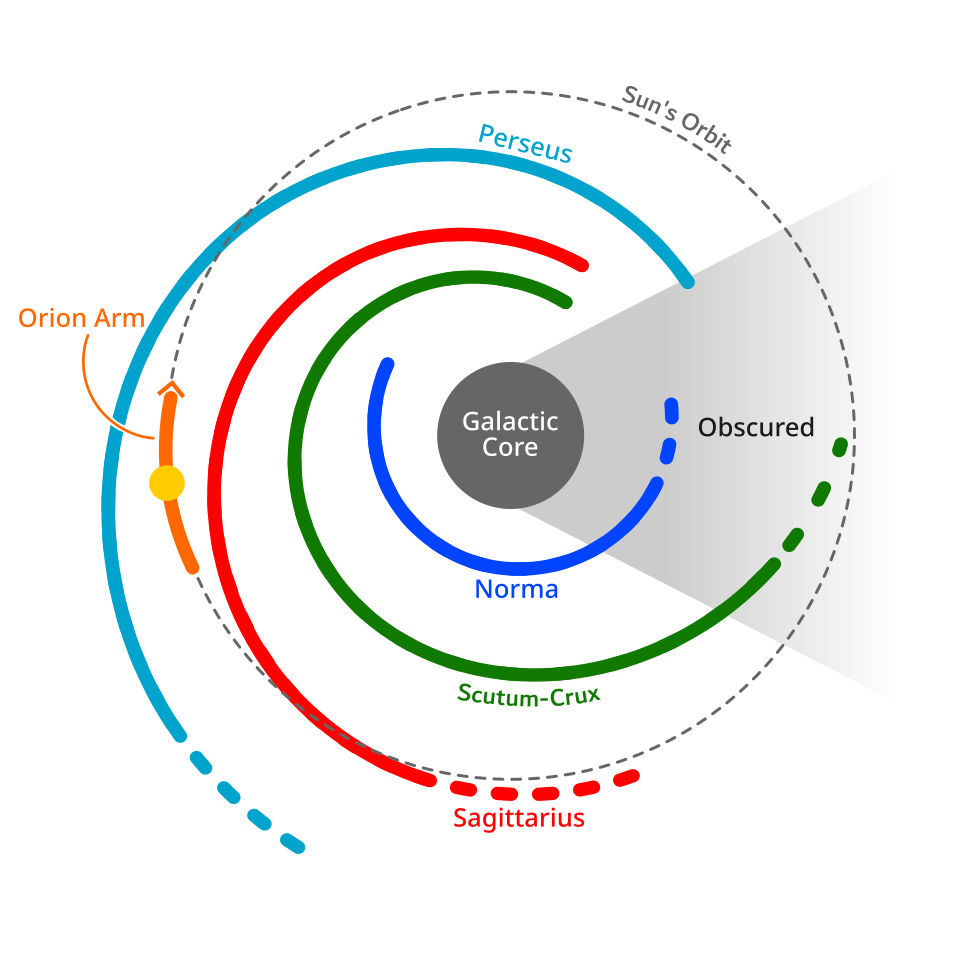

The most comprehensive mapping of the Milky Way's spiral structure has come from the BeSSeL (Bar and Spiral Structure Legacy) Survey and the Japanese VERA (VLBI Exploration of Radio Astrometry) project, which used very long baseline interferometry to measure trigonometric parallaxes, and therefore precise distances, to approximately 200 molecular masers associated with high-mass star-forming regions. The results, compiled by Reid and collaborators in 2019, delineate four major arms: the Scutum-Centaurus Arm, the Sagittarius Arm, the Perseus Arm, and the Outer Arm (also called the Norma-Cygnus Arm). In addition, several inter-arm spurs and segments have been identified, including the Local Arm (or Orion Spur), a relatively minor structure in which the Sun resides.4
The spiral arms are not fixed structures made of permanently resident stars but rather density waves, as described by the theory developed by Lin and Shu in 1964. These waves propagate through the disk at a pattern speed slower than the orbital speed of most disk stars, creating regions of enhanced density that trigger the compression of interstellar gas and the formation of new stars as clouds pass through them.16 The young, luminous, blue stars formed in spiral arms make them visually prominent, while the underlying density contrast in old stellar populations is more modest. The pitch angle of the Milky Way's spiral arms, a measure of how tightly they wind around the center, is approximately 12 to 14 degrees, consistent with a moderately wound spiral typical of Sbc-type galaxies.4
Major spiral arms of the Milky Way and their approximate distances from the galactic center4
The rotation curve and dark matter
The rotation curve of a galaxy describes how the orbital velocity of stars and gas varies with distance from the galactic center. For a galaxy whose mass is concentrated at the center, Keplerian mechanics predicts that orbital velocities should decrease with distance, following the same inverse-square-root law that governs planetary orbits in the Solar System. The Milky Way's rotation curve, however, remains approximately flat out to the farthest distances at which it can be reliably measured, a pattern first established for external spiral galaxies by Vera Rubin and collaborators in the late 1970s and now confirmed within our own Galaxy through multiple independent tracer populations.10, 18
Eilers and collaborators published one of the most precise measurements of the Milky Way's circular velocity curve in 2019, using a sample of approximately 23,000 red giant stars with distances determined from spectrophotometric parallaxes and velocities from Gaia and ground-based spectroscopic surveys. Their results show that the rotation curve remains essentially flat at approximately 229 kilometres per second from 5 kiloparsecs out to at least 25 kiloparsecs from the galactic center, with only the slightest hint of a decline at the outermost radii.10
The flatness of the rotation curve at large radii, where the density of visible matter falls off steeply, is among the most compelling pieces of evidence for a massive dark matter halo surrounding the Milky Way. The mass enclosed within a given radius can be calculated directly from the rotation curve, and at 25 kiloparsecs the enclosed mass substantially exceeds the total mass of all visible stars and gas. Fitting the rotation curve with a mass model that includes separate components for the stellar disk, bulge, gas, and dark matter halo, McMillan determined a total virial mass of (1.30 ± 0.30) × 1012 solar masses, of which the baryonic components (stars and gas) contribute only approximately 6 × 10¹⁰ solar masses, meaning that roughly 95 percent of the Galaxy's total mass is dark matter.2, 10
The dark matter halo is modeled as following a Navarro-Frenk-White (NFW) density profile, in which the density rises steeply toward the center and falls off as the inverse cube of the radius at large distances, a universal shape predicted by cosmological N-body simulations of cold dark matter structure formation.2, 19 The total stellar mass of the Galaxy, summing the thin disk, thick disk, and bulge, is approximately (5.4 ± 0.6) × 1010 solar masses.2
The interstellar medium
The space between stars in the Milky Way's disk is not empty but is filled with the interstellar medium (ISM), a complex mixture of gas and dust organized into phases of vastly different temperatures and densities. The total mass of interstellar gas in the Galaxy is estimated at roughly 10 to 15 percent of the stellar mass, or approximately 5 to 8 × 10⁹ solar masses, with roughly equal amounts in atomic hydrogen (H I) and molecular hydrogen (H2), plus a smaller contribution from ionized hydrogen and helium.1, 11
Atomic hydrogen, detectable through its 21-centimetre radio emission line, extends across the full diameter of the disk and traces the large-scale spiral structure. Surveys of H I emission have revealed that the atomic gas layer warps and flares at large galactocentric radii, bending significantly above and below the nominal midplane beyond approximately 12 kiloparsecs from the center, likely as a result of gravitational interactions with satellite galaxies or the infall of extragalactic gas.1
Molecular hydrogen, which forms in the densest and coldest regions of the ISM, is not directly observable at radio wavelengths under typical interstellar conditions and is instead traced through emission from carbon monoxide (CO), the most abundant molecule after H2. Comprehensive CO surveys of the Milky Way have mapped the distribution of molecular gas across the galactic plane, revealing that molecular clouds are strongly concentrated in a ring between roughly 4 and 8 kiloparsecs from the galactic center, coinciding with the inner spiral arms where the highest rates of star formation are observed.11 Individual giant molecular clouds contain masses ranging from 104 to 106 solar masses and have internal temperatures of only 10 to 20 kelvin, making them the coldest environments in the Galaxy and the sites where gravitational collapse forms new stars and planetary systems.11
Interstellar dust constitutes only about one percent of the ISM by mass but has a disproportionate effect on observations, absorbing and scattering optical and ultraviolet light from background stars and re-emitting the absorbed energy in the infrared. Dust extinction is most severe along lines of sight through the galactic plane, which is why the galactic center is completely invisible at optical wavelengths and why mapping the Milky Way's large-scale structure has historically required infrared, radio, and other long-wavelength observations.1
Sagittarius A* and the galactic center
At the dynamical center of the Milky Way lies Sagittarius A* (Sgr A*), a compact radio source first identified in 1974 that has since been established as a supermassive black hole. Two independent research programs, led by Reinhard Genzel at the Max Planck Institute for Extraterrestrial Physics and by Andrea Ghez at the University of California, Los Angeles, tracked the orbits of individual stars in the immediate vicinity of Sgr A* for more than two decades using adaptive optics on large ground-based telescopes. Their measurements demonstrated that stars orbit an unseen point mass at velocities exceeding 7,000 kilometres per second, with the star S2 (also designated S0-2) completing a full 16-year elliptical orbit with a pericentre passage of only 120 astronomical units from Sgr A*.7 The resulting mass determination of approximately 4.1 × 10⁶ solar masses concentrated within a volume smaller than the orbit of any of the monitored stars is consistent only with a supermassive black hole. This achievement was recognized with the Nobel Prize in Physics in 2020, awarded jointly to Genzel and Ghez.7
The GRAVITY instrument on the European Southern Observatory's Very Large Telescope Interferometer refined the distance to the galactic center to 8,178 ± 13 (statistical) ± 22 (systematic) parsecs and the black hole mass to (4.297 ± 0.012) × 106 solar masses, representing a 0.3 percent precision measurement, one of the most precise fundamental parameters of the Galaxy.8
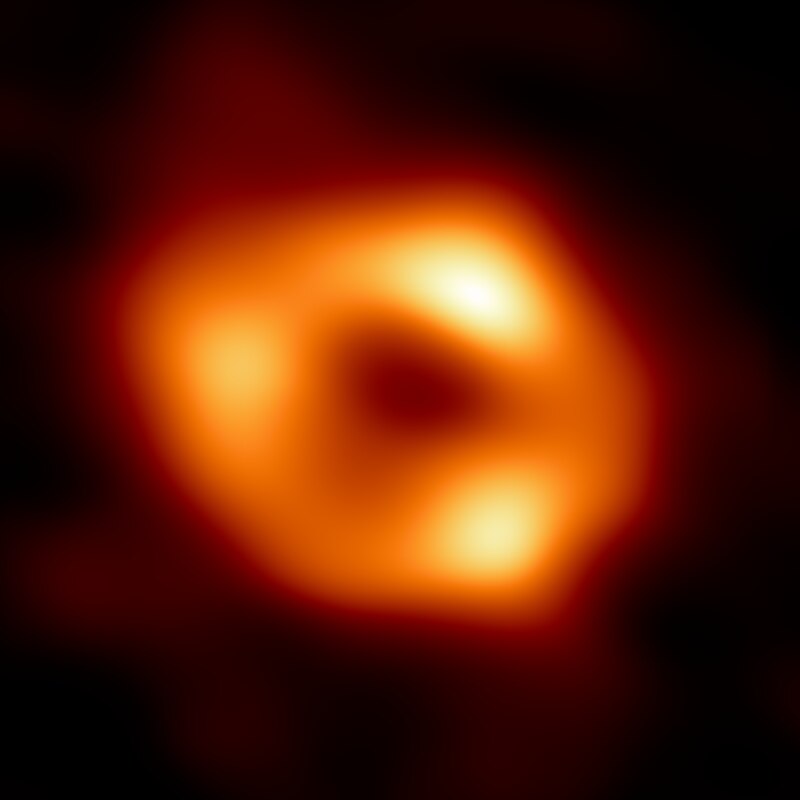
In May 2022, the Event Horizon Telescope (EHT) Collaboration released the first direct image of Sgr A*, obtained by combining observations from a global network of eight radio telescopes operating at a wavelength of 1.3 millimetres. The image revealed a bright, asymmetric ring of emission with a diameter of 51.8 ± 2.3 microarcseconds surrounding a dark central region, the shadow of the black hole. The ring morphology is consistent with the expected appearance of a Kerr black hole with a mass of approximately four million solar masses, as predicted by general relativity, and matches the mass independently determined from stellar orbits to within the measurement uncertainties.9 Sgr A* is currently a relatively quiescent black hole, accreting material at a rate far below the Eddington limit and producing luminosities billions of times fainter than active galactic nuclei and quasars powered by supermassive black holes of comparable mass in other galaxies.9
The stellar halo and accretion history
The stellar halo of the Milky Way is a diffuse, roughly spheroidal component containing old, metal-poor stars and approximately 150 globular clusters. Although it accounts for less than two percent of the Galaxy's total stellar mass, the halo preserves the most direct fossil record of the hierarchical assembly process by which the Milky Way grew through the accretion and disruption of smaller galaxies over cosmic time.1, 6
The most transformative discovery about the Milky Way's accretion history came from analysis of the Gaia satellite's second data release in 2018. Amina Helmi and collaborators identified a large population of stars in the inner stellar halo sharing a common origin, moving on highly radial (plunging) orbits with a distinct chemical composition distinct from the in-situ halo population. This debris, named Gaia-Enceladus (also known as the Gaia-Sausage, from the elongated shape of its velocity distribution), represents the remnant of a dwarf galaxy with a stellar mass comparable to the present-day Small Magellanic Cloud that merged with the proto-Milky Way approximately 8 to 11 billion years ago.6 The Gaia-Enceladus merger was not a minor event: the mass ratio of the merging galaxy to the proto-Milky Way was roughly one to four, making it a significant accretion event that dynamically heated the pre-existing thin disk into what is now observed as the thick disk and deposited a large fraction of the inner stellar halo.6
Ongoing accretion is directly visible today. The Sagittarius Dwarf Elliptical Galaxy, discovered by Ibata, Gilmore, and Irwin in 1994, is a small galaxy located only approximately 20 kiloparsecs from the galactic center on the opposite side of the Galaxy from the Sun. It is currently being torn apart by the Milky Way's tidal forces, and its disrupted stars have been traced in a vast stellar stream that wraps more than 360 degrees around the Galaxy, crossing both the northern and southern galactic hemispheres.12 The Sagittarius stream is one of the most spectacular examples of galactic cannibalism in progress and provides a powerful probe of the shape and mass distribution of the Milky Way's dark matter halo, because the stream's trajectory is shaped by the gravitational potential through which it orbits.12
The Milky Way's two most massive satellite galaxies, the Large Magellanic Cloud (LMC) and the Small Magellanic Cloud (SMC), are visible to the naked eye from the Southern Hemisphere. The LMC, with a stellar mass of roughly 2 to 3 × 10⁹ solar masses, is massive enough that its gravitational influence perturbs the Milky Way's disk and stellar halo, an effect that must be accounted for when modeling the Galaxy's total mass from tracer populations.17 The Milky Way currently has more than 60 known satellite galaxies, most of them ultra-faint dwarf galaxies discovered through systematic photometric surveys over the past two decades.17
Chemical evolution
The chemical composition of stars across the Milky Way provides a detailed chronological record of the Galaxy's star formation and enrichment history, because each generation of stars inherits the chemical elements produced by all previous generations and adds its own nucleosynthetic products to the interstellar medium before forming the next generation. This principle underlies the field of galactic chemical evolution, which uses the abundances of elements heavier than helium (collectively termed metals in astronomical usage) to reconstruct the timeline of star formation, gas accretion, and outflow in the Galaxy.13
One of the most diagnostic chemical signatures in the Milky Way is the ratio of alpha elements (oxygen, magnesium, silicon, calcium, and titanium, produced primarily by massive stars in core-collapse supernovae) to iron (produced both by core-collapse supernovae and, with a time delay of roughly one billion years, by Type Ia supernovae). Stars with high [α/Fe] ratios formed rapidly from gas enriched predominantly by core-collapse supernovae, before the delayed contribution of Type Ia supernovae could bring the iron abundance up. Stars with lower [α/Fe] ratios formed from gas that had been enriched over a longer period, allowing the iron contribution from Type Ia supernovae to accumulate. The chemical abundance plane of [α/Fe] versus [Fe/H] reveals a clear bimodal distribution in the solar neighborhood, with the high-[α/Fe] sequence corresponding to the thick disk and the low-[α/Fe] sequence corresponding to the thin disk.13
The radial metallicity gradient of the thin disk is another key observable: the average metallicity of young stars and H II regions decreases with increasing distance from the galactic center, at a rate of approximately −0.06 dex per kiloparsec. This gradient is a natural consequence of the inside-out formation of the disk, in which the inner regions formed first and experienced more star formation and chemical enrichment than the outer regions. Models of Milky Way chemical evolution that incorporate inside-out disk growth, radial gas flows, and the delayed contributions of different nucleosynthetic sources can reproduce the observed metallicity gradient, the [α/Fe] bimodality, and the age-metallicity relation with good fidelity.13
Summary of key Milky Way structural parameters1, 2, 8
| Parameter | Value |
|---|---|
| Total virial mass | (1.3 ± 0.3) × 1012 M⊙ |
| Total stellar mass | (5.4 ± 0.6) × 1010 M⊙ |
| Disk diameter (thin disk) | ~25–30 kpc (~80,000–100,000 ly) |
| Thin disk scale height | ~300 pc |
| Thick disk scale height | ~900–1,100 pc |
| Bar half-length | ~5.0 ± 0.2 kpc |
| Bar angle (to Sun–GC line) | ~28–33° |
| Sun–galactic center distance | 8,178 ± 26 pc |
| Circular velocity at Sun | ~233 km/s |
| Central black hole mass (Sgr A*) | (4.297 ± 0.012) × 106 M⊙ |
| Number of spiral arms | 4 major + Local Arm spur |
| Number of known satellite galaxies | >60 |
The Local Group and future evolution
The Milky Way is one of the two dominant members of the Local Group, a gravitationally bound collection of more than 80 galaxies spanning roughly three megaparsecs. The other dominant member is the Andromeda Galaxy (M31), a slightly more massive spiral galaxy located approximately 780 kiloparsecs away. The remaining members of the Local Group are dwarf galaxies, most of them satellites of either the Milky Way or M31, with the Triangulum Galaxy (M33) representing the only other significant spiral.17
Precise measurements of the Andromeda Galaxy's proper motion, first obtained from Hubble Space Telescope observations by van der Marel and collaborators in 2012 and refined with Gaia data in 2019, have established that the Milky Way and M31 are approaching each other at approximately 110 kilometres per second. N-body simulations of the future orbital evolution predict that the two galaxies will undergo a close encounter or merger in approximately 4.5 billion years, ultimately coalescing into a single, larger elliptical galaxy sometimes called Milkomeda or Milkdromeda.14, 15 The 2019 revision using Gaia proper motions suggested that the merger may occur somewhat later than the original 2012 estimate and that the initial encounter may be more of a glancing collision than a direct head-on impact, though the ultimate outcome, a merger, remains the same.15
During the merger, the orderly disk structures of both galaxies would be largely destroyed, their stars scattered onto chaotic orbits by the rapidly changing gravitational potential, as is observed in merging galaxy pairs throughout the universe. The Sun and Earth would survive the merger itself, as stellar collisions during galaxy mergers are extraordinarily rare given the vast distances between individual stars, though the night sky would be dramatically transformed as the two galaxies' stellar populations intermingle. The formation of a merged elliptical system from two spiral progenitors would mirror the process thought to have built the massive elliptical galaxies observed at the centers of galaxy clusters today.14
Galactic archaeology and the Gaia revolution
The study of the Milky Way has been transformed by the concept of galactic archaeology, the idea that the positions, velocities, ages, and chemical compositions of stars alive today can be used to reconstruct the Galaxy's formation history, much as human archaeologists reconstruct past civilizations from their material remains. This approach is uniquely powerful for the Milky Way because it is the only galaxy where individual stars can be studied in six-dimensional phase space (three positions and three velocities) across the full range of stellar luminosities.1
The European Space Agency's Gaia mission, which has published three major data releases since 2016, has measured the positions and proper motions of more than 1.8 billion stars and the parallaxes (and therefore distances) of more than 1.4 billion stars, with precisions reaching tens of microarcseconds for bright stars. These data have enabled the discovery of numerous stellar streams and substructures in the halo, the identification of the Gaia-Enceladus merger remnant discussed above, precise mapping of the disk's spiral structure and kinematic substructure, and the detection of phase-space spirals in the vertical motions of disk stars that reveal the Galaxy's disk was perturbed by a recent passage of the Sagittarius dwarf galaxy.1, 6
Complementary ground-based spectroscopic surveys, including APOGEE (Apache Point Observatory Galactic Evolution Experiment), GALAH (Galactic Archaeology with HERMES), and others, have measured the detailed chemical abundances of hundreds of thousands of stars, adding the chemical dimension to the kinematic data provided by Gaia. These chemical abundance measurements allow stars to be grouped by their common origin, a technique called chemical tagging, because stars born together in the same molecular cloud share nearly identical chemical fingerprints. When combined with asteroseismic age measurements for giant stars from missions such as Kepler and TESS, the result is an increasingly detailed and time-resolved picture of the Milky Way's formation, one that reveals not a smooth, gradual assembly but a complex history punctuated by significant accretion events, bursts and lulls of star formation, and the continuous reshaping of the disk by internal dynamics and external perturbations.1, 13
The Milky Way, studied in this level of detail, serves as the Rosetta Stone for understanding disk galaxy formation and evolution throughout the universe. The physical processes that shaped it, including hierarchical dark matter halo assembly, gas cooling and disk formation, bar and spiral arm instabilities, chemical enrichment, satellite accretion, and the growth of a central supermassive black hole, are the same processes that have shaped every disk galaxy observed at any redshift. The precision with which these processes can be dissected in the Milky Way, star by star, stream by stream, and element by element, makes it the single most important laboratory for testing the predictions of galaxy formation theory.1, 2, 20
References
The merger that led to the formation of the Milky Way's inner stellar halo and thick disk
Measuring Distance and Properties of the Milky Way's Central Supermassive Black Hole with Stellar Orbits
A geometric distance measurement to the Galactic center black hole with 0.3% uncertainty
First Sagittarius A* Event Horizon Telescope Results. I. The Shadow of the Supermassive Black Hole in the Center of the Milky Way
The M31 velocity vector. III. Future Milky Way–M31–M33 orbital evolution, merging, and fate of the Sun
First Gaia dynamics of the Andromeda system: DR2 proper motions, orbits, and rotation of M31 and M33
Extended rotation curves of high-luminosity spiral galaxies. IV. Systematic dynamical properties