Overview
- Dwarf galaxies are small, low-luminosity galaxies containing anywhere from a few thousand to several billion stars, making them the most abundant type of galaxy in the universe and fundamental building blocks in the hierarchical model of cosmic structure formation.
- The dark matter content of dwarf galaxies is exceptionally high relative to their stellar mass, with mass-to-light ratios reaching 100 to 1,000 times the solar value in ultra-faint dwarfs, making them among the most dark-matter-dominated objects known and critical laboratories for testing cold dark matter predictions.
- Discrepancies between the predicted and observed numbers of dwarf satellite galaxies around the Milky Way — the 'missing satellites' and 'too big to fail' problems — have driven major revisions to galaxy formation models and highlighted the importance of baryonic feedback processes in shaping the low-mass end of the galaxy luminosity function.
Classification and types
Dwarf galaxies are broadly defined as galaxies with luminosities below about one percent of the Milky Way's luminosity (absolute magnitude fainter than approximately M_B = -18), though no single physical threshold cleanly separates dwarfs from normal galaxies.1 The classification encompasses a wide range of morphologies, stellar populations, and gas content, and the category includes some of the most extreme objects in extragalactic astronomy.1
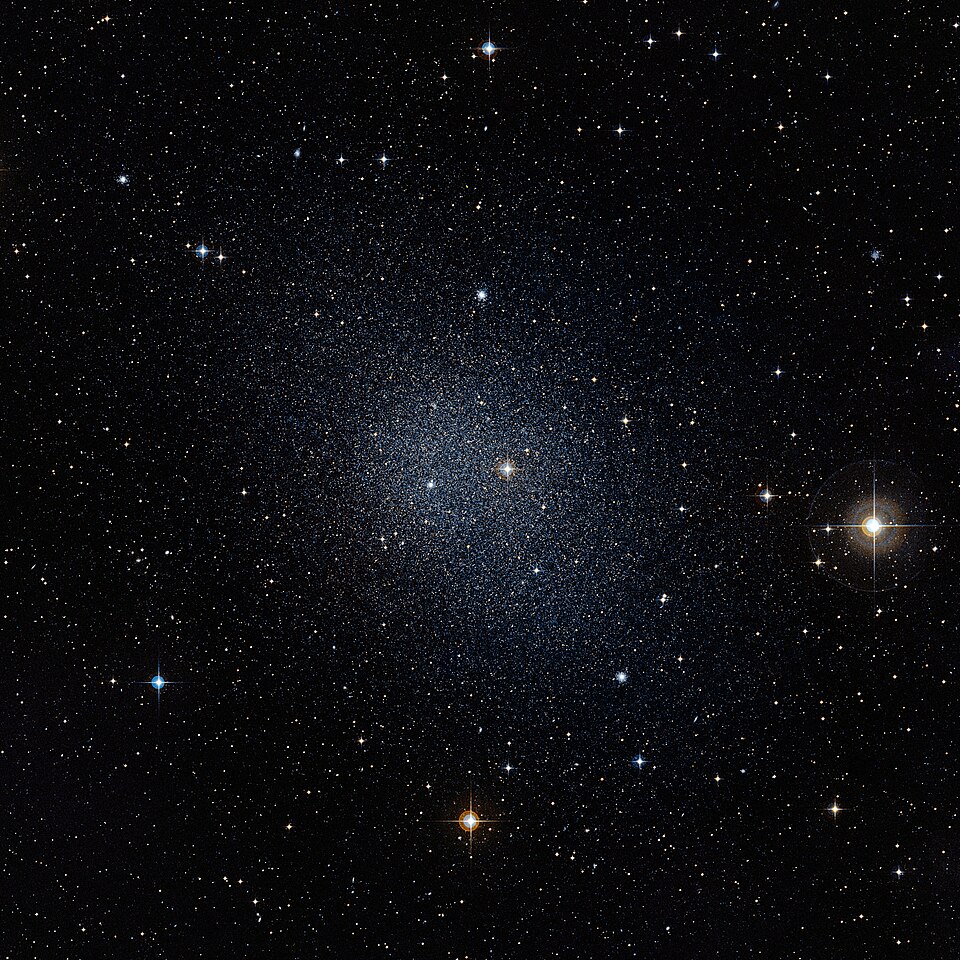

Dwarf spheroidal galaxies (dSphs) are low-surface-brightness, gas-poor systems with predominantly old stellar populations and little or no ongoing star formation.1 They are found almost exclusively as satellites of larger galaxies, with the Milky Way and Andromeda each hosting several dozen known dSphs including Draco, Sculptor, Fornax, and Ursa Minor.1, 12 Dwarf irregular galaxies (dIrrs), by contrast, contain significant reservoirs of neutral hydrogen gas, exhibit ongoing star formation, and tend to have younger stellar populations and bluer colours.1 The Magellanic Clouds, while sometimes classified as irregular galaxies rather than dwarfs, represent the massive end of the dwarf galaxy spectrum and are the largest satellite galaxies of the Milky Way.14
Ultra-faint dwarf galaxies (UFDs), discovered in significant numbers beginning in 2005 with systematic searches of Sloan Digital Sky Survey data, represent the extreme low-luminosity end of the galaxy population.6, 7 With total luminosities as low as a few hundred solar luminosities and stellar masses of only a few thousand solar masses, UFDs blur the boundary between galaxies and star clusters and are the faintest, most dark-matter-dominated, and most metal-poor stellar systems known.7, 8
Dark matter content
The most striking physical property of dwarf galaxies is the dominance of dark matter over baryonic matter in their total mass budgets.1, 11 Stellar velocity dispersion measurements in dwarf spheroidal galaxies consistently yield dynamical masses that far exceed the mass implied by their visible stars, with mass-to-light ratios ranging from roughly 10 in the more luminous dSphs to several hundred or even 1,000 in the ultra-faint dwarfs.7, 8
The Draco dwarf spheroidal, one of the first objects in which the dark matter problem was clearly demonstrated at sub-galactic scales, has a measured mass-to-light ratio of approximately 300 solar units within its half-light radius, indicating that dark matter comprises more than 99 percent of its total mass.11 Similar or even more extreme ratios have been measured in Segue 1, Willman 1, and other ultra-faint systems discovered in more recent surveys.7, 8
The extreme dark matter dominance of dwarf galaxies makes them ideal targets for indirect dark matter detection experiments, which search for gamma-ray or neutrino signals from dark matter particle annihilation or decay.11 Because dSphs contain very little gas and essentially no other high-energy astrophysical sources, any excess gamma-ray emission from their direction would be difficult to explain by conventional astrophysical processes, providing a relatively clean signal for dark matter searches.11 Observations by the Fermi Large Area Telescope have placed increasingly stringent upper limits on the dark matter annihilation cross-section using stacked observations of multiple dwarf spheroidal galaxies.8
The missing satellites problem
One of the most influential challenges to the standard cold dark matter (CDM) cosmological model emerged from comparisons between the predicted and observed numbers of dwarf satellite galaxies around Milky Way-mass hosts.3, 4 High-resolution N-body simulations of CDM structure formation consistently predicted that a Milky Way-mass dark matter halo should contain hundreds to thousands of bound sub-halos massive enough to host visible galaxies, yet only about a dozen satellite galaxies were known around the Milky Way as of the late 1990s.3, 4
This order-of-magnitude discrepancy, termed the "missing satellites problem," prompted extensive theoretical and observational work over the following two decades.3 On the observational side, deep surveys including the Sloan Digital Sky Survey, the Dark Energy Survey, and the Hyper Suprime-Cam survey have more than tripled the number of known Milky Way satellites, with approximately 60 confirmed as of the mid-2020s.6, 7 Completeness corrections accounting for the limited sky coverage of these surveys suggest that the total satellite population may number in the hundreds, significantly narrowing the gap between observation and prediction.8
On the theoretical side, the missing satellites problem is now largely understood as a consequence of baryonic physics rather than a failure of CDM itself.13 In low-mass dark matter halos, ultraviolet radiation from cosmic reionisation heats and ionises the intergalactic gas, preventing its accretion onto small halos and thereby suppressing galaxy formation in halos below a critical mass threshold.16 Additionally, supernova-driven winds can expel gas from shallow potential wells, quenching star formation after only a few bursts.13 These processes together predict that only a small fraction of low-mass dark matter sub-halos will host visible galaxies, naturally accounting for the apparent deficit of observed satellites.13
The too-big-to-fail problem
A related but distinct challenge emerged when Boylan-Kolchin and colleagues noted that the most massive sub-halos predicted by CDM simulations were too dense in their centres to be consistent with the kinematics of the brightest Milky Way dwarf spheroidals.5 Simulations predicted that the Milky Way should host several sub-halos with central masses large enough that they could not plausibly have failed to form stars, yet no observed satellites matched the expected kinematics of these massive sub-halos.5
This "too big to fail" problem suggested either that the central densities of dark matter halos were being overestimated by CDM simulations, or that some physical process was reducing the central densities of real sub-halos relative to dark-matter-only predictions.5 Proposed solutions include baryonic feedback from supernovae and stellar winds, which can redistribute dark matter in the centres of low-mass halos through repeated cycles of gas inflow and explosive outflow, creating dark matter "cores" rather than the steep "cusps" predicted by pure CDM simulations.13
Alternative solutions invoke modifications to the nature of dark matter itself, including warm dark matter, self-interacting dark matter, and fuzzy dark matter, each of which naturally suppresses small-scale structure or reduces central halo densities.5 Distinguishing between baryonic and dark matter solutions to the too-big-to-fail problem remains an active area of research, with dwarf galaxies providing the most sensitive observational tests.5
Chemical evolution and stellar populations
Dwarf galaxies exhibit a wide range of star formation histories, from systems that formed all their stars in a single ancient burst to those with extended or episodic star formation spanning billions of years.1, 15 The ultra-faint dwarfs contain exclusively ancient, metal-poor stars with ages exceeding 12 billion years, indicating that their star formation was truncated early, likely by reionisation.15 More luminous dSphs like Fornax and Carina show evidence of multiple episodes of star formation extending well past the epoch of reionisation, suggesting that their deeper potential wells allowed them to retain or re-accrete gas.1
The metallicities of stars in dwarf galaxies follow a well-defined luminosity-metallicity relation, with less luminous dwarfs having lower average metallicities.2 This trend is naturally explained by the lower gravitational binding energies of smaller galaxies, which allow metal-enriched gas to be more easily expelled by supernovae, reducing the efficiency of chemical self-enrichment.2 The most metal-poor stars known, with iron abundances less than one ten-thousandth of the solar value, have been found in ultra-faint dwarf galaxies, making these systems crucial for studying the nucleosynthetic products of the first generations of stars.15
Abundance patterns in dwarf galaxy stars differ systematically from those in the Milky Way halo at the same metallicity, with dwarf galaxy stars typically showing lower ratios of alpha elements (oxygen, magnesium, silicon) to iron.15 This chemical signature indicates that star formation in dwarf galaxies proceeded more slowly than in the proto-Milky Way, allowing Type Ia supernovae (which produce iron but few alpha elements) to contribute to chemical enrichment before star formation ceased.15
Tidal interactions and galactic cannibalism
Dwarf galaxies orbiting within the gravitational potential of a larger host galaxy are subject to tidal forces that can strip stars, gas, and dark matter from the dwarf, eventually disrupting it entirely.9, 10 The Sagittarius dwarf elliptical galaxy, discovered in 1994 at a distance of only about 70,000 light-years from the Galactic centre, is the most dramatic example of this process in the Local Group.9 It is currently being torn apart by the Milky Way's tidal field, with streams of stripped stars tracing its orbit across more than 360 degrees of sky.10
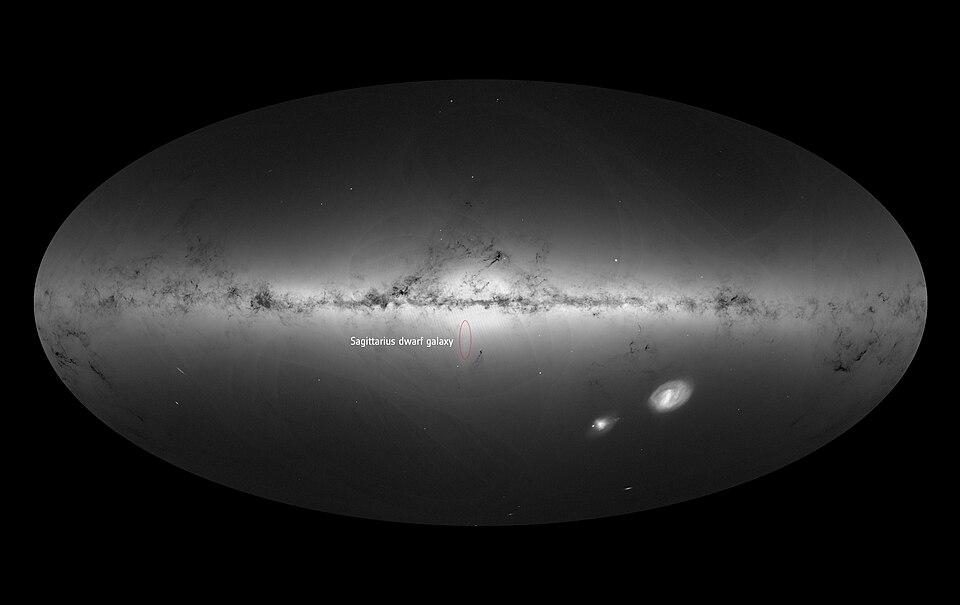

The Magellanic Stream, a filament of neutral hydrogen gas extending more than 200 degrees across the sky, is another consequence of tidal and ram-pressure interactions, in this case involving the Large and Small Magellanic Clouds and the Milky Way's hot gaseous halo.14 Dynamical models suggest that the Magellanic Clouds are on their first close approach to the Milky Way and that the stream was generated primarily by tidal interactions between the two Clouds before their infall.14
The cumulative accretion of disrupted dwarf galaxies over cosmic time contributes significantly to the growth of the stellar halos of large galaxies. Studies of stellar streams, phase-space substructure, and chemical abundance patterns in the Milky Way halo indicate that a substantial fraction of halo stars originated in accreted dwarf galaxies, consistent with the hierarchical assembly predicted by CDM cosmology.10 The identification of the Gaia-Enceladus-Sausage merger event, in which a relatively massive dwarf galaxy was accreted by the Milky Way approximately 10 billion years ago, has confirmed that even major accretion events leave long-lived kinematic and chemical signatures in the host galaxy.10
Role in hierarchical structure formation
In the standard Lambda-CDM cosmological model, structure in the universe forms hierarchically, with small dark matter halos collapsing first and subsequently merging to build larger halos over cosmic time.3 Dwarf galaxies are the visible manifestations of the smallest halos capable of forming stars, and they therefore represent the fundamental units from which larger galaxies are assembled.3, 4
The properties of the dwarf galaxy population — their abundance, spatial distribution, internal kinematics, and stellar content — provide some of the most sensitive tests of the CDM paradigm on small scales, where the predictions of different dark matter models diverge most strongly.5, 8 The discovery that all ultra-faint dwarf galaxies appear to reside within dark matter halos of roughly similar mass (approximately 10 billion solar masses within 300 parsecs) regardless of their luminosity suggests a common minimum halo mass scale for galaxy formation, likely set by the physics of reionisation.8
Surveys with next-generation facilities including the Vera C. Rubin Observatory are expected to discover hundreds of additional ultra-faint dwarf galaxies around the Milky Way and in the Local Volume, providing definitive tests of whether the satellite population matches CDM predictions once observational completeness is achieved.7 The census of dwarf galaxies beyond the Local Group, enabled by deep imaging surveys and resolved stellar population studies, will further constrain the universality of the satellite luminosity function and its dependence on host galaxy mass and environment.1
Dwarf galaxies as cosmic laboratories
Beyond their importance for cosmology and dark matter physics, dwarf galaxies serve as simplified laboratories for studying processes that are more difficult to disentangle in complex, massive galaxies.15 Their shallow gravitational potential wells make the effects of stellar feedback, gas dynamics, and environmental processes more pronounced and easier to model than in the deep potential wells of Milky Way-mass galaxies.2, 13
The extremely metal-poor stars preserved in ultra-faint dwarf galaxies provide a fossil record of nucleosynthesis in the early universe, including signatures of individual supernovae and neutron star mergers that are averaged away in the more complex chemical evolution histories of larger galaxies.15 Detection of r-process elements (europium, barium) at high relative abundances in some ultra-faint dwarf stars has provided evidence that neutron star mergers are a significant source of heavy elements, a conclusion independently confirmed by the electromagnetic counterpart of gravitational wave event GW170817.15
Dwarf galaxies also probe the epoch of reionisation, as the suppression of star formation in the smallest halos by the ultraviolet background provides an archaeological record of when and how reionisation occurred.16 The star formation histories of Local Group dwarfs, reconstructed from colour-magnitude diagrams of resolved stellar populations, consistently show a predominance of ancient stars with truncation ages consistent with reionisation at redshift six to seven, independently corroborating constraints from the cosmic microwave background and high-redshift quasar spectra.15, 16
References
Kinematics of the ultra-faint Milky Way satellites: solving the missing satellite problem
Dark matter in draco and the Local Group: implications for direct detection experiments