Overview
- Gravitational lensing — the bending of light by massive objects as predicted by Einstein's general theory of relativity — was first confirmed during the 1919 solar eclipse and has since become one of the most powerful observational tools in astrophysics.
- Strong lensing produces multiple images, arcs, and Einstein rings; weak lensing reveals the statistical distortion of background galaxy shapes by foreground mass; and microlensing detects transient brightness amplifications caused by stellar-mass objects, each regime probing mass distributions at different scales.
- The Bullet Cluster's spatial separation of X-ray-emitting gas from weak-lensing mass maps constitutes among the most direct empirical evidence for dark matter, while cosmic shear surveys and CMB lensing measurements constrain fundamental cosmological parameters including the amplitude of matter fluctuations.
Gravitational lensing is the deflection of light from distant astronomical sources by the gravitational field of intervening massive objects. Predicted by Albert Einstein's general theory of relativity, the phenomenon arises because mass curves the geometry of spacetime, and light follows the shortest paths (geodesics) through that curved geometry. A sufficiently massive foreground object — a star, a galaxy, or a cluster of galaxies — can therefore act as a natural lens, bending, magnifying, and sometimes multiplying the images of background sources.1, 7 First confirmed observationally during the total solar eclipse of 29 May 1919, when Arthur Eddington and collaborators measured the deflection of starlight passing near the Sun, gravitational lensing has evolved from a theoretical curiosity into one of the most versatile tools in modern astrophysics.2
The phenomenon manifests in three broadly defined regimes. Strong lensing produces dramatic multiple images, luminous arcs, and complete Einstein rings when the alignment between source, lens, and observer is sufficiently close. Weak lensing induces subtle, coherent distortions in the shapes of large populations of background galaxies, detectable only through statistical analysis. Microlensing occurs when a compact foreground object such as a star transiently amplifies the brightness of a background source without producing resolvable multiple images.7, 12 Together, these three regimes allow astronomers to map the distribution of dark matter, measure the masses of galaxies and galaxy clusters, detect exoplanets, probe the structure of distant quasars, and constrain the fundamental parameters of cosmology.
Theory and prediction
The deflection of light by gravity was first considered in the context of Newtonian mechanics, but the Newtonian prediction yields only half the correct value. In his general theory of relativity, published in 1915, Einstein showed that the curvature of spacetime near a massive body bends the trajectories of light rays by an angle that is twice the Newtonian estimate.1 For a light ray passing a point mass M at a closest-approach distance (impact parameter) b, the deflection angle is given by α = 4GM/(c2b), where G is the gravitational constant and c is the speed of light. For a ray grazing the surface of the Sun, this formula predicts a deflection of approximately 1.75 arcseconds.1, 2
The prediction was tested during the total solar eclipse of 29 May 1919, when two British expeditions — one led by Arthur Eddington on the island of Principe off the west coast of Africa, the other by Andrew Crommelin at Sobral in northeastern Brazil — photographed the positions of stars near the eclipsed Sun and compared them with reference photographs taken when the Sun was elsewhere in the sky. The results, reported by Frank Watson Dyson, Eddington, and Charles Davidson in 1920, confirmed Einstein's predicted deflection and effectively ruled out the half-value Newtonian estimate. The announcement made Einstein an international celebrity and established general relativity as the leading theory of gravitation.2
Einstein himself explored the possibility that a foreground star could act as a gravitational lens, producing a ring-shaped image of a perfectly aligned background star. In a brief 1936 paper in Science, he derived the angular radius of what is now called an Einstein ring and calculated the magnification of the lensed source. He concluded, however, that such an alignment was unlikely ever to be observed for stellar-mass lenses because the angular separations involved would be far too small to resolve.3 The following year, the Swiss astronomer Fritz Zwicky recognised that the masses and angular sizes of galaxies and galaxy clusters were far more favourable. In a remarkably prescient 1937 paper, Zwicky proposed that "nebulae" (galaxies) could serve as gravitational telescopes, noting that the probability of observing such lensing was "practically a certainty" and that the effect could be used to measure the masses of the lensing galaxies.4
In 1964, the Norwegian astrophysicist Sjur Refsdal demonstrated theoretically that if a distant variable source such as a supernova were multiply imaged by a gravitational lens, the time delay between the arrival of light along the different paths could be used to measure the Hubble constant, the expansion rate of the universe. This insight connected gravitational lensing directly to cosmography and provided a method for measuring cosmic distances that was independent of the traditional distance ladder.5
Strong lensing
Strong gravitational lensing occurs when the alignment between a background source, a massive foreground lens, and the observer is close enough to produce multiple distinct images of the source, or to distort a single image into an arc or a complete ring.
.jpg)
.jpg)
The phenomenon was first observed in 1979, when Dennis Walsh, Robert Carswell, and Ray Weymann identified the double quasar QSO 0957+561 A,B — two point-like images of the same quasar at redshift z = 1.41, separated by 6.1 arcseconds, with nearly identical spectra and redshifts. They demonstrated that the most parsimonious explanation was not a physical pair of quasars but a single quasar whose light was being split into two images by a foreground galaxy at z = 0.36.6 This discovery transformed gravitational lensing from a theoretical prediction into an observational reality.
In the late 1980s, astronomers began discovering dramatically distorted arc-like features in galaxy clusters. In 1987, Geneviève Soucail, Bernard Fort, Yannick Mellier, and Jean-Paul Picat reported a blue arc-shaped structure in the core of the galaxy cluster Abell 370, which subsequent spectroscopy revealed to be the gravitationally lensed image of a background galaxy stretched and magnified by the cluster's gravitational potential.8 These giant arcs demonstrated that entire galaxy clusters could function as gravitational lenses, bending the light of distant background galaxies into elongated arcs whose curvature traces the mass distribution of the cluster. The geometry and brightness of such arcs provide a direct measurement of the total mass enclosed within the arc radius, including both luminous and dark matter.9
Strong lensing by galaxy clusters reached a new level of observational sophistication with the Hubble Frontier Fields programme, which devoted over 840 orbits of the Hubble Space Telescope to deep imaging of six massive galaxy clusters — Abell 2744, MACSJ0416.1−2403, MACSJ0717.5+3745, MACSJ1149.5+2223, Abell S1063, and Abell 370 — selected for their exceptional lensing strength. These observations revealed dozens of multiply imaged background galaxies behind each cluster, enabling detailed reconstructions of the cluster mass distributions and the detection of some of the most distant and intrinsically faint galaxies ever observed, magnified into detectability by the cluster lenses.10
One of the most extraordinary discoveries from the Frontier Fields programme was SN Refsdal, a multiply imaged supernova behind the cluster MACSJ1149.5+2223, reported by Patrick Kelly and collaborators in 2015. The supernova appeared as four images arranged in an Einstein cross pattern around an elliptical galaxy within the cluster, providing the first realisation of the time-delay cosmography method that Refsdal had proposed more than fifty years earlier.11, 5 By measuring the time delays between the multiple supernova images, astronomers obtained an independent estimate of the Hubble constant, demonstrating the power of strong lensing as a cosmological probe.
Weak lensing
Weak gravitational lensing refers to the subtle, coherent distortion (shear) of the shapes of background galaxies caused by the gravitational field of intervening mass distributions. Unlike strong lensing, where individual images are dramatically distorted or multiplied, weak lensing produces tiny shape changes — typically at the level of a few percent — that cannot be detected in any single galaxy. The signal becomes detectable only when the shapes of large numbers of galaxies are measured and averaged, revealing a coherent pattern of tangential alignment around foreground mass concentrations.12
The first detection of weak gravitational lensing was reported in 1990 by J. Anthony Tyson, Frank Valdes, and Reginald Wenk, who measured the systematic alignment of faint background galaxy images around foreground galaxy clusters with high velocity dispersions. By stacking the shapes of many background galaxies, they detected a coherent tangential shear signal centred on the clusters, demonstrating that the statistical distortion of background galaxy shapes could be used to map the projected mass distribution of the foreground lens.13 This pioneering work opened the field of weak lensing mass reconstruction, in which the two-dimensional projected mass distribution of a cluster or other structure is recovered from the measured shear pattern of background galaxies.
The theoretical framework for weak lensing was systematically developed through the 1990s and comprehensively reviewed by Matthias Bartelmann and Peter Schneider in 2001. Their formalism describes how the tidal gravitational field of a foreground mass distribution induces a convergence (magnification) and a shear (shape distortion) in the images of background sources, and how these quantities can be related to the projected surface mass density of the lens through integral inversions.12 This framework underpins all modern weak lensing analyses, from cluster mass measurements to large-scale cosmic shear surveys.
Beyond individual clusters, weak lensing can detect the cumulative distortion of galaxy shapes by all the large-scale structure along the line of sight, a signal known as cosmic shear. Because cosmic shear is sensitive to both the total amount of matter in the universe and its degree of clustering, it provides a powerful and independent probe of cosmological parameters, particularly the matter density parameter (Ωm) and the amplitude of matter fluctuations (σ8), typically combined into the derived parameter S8 = σ8(Ωm/0.3)0.5.12, 20 Major cosmic shear surveys including the Dark Energy Survey (DES), the Hyper Suprime-Cam survey (HSC), and the Kilo-Degree Survey (KiDS) have measured this signal with increasing precision, and forthcoming surveys with the Euclid space telescope and the Vera C. Rubin Observatory's Legacy Survey of Space and Time (LSST) are expected to achieve substantially tighter constraints on the dark energy equation of state and the growth of cosmic structure.20, 21
The Bullet Cluster and dark matter
One of the most compelling demonstrations of the power of weak lensing — and of the existence of dark matter — came from observations of the galaxy cluster 1E 0657−558, widely known as the Bullet Cluster.
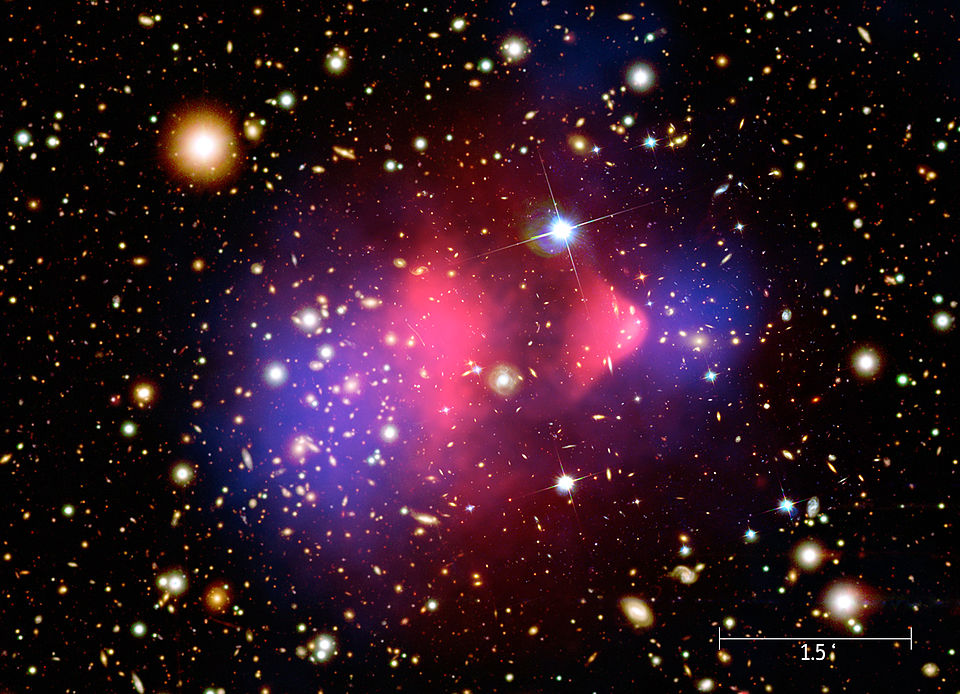

This system consists of two galaxy clusters that underwent a high-velocity collision approximately 100 million years ago. This system consists of two galaxy clusters that underwent a high-velocity collision approximately 100 million years ago. The collision separated the different mass components of the clusters in a way that provided what Douglas Clowe and collaborators described in 2006 as "a direct empirical proof of the existence of dark matter."14
The key observation is the spatial offset between the distribution of ordinary (baryonic) matter and the distribution of total mass as inferred from weak lensing. The majority of the baryonic mass in a galaxy cluster resides not in the visible galaxies but in the hot intracluster gas, which emits X-rays and can be mapped by X-ray telescopes such as Chandra. During the collision, the hot gas of the two clusters interacted electromagnetically, experiencing ram pressure that decelerated it and caused it to lag behind. The individual galaxies, which are essentially collisionless point particles separated by vast distances, passed through each other with minimal interaction. Crucially, the weak lensing mass maps showed that the dominant mass component — accounting for the majority of the total cluster mass — co-moved with the collisionless galaxies rather than with the X-ray-emitting gas.14
This spatial separation between the baryonic mass (concentrated in the X-ray gas) and the lensing mass (concentrated around the galaxies) is exceedingly difficult to explain without invoking a dominant component of non-baryonic, collisionless dark matter that passed through the collision unimpeded, just as the galaxies did. The Bullet Cluster observation is considered among the strongest pieces of evidence against modified-gravity alternatives to dark matter, because it demonstrates that the gravitational potential — as traced by lensing — does not follow the distribution of visible matter.14
Microlensing
Gravitational microlensing occurs when a compact foreground object — typically a star or a stellar remnant — passes close to the line of sight to a more distant background star. Because the angular separations involved are far too small to resolve individual images (typically of order microarcseconds), microlensing manifests not as visible image splitting but as a transient, achromatic brightening of the background source as the lens passes through alignment. The amplification follows a characteristic symmetric light curve whose timescale depends on the mass of the lens, the relative proper motion of the lens and source, and the distances involved.15
.jpg)
.jpg)
In 1986, Bohdan Paczyński proposed that if the dark halo of the Milky Way were composed of massive compact objects — later dubbed MACHOs (Massive Astrophysical Compact Halo Objects) — these objects would occasionally microlens stars in the Large Magellanic Cloud (LMC), producing detectable brightening events. Paczyński calculated that roughly one in a million LMC stars would be undergoing significant microlensing at any given time if the halo were entirely composed of compact objects, and he argued that this rate, though low, was within reach of dedicated monitoring surveys capable of observing millions of stars simultaneously.15
Three large-scale surveys — MACHO, EROS (Expérience pour la Recherche d'Objets Sombres), and OGLE (Optical Gravitational Lensing Experiment) — were launched in the early 1990s to search for microlensing events toward the Magellanic Clouds and the Galactic bulge. The MACHO project, after 5.7 years of monitoring 11.9 million stars in the LMC, detected 13 to 17 microlensing events. A maximum-likelihood analysis indicated that compact objects could account for at most approximately 20 percent of the mass of a standard dark matter halo, with a 95 percent confidence interval of 8 to 50 percent, ruling out MACHOs as the dominant constituent of galactic dark matter.18 This result was an important step in establishing that the dark matter in galactic halos is predominantly non-baryonic.
Microlensing also proved to be a powerful method for detecting extrasolar planets. In 1991, Shude Mao and Paczyński showed theoretically that if a lensing star has a planetary companion, the planet can perturb the microlensing light curve in a detectable way, producing a brief, sharp deviation from the smooth single-lens curve.16 The first confirmed detection of an exoplanet by microlensing came in 2004, when Ian Bond and collaborators reported a planetary companion to the lens star in the event OGLE-2003-BLG-235/MOA-2003-BLG-53, with a planet-to-star mass ratio of approximately 0.004, corresponding to a planet of roughly 1.5 Jupiter masses.17 Microlensing is uniquely sensitive to planets at relatively large orbital separations (several astronomical units) and to low-mass host stars, complementing the parameter space probed by transit and radial-velocity surveys.
Lensing as a cosmological probe
Gravitational lensing has emerged as one of the most important tools for constraining the fundamental parameters of cosmology. Because lensing responds directly to the total matter distribution — both luminous and dark — without requiring assumptions about the dynamical state or luminosity of the mass, it provides a uniquely clean measurement of the matter content and clustering of the universe.12
Cosmic shear surveys measure the weak lensing power spectrum, which encodes information about both the total matter density Ωm and the amplitude of matter fluctuations σ8. The KiDS-1000 cosmic shear analysis, for example, measured S8 = 0.759+0.024−0.021, a value that is lower than the prediction derived from the Planck satellite's analysis of the primary anisotropies of the cosmic microwave background (CMB) by approximately 3σ.20 A joint analysis combining KiDS-1000 weak lensing with spectroscopic galaxy clustering data from BOSS and 2dFLenS found a similar offset, with S8 = 0.766+0.020−0.014, representing an amplitude 8.3 ± 2.6 percent lower than the Planck CMB prediction.21 This discrepancy, known as the S8 tension, has also been reported by other weak lensing surveys including DES and HSC, and its resolution — whether through unrecognised systematic errors, new physics beyond the standard cosmological model, or improved data — is one of the central open questions in observational cosmology.
Gravitational lensing also affects the cosmic microwave background itself. As CMB photons travel from the surface of last scattering to the observer, they pass through the gravitational potential wells of the intervening large-scale structure, which deflects their paths by a few arcminutes on average. This CMB lensing smooths the acoustic peaks in the CMB power spectrum and introduces a non-Gaussian signal that can be extracted through statistical analysis. The Planck satellite detected CMB lensing at a significance of 40σ in its final data release, providing an independent measurement of the integrated matter distribution between the observer and the last scattering surface at redshift z ≈ 1100.19 CMB lensing is particularly valuable because it probes the mass distribution at higher redshifts than galaxy weak lensing surveys, and the combination of the two techniques tightly constrains the growth of structure over cosmic time.
Landmark discoveries
The history of gravitational lensing is punctuated by a series of landmark observations, each of which opened a new domain of investigation or provided a critical test of theory. The following table summarises the major milestones in the observational development of the field.
Landmark discoveries in gravitational lensing2, 6, 8, 11, 13, 14, 17, 18
| Year | Discovery | Regime | Significance |
|---|---|---|---|
| 1919 | Solar eclipse light deflection | Deflection | First confirmation of general relativity's prediction of light bending |
| 1979 | Twin Quasar QSO 0957+561 | Strong | First observed gravitational lens; doubly imaged quasar |
| 1987 | Giant arc in Abell 370 | Strong | First cluster-scale gravitational arc; confirmed cluster lensing |
| 1990 | Systematic galaxy shape alignments | Weak | First detection of weak lensing by galaxy clusters |
| 1993 | First microlensing events (MACHO, EROS, OGLE) | Micro | Demonstrated feasibility of microlensing surveys; constrained MACHO dark matter |
| 2004 | OGLE-2003-BLG-235/MOA-2003-BLG-53 | Micro | First exoplanet detected via gravitational microlensing |
| 2006 | Bullet Cluster mass mapping | Weak | Direct empirical evidence for dark matter from lensing-baryon offset |
| 2015 | SN Refsdal (Einstein cross supernova) | Strong | First multiply imaged supernova; realised Refsdal's 1964 time-delay method |
Each of these observations demonstrated a new capability of gravitational lensing and expanded the range of astrophysical questions that the phenomenon could address. The 1919 eclipse observation confirmed the foundational prediction of general relativity. The discovery of the Twin Quasar in 1979 proved that gravitational lensing operated at extragalactic scales. The detection of cluster arcs in the late 1980s revealed that galaxy clusters could be used as natural telescopes to study the distant universe. Weak lensing measurements in the 1990s and 2000s showed that the technique could map the distribution of dark matter across cosmic scales. Microlensing surveys constrained the baryonic content of the Milky Way's dark halo and discovered new classes of exoplanets. And the detection of SN Refsdal realised a half-century-old proposal for measuring the expansion rate of the universe through lensing time delays.2, 5, 6, 11, 14
Current and future surveys
Gravitational lensing science is entering an era of dramatically increased statistical power. Current and forthcoming surveys are designed to measure the shapes of hundreds of millions to billions of galaxies, enabling weak lensing measurements of unprecedented precision. The Dark Energy Survey (DES), which completed observations in 2019, imaged approximately 300 million galaxies over 5,000 square degrees of the southern sky. The KiDS survey, conducted with the OmegaCAM instrument on the VLT Survey Telescope, has provided some of the most precise cosmic shear measurements to date over approximately 1,350 square degrees.20, 21
The next generation of surveys promises order-of-magnitude improvements. The European Space Agency's Euclid space telescope, launched in July 2023, is designed to measure the shapes of approximately 1.5 billion galaxies over 15,000 square degrees, providing weak lensing measurements that are free of the atmospheric blurring that limits ground-based shape measurements. The Vera C. Rubin Observatory's Legacy Survey of Space and Time (LSST), expected to begin operations in the mid-2020s, will image approximately 20 billion galaxies over 18,000 square degrees from its site in Chile, providing a ground-based weak lensing dataset of extraordinary depth and breadth.12, 21 Together, Euclid and the Rubin Observatory are expected to constrain the dark energy equation of state, the neutrino mass sum, and the growth rate of cosmic structure with a precision that was unattainable with previous generations of surveys, making gravitational lensing central to the next decade of precision cosmology.
References
A determination of the deflection of light by the Sun's gravitational field, from observations made at the total eclipse of May 29, 1919
On the possibility of determining Hubble's parameter and the masses of galaxies from the gravitational lens effect
Multiple images of a highly magnified supernova formed by an early-type cluster galaxy lens
Detection of systematic gravitational lens galaxy image alignments: mapping dark matter in galaxy clusters
The MACHO Project: microlensing results from 5.7 years of Large Magellanic Cloud observations
KiDS-1000 cosmology: cosmic shear constraints and comparison between two point statistics
KiDS-1000 cosmology: multi-probe weak gravitational lensing and spectroscopic galaxy clustering constraints