Overview
- General relativity, published by Albert Einstein in November 1915, replaced Newton's conception of gravity as a force acting at a distance with a geometric theory in which mass and energy curve the fabric of spacetime and objects follow the straightest possible paths through that curved geometry — an insight rooted in the equivalence principle, which holds that the effects of gravity are locally indistinguishable from acceleration.
- The theory's key predictions — gravitational time dilation, the bending of starlight by the Sun, the precession of Mercury's orbit, and gravitational redshift — have been confirmed with extraordinary precision through a century of experiments, from Eddington's 1919 solar eclipse observations and the Pound–Rebka experiment to modern GPS satellite corrections and the direct detection of gravitational waves by LIGO.
- General relativity underpins modern cosmology, predicting the expanding universe, the Big Bang, black holes, and gravitational waves, yet it remains fundamentally incompatible with quantum mechanics at the Planck scale — a tension that represents one of the deepest unsolved problems in theoretical physics.
General relativity is the geometric theory of gravitation published by Albert Einstein in November 1915, in which gravity is not a force transmitted between objects but a manifestation of the curvature of spacetime caused by mass and energy.2 In Einstein's formulation, massive objects such as stars and planets warp the four-dimensional fabric of spacetime around them, and other objects — including light — move along the straightest possible paths (geodesics) through that curved geometry. What we perceive as the force of gravity is, in this picture, simply the natural motion of objects following the contours of curved spacetime.1 Over the past century, general relativity has passed every experimental test with extraordinary precision, from the deflection of starlight observed during solar eclipses to the detection of gravitational waves from merging black holes. It provides the theoretical foundation for modern cosmology, predicting the expansion of the universe, the Big Bang, and the existence of black holes, while remaining fundamentally incompatible with quantum mechanics — a tension that drives some of the most active research in theoretical physics today.9
The equivalence principle
The conceptual foundation of general relativity is the equivalence principle, which Einstein first articulated in 1907 and later described as "the happiest thought of my life." In its simplest form, the principle states that the effects of gravity are locally indistinguishable from the effects of acceleration. An observer in a sealed laboratory cannot tell, by any local experiment, whether the laboratory is resting on the surface of a massive planet or accelerating uniformly through empty space at the same rate.1, 9
This seemingly modest observation has profound consequences. If gravity and acceleration are equivalent, then gravity must affect all forms of matter and energy identically, regardless of their composition. A beam of light must bend in a gravitational field just as it would in an accelerating elevator, and clocks must run slower in stronger gravitational fields just as they do in accelerating reference frames. The equivalence principle thus immediately implies two of general relativity's most important predictions: the gravitational deflection of light and gravitational time dilation.1
Einstein recognised that the equivalence principle could not be accommodated within the framework of special relativity, which describes physics in flat, uncurved spacetime. If gravity makes all objects follow the same trajectories regardless of their mass or composition, then gravity is not a force at all but a property of the spacetime through which objects move. This insight led Einstein to conclude that gravity must be described by the curvature of spacetime itself — a geometric reformulation that required the mathematical language of Riemannian geometry and tensor calculus, which Einstein spent the years from 1907 to 1915 mastering with the help of his friend and collaborator Marcel Grossmann.1
The Einstein field equations
Einstein presented the final form of his gravitational field equations to the Prussian Academy of Sciences in Berlin on 25 November 1915, publishing them in a brief paper titled "Die Feldgleichungen der Gravitation."2 The equations relate the curvature of spacetime — encoded in the Einstein tensor, a mathematical object constructed from the Ricci curvature tensor and the metric tensor — to the distribution of mass and energy within that spacetime, encoded in the stress-energy tensor. Conceptually, the relationship can be summarised as: matter tells spacetime how to curve, and spacetime tells matter how to move.1
The field equations are a set of ten coupled, nonlinear partial differential equations, making them notoriously difficult to solve exactly. Nevertheless, exact solutions exist for several physically important cases. The first was derived by Karl Schwarzschild in January 1916, just weeks after Einstein published the field equations. The Schwarzschild solution describes the gravitational field outside a spherically symmetric, non-rotating mass and contains a critical radius — the Schwarzschild radius — at which the metric becomes singular, foreshadowing the concept of black holes.6 Other exact solutions include the Kerr metric for rotating black holes (1963), the Friedmann–Lemaître–Robertson–Walker metric for homogeneous, isotropic expanding universes (1922–1935), and the de Sitter solution for a universe dominated by a cosmological constant.
In 1917, Einstein applied his field equations to cosmology for the first time, attempting to construct a model of the universe as a whole. Because the equations predicted a dynamic universe — one that would either expand or contract — and Einstein at that time believed the universe to be static, he introduced an additional term called the cosmological constant (Λ) to balance gravity and produce a static solution.11 After Edwin Hubble's observations in the late 1920s established that distant galaxies are systematically receding, Einstein reportedly considered the cosmological constant his "greatest blunder." Ironically, the discovery of accelerating expansion in 1998 revived the cosmological constant as a possible explanation for dark energy, restoring it to a central role in modern cosmology.16
Key predictions
General relativity makes several specific, quantitative predictions that differ from Newtonian gravity and can be tested experimentally. The most important of these are the anomalous precession of planetary orbits, the deflection of light by massive bodies, gravitational time dilation, and gravitational redshift.9
Precession of Mercury's orbit. The orbit of Mercury, the innermost planet, precesses around the Sun at a rate that differs from the Newtonian prediction by approximately 43 arcseconds per century. This discrepancy, known since the mid-nineteenth century, had resisted explanation for decades. In November 1915, before arriving at the final form of his field equations, Einstein showed that general relativity predicts precisely this anomalous precession, accounting exactly for the discrepancy without any ad hoc adjustments. He later described this result as having given him "heart palpitations."3 The successful prediction of Mercury's perihelion advance provided the first evidence that general relativity was correct and remains one of the classical tests of the theory.9
Deflection of light. General relativity predicts that a ray of light passing near a massive body is deflected by an angle proportional to the mass and inversely proportional to the closest-approach distance. For starlight grazing the surface of the Sun, the predicted deflection is approximately 1.75 arcseconds — exactly twice the value that would be obtained from a Newtonian calculation treating photons as massive particles.1 This effect, now known as gravitational lensing, has become one of the most powerful observational tools in modern astrophysics.
Gravitational time dilation. General relativity predicts that clocks run more slowly in stronger gravitational fields. A clock at the surface of the Earth ticks more slowly than an identical clock at higher altitude, because the surface clock sits deeper in Earth's gravitational potential well. This effect, though minute under terrestrial conditions, is large enough to have practical consequences: the Global Positioning System (GPS) must account for both special-relativistic time dilation (due to satellite velocity) and general-relativistic time dilation (due to the weaker gravitational field at satellite altitude) to maintain positional accuracy.10
Gravitational redshift. A closely related prediction is that light climbing out of a gravitational potential well loses energy and is shifted toward longer wavelengths — a phenomenon known as gravitational redshift. Conversely, light falling into a gravitational well is blueshifted. The magnitude of the effect depends on the difference in gravitational potential between the emitter and the receiver. For light emitted at the surface of the Sun and observed at Earth, general relativity predicts a fractional frequency shift of approximately two parts per million — small but measurable with spectroscopic techniques.1, 9
Gravitational waves. General relativity also predicts that accelerating masses produce ripples in the fabric of spacetime that propagate outward at the speed of light, carrying energy away from their source. Einstein derived the existence of these gravitational waves in 1916, showing that the linearised field equations admit wave-like solutions analogous to electromagnetic waves. Unlike electromagnetic radiation, however, gravitational waves are produced by the time-varying quadrupole moment of a mass distribution — not by its monopole or dipole — which means that only asymmetric accelerations generate gravitational radiation. The effect is extraordinarily weak: a typical astrophysical signal changes the distance between two points separated by several kilometres by less than the diameter of a proton.1, 7
Experimental confirmations
The history of general relativity is, in large part, a history of increasingly precise experimental tests. Each generation of experiments has confirmed the theory's predictions with greater accuracy, and no deviation has ever been detected.9
.jpg)
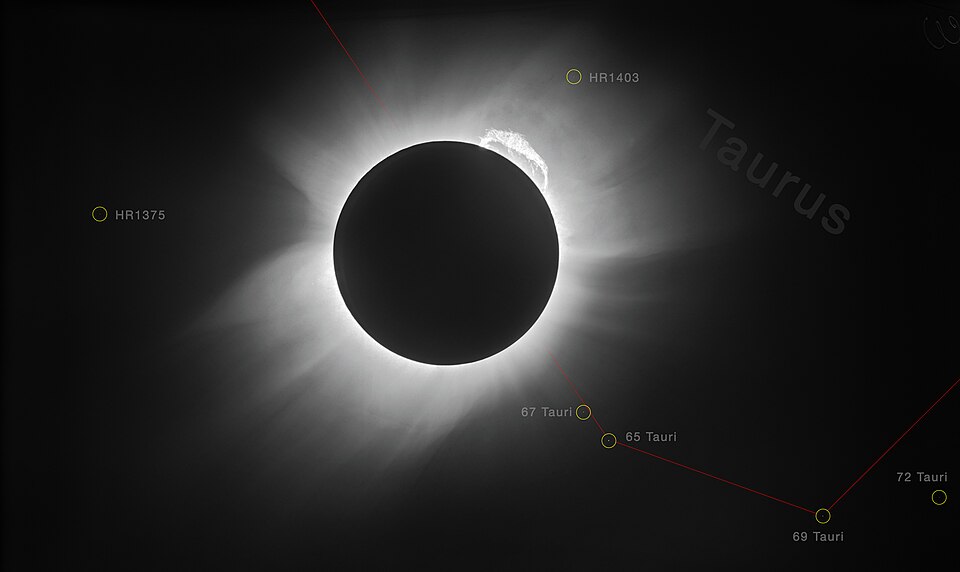
The 1919 solar eclipse. The first direct test of general relativity came during the total solar eclipse of 29 May 1919, when two British expeditions — one led by Arthur Eddington on the island of Príncipe and the other by Andrew Crommelin at Sobral, Brazil — photographed the positions of stars near the eclipsed Sun. The results, reported by Frank Watson Dyson, Eddington, and Charles Davidson, confirmed Einstein's predicted deflection of approximately 1.75 arcseconds and effectively ruled out the half-value Newtonian prediction. The announcement, reported on the front pages of newspapers worldwide, made Einstein an international celebrity and established general relativity as the leading theory of gravitation.4
The Pound–Rebka experiment. In 1960, Robert Pound and Glen Rebka at Harvard University performed the first precise measurement of gravitational redshift in a terrestrial laboratory. Using the Mössbauer effect to produce gamma-ray photons of extremely well-defined energy, they measured the frequency shift of 14.4 keV photons from iron-57 as they traveled vertically through a 22.6-metre tower in the Jefferson Physical Laboratory. The measured frequency shift agreed with the prediction of general relativity to within 10 percent, later improved to 1 percent in subsequent experiments.5
GPS and precision clocks. The Global Positioning System provides one of the most practical and continuously operating demonstrations of general relativity. Each GPS satellite carries precise atomic clocks, and the system determines position by triangulating signals from multiple satellites. Because the satellites orbit at approximately 20,200 kilometres altitude, where the gravitational field is weaker than at Earth's surface, their clocks tick faster by about 45 microseconds per day due to general-relativistic time dilation. Simultaneously, the satellites' orbital velocity of approximately 3.9 kilometres per second causes their clocks to tick slower by about 7 microseconds per day due to special-relativistic time dilation. The net effect is a gain of roughly 38 microseconds per day. Without correcting for these relativistic effects, GPS positional errors would accumulate at a rate of approximately 10 kilometres per day, rendering the system useless.10
Gravity Probe B. The NASA satellite experiment Gravity Probe B, launched in 2004 and reporting final results in 2011, provided the most precise measurement of two predictions of general relativity in the weak-field regime. Using four ultra-precise gyroscopes orbiting Earth in a polar orbit at 642 kilometres altitude, the experiment measured the geodetic effect — the precession of a gyroscope's spin axis due to the curvature of spacetime around Earth — and the frame-dragging effect, in which Earth's rotation drags nearby spacetime around with it. The geodetic precession was measured at 6,601.8 ± 18.3 milliarcseconds per year, in excellent agreement with the general-relativistic prediction of 6,606.1 milliarcseconds per year. The frame-dragging precession was measured at −37.2 ± 7.2 milliarcseconds per year, consistent with the predicted value of −39.2 milliarcseconds per year.18
Gravitational waves and LIGO. On 14 September 2015, the two detectors of the Laser Interferometer Gravitational-Wave Observatory (LIGO) simultaneously recorded the signal GW150914: gravitational waves from the merger of two black holes approximately 1.3 billion light-years away. The observed waveform — a characteristic "chirp" rising in frequency and amplitude — matched the predictions of general relativity for two black holes of approximately 36 and 29 solar masses spiralling together and merging into a single black hole of about 62 solar masses, with the remaining 3 solar masses radiated as gravitational-wave energy. Detailed analysis showed no deviations from general relativity in any aspect of the signal, providing the first test of the theory in the strong-field, highly dynamical regime.7, 8
Major experimental tests of general relativity4, 5, 7, 9, 10, 18
| Test | Year | Prediction confirmed | Precision |
|---|---|---|---|
| Mercury perihelion advance | 1915 | 43 arcsec/century anomalous precession | ~0.1% |
| Eddington solar eclipse | 1919 | 1.75 arcsec light deflection | ~30% |
| Pound–Rebka | 1960 | Gravitational redshift | ~1% |
| Shapiro time delay | 1964–1971 | Radar signal delay near Sun | ~0.1% |
| GPS satellite corrections | 1978–present | Gravitational time dilation | ~0.01% |
| Gravity Probe B | 2004–2011 | Geodetic effect & frame-dragging | ~0.3% |
| LIGO (GW150914) | 2015 | Gravitational waves; strong-field dynamics | Waveform match >99% |
| EHT (M87*) | 2019 | Black hole shadow size | ~7% |
Cosmological implications
General relativity is the theoretical framework on which all of modern cosmology is built. When applied to the universe as a whole, the field equations predict that space itself must be dynamic — either expanding or contracting. Although Einstein initially resisted this implication by introducing the cosmological constant, the theoretical work of Alexander Friedmann in 1922 and Georges Lemaître in 1927, combined with Edwin Hubble's observational discovery of the systematic recession of distant galaxies, established that the universe is expanding.12, 13
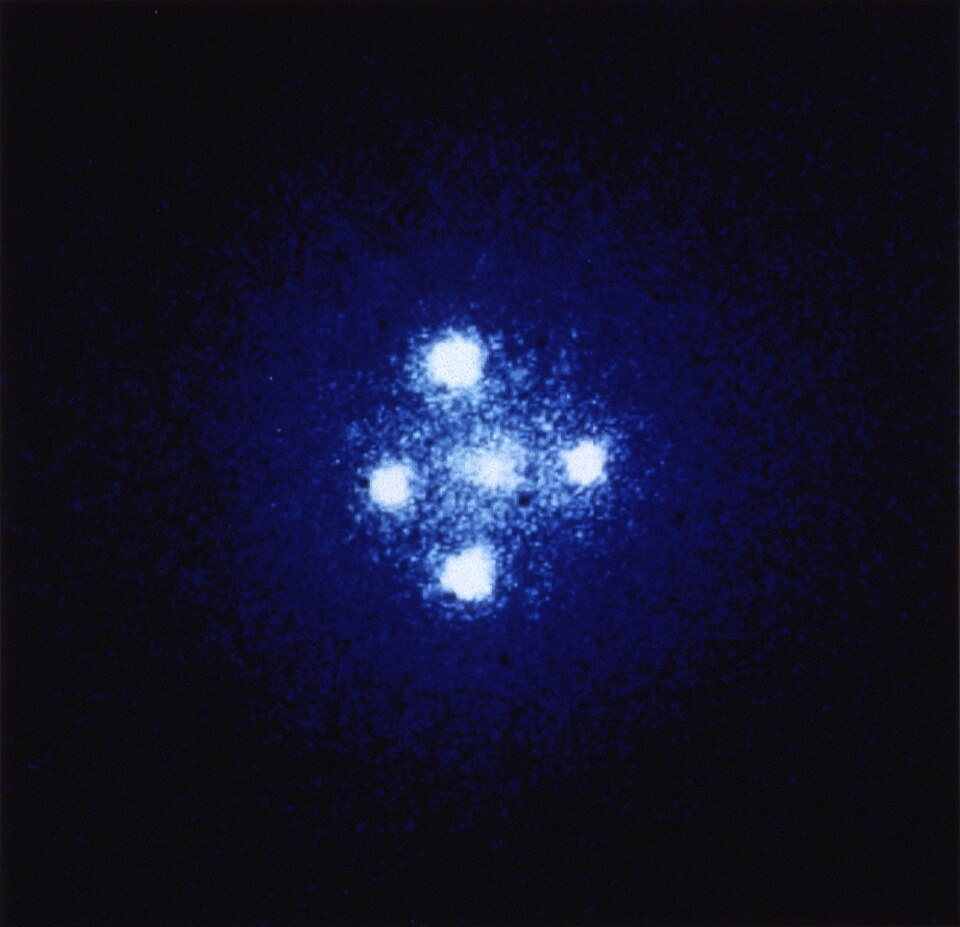

Running the expansion backward in time leads to the conclusion that the universe originated in an extremely hot, dense state — the Big Bang. The predictions of Big Bang cosmology, derived directly from general relativity, include the existence of the cosmic microwave background radiation (the thermal afterglow of the early universe), the primordial abundances of light elements produced during the first few minutes of cosmic history, and the large-scale structure of the universe as it evolved from tiny initial density fluctuations under the influence of gravity.16 All three predictions have been confirmed observationally with remarkable precision, most recently by the Planck satellite, which measured the properties of the cosmic microwave background to extraordinary accuracy and found them to be in excellent agreement with the predictions of general relativity applied within the standard Lambda-CDM cosmological model.16
General relativity also predicts the existence of black holes — regions of spacetime where the curvature becomes so extreme that nothing, including light, can escape. The first theoretical prediction of complete gravitational collapse came from J. Robert Oppenheimer and Hartland Snyder in 1939, who showed that a sufficiently massive star would collapse to a singularity within its Schwarzschild radius.14 Black holes were observationally confirmed through multiple independent lines of evidence over the following decades: from X-ray binaries in the 1970s, to the direct detection of gravitational waves from merging black holes by LIGO in 2015, to the Event Horizon Telescope's resolved images of the supermassive black holes M87* in 2019 and Sagittarius A* in 2022.7, 17
The expanding universe described by general relativity also provides the framework for Hubble's law, which relates the recession velocity of distant galaxies to their distance. This relationship is not the result of galaxies flying apart through space but of space itself stretching, carrying galaxies along with it. The rate of expansion, quantified by the Hubble constant, has been measured with increasing precision through multiple independent methods, including observations of the cosmic microwave background, Type Ia supernovae, and gravitational-wave "standard sirens."16
Perhaps the most dramatic cosmological consequence of general relativity emerged in the late 1990s, when observations of distant Type Ia supernovae revealed that the expansion of the universe is not slowing down under the pull of gravity, as had long been assumed, but is accelerating. This accelerating expansion implies the existence of a component with negative pressure — now called dark energy — that drives spacetime apart. The simplest explanation is Einstein's cosmological constant, a uniform energy density inherent to empty space. Within the Lambda-CDM model built on general relativity, dark energy accounts for approximately 68 percent of the total energy content of the universe, making it the dominant component of the cosmos and one of the deepest mysteries in physics.16
Strong-field tests
While the classical tests of general relativity — Mercury's perihelion, light deflection, gravitational redshift — probe the theory in the weak-field, slow-motion regime where gravitational effects are small perturbations on flat spacetime, the most stringent modern tests probe the strong-field regime where gravitational effects are dominant and spacetime curvature is extreme.9
The detection of gravitational waves by LIGO provided the first test of general relativity in the strong-field, highly dynamical regime. For the first detected event, GW150914, the LIGO–Virgo collaboration performed multiple independent tests, including consistency checks between the inspiral and merger-ringdown portions of the waveform, searches for deviations in the post-Newtonian expansion coefficients, constraints on the mass of the graviton (which general relativity predicts to be exactly zero), and tests of the no-hair theorem by verifying that the ringdown frequencies matched those predicted for a Kerr black hole of the inferred mass and spin. All tests were consistent with general relativity, with no statistically significant deviations.8
The Event Horizon Telescope (EHT) provided another test in the strong-field regime by imaging the shadow of the supermassive black hole M87*. The observed shadow diameter of 42 ± 3 microarcseconds was consistent with the prediction of general relativity for a black hole of approximately 6.5 billion solar masses, confirming the theory's description of spacetime geometry in the immediate vicinity of an event horizon.17
Across more than a century of testing, general relativity has been confirmed at scales ranging from millimetres (laboratory torsion-balance experiments) to cosmological distances (the large-scale structure of the universe), in gravitational fields ranging from the weak terrestrial field to the extreme curvature near merging black holes. Clifford Will's comprehensive review of experimental tests, updated through 2014, catalogues dozens of independent tests spanning multiple regimes, all consistent with general relativity.9
The unification problem
Despite its extraordinary empirical success, general relativity is known to be incomplete. The theory is a classical field theory — it treats spacetime as a smooth, continuous manifold and does not incorporate the principles of quantum mechanics. Yet quantum mechanics is the framework that governs the behaviour of matter at the atomic and subatomic scale, and its predictions have been confirmed with equal or greater precision than those of general relativity. The two pillars of modern physics are fundamentally incompatible: general relativity breaks down in regimes where both gravitational and quantum effects are significant, such as the singularities predicted at the centres of black holes and at the moment of the Big Bang.9
The search for a theory of quantum gravity — a framework that would unify general relativity and quantum mechanics into a single consistent description of nature — has been one of the central goals of theoretical physics for nearly a century. The challenge is formidable. Quantum field theory, the mathematical framework that successfully describes the electromagnetic, weak, and strong nuclear forces (the latter two unified in the Standard Model of particle physics), treats forces as mediated by quantum particles exchanged between matter fields. Attempts to apply the same quantisation procedure to gravity — treating gravitational interactions as mediated by hypothetical spin-2 particles called gravitons — lead to mathematical infinities that cannot be absorbed through the standard renormalisation techniques that work for the other forces.9, 15
Two major theoretical programmes have emerged as leading candidates for quantum gravity. String theory replaces point particles with one-dimensional vibrating strings, whose different modes of vibration correspond to different particles, including a massless spin-2 mode that naturally reproduces the graviton. String theory requires extra spatial dimensions (typically six or seven beyond the four of ordinary spacetime) and has produced important theoretical insights, including the calculation of black hole entropy that matches the Bekenstein–Hawking formula, but it has not yet yielded testable predictions that distinguish it from general relativity at accessible energies. Loop quantum gravity takes a different approach, attempting to quantise spacetime itself by describing it as a network of discrete loops at the Planck scale (approximately 10−35 metres), below which the smooth spacetime of general relativity gives way to a granular quantum structure. Loop quantum gravity preserves the background-independence of general relativity — the principle that spacetime is not a fixed stage but a dynamical entity — but faces challenges in reproducing the smooth classical spacetime of general relativity as an emergent large-scale limit.9
The energy scale at which quantum gravitational effects are expected to become significant — the Planck energy, approximately 1019 GeV — is roughly 15 orders of magnitude beyond the reach of the most powerful particle accelerators, making direct experimental tests of quantum gravity extraordinarily difficult. Nevertheless, indirect constraints from astrophysical observations, including the arrival times of high-energy photons from distant gamma-ray bursts and the properties of the cosmic microwave background, have begun to probe Planck-scale physics and have so far found no evidence of departures from the predictions of smooth, classical spacetime.9
Modern status and ongoing tests
As of the 2020s, general relativity remains the most precisely tested theory in all of physics. It has been confirmed in the weak-field regime to parts per million through solar-system experiments and in the strong-field regime through gravitational-wave observations, with no confirmed deviations.9 The theory provides the foundation for the Lambda-CDM model of cosmology, which describes the composition and evolution of the universe with remarkable accuracy: the Planck satellite's measurements of the cosmic microwave background are consistent with a spatially flat universe composed of approximately 5 percent ordinary matter, 27 percent dark matter, and 68 percent dark energy, precisely as predicted by general relativity applied within the standard cosmological framework.16
Several ongoing and planned experiments continue to test general relativity with increasing precision. Gravitational-wave observatories are accumulating a growing catalogue of events from merging compact objects, each providing a new test of the theory in the strong-field regime. The Event Horizon Telescope continues to refine its images of black hole shadows, testing the predictions of the Kerr metric for rotating black holes. Pulsar timing arrays have detected evidence of a gravitational-wave background at nanohertz frequencies, consistent with the superposition of signals from orbiting supermassive black hole binaries across the universe. Future space-based detectors such as LISA (the Laser Interferometer Space Antenna), planned for launch around 2035, will detect gravitational waves from merging supermassive black holes and from extreme mass-ratio inspirals, which will map the geometry of spacetime around black holes with exquisite precision and provide the most stringent tests yet of general relativity's predictions for the Kerr metric.7, 8
General relativity, born from Einstein's insight that gravity is not a force but a curvature of spacetime, has shaped our understanding of the universe at every scale — from the trajectories of satellites orbiting Earth to the origin and fate of the cosmos itself. Its predictions have been confirmed with a precision that would have astonished Einstein, and its implications continue to unfold as new observational windows reveal the gravitational universe. Yet the theory's incompatibility with quantum mechanics ensures that the search for its successor remains one of the most profound challenges in science.9
References
A determination of the deflection of light by the Sun's gravitational field, from observations made at the total eclipse of May 29, 1919
Un univers homogène de masse constante et de rayon croissant rendant compte de la vitesse radiale des nébuleuses extra-galactiques
First M87 Event Horizon Telescope results. I. The shadow of the supermassive black hole