Overview
- The cosmic microwave background (CMB) is thermal radiation left over from the early universe, filling all of space at a temperature of 2.725 K — the oldest light we can observe, emitted roughly 380,000 years after the Big Bang.
- Its near-perfect blackbody spectrum and tiny temperature fluctuations (one part in 100,000) encode a detailed record of the early universe's composition, geometry, and the seeds of all large-scale structure.
- Precision measurements by the COBE, WMAP, and Planck satellites have turned the CMB into cosmology's most powerful instrument, pinning down the universe's age (13.8 billion years), geometry (flat), and content (5% ordinary matter, 27% dark matter, 68% dark energy).
The cosmic microwave background (CMB) is a pervasive bath of microwave radiation that fills the entire observable universe uniformly in every direction. It is the oldest light we can detect, released approximately 380,000 years after the Big Bang when the universe first became cool enough for electrons and protons to combine into neutral hydrogen atoms — an era cosmologists call recombination. Prior to that moment, the universe was so hot and dense that photons could not travel freely; they were continuously scattered by the fog of free electrons. When recombination occurred, photons decoupled from matter and streamed outward unimpeded, carrying a snapshot of the universe at that early epoch. Today, expanded and cooled by 13.8 billion years of cosmic expansion, that ancient light arrives at our detectors as microwave radiation with a characteristic temperature of 2.725 kelvin.11, 12
The CMB is more than a relic of the distant past. Its near-perfect blackbody spectrum, subtle temperature anisotropies, and polarization patterns encode a detailed record of the universe's geometry, matter content, expansion history, and the primordial perturbations that seeded every galaxy and galaxy cluster in existence today. Precision measurements of the CMB by three generations of satellite observatories — COBE, WMAP, and Planck — have transformed cosmology from a largely speculative discipline into a precision science capable of constraining fundamental parameters to fractions of a percent.10
Theoretical prediction
The possibility of a relic radiation background was first raised in the context of Big Bang nucleosynthesis — the theory explaining how the lightest chemical elements (hydrogen, helium, and lithium) were forged in the first few minutes after the Big Bang. In 1948, Ralph Alpher, Hans Bethe, and George Gamow published a landmark paper on the synthesis of elements in an expanding universe, commonly referred to as the αβγ paper after the authors' initials.1 Gamow's model required a hot, dense early universe, and he and his collaborators quickly recognized that the radiation present at those extreme conditions would not simply disappear as the universe expanded — it would cool, redshift, and persist.
In a 1949 paper, Alpher and Robert Herman calculated that this relic radiation should today have a temperature of approximately 5 kelvin — a remarkable prediction made sixteen years before the radiation was actually detected.2 The prediction was essentially ignored by the mainstream physics community for over a decade. No telescope sensitive to the relevant microwave frequencies was being systematically pointed at the sky for cosmological purposes, and the theoretical framework of the Big Bang had not yet achieved the institutional credibility it would later command.
The accidental discovery
The CMB was discovered in 1964–1965 by Arno Penzias and Robert Wilson, two radio astronomers at Bell Telephone Laboratories in Holmdel, New Jersey, who were not looking for it. They were testing a large horn-shaped microwave antenna originally designed for satellite communication. After eliminating every conceivable source of instrumental noise — including cleaning pigeon droppings from the antenna — they found an irreducible excess of microwave noise corresponding to a temperature of approximately 3.5 kelvin that was uniform in all directions and present at all hours of the day and across all seasons. The signal was isotropic: it did not track the Milky Way, the sun, or any other obvious source.3
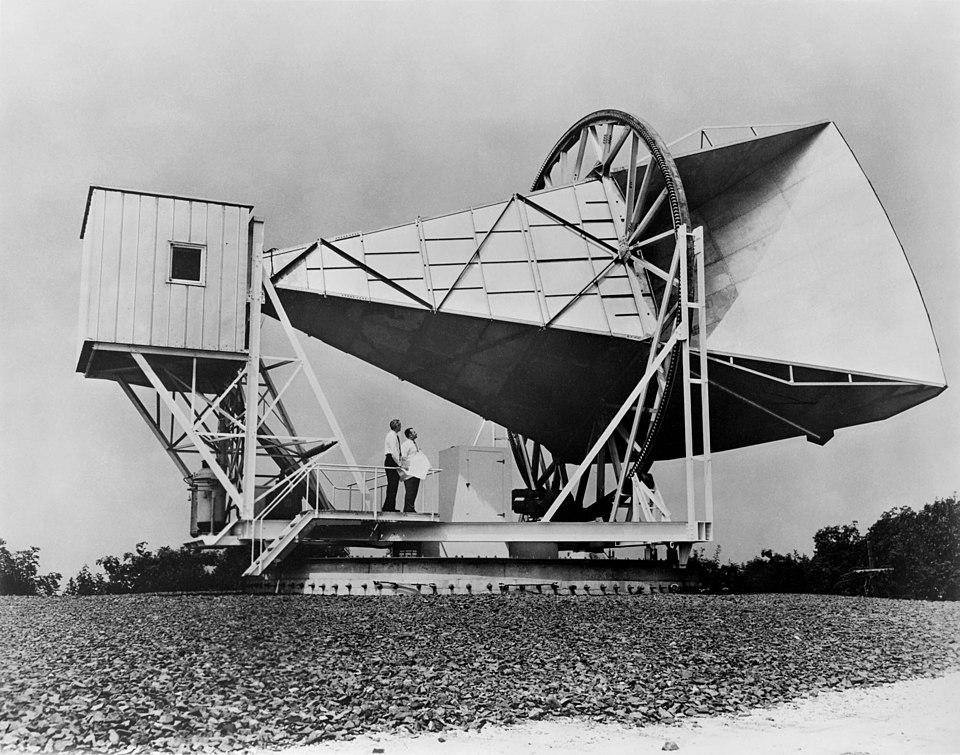

Meanwhile, a group at nearby Princeton University led by Robert Dicke had independently been working out the theory of a relic radiation background and were building an instrument to detect it. When Penzias called Dicke to describe the unexplained signal, Dicke immediately understood what it was. The two groups published companion papers in the Astrophysical Journal in 1965: Penzias and Wilson reported the observation, and Dicke and colleagues provided the cosmological interpretation.3, 4 For their discovery, Penzias and Wilson were awarded the Nobel Prize in Physics in 1978.
The blackbody spectrum and COBE/FIRAS
A crucial test of the CMB's cosmological origin was whether its spectrum — the distribution of energy across different frequencies — matched that of a perfect blackbody. A blackbody is an idealized physical object that absorbs all radiation and re-emits it with a characteristic spectral shape determined solely by temperature, described by the Planck function. The hot, opaque early universe was an exceptionally good blackbody, so Big Bang theory predicted that the CMB spectrum should be essentially perfect. Any significant deviation from a Planck spectrum would signal previously unknown physics or energy injection events after decoupling.5
The Cosmic Background Explorer (COBE) satellite, launched by NASA in November 1989, carried an instrument called FIRAS (Far Infrared Absolute Spectrophotometer) designed to measure the CMB spectrum with extraordinary precision. In 1990, John Mather and colleagues published the first FIRAS results, revealing a spectrum that matched a 2.735-kelvin blackbody so perfectly that the measurement itself became the most precise confirmation of a theoretical prediction in the history of physics.5 A systematic reanalysis using the full FIRAS dataset, published in 1996, refined the temperature to 2.728 ± 0.004 kelvin and placed stringent limits on any departures from a Planck spectrum.11 The definitive modern measurement, incorporating subsequent calibration refinements, places the CMB temperature at 2.7255 ± 0.0006 kelvin.12 The near-perfect blackbody form is powerful evidence that the early universe was in thermal equilibrium, exactly as the Big Bang model requires.
John Mather shared the 2006 Nobel Prize in Physics with George Smoot for their roles in the COBE mission — Mather for leading the FIRAS instrument and Smoot for the discovery of CMB temperature anisotropies using a separate instrument on the same satellite.
Temperature anisotropies
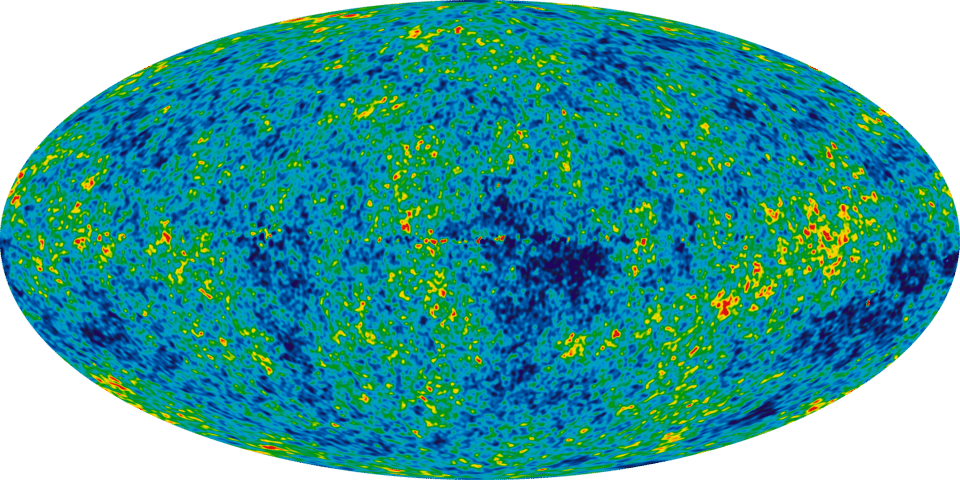
While the CMB is extraordinarily uniform, it is not perfectly so. The second major result from COBE came from its Differential Microwave Radiometer (DMR) instrument, which mapped tiny temperature differences across the full sky. In 1992, Smoot and colleagues announced the detection of these CMB anisotropies — variations in temperature of roughly one part in 100,000 (approximately 30 microkelvin) on angular scales of 10 degrees and larger.6 These tiny fluctuations were expected from theory: they represent density variations in the early universe, regions slightly denser or more rarefied than average, which over cosmic time grew by gravitational attraction into the galaxies, galaxy clusters, and cosmic filaments seen today.
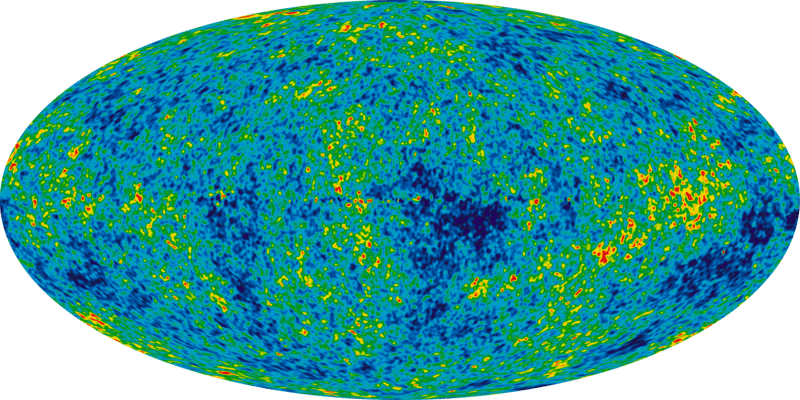

The anisotropy pattern observed by COBE was too coarse-grained — limited to angular scales above about 7 degrees — to distinguish between competing cosmological models. The critical next step was measuring the CMB on finer angular scales, particularly around 1 degree, where theory predicted distinctive peaks in the temperature power spectrum arising from acoustic oscillations. The Wilkinson Microwave Anisotropy Probe (WMAP), launched in 2001, provided the first high-resolution all-sky map of the CMB. WMAP's first-year results, published in 2003, measured the temperature power spectrum to unprecedented precision and, when combined with complementary data, determined the universe to be geometrically flat, approximately 13.7 billion years old, and composed of approximately 4% ordinary baryonic matter, 23% dark matter, and 73% dark energy.7 Nine years of WMAP data, published in 2013, substantially refined these numbers.8
The current state of the art comes from the European Space Agency's Planck satellite, which operated from 2009 to 2013 and produced maps of the CMB with sensitivity and angular resolution surpassing WMAP by a factor of roughly three. The Planck 2018 cosmological parameter analysis remains the definitive measurement of CMB-derived cosmological parameters.9
Acoustic oscillations and the power spectrum
Before recombination, the universe was filled with a tightly coupled plasma of photons, electrons, and baryons (protons and neutrons). Gravity pulled baryons into potential wells created by dark matter, compressing the plasma and raising its temperature and pressure. The photon pressure then pushed back against this compression, creating oscillations — sound waves propagating through the primordial plasma — analogous to the acoustic resonances in a musical instrument. These oscillations had a characteristic scale set by the distance sound could travel before recombination froze the pattern in place; this distance is called the sound horizon, approximately 150 megaparsecs in comoving coordinates.13, 14
When the CMB is analyzed in terms of its angular power spectrum — decomposing the all-sky temperature map into spherical harmonics and measuring the amplitude of fluctuations at each angular scale — a series of peaks and troughs appears. These acoustic peaks carry a remarkable amount of information. The angular position of the first peak, at a multipole moment of roughly ℓ ≈ 220 (corresponding to an angular scale of about 1 degree), constrains the total energy density of the universe and therefore its geometry: the observed position indicates that the universe is spatially flat to within 1%.9 The relative heights of successive peaks constrain the baryon-to-photon ratio, the matter-to-radiation ratio, and the dark matter abundance. The third peak, for instance, is sensitive to the density of dark matter because dark matter, unlike baryons, does not couple to photons and therefore does not experience the same acoustic damping.14
Key cosmological parameters from Planck 2018 CMB analysis9
| Parameter | Value |
|---|---|
| Age of the universe | 13.801 ± 0.024 billion years |
| Hubble constant (H0) | 67.4 ± 0.5 km s−1 Mpc−1 |
| Ordinary baryonic matter | 4.9% |
| Dark matter | 26.4% |
| Dark energy (Λ) | 68.7% |
| CMB temperature (T0) | 2.7255 K |
| Spatial curvature (Ωk) | −0.001 ± 0.002 (consistent with flat) |
The sound horizon imprinted in the CMB anisotropies also leaves a detectable imprint on the large-scale distribution of galaxies, where it is known as the baryon acoustic oscillation (BAO) scale. This scale serves as a standard ruler in the late universe: by measuring the BAO feature in galaxy surveys at various redshifts, cosmologists can trace the expansion history of the universe independently of the CMB.18 The consistency between CMB-derived geometry and BAO-derived distances is one of the most powerful cross-checks in modern cosmology.
CMB polarization
In addition to temperature anisotropies, the CMB carries a polarization signal generated by Thomson scattering — the same process by which sunlight scattered off water surfaces or glass becomes polarized. When photons last scattered off electrons in the pre-recombination plasma, any local quadrupole anisotropy in the incoming radiation produced a net linear polarization of the outgoing photons. The result is a sky-wide polarization field imprinted at the moment of decoupling.14
Polarization patterns in the CMB are conventionally decomposed into two modes based on their geometric properties. E-modes (gradient modes) have no curl and are generated by both scalar density perturbations (the same acoustic oscillations that drive temperature anisotropies) and gravitational waves. B-modes (curl modes) cannot be generated by scalar perturbations to linear order; they arise from primordial gravitational waves — ripples in spacetime produced during cosmic inflation — and from gravitational lensing of E-modes by intervening matter along the line of sight.14 Detecting primordial B-modes would be direct evidence for inflation and would constrain the energy scale at which it occurred.
In 2013, the South Pole Telescope reported the first detection of B-mode polarization generated by gravitational lensing — a secondary signal rather than a primordial one.15 The following year, the BICEP2 experiment announced a detection of degree-scale B-modes interpreted as evidence for primordial gravitational waves, generating significant excitement.16 However, a joint analysis by the BICEP2/Keck Array and Planck teams published in 2015 demonstrated that the signal was fully consistent with thermal emission from polarized dust in our own galaxy, leaving no statistically significant evidence for primordial gravitational waves at that sensitivity level.17 The search for primordial B-modes continues with next-generation experiments including CMB-S4 and the Simons Observatory.
CMB lensing and the Sunyaev-Zel'dovich effect
Beyond its primary temperature and polarization fluctuations, the CMB carries secondary signals imprinted during its 13.8-billion-year journey from the surface of last scattering to our detectors. Two of the most scientifically productive secondary effects are gravitational lensing and the thermal Sunyaev-Zel'dovich effect.
Gravitational lensing of the CMB occurs when the photons' paths are deflected by the gravitational potential of intervening matter — dark matter halos, galaxy clusters, and cosmic filaments — accumulated over the entire line of sight. This lensing blurs and distorts the primary CMB temperature pattern in a statistical sense that can be extracted through a technique called lensing reconstruction.23 The resulting lensing map directly traces the projected mass distribution of the universe out to redshifts of approximately 2–3, providing a measurement of the clustering of matter that is sensitive to both the matter power spectrum and the sum of neutrino masses. CMB lensing measurements from SPT-SZ, ACT, and Planck have become essential tools in constraining cosmological models beyond those testable with primary CMB fluctuations alone.20
The Sunyaev-Zel'dovich (SZ) effect arises when CMB photons inverse-Compton scatter off hot electrons in the intracluster medium of galaxy clusters.19 The high-energy electrons transfer energy to the CMB photons, shifting their spectrum in a characteristic way: photons are depleted at frequencies below roughly 217 gigahertz and enhanced above it. This spectral distortion allows galaxy clusters to be identified and characterized from CMB maps independently of their redshift, making the SZ effect a powerful tool for cluster cosmology and surveys of large-scale structure. Planck's all-sky SZ cluster catalog has provided independent constraints on the matter power spectrum amplitude that, combined with primary CMB data, refine measurements of structure growth throughout cosmic history.10
The Hubble tension
One of the most significant unresolved tensions in contemporary cosmology arises from a comparison between the Hubble constant as inferred from the CMB and as measured directly from observations of the local universe. The Planck 2018 CMB analysis yields a Hubble constant of H0 = 67.4 ± 0.5 km s−1 Mpc−1, meaning the universe is expanding at this rate when extrapolated from the early universe using the standard ΛCDM model.9

Direct measurements using the cosmic distance ladder — anchored by Cepheid variable stars and Type Ia supernovae — consistently return higher values, approximately 73 km s−1 Mpc−1.21, 22
The discrepancy between these two values currently stands at approximately 4–5 standard deviations, well above the threshold conventionally required to claim a statistically significant tension. Both the CMB-based and distance-ladder measurements have been extensively cross-checked with independent methods, and neither appears to harbor a straightforward systematic error of the required magnitude. If the tension is real rather than an artifact of unknown systematics, it implies new physics beyond the standard cosmological model — possible candidates include early dark energy, extra relativistic species (additional light neutrinos or similar particles), or modifications to the late-time expansion history of the universe. The Hubble tension is widely considered one of the most important open problems in cosmology.10, 21
CMB-derived Hubble constant vs. local distance-ladder measurements9, 21
What the CMB tells us about the universe
The power of the CMB as a cosmological probe derives from the large number of independent observables it provides — the positions and heights of acoustic peaks, the polarization spectrum, the lensing signal, secondary anisotropies — all of which must be simultaneously satisfied by any viable model. Within the framework of the standard ΛCDM model (Lambda Cold Dark Matter), a six-parameter fit to the Planck 2018 CMB power spectra determines the universe's properties with remarkable precision.9, 24
The geometry of the universe is constrained by the angular position of the first acoustic peak. The peak's observed location at ℓ ≈ 220 corresponds to a comoving sound horizon of approximately 147 megaparsecs projected onto a 1-degree angular scale — exactly what would be observed in a spatially flat universe. A positively curved (closed) universe would shift the peak to smaller angular scales (higher ℓ), and a negatively curved (open) universe would shift it to larger scales. The Planck data constrain the total energy density to within 0.2% of the critical density required for flatness, providing the most precise measurement of the universe's spatial geometry.9
The matter content of the universe is encoded in the relative amplitudes of successive acoustic peaks. The ratio of the second peak to the first is sensitive to the baryon density, because baryons add mass to the acoustic oscillator — more baryons increase the odd-numbered peaks (compressions) relative to the even-numbered peaks (rarefactions). The ratio of the third peak to the first constrains the total matter density, because dark matter, which does not interact with radiation, contributes gravitational potential wells without sharing the radiation pressure that damps the oscillations. From these ratios, the Planck analysis finds that ordinary baryonic matter accounts for approximately 4.9% of the total energy budget of the universe, dark matter accounts for approximately 26.4%, and the remaining 68.7% is dark energy in the form of a cosmological constant.9
The age of the universe follows from the expansion rate (Hubble constant) and the matter-energy content via the Friedmann equations. The Planck CMB analysis yields an age of 13.801 ± 0.024 billion years — a measurement precise to better than 0.2%.9 This extraordinary precision, derived from the careful analysis of light released 380,000 years after the Big Bang, stands as one of the signal achievements of modern observational cosmology. The CMB will continue to be a foundational dataset for cosmology as next-generation experiments push into unexplored regimes of sensitivity, angular resolution, and frequency coverage, testing the standard model with ever-increasing stringency and probing for physics that lies beyond it.
References
A preliminary measurement of the cosmic microwave background spectrum by the Cosmic Background Explorer (COBE) satellite
First-year Wilkinson Microwave Anisotropy Probe (WMAP) observations: determination of cosmological parameters
Nine-year Wilkinson Microwave Anisotropy Probe (WMAP) observations: cosmological parameter results
Detection of B-mode polarization in the cosmic microwave background with data from the South Pole Telescope
The observations of relic radiation as a test of the nature of X-ray radiation from the clusters of galaxies
Observational evidence from supernovae for an accelerating universe and a cosmological constant