Overview
- The Big Bang is the prevailing scientific model for the origin and evolution of the universe, supported by three independent pillars of evidence: the observed expansion of the universe, the cosmic microwave background radiation, and the predicted abundances of light elements produced in the first minutes.
- The term 'Big Bang' is frequently misunderstood: it does not describe an explosion of matter through space, but rather the rapid expansion of space itself from an extremely hot, dense initial state approximately 13.8 billion years ago.
- The theory was developed incrementally by Georges Lemaître, Edwin Hubble, George Gamow, and others, and confirmed decisively by Arno Penzias and Robert Wilson's 1965 detection of the cosmic microwave background, a faint afterglow of radiation predicted by the model.
The Big Bang is the prevailing scientific model describing the origin and evolution of the universe. According to this model, the universe began approximately 13.8 billion years ago in an extremely hot, dense state and has been expanding and cooling ever since.9 The theory is one of the most thoroughly tested frameworks in all of science, supported by multiple independent lines of observational evidence that converge on the same conclusion. It is important to clarify at the outset what the Big Bang is not: it does not describe an explosion of matter through a pre-existing space, but rather the rapid expansion of space itself from an initial singularity—a state of matter and energy so compressed that the known laws of physics break down at its very boundary.
Historical development of the theory
The intellectual foundations of the Big Bang rest on Albert Einstein's 1915 general theory of relativity, which described gravity as the curvature of spacetime caused by mass and energy. When Einstein applied his equations to the universe as a whole, they implied that the universe could not be static—it must be either expanding or contracting. Einstein was uncomfortable with this result and introduced a "cosmological constant" to force a static solution, a move he later called his "greatest blunder."


The theoretical breakthrough came from the Belgian priest and physicist Georges Lemaître. In a 1927 paper published in the Annales de la Société Scientifique de Bruxelles, Lemaître derived an expanding-universe solution from Einstein's equations and estimated a numerical value for the rate of that expansion using available data on the recession velocities of galaxies.1 This work largely preceded Edwin Hubble's more famous observational confirmation. In a follow-up paper published in 1931, Lemaître extended the logic in a profound direction: if the universe is expanding today, then running time backward implies that all matter and energy once occupied a single point of unimaginable density. He called this the "primeval atom."17
The observational confirmation of cosmic expansion came from Edwin Hubble's landmark 1929 paper. Using the 100-inch Hooker telescope at Mount Wilson Observatory, Hubble measured the distances to dozens of galaxies using Cepheid variable stars as "standard candles," and plotted those distances against the galaxies' redshifts—the stretching of light toward longer, redder wavelengths caused by recession. The data revealed a clear linear relationship: the farther a galaxy, the faster it recedes.2 This relationship, now known as the Hubble–Lemaître law, is the observational cornerstone of the expanding universe and, by extension, the Big Bang model.
The next major theoretical advance came in 1948, when physicist George Gamow and his collaborator Ralph Alpher published a paper arguing that the extreme temperatures of the early universe would have driven nuclear fusion reactions that synthesized the lightest elements.3 In a subsequent paper, Alpher and Robert Herman made a remarkable prediction: the heat radiation from the early universe should still be detectable today, cooled by cosmic expansion to a temperature of roughly 5 Kelvin, filling all of space uniformly.4 This prediction would remain unconfirmed for another sixteen years.
Discovery of the cosmic microwave background
In 1964, radio astronomers Arno Penzias and Robert Wilson at Bell Laboratories in New Jersey were calibrating a large horn antenna designed for satellite communications. They detected a persistent, isotropic noise in their receiver that they could not explain. The signal came from every direction in the sky with equal intensity. After eliminating all conceivable sources of interference—including, famously, pigeon droppings inside the antenna—the noise remained.5 A short distance away at Princeton University, Robert Dicke and his colleagues had independently been preparing to search for exactly this signal as a test of the Big Bang model.6 The two groups recognized what Penzias and Wilson had found: the cosmic microwave background (CMB), the afterglow of the hot, dense early universe, cooled to approximately 2.725 Kelvin by 13.8 billion years of cosmic expansion.23 Penzias and Wilson received the Nobel Prize in Physics in 1978 for the discovery.
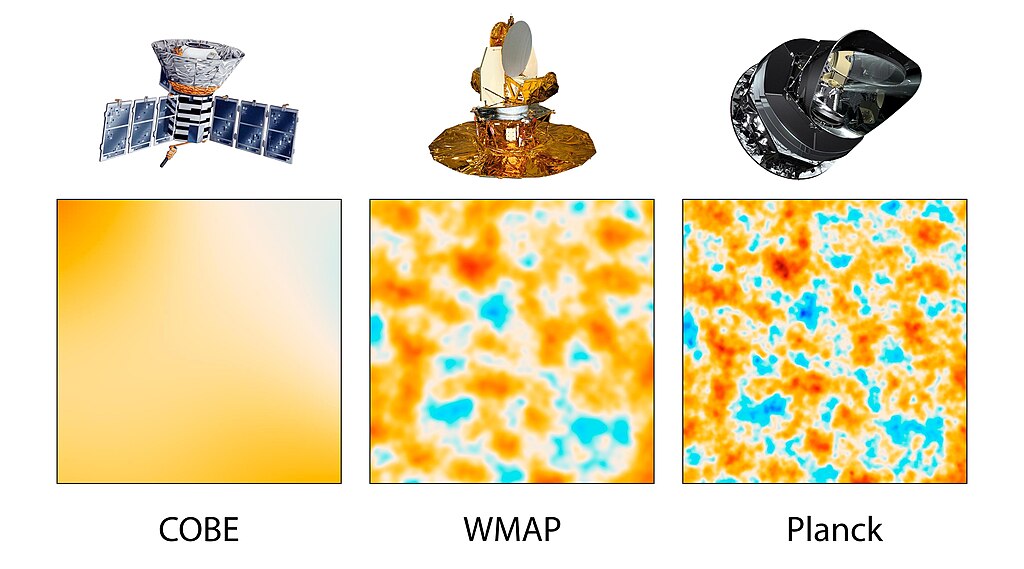

The CMB was later mapped with extraordinary precision by a series of satellite missions. NASA's Cosmic Background Explorer (COBE), launched in 1989, confirmed that the CMB spectrum follows a near-perfect blackbody curve and revealed tiny temperature fluctuations across the sky at the level of one part in 100,000.7 These fluctuations, known as anisotropies, represent the primordial density variations that seeded the formation of all large-scale structure—galaxies, clusters, and cosmic filaments. The WMAP satellite, operating from 2001 to 2010, mapped these anisotropies with far greater resolution and precision, yielding precise measurements of cosmological parameters.8 The Planck satellite, a European Space Agency mission whose final results were published in 2020, produced the most detailed map of the CMB ever assembled and pinned the age of the universe at 13.787 ± 0.020 billion years.9
Three independent pillars of evidence
The scientific confidence in the Big Bang rests not on a single observation but on three entirely independent lines of evidence that each corroborate the others with quantitative precision.
The first pillar is the expansion of the universe, established by the Hubble–Lemaître law and confirmed by decades of subsequent observations.2 In the late 1990s, two independent teams studying Type Ia supernovae as standard candles discovered that the expansion of the universe is not slowing under gravity but actually accelerating.10, 11 This discovery, which earned its leaders the 2011 Nobel Prize in Physics, implied the existence of a "dark energy"—a form of energy permeating all of space that acts in opposition to gravity. The accelerating expansion is now a fundamental component of the standard cosmological model.
The second pillar is the cosmic microwave background. Its existence, temperature, near-perfect blackbody spectrum, and pattern of anisotropies are all precisely predicted by the Big Bang model and match observations with extraordinary accuracy.7, 8, 9 No competing cosmological model has ever reproduced this pattern.
The third pillar is Big Bang nucleosynthesis (BBN): the formation of light nuclei in the first minutes of the universe's existence. In the extreme heat of the early universe, protons and neutrons collided at enormous energies, fusing to form nuclei of hydrogen, deuterium, helium-3, helium-4, and lithium-7. The Big Bang model makes precise quantitative predictions about the primordial abundances of each of these elements based on a single free parameter—the baryon density of the universe.12, 13 Astronomers measure these primordial abundances in the oldest, most chemically primitive objects in the universe, and the agreement between prediction and observation is remarkable.14
Big Bang nucleosynthesis: predicted vs. observed primordial abundances13, 14, 25
| Element / isotope | BBN prediction | Observed abundance |
|---|---|---|
| Helium-4 (mass fraction) | ~25% | ~24–25% |
| Deuterium (D/H by number) | ~2.5 × 10⁻⁵ | ~2.5 × 10⁻⁵ |
| Helium-3 (3He/H by number) | ~1 × 10⁻⁵ | ~1–2 × 10⁻⁵ |
| Lithium-7 (7Li/H by number) | ~5 × 10⁻¹⁰ | ~1.6 × 10⁻¹⁰ (lithium problem) |
The agreement between theory and observation for hydrogen, deuterium, and helium is among the most precise quantitative confirmations in all of cosmology. The discrepancy for lithium-7—where observed abundances in old metal-poor stars are roughly three times lower than predicted—is a known open problem, sometimes called the "cosmological lithium problem," and is an active area of research. It does not undermine the Big Bang model, as the discrepancy may reflect stellar physics that depletes lithium over time rather than an error in BBN theory.25
Timeline of the early universe
The Big Bang model makes specific predictions about conditions at each stage of the universe's evolution, from the first fractions of a second to billions of years later. The timeline is subdivided into epochs defined by the dominant physical processes at each stage.
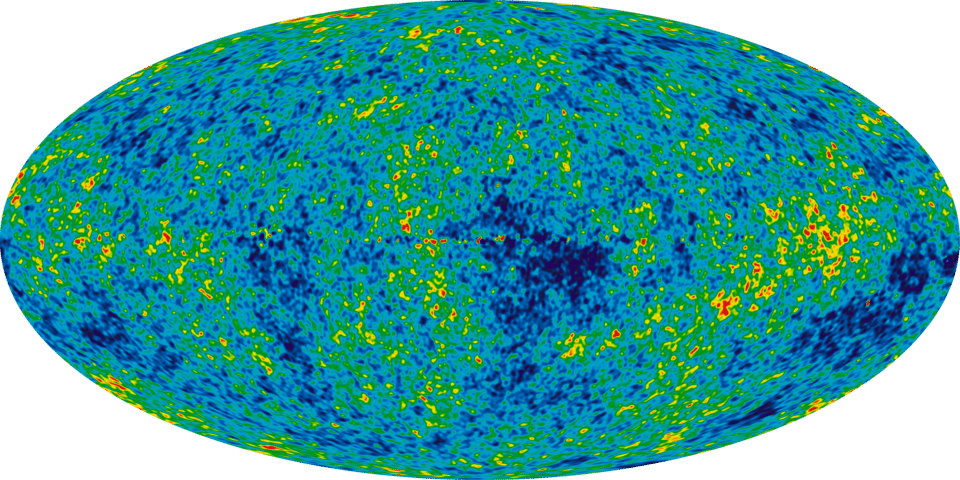

The Planck epoch encompasses the first 10−43 seconds after the Big Bang, a period so extreme that the four known forces of nature—gravity, electromagnetism, the strong nuclear force, and the weak nuclear force—are thought to have been unified into a single interaction. The temperature at this epoch exceeded 1032 Kelvin. Current physics has no confirmed theory capable of describing this regime; a complete theory of quantum gravity would be required.22
Beginning around 10−36 seconds, the universe is thought to have undergone a period of cosmic inflation: an exponential expansion in which a patch of space smaller than a proton expanded to macroscopic scales in an extraordinarily brief interval.15 This hypothesis, first proposed by Alan Guth in 1981 and developed independently by Alexei Starobinsky and others, was introduced to resolve several puzzling features of the observable universe: the near-perfect uniformity of the CMB across regions of the sky that could never have been in causal contact (the "horizon problem"), the extremely precise flatness of the universe's geometry (the "flatness problem"), and the absence of magnetic monopoles predicted by grand unified theories.15, 16 Inflation also provides a mechanism for generating the primordial density fluctuations observed in the CMB: quantum fluctuations on subatomic scales were stretched to cosmic scales by the rapid expansion.24
After inflation, the universe reheated as the inflaton field decayed, and the quark epoch began. For the first microsecond, the universe was a quark-gluon plasma—a soup of the fundamental particles of matter too hot and energetic to bind together into composite particles.21 A critical and still not fully understood process occurred during this period: baryogenesis, the slight asymmetry between matter and antimatter that resulted in a universe filled with matter rather than being entirely annihilated. The three theoretical conditions for baryogenesis (violation of baryon number, violation of charge-parity symmetry, and departure from thermal equilibrium) were identified by Andrei Sakharov in 1967, but a complete mechanism consistent with all observations has not been established.20
At approximately one microsecond, the universe had cooled enough for quarks to combine into protons and neutrons—collectively called hadrons—in the hadron epoch. Shortly thereafter, at roughly one second after the Big Bang, the temperature dropped below the threshold at which neutrinos interact strongly with matter, and neutrinos effectively decoupled from the rest of the universe, streaming freely as a background radiation analogous to the CMB.
From approximately one second to three minutes, the temperature of the universe fell through the narrow window in which nuclear fusion is both energetically possible and sustained: the epoch of Big Bang nucleosynthesis. Protons and neutrons fused to form deuterium, which then reacted further to produce helium-4, helium-3, and trace amounts of lithium-7.12, 13 After roughly twenty minutes, the universe had cooled below the fusion threshold, locking in the light-element abundances that astronomers measure today.
For the next 380,000 years, the universe remained a hot, opaque plasma of electrons, protons, and nuclei, permeated by photons that scattered constantly off the free electrons and could not travel freely. At approximately 380,000 years after the Big Bang, the universe had cooled to roughly 3,000 Kelvin—cool enough for electrons and protons to combine into neutral hydrogen atoms for the first time. This epoch of recombination made the universe transparent. The photons that had been trapped in the plasma were suddenly free to travel unimpeded in all directions, and it is these photons that we observe today as the cosmic microwave background.9 The CMB is therefore literally a snapshot of the universe as it appeared 380,000 years after its beginning.
Following recombination, the universe entered the cosmic dark ages: a period of several hundred million years during which no luminous sources existed.19 Matter was distributed nearly uniformly, with only the tiny density fluctuations imprinted by inflation. Over hundreds of millions of years, gravity slowly amplified these fluctuations. Regions slightly denser than average attracted more matter, growing denser still, while surrounding regions emptied. Eventually the overdense regions collapsed under their own gravity to form the first stars.18
The first stars, known as Population III stars, are estimated to have ignited approximately 100 to 500 million years after the Big Bang.18 These objects were formed from almost pure hydrogen and helium—the metals forged by stellar nucleosynthesis did not yet exist in significant quantities. They are thought to have been extraordinarily massive, luminous, and short-lived, and their ultraviolet radiation began the process of reionization: re-ionizing the neutral hydrogen that had filled the universe since recombination.19 By approximately one billion years after the Big Bang, the first galaxies had assembled, and reionization was largely complete.
What the Big Bang does and does not explain
A pervasive misconception about the Big Bang is that it describes an explosion of matter through a pre-existing, empty space—as if the early universe were a cosmic bomb detonating at a point in an otherwise empty void. This is incorrect. General relativity describes the Big Bang as the expansion of space itself. There is no center of the explosion, no edge, and no "outside." Every point in space is moving away from every other point, and an observer at any location would see all other galaxies receding, just as Hubble observed from Earth. An analogy often used is the surface of an inflating balloon: dots drawn on the surface all recede from one another as the balloon inflates, but there is no privileged center on the surface.22
The Big Bang model does not claim to explain what caused the Big Bang, or what, if anything, existed "before" it. The concept of time itself, within general relativity, is tied to the geometry of spacetime, which originated in the Big Bang; asking what preceded it may not be a well-formed physical question under current theory. These are genuine open problems at the frontier of cosmology and quantum gravity, and the honest answer is that current science does not resolve them. The Big Bang model is a description of the universe's evolution from a very early hot, dense state forward in time, not a complete account of ultimate origins.22
Similarly, the Big Bang model does not, by itself, explain the large-scale structure of the universe—why matter is arranged in filaments, walls, and voids—without invoking cosmic inflation, which provides the primordial seed fluctuations. Nor does it explain the nature of dark matter (roughly 27% of the energy density of the universe) or dark energy (roughly 68%), both of which are inferred from observations but whose physical nature remains unknown.9
Cosmic inflation and the flatness of the universe
Cosmic inflation, the hypothesized period of exponential expansion in the first fractions of a second, occupies a central place in modern cosmology because it elegantly resolves multiple puzzles simultaneously.15 The horizon problem arises from the observation that opposite sides of the observable universe—regions separated by 93 billion light-years today, far too distant to ever have exchanged information—have nearly identical CMB temperatures to one part in 100,000. Without inflation, there is no physical mechanism to explain this uniformity. Inflation solves the problem by proposing that the entire observable universe was once a tiny, causally connected region that was stretched to enormous scales; its uniform temperature is a relic of that initial causal contact.24
The flatness problem concerns the geometry of the universe. Measurements of the CMB and large-scale structure consistently show that the universe is geometrically flat (or very nearly so) to high precision—meaning the total energy density is extremely close to the critical density.9 In the standard Big Bang without inflation, this flatness requires extraordinary fine-tuning of the initial conditions to a precision of roughly one part in 1060. Inflation naturally drives the geometry toward flatness: any curvature in the initial patch is stretched away, just as the surface of an inflating balloon becomes locally flat. The inflationary prediction of a flat universe has been confirmed by WMAP and Planck to high accuracy.8, 9
The specific predictions of inflationary models—including the spectrum of density fluctuations imprinted in the CMB—have been tested in detail and are consistent with observations, though distinguishing between the many specific inflationary models proposed remains an active area of research.24
Key epochs in the thermal history of the universe9, 13, 18, 19
Scientific status and alternative models
The Big Bang is not a speculative hypothesis. It is a mature scientific theory—a framework supported by an extensive body of quantitative predictions confirmed by independent observations. The three pillars of expansion, the CMB, and BBN abundances were each predicted before they were fully observed, and each has been confirmed with increasing precision as instrumentation has improved.5, 12, 13 Alternative cosmological models, such as the Steady State theory proposed by Fred Hoyle, Hermann Bondi, and Thomas Gold in 1948, were falsified by the discovery of the CMB and by observations showing that the universe was denser and more active in the past than it is today—a fact incompatible with a universe in a perpetual steady state but fully expected in the Big Bang framework.6
The scientific community's acceptance of the Big Bang is essentially universal among professional cosmologists and astrophysicists. The open questions that remain—the nature of dark matter and dark energy, the mechanism of inflation, baryogenesis, and the physics of the Planck epoch—are frontiers within the model, not challenges to it. They are evidence of a living, productive scientific program, not of weakness in the underlying framework.
References
Un univers homogène de masse constante et de rayon croissant rendant compte de la vitesse radiale des nébuleuses extra-galactiques
Nine-year Wilkinson Microwave Anisotropy Probe (WMAP) observations: cosmological parameter results
Observational evidence from supernovae for an accelerating universe and a cosmological constant
Determination of the cosmic microwave background temperature using a ground-based millimeter-wave bolometric camera