Overview
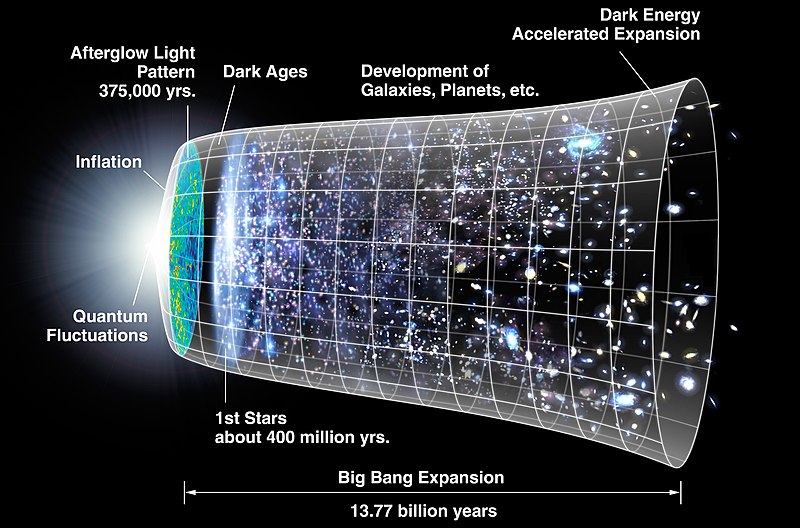
- Cosmic inflation is the hypothesized period of exponential expansion of space in the first fraction of a second after the Big Bang, during which the observable universe grew by a factor of at least 10⁶⁰ in roughly 10⁻³₂ seconds, resolving the horizon, flatness, and magnetic monopole problems of classical Big Bang cosmology.
- Quantum vacuum fluctuations stretched to macroscopic scales during inflation became the primordial density perturbations that seeded all large-scale cosmic structure, a prediction spectacularly confirmed by the nearly scale-invariant power spectrum measured in the cosmic microwave background by COBE, WMAP, and Planck.
- Inflation predicts a spatially flat universe and a specific spectral index of primordial perturbations, both confirmed to high precision by Planck, while the predicted primordial gravitational wave signal remains undetected, with the current upper limit on the tensor-to-scalar ratio standing at r < 0.036 from the BICEP/Keck Array.
Cosmic inflation is the hypothesized period of extraordinarily rapid, exponential expansion of space in the very early universe, occurring within roughly the first 10−36 to 10−32 seconds after the Big Bang. First proposed by Alan Guth in 1981, the theory holds that the observable universe expanded by a factor of at least e60 — approximately 1026 — during this fleeting interval, driven by the enormous energy density of a quantum field called the inflaton.1 In doing so, inflation smoothed out any initial irregularities, flattened the spatial geometry of the universe, and diluted any exotic relics such as magnetic monopoles that may have been produced at even earlier epochs.1, 18
The inflationary paradigm also provides a remarkable bridge between quantum mechanics and the largest structures in the cosmos. During inflation, microscopic quantum vacuum fluctuations in the inflaton field were stretched to astronomical scales and frozen into the fabric of spacetime, becoming the primordial density perturbations that would eventually seed the formation of galaxies, galaxy clusters, and the entire cosmic web.5, 6, 7 These predictions have been tested with extraordinary precision by satellite missions including COBE, WMAP, and Planck, whose measurements of the cosmic microwave background power spectrum are in striking agreement with inflationary theory.8, 9, 16
Problems with classical Big Bang cosmology
Although the standard hot Big Bang model successfully accounts for the expansion of the universe, the cosmic microwave background (CMB) radiation, and the abundances of light elements forged in Big Bang nucleosynthesis, it contains several puzzling features that require extraordinary fine-tuning of initial conditions. These problems — identified in the 1970s and early 1980s — provided the primary motivation for the development of inflationary theory.1, 18
The horizon problem arises from the remarkable uniformity of the CMB. Observations show that the CMB temperature is the same to one part in 100,000 across the entire sky, yet in the standard Big Bang model, regions on opposite sides of the observable universe were never in causal contact — they lie beyond each other's particle horizons. Without some mechanism to bring these regions into thermal equilibrium before they became causally disconnected, their near-perfect isotropy is an unexplained coincidence.1, 21
The flatness problem concerns the spatial geometry of the universe. General relativity permits the universe to be positively curved (closed), negatively curved (open), or flat, depending on whether the total energy density parameter Ω is greater than, less than, or equal to one. In the standard Big Bang model, any deviation of Ω from unity grows rapidly with time, so the fact that Ω is measured to be extremely close to one today implies that it must have been fine-tuned to unity to extraordinary precision — to within one part in 1060 — at the Planck epoch.1, 22 There is no mechanism in classical Big Bang cosmology to explain why the universe should have begun in this exquisitely balanced state.
The magnetic monopole problem (sometimes called the relic problem) stems from grand unified theories (GUTs) of particle physics, which predict that phase transitions in the very early universe should have produced copious quantities of topological defects such as magnetic monopoles — hypothetical particles carrying isolated north or south magnetic poles. These monopoles would be extremely massive and stable, and their predicted abundance is so large that they would dominate the energy density of the universe today, in gross contradiction with observations.1, 24 Standard Big Bang cosmology offers no explanation for their absence.
Guth's original proposal and "old inflation"
In January 1981, Alan Guth, then a particle physicist at the Stanford Linear Accelerator Center, published a paper titled "Inflationary universe: A possible solution to the horizon and flatness problems" that introduced the concept of cosmic inflation.1 Guth's insight was that if the early universe underwent a brief period of exponential expansion, all three of the puzzles described above would be resolved simultaneously. During inflation, a small, causally connected patch of space would be stretched to encompass the entire observable universe, explaining the uniformity of the CMB. The exponential expansion would drive the spatial curvature toward zero regardless of its initial value, solving the flatness problem. And any magnetic monopoles produced before or during the GUT phase transition would be diluted to negligible densities by the enormous expansion factor.1, 18
Guth's mechanism relied on the concept of a false vacuum — a metastable state of a scalar field with a large energy density that mimics a cosmological constant and drives exponential, de Sitter expansion of space. In this scenario, the universe supercools during a first-order phase transition associated with grand unification, remaining trapped in the false vacuum while the expansion proceeds at an exponential rate. The phase transition eventually completes through the nucleation of bubbles of the true vacuum, which expand and collide, converting the vacuum energy into a hot plasma of particles and radiation.1, 24
Guth was not the only physicist to recognise the cosmological significance of exponential expansion in the early universe. In 1980, Alexei Starobinsky in Moscow proposed a cosmological model based on quantum corrections to general relativity that produced a de Sitter phase in the early universe, though he did not frame it in terms of solving the horizon and flatness problems.2 Also in 1980, Demosthenes Kazanas at NASA's Goddard Space Flight Center independently explored the cosmological consequences of an exponential expansion driven by spontaneous symmetry breaking, and in 1981 Katsuhiko Sato in Japan analysed the dynamics of first-order vacuum phase transitions in an expanding universe.25, 24
Guth himself recognised a critical flaw in his original scenario, which he termed the graceful exit problem. In old inflation, the phase transition proceeds by the random nucleation of true-vacuum bubbles within a background of false vacuum that is expanding exponentially. Because the space between the bubbles expands faster than the bubbles themselves can grow and merge, the phase transition never completes: the bubbles remain isolated islands in an eternally inflating sea. Even where bubbles do collide, the resulting distribution of energy is extremely inhomogeneous, producing a universe nothing like the smooth, hot Big Bang aftermath required by observation.1, 18
New inflation and slow-roll dynamics
The graceful exit problem was solved in 1982 by two independent proposals. Andrei Linde in Moscow proposed what he called "new inflation," in which the inflaton field does not tunnel out of a false vacuum but instead rolls slowly along a nearly flat region of its potential energy function.3 Independently and almost simultaneously, Andreas Albrecht and Paul Steinhardt at the University of Pennsylvania developed a closely related model in which a scalar field associated with a grand unified theory undergoes a slow, continuous transition rather than a sudden jump between vacuum states.4
In these slow-roll models, inflation is driven not by a metastable false vacuum but by the potential energy of the inflaton field as it slowly descends a gently sloping potential. As long as the field changes slowly compared to the expansion rate of the universe, the energy density remains approximately constant and the expansion is quasi-exponential.3, 4, 21 The condition for sustained inflation is quantified by two slow-roll parameters, conventionally denoted ε and η, which measure the steepness and curvature of the potential respectively. Inflation occurs when both parameters are much smaller than unity and ends when the field reaches a steeper region of the potential where slow-roll conditions are violated.21, 22
When the inflaton reaches the minimum of its potential, it oscillates rapidly about the minimum, and these oscillations decay into a hot plasma of standard-model particles through a process called reheating. Reheating converts the vacuum energy that drove inflation into the thermal energy of a hot, dense universe, seamlessly connecting the inflationary epoch to the standard hot Big Bang evolution.21, 22 The graceful exit problem is thus avoided entirely: there is no bubble nucleation, no incomplete phase transition, and no catastrophic inhomogeneity. The universe emerges from inflation in a homogeneous, isotropic, spatially flat, and extremely hot state — precisely the initial conditions that the standard Big Bang model had previously been forced to assume without explanation.
In 1983, Linde further generalised the inflationary paradigm with chaotic inflation, demonstrating that inflation does not require a specific phase transition or a special initial state. In chaotic inflation, the inflaton field starts at a large, random value in some region of space, and if the potential energy is sufficiently flat at large field values, that region inflates by an enormous factor.13 This insight greatly expanded the range of potentials and initial conditions under which inflation could occur, making the paradigm considerably more robust.13, 22
Quantum fluctuations and the origin of structure
Perhaps the most profound consequence of inflation is its explanation for the origin of all structure in the observable universe. During the inflationary epoch, the inflaton field is not perfectly uniform: like all quantum fields, it is subject to irreducible quantum vacuum fluctuations — tiny, random variations in the field value from point to point in space. Under normal circumstances, these fluctuations occur on submicroscopic scales and are ephemeral. During inflation, however, the exponential expansion of space stretches these quantum fluctuations to macroscopic and even cosmological scales, far larger than the Hubble horizon, where they become "frozen" as classical perturbations in the density and curvature of the universe.5, 6, 7
This mechanism was first identified by Viatcheslav Mukhanov and Gennady Chibisov in 1981, working in the context of Starobinsky's model, who showed that quantum fluctuations during a de Sitter phase would produce a spectrum of density perturbations with a characteristic form.5 In 1982, four groups independently calculated the spectrum of perturbations generated during slow-roll inflation: Stephen Hawking, Alexei Starobinsky, Alan Guth and So-Young Pi, and James Bardeen, Paul Steinhardt and Michael Turner all arrived at the same essential result.6, 7 The predicted spectrum is nearly scale-invariant — meaning that the amplitude of perturbations is approximately the same on all length scales — with a slight tilt toward larger amplitudes on larger scales. This spectrum is characterised by the scalar spectral index ns, which equals exactly 1 for perfect scale invariance and is predicted by most inflationary models to be slightly less than 1.21, 22
After inflation ends and the universe transitions to radiation-dominated and then matter-dominated expansion, the frozen perturbations re-enter the Hubble horizon at successively later times, with larger-scale perturbations entering later. These density perturbations serve as the seeds for the gravitational collapse that eventually produces galaxies, galaxy clusters, filaments, and voids — the entire large-scale structure of the cosmos.22, 23 The fact that the observed distribution of matter in the universe and the pattern of temperature fluctuations in the CMB are both consistent with an initially nearly scale-invariant, Gaussian spectrum of perturbations constitutes one of the most compelling pieces of evidence for inflation.8, 16
Predictions and observational evidence
Inflation makes several precise, quantitative predictions that can be tested against observations of the cosmic microwave background and the large-scale distribution of matter. The primary predictions are: a spatially flat universe (Ωtotal = 1), a nearly scale-invariant spectrum of primordial density perturbations, superhorizon correlations in the CMB, and Gaussian statistics of the primordial fluctuations.18, 21 Each of these has been tested to high precision.
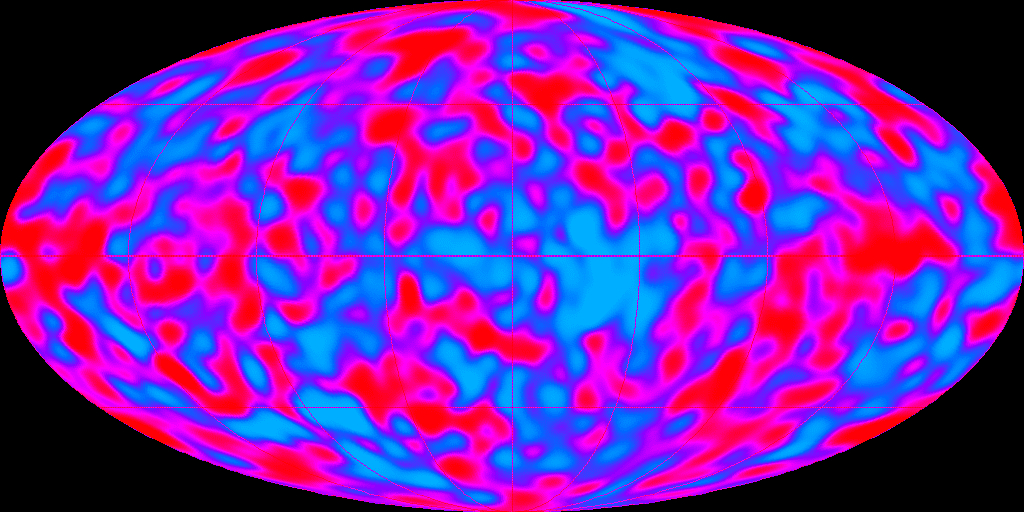

The first detection of CMB temperature anisotropies by the COBE satellite's Differential Microwave Radiometer in 1992 revealed fluctuations at a level of approximately 30 µK on angular scales of 10 degrees, with a power spectrum consistent with the Harrison-Zel'dovich scale-invariant form predicted by inflationary models.16 This discovery, which earned George Smoot and John Mather the 2006 Nobel Prize in Physics, provided the first direct evidence that the primordial perturbation spectrum had the form predicted by inflation.
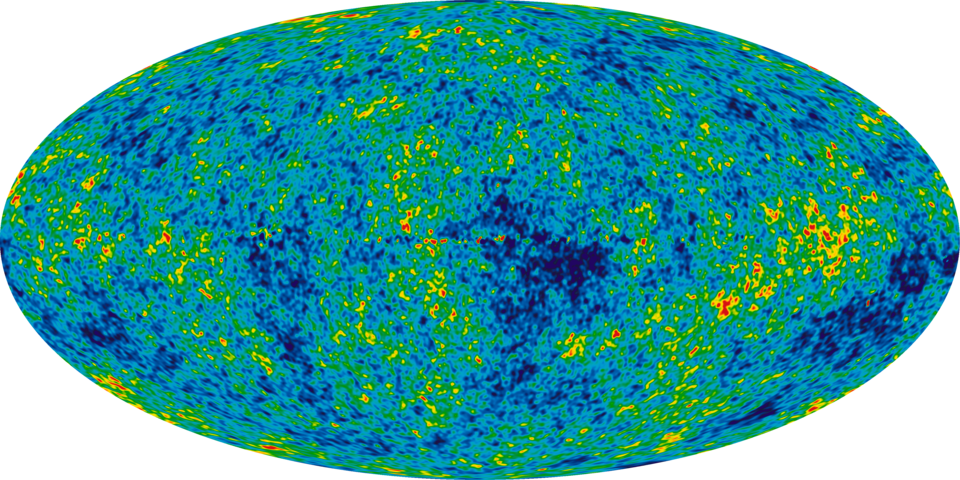
The WMAP satellite, which observed the CMB from 2001 to 2010, dramatically sharpened these measurements. WMAP's first-year results confirmed that the universe is spatially flat to high precision, finding a total density parameter Ωtotal = 1.02 ± 0.02, and measured the scalar spectral index to be ns = 0.99 ± 0.04, consistent with the slight red tilt predicted by inflation.17
The European Space Agency's Planck satellite, which operated from 2009 to 2013, provided the most precise measurements of the CMB to date. The final Planck 2018 data release (published in 2020) determined the scalar spectral index to be ns = 0.9649 ± 0.0042, a definitive detection of departure from exact scale invariance at greater than 8σ significance — precisely as most inflationary models predict.8 Planck also confirmed spatial flatness with extraordinary precision, constraining the curvature density parameter to ΩK = 0.001 ± 0.002 when combined with baryon acoustic oscillation data, consistent with the perfectly flat universe predicted by inflation.9 The primordial perturbations were found to be highly Gaussian, with no statistically significant detection of primordial non-Gaussianity.8
Inflationary predictions and observational constraints8, 9, 10
| Prediction | Inflationary expectation | Observed value | Source |
|---|---|---|---|
| Spatial flatness | Ωtotal = 1 | ΩK = 0.001 ± 0.002 | Planck + BAO (2020) |
| Scalar spectral index | ns slightly < 1 | ns = 0.9649 ± 0.0042 | Planck (2020) |
| Running of spectral index | dns/d ln k ≈ 0 | −0.0045 ± 0.0067 | Planck (2020) |
| Gaussianity | Nearly Gaussian | fNL = −0.9 ± 5.1 | Planck (2020) |
| Adiabatic perturbations | Purely adiabatic | No isocurvature detected | Planck (2020) |
| Tensor-to-scalar ratio | Model-dependent (r > 0) | r < 0.036 (95% CL) | BICEP/Keck (2021) |
The consistency between these precise measurements and the generic predictions of slow-roll inflation has led most cosmologists to regard inflation as a central component of the standard cosmological model, though the specific identity and physics of the inflaton field remain unknown.8, 18
Gravitational waves and the tensor-to-scalar ratio
In addition to scalar (density) perturbations, inflation also predicts the generation of primordial gravitational waves — tensor perturbations in the fabric of spacetime itself. These arise from quantum fluctuations in the gravitational field during inflation and, like the scalar perturbations, are stretched to superhorizon scales by the exponential expansion. The amplitude of the predicted gravitational wave signal is directly proportional to the energy scale at which inflation occurred, making it a powerful probe of the physics of the inflationary epoch.21, 22
The relative strength of the gravitational wave signal is quantified by the tensor-to-scalar ratio r, defined as the ratio of the amplitude of tensor perturbations to scalar perturbations. A detection of primordial gravitational waves would not only provide direct evidence for inflation but would also determine the energy scale at which inflation occurred: a value of r = 0.01, for example, would imply inflation at an energy scale of roughly 1016 GeV, close to the grand unification scale.21, 22 Primordial gravitational waves would imprint a distinctive signature in the polarisation of the CMB, producing a curl-like pattern known as B-mode polarisation at large angular scales. This B-mode signal is the primary observational target for detecting inflationary gravitational waves.21
In March 2014, the BICEP2 collaboration announced the detection of B-mode polarisation at degree angular scales, reporting a tensor-to-scalar ratio of r = 0.20+0.07−0.05 — a result that, if confirmed, would have constituted the first direct evidence for inflation and would have determined the energy scale of inflation to be near the GUT scale.11 The announcement generated enormous excitement in the physics community, but concerns quickly emerged about the potential contribution of polarised thermal emission from Galactic dust to the observed signal. A joint analysis by the BICEP2/Keck and Planck collaborations published in 2015 demonstrated that the BICEP2 signal was largely, and possibly entirely, attributable to Galactic dust rather than primordial gravitational waves, finding no statistically significant evidence for a nonzero tensor-to-scalar ratio.12
The most stringent constraint to date comes from the BICEP/Keck 2021 analysis, which combined data from BICEP2, the Keck Array, and BICEP3 through the 2018 observing season with Planck and WMAP data. This analysis set an upper limit of r < 0.036 at 95 percent confidence, ruling out many simple inflationary models with large gravitational wave production, including all monomial power-law potentials.10 Future experiments, including the ground-based CMB-S4 observatory and the space-based LiteBIRD satellite, aim to reach sensitivities of r ∼ 0.001, which would probe a much wider range of inflationary models and potentially detect the gravitational wave signal if it exists at a level consistent with many theoretically motivated scenarios.10
The landscape of inflationary models
Since the original proposals of the early 1980s, a vast number of inflationary models have been constructed, each specified by a different choice of inflaton potential, field content, and coupling to gravity. A comprehensive 2014 catalogue by Martin, Ringeval, and Vennin documented and analysed more than 70 distinct single-field inflationary models, comparing their predictions against Planck data.20

The diversity of these models reflects both the flexibility of the inflationary framework and the current ignorance about the fundamental physics at the energy scales relevant to inflation.
Among the most studied classes of models are large-field models, in which the inflaton traverses a distance greater than the Planck mass in field space during inflation. The simplest examples — monomial potentials of the form V(φ) ∝ φn — predict relatively large values of the tensor-to-scalar ratio and have been progressively disfavoured by BICEP/Keck constraints.10, 20 Linde's chaotic inflation with a quadratic potential (n = 2), long considered one of the simplest and most natural inflationary models, is now ruled out at high significance by the combined Planck and BICEP/Keck data.8, 10
Small-field models and plateau models, in which inflation occurs on a flat plateau of the potential at field values well below the Planck mass, predict smaller values of r and are currently favoured by observational data. Starobinsky's 1980 R2 model, which was the first inflationary model chronologically, predicts ns ≈ 0.964 and r ≈ 0.004 for 55 e-folds of inflation, placing it squarely within the observationally preferred region.2, 8 Natural inflation, proposed by Freese, Frieman, and Olinto in 1990, uses a pseudo Nambu-Goldstone boson as the inflaton, providing a natural mechanism for the extreme flatness of the potential required for slow-roll inflation.15 However, in its simplest form, natural inflation is now in tension with Planck data unless the symmetry-breaking scale is very large.8
The Planck 2018 inflation analysis found that the data favour concave potentials over convex ones, with plateau-like models such as Starobinsky R2 inflation and Higgs inflation providing the best fits to the observed values of ns and the upper bound on r.8 The ongoing narrowing of the observationally allowed parameter space is progressively eliminating entire classes of models, making inflation an increasingly testable and falsifiable hypothesis despite the large theoretical landscape.
Predicted tensor-to-scalar ratio by model class8, 10, 20
Eternal inflation and the multiverse

A striking consequence of many inflationary models is that, once inflation begins, it may never end globally. In 1983, Alexander Vilenkin showed that in new inflation, quantum fluctuations can push the inflaton field back up the potential in some regions of space, sustaining inflation there even as other regions exit inflation and thermalise.14 The inflating regions expand exponentially, continually producing new volume faster than regions can exit inflation. The result is eternal inflation: a process in which the universe as a whole inflates forever, with "pocket universes" — regions that have undergone reheating and evolved into something resembling our observable universe — forming as isolated bubbles or domains within an eternally inflating background.14, 13
In chaotic inflation, eternal inflation arises even more naturally. At sufficiently large field values, quantum fluctuations in the inflaton field can dominate over the classical slow-roll motion, causing some regions to climb to even larger field values and inflate even more rapidly. This self-reproducing process generates an infinite, ever-expanding multiverse in which different pocket universes may have different physical properties, depending on how the inflaton field decays and what vacuum state is reached in each region.13, 23
The concept of eternal inflation raises deep questions about predictability and testability in cosmology. If the multiverse contains an infinite number of pocket universes with different properties, the theory cannot make unique predictions for the properties of our own universe without a measure — a prescription for assigning relative probabilities to different types of pocket universes. Defining a consistent and physically motivated measure on the multiverse has proven extraordinarily difficult and remains one of the most challenging open problems in theoretical cosmology.19, 23
Open questions and criticisms
Despite its observational successes, inflation faces several unresolved theoretical questions and has attracted substantive criticism. One fundamental issue is the identity of the inflaton. No particle in the Standard Model of particle physics has the properties required to serve as the inflaton in the simplest inflationary models, though proposals exist to identify it with the Higgs boson (in the non-minimally coupled "Higgs inflation" scenario) or with fields predicted by extensions of the Standard Model such as supersymmetry or string theory.20, 21 The inflaton potential must be extraordinarily flat to sustain slow-roll inflation, and explaining this flatness from first principles remains an open challenge in particle physics.
The trans-Planckian problem concerns the fact that the quantum fluctuations that become the observed perturbations in the CMB had physical wavelengths far shorter than the Planck length at the onset of inflation. At such scales, the standard framework of quantum field theory on a classical spacetime background may break down, and the predictions of inflation could in principle be sensitive to unknown Planck-scale physics.21, 23 Whether the observable predictions of inflation are robust against trans-Planckian effects depends on assumptions about quantum gravity that cannot yet be tested.
In 2013, Ijjas, Steinhardt, and Loeb argued that the inflationary paradigm is in trouble following the Planck 2013 results. Their critique centred on the observation that the simplest and most natural inflationary models (those with power-law potentials) are disfavoured by the data, while the surviving plateau models require special initial conditions or fine-tuning of their potentials, undermining the original motivation of inflation as a theory that explains the initial conditions of the Big Bang without fine-tuning.19 They further argued that the combination of eternal inflation and the multiverse renders the inflationary paradigm unfalsifiable, because any observation can be accommodated within some pocket universe somewhere in the multiverse. This critique prompted vigorous debate, with defenders of inflation arguing that the paradigm's successful predictions of spatial flatness, the scalar spectral index, Gaussianity, and adiabaticity constitute strong empirical support that should not be dismissed.18, 19
Other open questions include whether inflation requires a full theory of quantum gravity for its completion, whether the initial conditions for inflation can themselves be explained (the "problem of initial conditions for inflation"), and whether alternative theories such as the ekpyrotic or bouncing cosmology scenarios can reproduce inflation's observational successes without requiring an inflationary epoch.19, 21 The search for primordial gravitational waves through B-mode polarisation measurements remains the most promising avenue for distinguishing between competing models and potentially ruling out broad classes of inflationary scenarios. A confirmed detection of r would determine the energy scale of inflation, while a sufficiently stringent upper bound would exclude all large-field models and point toward specific classes of small-field or plateau potentials.10, 8
References
A new inflationary universe scenario: A possible solution of the horizon, flatness, homogeneity, isotropy and primordial monopole problems
Improved constraints on primordial gravitational waves using Planck, WMAP, and BICEP/Keck observations through the 2018 observing season
First-year Wilkinson Microwave Anisotropy Probe (WMAP) observations: Determination of cosmological parameters
Inflationary cosmology: Exploring the universe from the smallest to the largest scales