Overview
- Astronomers cannot use a single method to measure distances across the universe. Instead, they use a chain of overlapping techniques—each calibrated by the one below it—called the cosmic distance ladder.
- The rungs of the ladder range from radar ranging in the solar system, to stellar parallax for nearby stars, to Cepheid variable stars and Type Ia supernovae for distances reaching billions of light-years.
- A current disagreement between two measurement approaches—known as the Hubble tension—has exposed possible gaps in the ladder and is one of the most actively contested problems in cosmology.
Measuring the distance to a nearby star, let alone a galaxy on the far side of the observable universe, presents a problem that no single technique can solve. Light carries no label announcing how far it has traveled. Astronomers therefore built an interlocking sequence of distance-measurement methods, each applicable over a certain range of scales and each calibrated by the method immediately beneath it. This sequence is called the cosmic distance ladder, and it is one of the most consequential achievements in the history of observational astronomy. Errors at the lowest rungs propagate upward, amplifying across ever-larger scales, which is why the calibration of each step is a subject of intense and continuing scientific debate.1, 22
The foundation: radar ranging in the solar system
The entire ladder rests on a precise knowledge of distances within our own solar system. Before reliable radar technology existed, astronomers estimated the astronomical unit (AU) — the mean distance between the Earth and the Sun — by observing the parallax of Mars or tracking the transits of Venus across the solar disk. These geometric methods produced useful estimates but carried uncertainties of roughly one part in a thousand.24
Beginning in the 1960s, radar ranging transformed solar system astrometry. Astronomers transmitted radio pulses toward Venus and other planets, then timed how long the echo took to return. Because the speed of light is known with extreme precision, these round-trip travel times translated directly into distances. In 1963, radar observations of Venus by Goldstein and Carpenter established a value for the astronomical unit accurate to within a few kilometers — roughly one part in ten million.24 Today the IAU defines one astronomical unit as exactly 149,597,870,700 meters. This bedrock value propagates into every higher rung of the ladder, so its precision is foundational.
Stellar parallax: triangulating the nearest stars
The simplest way to measure the distance to a nearby star is the same triangulation a surveyor uses on Earth. As our planet orbits the Sun, nearby stars appear to shift slightly against the background of much more distant stars. This apparent shift, measured in arcseconds, is called stellar parallax. A star at a distance of one parsec (approximately 3.26 light-years) shows a parallax angle of exactly one arcsecond, and this definition fixes the parsec as the natural unit of stellar distance. The technique is geometrically exact; it requires no assumptions about the physical nature of the star being observed.7
From the ground, atmospheric turbulence limits parallax measurements to stars within a few hundred light-years and introduces errors that swamp measurements of more distant objects. The European Space Agency's Hipparcos satellite, operating from 1989 to 1993, lifted these constraints by measuring parallaxes from above the atmosphere. Hipparcos produced reliable distances for about 120,000 stars out to roughly 1,600 light-years with milliarcsecond precision, providing the first large, homogeneous dataset of stellar distances that could anchor higher rungs of the ladder.7
The Gaia mission, launched by ESA in 2013 and still operating as of 2026, has extended parallax measurements to an unprecedented scale. Gaia Data Release 3, published in 2023, contains astrometric solutions for more than 1.46 billion sources, with parallax uncertainties below 25 microarcseconds for the brightest stars — an improvement of roughly two orders of magnitude over Hipparcos.8 This extraordinary precision allows direct geometric distance measurements out to several kiloparsecs (thousands of light-years), substantially overlapping the range where Cepheid variable stars become useful. Gaia's parallaxes have been used to calibrate the Cepheid period-luminosity relation directly, anchoring the distance ladder at an entirely new level of rigor.19, 27
Cepheid variable stars and Leavitt's law
Beyond a few kiloparsecs, even Gaia's extraordinary precision cannot deliver reliable parallaxes for individual stars. The ladder must step up to a different kind of standard: objects whose intrinsic luminosity — their true brightness — is known from some independent property. A Cepheid variable star is exactly such an object. Cepheids are giant, pulsating stars that brighten and dim with a period ranging from about one day to more than a hundred days. Their defining property is that this pulsation period is tightly correlated with their intrinsic luminosity: the longer the period, the more luminous the star.4
.jpg)
.jpg)
This relationship was discovered by Henrietta Swan Leavitt, a human computer at the Harvard College Observatory. Working between 1908 and 1912, Leavitt studied photographic plates of the Small Magellanic Cloud — a satellite galaxy of the Milky Way — and identified 25 Cepheid variables. Because all the stars in the Small Magellanic Cloud lie at essentially the same distance from Earth, any differences in their apparent brightness had to reflect differences in their true luminosity. Leavitt found a clear and quantifiable relationship: brighter Cepheids pulsated more slowly.4 This period-luminosity relation, now often called Leavitt's Law, meant that any astronomer who could observe the pulsation period of a Cepheid anywhere in the universe could deduce the star's intrinsic luminosity, compare it with the star's apparent brightness as seen from Earth, and calculate the distance directly.
Leavitt's law required calibration — the period-luminosity relation gives only relative luminosities unless the absolute brightness of at least one Cepheid can be fixed by an independent method. This calibration was achieved initially by statistical parallax and later, with far greater precision, by the direct parallax measurements of Hipparcos and Gaia.13, 19 Once calibrated, Cepheids can be observed in galaxies tens of millions of light-years away, provided a sufficiently powerful telescope is available. The Hubble Space Telescope detected Cepheids in galaxies out to approximately 40 megaparsecs (roughly 130 million light-years), forming the empirical base upon which the SH0ES project (Supernovae H0 for the Equation of State) built its determination of the Hubble constant.1, 2
The historical importance of Cepheids cannot be overstated. In the 1920s, Edwin Hubble identified Cepheids in what was then known as the Andromeda Nebula and used Leavitt's law to show that Andromeda lay far beyond the boundary of the Milky Way — proving that it was an independent galaxy in its own right and permanently resolving the "Great Debate" over the scale of the universe.5 A few years later, Hubble measured Cepheid distances and recession velocities for a sample of galaxies and announced the linear relationship between distance and recession speed that now bears his name — the Hubble-Lemaître law.6
Type Ia supernovae: standard candles at cosmic distances
Cepheids are extraordinarily useful, but they are faint enough relative to their host galaxies that even the Hubble Space Telescope cannot reliably detect them beyond about 40 megaparsecs. To reach the far corners of the observable universe — distances of hundreds to thousands of megaparsecs — astronomers require objects that are intrinsically far more luminous. Type Ia supernovae fill this role.
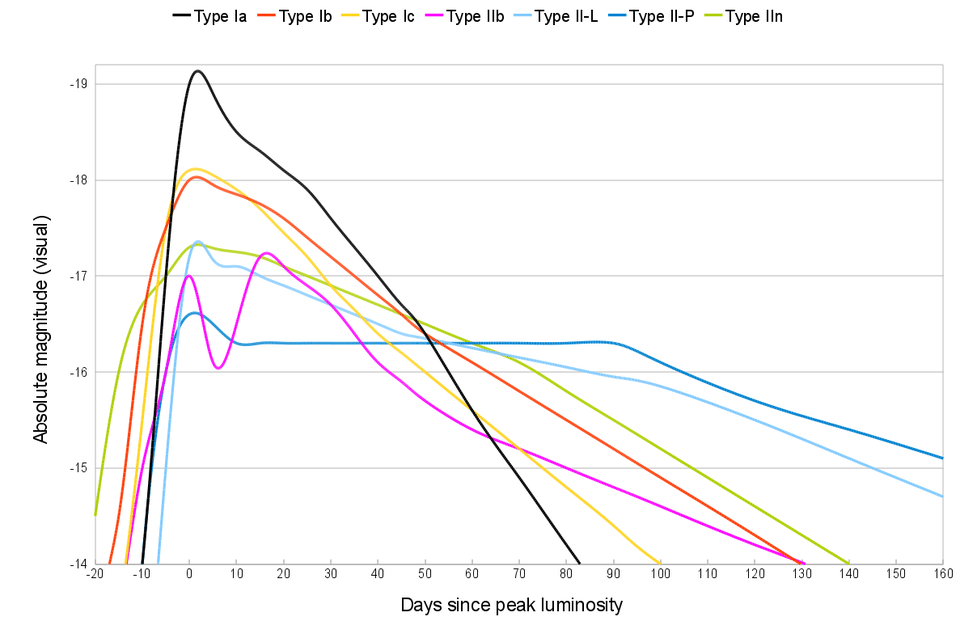

A Type Ia supernova occurs when a white dwarf star — the dense, Earth-sized remnant of a Sun-like star — accretes enough matter to reach a critical mass threshold and undergoes thermonuclear runaway, obliterating itself in an explosion that briefly outshines the entire galaxy hosting it. The critical observation, made definitively by Mark Phillips in 1993, is that the peak luminosity of a Type Ia supernova is tightly correlated with how quickly the supernova fades afterward.10 Events that peak at greater intrinsic brightness decline more slowly; fainter events fade more quickly. This empirical relationship, known as the Phillips relation, allows astronomers to standardize Type Ia supernovae — measuring the decline rate corrects for differences in peak luminosity, turning an intrinsically variable class of events into reliable standard candles.10, 25
Calibrating the intrinsic brightness of Type Ia supernovae requires first measuring the distances to nearby galaxies that have hosted them, primarily using Cepheids. Once this calibration is in place, supernovae can be observed at redshifts exceeding 1 — corresponding to distances of many billions of light-years — where the physics of the supernova explosion effectively carries its distance information encoded in apparent brightness. It was precisely this technique that, in 1998 and 1999, led two independent teams — the High-Z Supernova Search Team led by Brian Schmidt and Adam Riess, and the Supernova Cosmology Project led by Saul Perlmutter — to the stunning discovery that the expansion of the universe is accelerating.11, 12 This discovery, for which Perlmutter, Schmidt, and Riess shared the 2011 Nobel Prize in Physics, required a reliable distance ladder extending to billions of light-years.
Principal rungs of the cosmic distance ladder1, 7, 8, 17, 22
| Method | Applicable range | Key calibrator | Key limitation |
|---|---|---|---|
| Radar ranging | Within solar system (<50 AU) | Speed of light | Limited to solar system objects |
| Stellar parallax (Gaia) | Up to ~10 kiloparsecs | Radar-determined AU | Angular precision limit |
| Cepheid variables | ~0.05–40 megaparsecs | Gaia parallaxes | Crowding, dust, metallicity |
| Tip of red giant branch (TRGB) | ~1–20 megaparsecs | Gaia parallaxes (RR Lyrae) | Requires resolved stellar populations |
| Tully-Fisher relation | ~5–150 megaparsecs | Cepheids / TRGB | Galaxy inclination and morphology |
| Surface brightness fluctuations | ~1–100 megaparsecs | Cepheids / TRGB | Requires elliptical galaxies |
| Type Ia supernovae | ~10 megaparsecs to z > 1 | Cepheids / TRGB | Intrinsic scatter, dust |
| Baryon acoustic oscillations | ~150 megaparsecs to z ~ 2 | CMB angular scale | Requires large galaxy surveys |
| Hubble-Lemaître law (redshift) | z > 0.01 (cosmological) | H0 from calibrated ladder | Peculiar velocities at low z |
Secondary distance indicators
Several additional techniques occupy overlapping rungs of the ladder, providing either independent cross-checks or access to distance ranges where Cepheids and supernovae are difficult to apply.
The Tully-Fisher relation, introduced by R. Brent Tully and J. Richard Fisher in 1977, connects the rotational velocity of a spiral galaxy to its intrinsic luminosity.14 More massive galaxies rotate faster and emit more light; by measuring how fast a galaxy spins — typically from the Doppler broadening of its radio emission line profile — one can infer its true luminosity and thus its distance. The Tully-Fisher relation is calibrated using galaxies whose distances are known from Cepheids or the tip of the red giant branch, and it extends usefully to distances of roughly 150 megaparsecs.15 Its main limitation is that it applies only to rotating disk galaxies and is sensitive to how the galaxy is inclined relative to our line of sight.
Surface brightness fluctuations (SBF) exploit the granular texture of a galaxy's resolved stellar population as seen from a large distance. When a galaxy is close enough that individual stars are partially resolved, the image appears "grainy." As the galaxy recedes, this graininess smooths out in a predictable way because more stars are averaged within each image pixel. The amplitude of this fluctuation pattern scales with distance and, once calibrated using Cepheid distances to nearby galaxies, can serve as a distance indicator out to roughly 100 megaparsecs, with particular power for elliptical galaxies where Cepheids cannot be found.16, 26
The tip of the red giant branch (TRGB) has emerged as a particularly important alternative rung. When low-mass stars in old stellar populations reach the tip of the red giant branch phase of their evolution, they all ignite helium fusion at nearly the same core mass, producing a sharp and predictable maximum luminosity in the infrared. This luminosity threshold appears as a distinct break in the brightness distribution of a resolved galaxy's stellar population. The TRGB method is valuable partly because it is physically distinct from Cepheids — red giants are old, slow-evolving stars rather than young, massive pulsators — and partly because it is less sensitive to dust obscuration in certain wavelength bands. The Carnegie-Chicago Hubble Program used the TRGB independently of Cepheids to determine the Hubble constant, finding a value of 69.6 ± 1.9 km/s/Mpc, somewhat lower than the Cepheid-based SH0ES value.18, 23
Baryon acoustic oscillations: an independent ruler
All of the methods described above belong to what cosmologists call the "distance ladder" in the strict sense — a chain of calibrations rooted in local, geometric measurements. An entirely different approach, baryon acoustic oscillations (BAO), derives its standard ruler from the physics of the early universe rather than from local calibrations, and therefore provides a largely independent check on the ladder's upper rungs.
In the hot, dense plasma of the early universe, pressure waves — sound waves, essentially — propagated through the mix of photons and baryonic matter (protons and neutrons). When the universe cooled sufficiently about 380,000 years after the Big Bang for electrons to combine with protons and form neutral hydrogen, the sound waves froze in place. This left a preferred clustering scale of approximately 150 megaparsecs imprinted in the large-scale distribution of matter, visible today as a subtle excess in the probability of finding pairs of galaxies separated by that characteristic distance.17
Daniel Eisenstein and collaborators announced the first clear detection of this signal in 2005 using a sample of 46,748 luminous red galaxies from the Sloan Digital Sky Survey.17 Once the physical size of this "standard ruler" is determined from observations of the cosmic microwave background — which fixes the sound horizon with high precision through the Planck satellite's mapping of temperature fluctuations — BAO surveys of galaxies can measure the angular size of the ruler at different redshifts and thereby trace the expansion history of the universe with extraordinary statistical power. Because BAO is calibrated entirely by early-universe physics rather than by the local distance ladder, it provides an important cross-check on the Hubble constant measurement independent of any assumption about stellar distances.3, 17
The Hubble-Lemaître law and the expansion of the universe
At the uppermost rung of the ladder sits the Hubble-Lemaître law: the empirical relationship that a galaxy's recession velocity is proportional to its distance, described by the equation v = H0d, where H0 is the Hubble constant. Hubble published this relation in 1929, based on Cepheid distances and radial velocities for a sample of 24 galaxies.6 The theoretical basis for this relationship had been anticipated by the Belgian priest and mathematician Georges Lemaître, who in 1927 derived the linear distance-velocity relationship from general relativity and estimated a numerical value of the expansion rate from published astronomical data — a contribution formally acknowledged when the IAU renamed the law in 2018.
The Hubble constant encapsulates the current expansion rate of the universe and therefore encodes the universe's size and age. Because it connects all measured galaxy distances to a universal scale, every rung of the ladder below it ultimately influences the numerical value astronomers derive. A 3% error in the Cepheid period-luminosity zero-point propagates directly into a 3% error in H0. This sensitivity makes the precise determination of H0 both one of the most important and one of the most technically demanding problems in observational cosmology.22
The Hubble tension
The most consequential unresolved controversy in contemporary cosmology concerns a disagreement between two families of H0 measurements that has grown steadily more statistically significant over the past decade and is now widely referred to as the Hubble tension.
On one side of the tension sits the "late-universe" measurement, obtained by climbing the distance ladder from local geometric anchors to supernovae. The SH0ES project, led by Adam Riess, has refined this approach progressively and now reports H0 = 73.04 ± 1.04 km/s/Mpc, based on Cepheid distances to 37 supernova host galaxies calibrated against geometric anchors including Gaia parallaxes, the Large Magellanic Cloud distance from eclipsing binaries, and the geometric maser distance to NGC 4258.2
On the other side stands the "early-universe" measurement, derived from the Planck satellite's observations of the cosmic microwave background (CMB). By fitting the standard cosmological model (ΛCDM) to the detailed pattern of temperature fluctuations in the CMB, the Planck Collaboration obtains H0 = 67.4 ± 0.5 km/s/Mpc — a value more than five standard deviations below the SH0ES result.3 BAO measurements, which are also rooted in early-universe physics when combined with CMB data, are consistent with the lower Planck value.3, 17
A discrepancy at the five-sigma level is sufficiently large that random statistical fluctuation is an extremely unlikely explanation. The scientific community has examined whether the tension could reflect systematic errors in the distance ladder — for example, if Cepheid measurements are biased by blending with unresolved neighboring stars in crowded galaxy environments. This concern prompted the use of the James Webb Space Telescope (JWST), which has higher angular resolution than Hubble, to observe Cepheids in supernova host galaxies. The first JWST results, published in 2022 by Riess and collaborators, found no significant change in the Cepheid distances from those derived with Hubble, arguing against crowding bias as the resolution of the tension.21
Whether the tension is ultimately resolved by undetected systematic errors, by new physics beyond the standard cosmological model (such as early dark energy or a time-varying equation of state), or by some combination of both remains an open question as of 2026.22 The TRGB method, which uses a physically independent rung, yields values intermediate between the two extremes — Freedman's 2021 reanalysis gives 69.8 ± 1.7 km/s/Mpc — adding to rather than resolving the debate about where any systematic errors might originate.23
Hubble constant measurements from different methods2, 3, 18, 23
Error propagation and the importance of calibration
The distance ladder is only as reliable as its weakest rung. Uncertainties at each step propagate multiplicatively into all higher steps, a property that has driven decades of effort to reduce systematic errors at the foundational rungs. The historical uncertainty on the Hubble constant illustrates this starkly: in the 1970s and 1980s, estimates ranged from 50 to 100 km/s/Mpc — a factor of two — reflecting genuine disagreement about whether Cepheid calibrations, the intrinsic brightness of supernovae, or the peculiar velocities of nearby galaxies were responsible for the scatter. The primary science driver of the Hubble Space Telescope, when it was proposed in the 1970s, was explicitly to resolve this discrepancy by detecting Cepheids in galaxies beyond the Local Group with sufficient clarity to break the factor-of-two deadlock.9
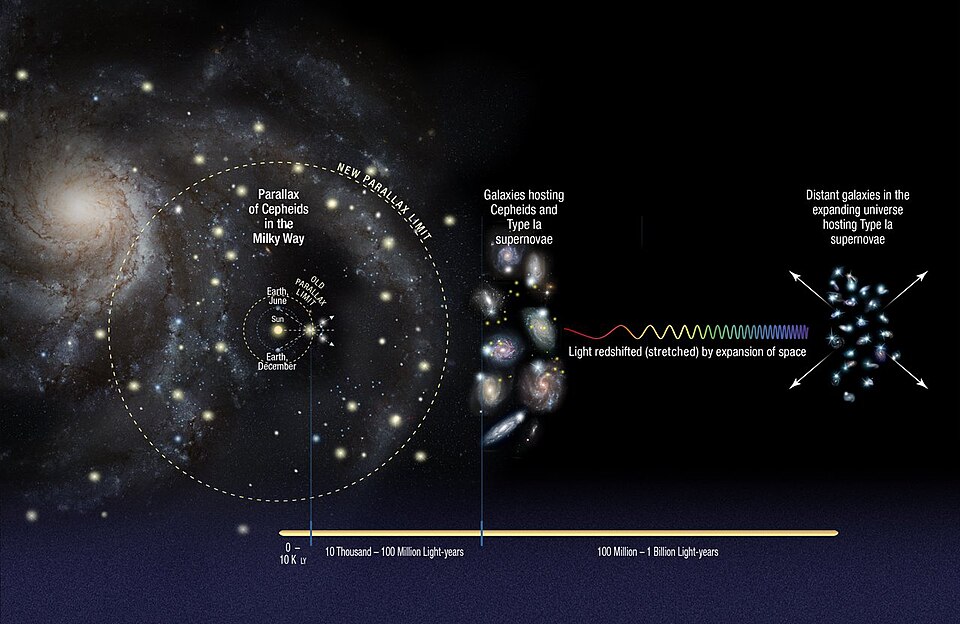

Systematic uncertainties in Cepheid distances arise from several physical effects. Dust between the observer and the Cepheid reddens and dims the star, mimicking greater distance unless multiband photometry is used to correct for the effect. The pulsation behavior of Cepheids also depends weakly on their metallicity — the abundance of elements heavier than helium — so Cepheids in metal-poor dwarf galaxies pulsate slightly differently than those in the metal-rich Milky Way used for calibration. Correcting for metallicity requires auxiliary measurements and introduces a source of debate that has persisted in the literature.13, 19
For Type Ia supernovae, the dominant sources of systematic uncertainty include the intrinsic color variation of the explosions (not all supernovae of the same luminosity have the same color), the possible evolution of the supernova population with cosmic time (whether supernovae at high redshift are physically identical to nearby ones), and sample selection effects that can bias measurements if fainter supernovae are systematically missed in surveys of distant galaxies.20, 25 The careful quantification of these effects has consumed much of the effort of large supernova survey collaborations over the past two decades.
The James Webb Space Telescope and the future of the ladder
The James Webb Space Telescope, operational since 2022, has opened a new chapter in distance ladder research. Its superior angular resolution at infrared wavelengths allows it to detect and measure Cepheids in galaxies previously out of Hubble's reach, while also resolving crowded stellar environments that may have introduced biases in Hubble-based Cepheid photometry. The first JWST-based Cepheid study, published by Riess and collaborators in 2022, observed Cepheids in the host galaxies of four Type Ia supernovae and found that the resulting Hubble constant was consistent with the Hubble Space Telescope value — reinforcing rather than undermining the high value of H0 from the local distance ladder.21
JWST is also expected to improve TRGB measurements by detecting the sharp luminosity cutoff in more distant and diverse galaxy samples, testing whether the intermediate values obtained by the Carnegie-Chicago Hubble Program persist with better photometry and a larger statistical base.18, 23 More broadly, planned surveys and missions across the coming decade — including the Vera C. Rubin Observatory's Legacy Survey of Space and Time, the Euclid satellite's weak-lensing and BAO survey, and Nancy Grace Roman Space Telescope supernova programs — will deliver dramatically larger samples at every rung. Whether this accumulating precision confirms the Hubble tension as a sign of genuinely new physics or reveals a systematic error that has eluded detection will be one of the defining scientific questions of observational cosmology in the late 2020s.
References
A comprehensive measurement of the local value of the Hubble constant with 1 km/s/Mpc uncertainty from the Hubble Space Telescope and the SH0ES team
Observational evidence from supernovae for an accelerating universe and a cosmological constant
A new calibration of Galactic Cepheid period-luminosity relations from B to K bands, and a comparison with LMC relations
Detection of the Baryon Acoustic Peak in the Large-Scale Correlation Function of SDSS Luminous Red Galaxies
The Carnegie-Chicago Hubble Program. VIII. An independent determination of the Hubble constant based on the tip of the red giant branch
Cosmic distances calibrated to 1% precision with Gaia EDR3 parallaxes and Hubble Space Telescope photometry of 75 Milky Way Cepheids
Observational constraints on the nature of dark energy: First cosmological results from the SDSS Supernova Survey
The Carnegie-Chicago Hubble Program. XI. The Hubble constant based on the tip of the red giant branch method
A high angular resolution survey of surface brightness fluctuations in early-type galaxies