Overview
- Cepheid variables are luminous pulsating giant and supergiant stars whose period of brightness variation is tightly correlated with their intrinsic luminosity — a relationship discovered by Henrietta Swan Leavitt in 1912 from observations of variable stars in the Small Magellanic Cloud, establishing one of the most important standard candles in observational astronomy.
- The pulsation is driven by the kappa mechanism, in which a subsurface layer of partially ionized helium acts as a heat valve, trapping radiation during compression and releasing it during expansion. Classical (Type I) Cepheids are young, metal-rich Population I stars found in galactic disks, while Type II Cepheids are older, metal-poor Population II stars found in globular clusters and galactic halos.
- Cepheids have been central to two of the greatest discoveries in modern cosmology — Edwin Hubble’s 1924 proof that galaxies are systems external to the Milky Way and the HST Key Project’s measurement of the Hubble constant — and remain at the heart of the ongoing Hubble tension, with JWST observations now testing whether systematic errors in Cepheid photometry can resolve the discrepancy.
Cepheid variables are luminous pulsating stars — typically yellow supergiants of spectral types F through K — that expand and contract in a remarkably regular rhythm, brightening as they swell and dimming as they shrink. Their significance to astronomy is difficult to overstate: the tight relationship between a Cepheid’s pulsation period and its intrinsic luminosity makes these stars among the most reliable distance indicators in the universe, forming a critical rung on the cosmic distance ladder. Since Henrietta Swan Leavitt’s discovery of the period–luminosity relation in 1912, Cepheids have anchored two of the most consequential measurements in the history of cosmology — the extragalactic distance scale and the expansion rate of the universe.1, 4
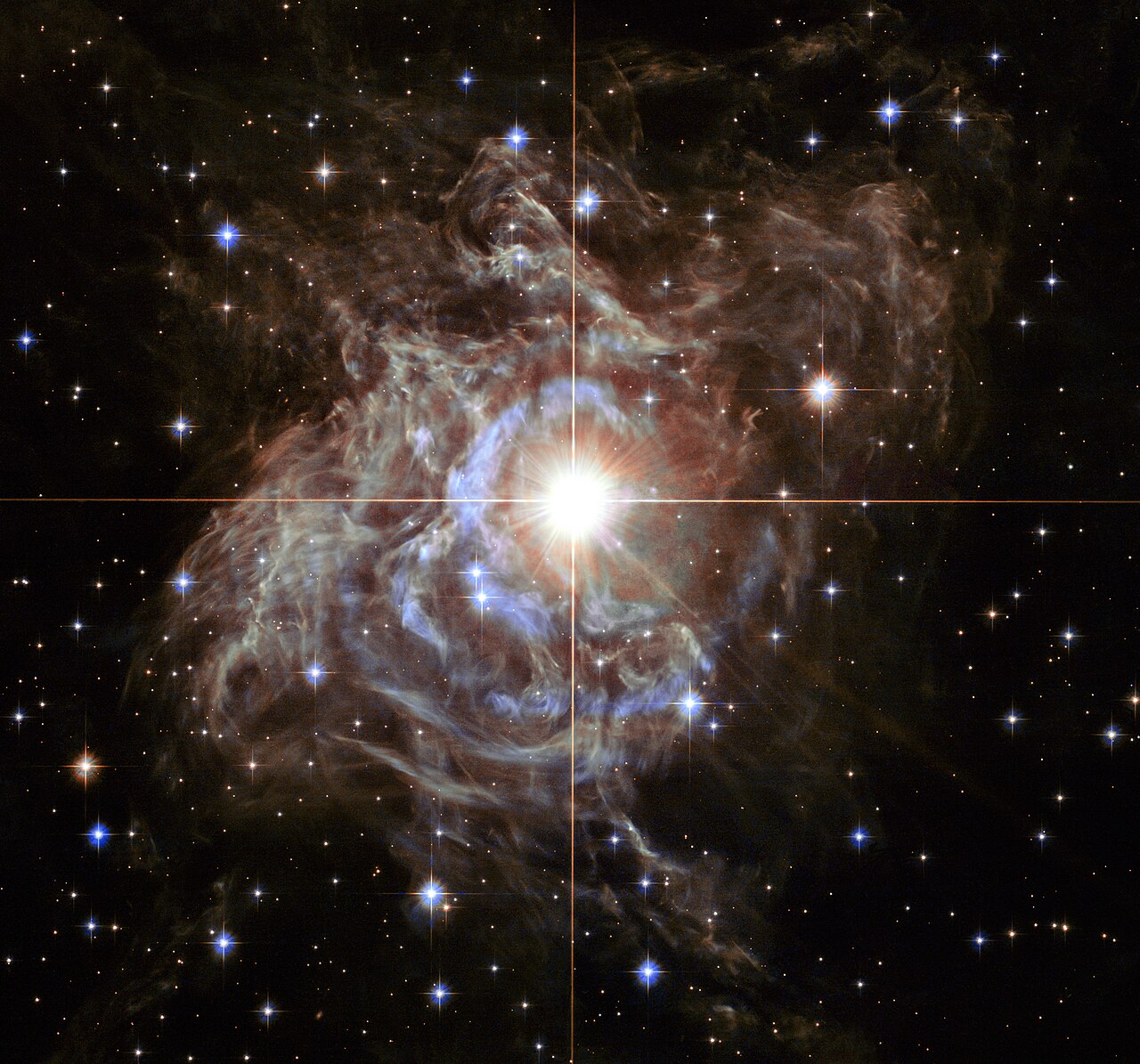

Leavitt’s discovery
In 1908, Henrietta Swan Leavitt, a “computer” at the Harvard College Observatory, published a catalogue of 1,777 variable stars she had identified on photographic plates of the Magellanic Clouds. Among these, she noted that the brighter variables tended to have longer periods of variation.9 Four years later, in a brief paper co-authored with Edward Pickering, Leavitt examined 25 Cepheid variables in the Small Magellanic Cloud and demonstrated that the relationship between period and apparent magnitude was remarkably linear when magnitude was plotted against the logarithm of the period. Because all the stars in the Small Magellanic Cloud are at approximately the same distance from Earth, their differences in apparent brightness directly reflected differences in intrinsic luminosity. Leavitt had discovered the period–luminosity relation — the foundational law that would make Cepheids the premier distance indicators in extragalactic astronomy.1
Leavitt herself recognized the implication: “Since the variables are probably at nearly the same distance from the Earth, their periods are apparently associated with their actual emission of light.” She noted that if the distance to any single Cepheid could be determined by an independent method, the period–luminosity relation would immediately yield distances to all other Cepheids — and to any stellar system containing them.1 The calibration problem she identified would occupy astronomers for the next century. Ejnar Hertzsprung and Harlow Shapley made the first attempts to anchor the zero point of the relation using statistical parallax methods, but early calibrations were hampered by interstellar extinction — the dimming of starlight by dust — and by the unrecognized distinction between different classes of Cepheids.4, 6
Physics of pulsation: the kappa mechanism
The physical mechanism driving Cepheid pulsation was not understood until the mid-twentieth century, when Arthur Eddington proposed that the stars act as heat engines and S. A. Zhevakin identified the critical role of helium ionization. The accepted explanation is the kappa mechanism, named after the opacity coefficient (κ) of stellar material. In a normal star, compression heats the gas and makes it more transparent (lower opacity), allowing radiation to escape and damping any oscillation. In a Cepheid, however, a subsurface zone of partially ionized helium (He II to He III) behaves differently: when compressed, the ionization fraction increases, the opacity rises rather than falls, and the layer traps radiation. The accumulated radiation pressure drives the envelope outward, the helium recombines, opacity drops, radiation escapes, and the envelope falls back — completing one pulsation cycle.7, 14
This mechanism operates only within a specific range of surface temperatures, defining a nearly vertical band across the Hertzsprung–Russell diagram known as the instability strip. Stars crossing this strip during post-main-sequence evolution become Cepheids. The strip spans roughly 5,000 to 7,500 K in effective temperature, and its location determines which stars pulsate: too hot, and helium is fully ionized throughout the envelope, eliminating the opacity valve; too cool, and convection transports energy so efficiently that the kappa mechanism cannot build up sufficient pressure.14, 5 The period of pulsation is governed primarily by the star’s mean density — the pulsation theorem states that the period times the square root of mean density is approximately constant. More luminous Cepheids are physically larger and less dense, so they pulsate with longer periods, which is the underlying physical basis for Leavitt’s empirical law.7
Classical Cepheids and Type II Cepheids
The term “Cepheid variable” encompasses two distinct populations with different period–luminosity relations, a distinction that was not clearly understood until Walter Baade’s work in the 1950s. Classical Cepheids (also called Type I Cepheids or δ Cephei stars) are young, massive, metal-rich Population I stars found in the disks and spiral arms of galaxies. They have masses between roughly 3 and 13 solar masses, luminosities of 103 to 105 solar luminosities, and periods ranging from about 1 to over 100 days. These are the stars that define the standard period–luminosity relation used for extragalactic distance measurement.5, 6
Type II Cepheids (also called Population II Cepheids, including the subtypes BL Herculis, W Virginis, and RV Tauri stars) are older, lower-mass, metal-poor stars found in globular clusters, the galactic halo, and the galactic bulge. At a given period, Type II Cepheids are approximately 1.5 magnitudes fainter than classical Cepheids. Before Baade recognized in 1952 that these two populations followed different period–luminosity relations, astronomers had been systematically underestimating extragalactic distances by conflating the two classes. Baade’s revision immediately doubled the estimated distances to external galaxies, resolving a long-standing paradox in which some galaxies had appeared to be older than the universe itself.4, 6
The metallicity dependence of the period–luminosity relation remains an active area of research. Because the opacity that drives the kappa mechanism depends on the metal content of the stellar envelope, Cepheids in metal-poor galaxies may follow a slightly different relation than those in metal-rich environments. This effect, typically estimated at a few hundredths of a magnitude per dex of metallicity, is one of the systematic uncertainties that propagates through the distance ladder and contributes to current debates about the value of the Hubble constant.4, 13
Hubble and the realm of the nebulae
The most dramatic early application of the period–luminosity relation came in 1924, when Edwin Hubble identified Cepheid variable stars in the Andromeda Nebula (M31) using the 100-inch Hooker telescope at Mount Wilson Observatory. By measuring their periods and applying Leavitt’s relation, Hubble calculated a distance to Andromeda of approximately 900,000 light-years — far beyond the estimated diameter of the Milky Way. This single measurement resolved the “Great Debate” between Harlow Shapley and Heber Curtis over whether the spiral nebulae were structures within our galaxy or independent “island universes.” The nebulae were galaxies in their own right, and the universe was vastly larger than previously imagined.8
Hubble went on to measure Cepheid distances to several nearby galaxies and, combined with Vesto Slipher’s redshift measurements, published his 1929 paper establishing a linear relationship between a galaxy’s distance and its recession velocity — Hubble’s law. The original value of the Hubble constant, approximately 500 km/s/Mpc, was far too high, primarily because Hubble’s Cepheid calibration did not account for the Type I/Type II distinction or for interstellar extinction. Nevertheless, the discovery that the universe is expanding remains one of the most consequential findings in the history of science, and it rested entirely on the Cepheid distance scale.18, 4
The HST Key Project and modern calibration
Establishing a precise value for the Hubble constant was one of the primary scientific justifications for the Hubble Space Telescope. The HST Key Project, led by Wendy Freedman, Jeremy Mould, and Robert Kennicutt, used HST to observe Cepheid variables in 31 galaxies out to distances of about 25 megaparsecs. By calibrating the Cepheid period–luminosity relation with improved Galactic parallaxes and Large Magellanic Cloud distances, and by using the Cepheid distances to calibrate secondary indicators — Type Ia supernovae, the Tully–Fisher relation, surface brightness fluctuations, and Type II supernovae — the project published its final result in 2001: H0 = 72 ± 8 km/s/Mpc.2
The Key Project represented a major advance in precision, but it also highlighted the challenges inherent in Cepheid photometry. In crowded stellar fields, the light of a Cepheid blends with unresolved background stars, systematically biasing the measured brightness and hence the inferred distance. HST’s resolution mitigated this problem compared to ground-based telescopes, but did not eliminate it. Additionally, the Key Project relied on a distance to the Large Magellanic Cloud as its geometric anchor — a value that itself carried uncertainties from multiple methods including eclipsing binaries, red clump stars, and RR Lyrae variables.2, 4
The SH0ES (Supernova H0 for the Equation of State) program, led by Adam Riess, built on the Key Project framework but introduced several methodological refinements. SH0ES used near-infrared observations to reduce sensitivity to dust extinction and metallicity, anchored the Cepheid scale using multiple geometric calibrations (Milky Way parallaxes from Gaia, masers in NGC 4258, and detached eclipsing binaries in the Large Magellanic Cloud), and restricted the analysis to Type Ia supernovae in galaxies where Cepheids had been directly observed. By 2022, SH0ES reported H0 = 73.04 ± 1.04 km/s/Mpc, a measurement with 1.4% precision — the most precise local determination of the Hubble constant to date.3, 11
JWST and the Hubble tension
The SH0ES value of H0 stands in significant tension with the value inferred from observations of the cosmic microwave background by the Planck satellite. Planck’s measurement, which assumes the standard ΛCDM cosmological model and extrapolates the expansion rate from the early universe to the present day, yields H0 = 67.4 ± 0.5 km/s/Mpc — a discrepancy of roughly 5σ from the SH0ES result. This disagreement, known as the Hubble tension, is one of the most pressing open problems in cosmology. If the discrepancy is real and not the result of systematic error, it may indicate new physics beyond the standard cosmological model.12, 15
One hypothesis for resolving the tension targets the Cepheid rung of the distance ladder. If crowding effects in HST Cepheid photometry systematically bias distances to supernova host galaxies, the local H0 measurement could be artificially high. The James Webb Space Telescope, with its superior infrared sensitivity and angular resolution, was deployed to test this possibility. In 2022, Riess and collaborators published JWST observations of Cepheids in the host galaxies of four Type Ia supernovae. The JWST photometry confirmed the HST measurements, showing that crowding corrections in the HST analysis had been handled accurately and that the Cepheid-based distance scale was not significantly biased by blending effects. The Hubble tension persisted.10
An alternative approach to the local distance ladder bypasses Cepheids entirely. Wendy Freedman and collaborators have used the tip of the red giant branch (TRGB) method — which measures distances by identifying the brightest red giant stars in a galaxy’s halo, a region less affected by crowding — and have reported intermediate values of H0 that fall closer to the Planck result. Whether the TRGB and Cepheid scales can be fully reconciled, or whether they reflect genuine systematic differences, remains a subject of active investigation.16 Meanwhile, Gaia’s ever-improving parallax measurements for Milky Way Cepheids continue to sharpen the geometric anchor at the base of the ladder, reducing the uncertainty in the zero point of the period–luminosity relation to below 1%.17, 11
After more than a century of service as astronomy’s most important standard candle, Cepheid variables remain at the center of cosmological measurement — and cosmological controversy. The precision of modern Cepheid observations has improved by orders of magnitude since Leavitt’s original photographic plates, but the fundamental insight remains unchanged: the regular heartbeat of a pulsating star, once calibrated, can reveal the distance to the farthest reaches of the observable universe.4, 5
References
Final results from the Hubble Space Telescope Key Project to measure the Hubble constant
A comprehensive measurement of the local value of the Hubble constant with 1 km/s/Mpc uncertainty from the Hubble Space Telescope and the SH0ES team
Cosmic distances calibrated to 1% precision with Gaia EDR3 parallaxes and Hubble Space Telescope photometry of 75 Milky Way Cepheids
The Carnegie-Chicago Hubble Program. VIII. An independent determination of the Hubble constant based on the tip of the red giant branch