Overview
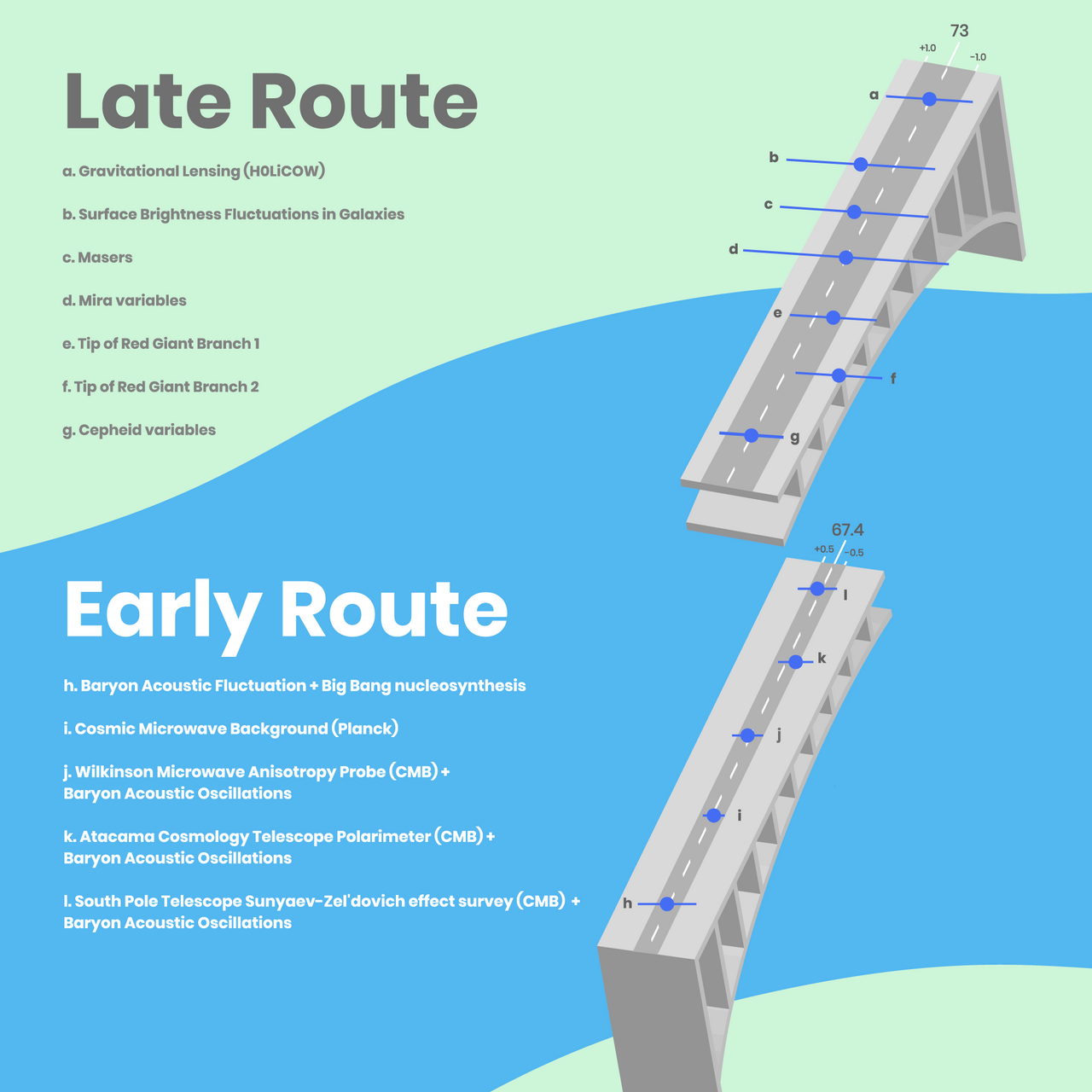
- The Hubble constant H₀ describes how fast the universe is expanding today. Two independent measurement approaches yield values that disagree by roughly 8 percent: the Planck satellite infers 67.4 km/s/Mpc from the early universe, while the SH0ES team measures 73.0 km/s/Mpc using Cepheid-calibrated Type Ia supernovae in the local universe.
- The discrepancy has reached a statistical significance of approximately 5 sigma—far beyond the threshold for a serious anomaly—and has been confirmed by JWST observations that ruled out crowding errors in Cepheid photometry as the source of the problem, leaving the origin of the disagreement genuinely unexplained.
- If the tension is real and not caused by unrecognized systematic errors, it implies that the standard cosmological model Lambda-CDM is incomplete, and that some form of new physics—possibly operating in the early universe or modifying the behavior of dark matter or dark energy—is required to reconcile the two measurements.
The universe is expanding. That much has been established since the late 1920s, when Edwin Hubble compiled observations showing that distant galaxies recede from us at velocities proportional to their distance—the relationship now encoded in Hubble's law.1 The proportionality constant in that relationship is the Hubble constant, written H₀, and it tells us the current rate at which the universe is expanding: for every megaparsec of distance between two points in space, those points are moving apart at H₀ kilometres per second. Measuring that number accurately has been one of the central goals of observational cosmology for nearly a century.
.png)
In the past decade, that goal has produced one of the deepest puzzles in modern physics. Two independent families of measurement—one anchored in the early universe and one rooted in the local, late-time universe—yield values of H₀ that disagree by roughly 8 percent. The discrepancy is not a rounding error or a minor calibration dispute. As of 2022 it stands at approximately 5 sigma, the conventional threshold above which physicists conclude that an anomaly is almost certainly real rather than a statistical fluctuation.3 The disagreement has been cross-checked, independently confirmed, and scrutinized for instrumental and methodological errors with unusual thoroughness. It refuses to go away. Cosmologists call it the Hubble tension, and if it is genuine it implies that the standard cosmological model is missing something fundamental.
What the Hubble constant means
Hubble's law states that a galaxy at distance d recedes from us at a velocity v = H₀ × d. The constant H₀ is conventionally expressed in units of kilometres per second per megaparsec (km/s/Mpc), where one megaparsec equals about 3.26 million light-years. A value of 70 km/s/Mpc, for instance, means that a galaxy 1 megaparsec away is receding at 70 km/s; a galaxy 10 megaparsecs away at 700 km/s; and so on. The subscript zero denotes the present-day value, distinguishing it from the Hubble parameter H(t), which varies over time as the expansion rate evolves.1
H₀ is not merely a curiosity. It sets the age and size of the observable universe: roughly speaking, the age of a flat, matter-dominated universe is proportional to 1/H₀, so a higher Hubble constant implies a younger universe. It governs the distance scale that underpins virtually all of extragalactic astronomy. And in the context of the standard cosmological model, Lambda-CDM, it is one of six fundamental parameters whose values are simultaneously constrained by observations of the cosmic microwave background, the large-scale distribution of galaxies, and the expansion history of the universe.2
The early-universe measurement
The most precise early-universe measurement of H₀ comes from the Planck satellite, which mapped the temperature and polarisation anisotropies of the cosmic microwave background (CMB) with extraordinary precision. The CMB is light released when the universe was approximately 380,000 years old and had cooled enough for protons and electrons to combine into neutral hydrogen. Tiny fluctuations in its temperature—at the level of one part in 100,000—encode detailed information about the physical conditions of the early universe.2
The angular scale and relative amplitudes of these fluctuations depend sensitively on the values of the cosmological parameters, including H₀. By fitting the observed CMB power spectrum to the Lambda-CDM model, the Planck Collaboration derived a Hubble constant of 67.4 ± 0.5 km/s/Mpc.2 This is not a direct measurement of today's expansion rate but an inference: assuming that Lambda-CDM correctly describes how the universe evolved from recombination to the present, the parameters that best fit the CMB data imply a specific present-day expansion rate. The precision is remarkable—better than 1 percent—but it is completely contingent on the validity of the assumed model.
Baryon acoustic oscillations (BAO) provide a complementary early-universe probe. The same acoustic waves that imprinted structure on the CMB also left a characteristic scale—roughly 150 megaparsecs—in the clustering of galaxies. By measuring this scale at different redshifts, surveys like the Sloan Digital Sky Survey can infer the expansion history and, anchored by the sound horizon scale from the CMB, derive H₀. BAO measurements are consistent with the Planck value and similarly favour the lower end of the range.9, 15
The late-universe measurement
The late-universe approach measures H₀ directly, without assuming any cosmological model, by constructing a cosmic distance ladder. The ladder works by calibrating increasingly distant standard candles against one another, beginning with geometric distance measurements in the solar neighbourhood and extending outward to cosmological distances where the recession velocities of galaxies are large enough that H₀ can be extracted cleanly from Hubble's law.
The most influential late-universe programme is the SH0ES project (Supernovae H₀ for the Equation of State of Dark Energy), led by Adam Riess and colleagues. SH0ES uses Cepheid variable stars—pulsating giant stars whose period of variability correlates tightly with their intrinsic luminosity, a relationship discovered by Henrietta Swan Leavitt in 1912—to calibrate the peak luminosities of Type Ia supernovae. Cepheids are measured in galaxies that have also hosted Type Ia supernovae, establishing an absolute luminosity scale for the supernovae. Those calibrated supernovae are then used at much greater distances, where galaxy recession velocities are dominated by cosmic expansion rather than local gravitational motions, to measure H₀ directly.4
The 2022 SH0ES analysis, incorporating 42 Cepheid-calibrated supernova host galaxies and over 700 Type Ia supernovae at cosmological distances, yielded H₀ = 73.04 ± 1.04 km/s/Mpc.3 This represents a measurement uncertainty of approximately 1.4 percent—comparable in precision to the Planck determination, and 5 sigma higher.
Statistical significance and independent probes
A discrepancy of 5 sigma in particle physics is the threshold for claiming a discovery. In cosmology it means that the probability of the tension arising by chance from statistical fluctuations alone—assuming both measurements are free of systematic error—is less than one in a million. This level of significance is not achieved by a single comparison: the 5-sigma figure emerges from the 2022 SH0ES result compared against Planck, and is robust to the specific statistical treatment used.3
What makes the tension particularly compelling is the range of independent measurements that corroborate one or both sides. On the late-universe side, strong gravitational lensing time delays provide an entirely independent method. When a massive galaxy lies between Earth and a distant quasar, the gravitational field of the intervening mass creates multiple images of the quasar. Because the light paths to each image differ in length and pass through different gravitational potentials, any variability in the quasar appears in different images at different times. These time delays depend on the geometry of the universe and on H₀. The H0LiCOW programme analysed six multiply-imaged quasar systems and obtained H₀ = 73.3 +1.7−1.8 km/s/Mpc—a 2.4-percent measurement in good agreement with SH0ES and independently 5.3 sigma in tension with Planck.7 Subsequent TDCOSMO analyses with more conservative assumptions on the mass profile of the lensing galaxies have widened the uncertainty considerably, reducing the tension with the CMB but not eliminating it.17
Gravitational wave standard sirens offer a third, completely model-independent route. In 2017, the LIGO and Virgo detectors observed gravitational waves from a binary neutron star merger, GW170817, accompanied by a short gamma-ray burst and a wealth of electromagnetic follow-up. The gravitational wave signal encodes the luminosity distance to the merger directly, without any calibration chain, and the optical identification of the host galaxy NGC 4993 provided the recession velocity. The resulting measurement—H₀ = 70 +12−8 km/s/Mpc—is consistent with both the CMB and SH0ES values given its large uncertainty, but future events from LIGO's expanding catalogue are expected to reduce that uncertainty toward the few-percent level where the tension can be probed independently.8, 16
The Tip of the Red Giant Branch (TRGB) method provides a separate late-universe rung that does not rely on Cepheids. Old low-mass stars undergo a helium flash at a predictable luminosity when they reach the tip of the red giant branch, providing a standard candle that can be used to calibrate supernovae through a different stellar population. Results from TRGB have been a source of ongoing debate: the Carnegie-Chicago Hubble Program (CCHP) led by Wendy Freedman obtained values near 69–70 km/s/Mpc, intermediate between the Planck and SH0ES values and in tension with neither.6, 13 The difference between TRGB and SH0ES results has been attributed to different choices of calibration anchors and photometric zero-points, and the TRGB community remains divided on whether their method favours the high or intermediate value.
The JWST recalibration
One of the most persistent concerns about the SH0ES measurement was the possibility of photometric crowding. Cepheids in distant galaxies are observed against dense stellar backgrounds, and if nearby unresolved stars contaminate the Cepheid photometry, their apparent brightness would be biased—potentially inflating the inferred distance and pulling H₀ upward. This was a plausible systematic because the Hubble Space Telescope, which SH0ES relied upon, operates in the optical and near-infrared with a point spread function wide enough that blending of nearby stars could in principle go undetected.3
The James Webb Space Telescope, with its larger mirror and superior infrared sensitivity, can resolve stellar populations in Cepheid host galaxies with far greater clarity than Hubble. In 2023 and 2024, Riess and the SH0ES team used JWST to re-observe Cepheids in five of the supernova host galaxies central to their calibration. The results were unambiguous: the JWST photometry agreed with the HST measurements to within the measurement uncertainties, and the analysis rejected crowding as an explanation for the Hubble tension at 8 sigma confidence.12 The JWST observations did not change the inferred value of H₀; they eliminated one of the most plausible remaining sources of systematic error in the late-universe measurement. The Freedman CCHP team also used JWST and derived TRGB and Cepheid distances that continue to yield intermediate values, with their 2024 analysis returning H₀ = 69.96 ± 1.05 (statistical) ± 1.74 (systematic) km/s/Mpc—still in tension with neither extreme but consistent with the TRGB results being genuinely lower than SH0ES Cepheids.13
Possible resolutions
The Hubble tension has attracted an enormous volume of proposed solutions, which fall into three broad categories: unrecognized systematic errors in one or both measurement chains, modifications to the late-universe expansion history, and modifications to the early-universe physics. A comprehensive review published in 2021 catalogued more than 200 proposed solutions in the literature.5
Systematic errors remain on the table despite extensive scrutiny. The JWST results have substantially constrained crowding as a source of error in Cepheid photometry, but other potential systematics—the metallicity dependence of the Cepheid period-luminosity relation, the absolute calibration of the distance scale via geometric methods, and the treatment of dust extinction—have not been fully exhausted. On the CMB side, the Planck analysis involves choices about foreground modelling and likelihood approximations that could in principle introduce small biases. However, given that multiple independent methods on both sides roughly agree with their respective anchor values, a single unrecognized systematic large enough to account for the full 5-sigma tension would need to affect multiple separate measurement chains in a consistent direction—a coincidence that is increasingly difficult to sustain.5
Among new-physics proposals, early dark energy (EDE) is the most studied. In the standard Lambda-CDM model, the universe before recombination is dominated by radiation and matter. EDE models add a component that contributes a significant fraction of the energy density of the universe for a brief period just before recombination, then dilutes away rapidly. This would reduce the size of the sound horizon at recombination—the characteristic scale imprinted in both the CMB and the BAO pattern—which in turn would require a higher H₀ to match the observed angular scale of CMB fluctuations. EDE models can therefore shift the inferred CMB value of H₀ upward toward the SH0ES measurement.10 The difficulty is that EDE models typically worsen the fit to other cosmological observables, particularly the amplitude of matter fluctuations (described by the parameter S₈), and CMB data place tight constraints on the allowed energy fraction of any such component.18
Modifications to dark matter are another avenue. Interacting dark matter models, in which dark matter couples to dark radiation rather than being perfectly cold and collisionless, can alter the damping scale in the CMB and shift the inferred cosmological parameters.11 Decaying dark matter, self-interacting dark matter, and dark matter that transitions between states around the epoch of matter-radiation equality have all been proposed. None has yet achieved a fully satisfactory resolution without introducing new tensions elsewhere in the cosmological parameter space.
Modified gravity theories, additional neutrino species with non-standard interactions, and a time-varying equation of state for dark energy have all been explored. The large-scale structure constraints from galaxy surveys, summarised by the full-shape power spectrum analysis, independently confirm that late-universe data favour values of H₀ and S₈ that are jointly difficult to reconcile with a single coherent model that also fits the CMB perfectly.14 This suggests the tension is not simply a Hubble constant problem but may reflect a broader inconsistency in Lambda-CDM across different epochs and probes.
Current state of the debate
As of early 2026, the Hubble tension remains unresolved. The SH0ES measurement has survived its most serious systematic challenge—Cepheid crowding—and the Planck CMB result is among the most thoroughly cross-checked datasets in cosmology. The tension between them at approximately 5 sigma is accepted across the community as a genuine and serious anomaly, even if its origin is disputed.
The intermediate TRGB results from the CCHP programme introduce a complication: if the TRGB-based distance scale is correct, then either the SH0ES Cepheid calibration carries a residual systematic, or the TRGB method itself has an error, or the true H₀ lies somewhere between the two late-universe results and the tension with Planck is modestly reduced. The 2024 CCHP JWST analysis does not resolve this ambiguity; it refines the TRGB value without converging on the SH0ES number.13
The coming decade will bring substantially more data. DESI (the Dark Energy Spectroscopic Instrument) is accumulating the largest spectroscopic galaxy survey ever assembled, providing BAO measurements of unprecedented precision across a wide range of redshifts. The Vera C. Rubin Observatory will eventually deliver photometric distances to millions of Type Ia supernovae. The growing LIGO-Virgo-KAGRA catalogue of binary neutron star mergers will progressively sharpen the gravitational wave standard siren measurement toward the few-percent precision needed to independently adjudicate the tension. The Euclid satellite will constrain weak gravitational lensing and the matter power spectrum to new levels of accuracy.
Whether these datasets will resolve the tension by revealing a systematic error, or will deepen it by confirming new physics, is one of the defining open questions of contemporary cosmology. The Hubble tension is not merely a disagreement between two numbers. It is a direct test of whether the standard cosmological model—built on general relativity, cold dark matter, and a cosmological constant—is the complete account of cosmic history that it has long appeared to be. If the discrepancy survives scrutiny, it will demand a revision of that account at a fundamental level.
References
- Hubble, E. P. "A relation between distance and radial velocity among extra-galactic nebulae." Proceedings of the National Academy of Sciences 15: 168–173, 1929.
- Aghanim, N. et al. (Planck Collaboration). "Planck 2018 results. VI. Cosmological parameters." Astronomy & Astrophysics 641: A6, 2020.
- Riess, A. G. et al. "A comprehensive measurement of the local value of the Hubble constant with 1 km/s/Mpc uncertainty from the Hubble Space Telescope and the SH0ES team." The Astrophysical Journal Letters 934: L7, 2022.
- Riess, A. G. et al. "A 2.4% determination of the local value of the Hubble constant." The Astrophysical Journal 826: 56, 2016.
- Di Valentino, E. et al. "In the realm of the Hubble tension—a review of solutions." Classical and Quantum Gravity 38: 153001, 2021.
- Freedman, W. L. et al. "Tip of the red giant branch distances. II. Zero-point calibration." The Astrophysical Journal 891: 57, 2020.
- Wong, K. C. et al. "H0LiCOW—XIII. A 2.4 per cent measurement of H₀ from lensed quasars: 5.3σ tension between early- and late-universe probes." Monthly Notices of the Royal Astronomical Society 498: 1420–1439, 2020.
- Abbott, B. P. et al. (LIGO Scientific Collaboration and Virgo Collaboration). "A gravitational-wave standard siren measurement of the Hubble constant." Nature 551: 85–88, 2017.
- Percival, W. J. et al. "Baryon acoustic oscillations in the Sloan Digital Sky Survey Data Release 7 galaxy sample." Monthly Notices of the Royal Astronomical Society 401: 2148–2168, 2010.
- Poulin, V. et al. "Early dark energy can resolve the Hubble tension." Physical Review Letters 122: 221301, 2019.
- Kumar, S. & Nunes, R. C. "Can interacting dark energy solve the H₀ tension?" Physical Review D 94: 123511, 2016.
- Riess, A. G. et al. "JWST observations reject unrecognized crowding of Cepheid photometry as an explanation for the Hubble tension at 8σ confidence." The Astrophysical Journal Letters 962: L17, 2024.
- Freedman, W. L. et al. "Status report on the Chicago-Carnegie Hubble Program (CCHP): measurement of the Hubble constant using the Hubble and James Webb Space Telescopes." arXiv preprint 2408.06153, 2024.
- Philcox, O. H. E. & Ivanov, M. M. "The Hubble tension in light of the full-shape analysis of large-scale structure data." Physical Review D 105: 043517, 2022.
- Aubourg, E. et al. "Cosmological implications of baryon acoustic oscillation measurements." Physical Review D 92: 123516, 2015.
- Schutz, B. F. "Measuring the Hubble constant with gravitational wave observations." Nature 323: 310–311, 1986.
- Birrer, S. et al. (TDCOSMO). "The Hubble constant from eight time-delay galaxy lenses." Astronomy & Astrophysics 643: A165, 2020.
- Hill, J. C. et al. "Cosmological perturbations and short-lived early dark energy." Physical Review D 102: 043507, 2020.
References
A comprehensive measurement of the local value of the Hubble constant with 1 km/s/Mpc uncertainty from the Hubble Space Telescope and the SH0ES team
H0LiCOW—XIII. A 2.4 per cent measurement of H₀ from lensed quasars: 5.3σ tension between early- and late-universe probes
Baryon acoustic oscillations in the Sloan Digital Sky Survey Data Release 7 galaxy sample
JWST observations reject unrecognized crowding of Cepheid photometry as an explanation for the Hubble tension at 8σ confidence
Status report on the Chicago-Carnegie Hubble Program (CCHP): measurement of the Hubble constant using the Hubble and James Webb Space Telescopes