Overview
- Globular clusters are ancient, gravitationally bound spherical collections of hundreds of thousands to millions of stars that orbit galaxies as satellite systems, with the Milky Way hosting approximately 150 such clusters ranging in age from about 10 to 13 billion years.
- Once considered the simplest stellar populations in nature, globular clusters have been revealed by Hubble Space Telescope photometry to harbor multiple stellar populations with distinct chemical abundance patterns, a discovery that has overturned decades of theoretical assumptions about their formation.
- Globular clusters serve as critical tools in astrophysics: their main-sequence turnoff ages provide independent lower limits on the age of the universe, their RR Lyrae variable stars calibrate the cosmic distance ladder, and their orbital kinematics trace the dark matter distribution of their host galaxies.
Globular clusters are among the oldest and most visually striking objects in the universe. Each is a dense, roughly spherical collection of hundreds of thousands to millions of stars, bound together by mutual gravity and orbiting a host galaxy as a self-contained satellite system. The Milky Way possesses approximately 150 known globular clusters, distributed in a roughly spherical halo around the galactic center, while giant elliptical galaxies may host tens of thousands.1, 12 Because globular clusters formed early in cosmic history, with the oldest dating to within a billion years of the Big Bang, they serve as fossil records of the conditions that prevailed during the earliest epochs of galaxy assembly. Their ages, chemical compositions, and orbital properties collectively encode information about star formation, nucleosynthesis, and the gravitational architecture of galaxies that no other class of object provides as directly.
The study of globular clusters has undergone a profound transformation since the early 2000s. For most of the twentieth century, each cluster was regarded as a simple stellar population — a single generation of stars, all born at the same time from a chemically homogeneous cloud. This elegant simplicity made globular clusters ideal test beds for models of stellar evolution. The discovery, primarily through Hubble Space Telescope photometry, that virtually every well-studied globular cluster in fact harbors multiple stellar populations with distinct chemical abundance patterns has overturned this paradigm and remains one of the most active areas of research in stellar astrophysics.4, 6
Discovery and early observations
The first globular cluster to be identified, though not recognized as such at the time, was likely the object now catalogued as M22, reported by the German astronomer Abraham Ihle in 1665 as a hazy patch in the constellation Sagittarius. The celebrated Great Cluster in Hercules, M13, was noted by Edmond Halley in 1714, and Charles Messier added it to his catalogue of nebulous objects in 1764, describing it as a round nebula containing no stars.1 The inability of early telescopes to resolve these objects into individual stars left their nature uncertain for over a century.
The crucial advance came with William Herschel, who used his progressively larger reflecting telescopes to resolve globular clusters into their constituent stars for the first time. In his 1789 catalogue of nebulae and star clusters, Herschel coined the term globular cluster to describe these dense, round concentrations of resolved stars, distinguishing them from the irregular, unresolved nebulae that he could not separate into individual points of light.1 By the end of his survey programme, Herschel had catalogued 36 globular clusters and demonstrated that their characteristic spherical morphology was not an artefact of limited resolution but a genuine physical property.
The astronomical significance of globular clusters reached a new level in 1918, when Harlow Shapley used the distribution of globular clusters in the sky to determine the position of the Sun within the Milky Way. Shapley observed that the globular cluster system is concentrated toward the constellation Sagittarius and reasoned that the clusters orbit the galactic center in a roughly spherical distribution. By estimating their distances using the period-luminosity relation of the RR Lyrae and Cepheid variable stars they contain, Shapley concluded that the Sun lies far from the center of the galaxy — approximately 15 kiloparsecs away in his original estimate, later revised downward to roughly 8 kiloparsecs.1, 11 This work fundamentally reshaped astronomers' understanding of the scale and structure of the Milky Way.
Observational properties and structure
Globular clusters are immediately distinguishable from other stellar systems by their characteristic spherical symmetry and extreme central stellar density. A typical Milky Way globular cluster contains between 104 and 106 stars within a roughly spherical volume with a half-light radius — the radius enclosing half of the cluster's total luminosity — of only 2 to 5 parsecs, though some clusters are considerably more compact and others more extended.1, 7 At the centers of the densest clusters, stellar densities can exceed 104 stars per cubic parsec, tens of thousands of times higher than the density in the solar neighbourhood, where the nearest star to the Sun lies more than a parsec away.
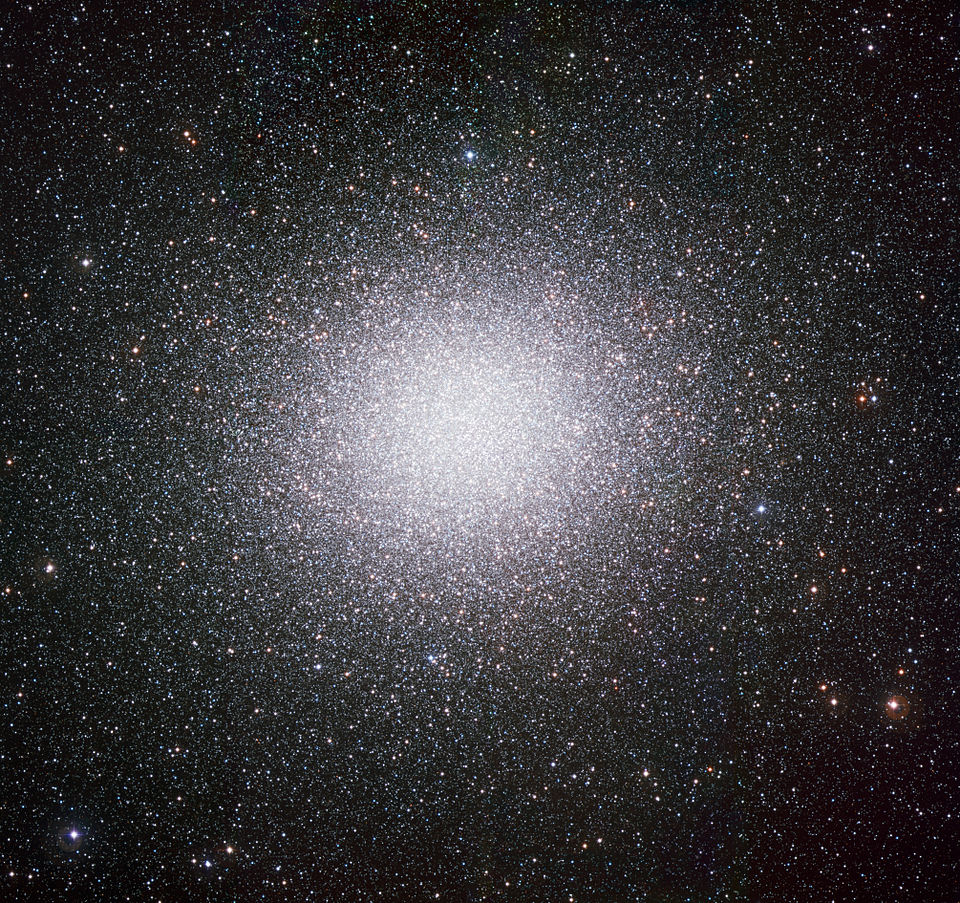

The surface brightness profiles of globular clusters are well described by the family of King models, developed by Ivan King in the 1960s. King showed that the radial light distribution of a globular cluster can be parameterised by two quantities: a core radius, within which the surface brightness is approximately constant, and a tidal radius, beyond which the gravitational influence of the host galaxy strips stars from the cluster.7 The ratio of tidal radius to core radius, called the concentration parameter, varies widely among clusters. Low-concentration clusters have extended, diffuse profiles, while high-concentration clusters have sharply peaked centers and extended envelopes. A subset of clusters, designated core-collapsed, have undergone such extreme central contraction that their core radii have shrunk to values too small to resolve, producing a power-law cusp in the central surface brightness rather than a flat core.7, 8
The total luminosities of Milky Way globular clusters span more than three orders of magnitude, from the faint Palomar-type clusters with absolute visual magnitudes around MV = −2 to the most luminous system, Omega Centauri (NGC 5139), at MV ≈ −10.3, corresponding to roughly 106 solar luminosities. Omega Centauri is so massive and complex — containing approximately 10 million stars with a spread in metallicity and multiple stellar populations — that it is widely suspected to be the stripped nucleus of a dwarf galaxy that was captured and partially disrupted by the Milky Way.1, 4
Color-magnitude diagrams and stellar populations
The defining observational tool for studying the stellar content of globular clusters is the color-magnitude diagram (CMD), the observational analogue of the Hertzsprung-Russell diagram. Because all stars in a cluster lie at essentially the same distance from the observer and share a common origin, a CMD of a globular cluster — plotting each star's apparent magnitude against its color index — directly reveals the evolutionary sequences of a coeval stellar population.
The first modern CMD of a globular cluster was constructed by Allan Sandage in 1953 for the cluster M3 (NGC 5272). Sandage used photoelectric photometry to plot the magnitudes and colors of hundreds of individual stars in M3, revealing for the first time the characteristic morphology that defines globular cluster CMDs: a well-populated main sequence terminating at a sharp main-sequence turnoff, a broad red giant branch ascending from the turnoff toward higher luminosities and redder colors, a horizontal branch at approximately constant luminosity populated by helium-burning stars and RR Lyrae variables, and an asymptotic giant branch rising above the horizontal branch.2 Sandage's CMD of M3 confirmed the theoretical predictions of stellar evolution models and established the CMD as the primary empirical testing ground for those models.
The stars inhabiting globular clusters are overwhelmingly old and metal-poor. Spectroscopic measurements reveal that globular cluster stars typically have iron abundances between 1/300 and 1/3 of the solar value, placing them among the most chemically primitive objects in the galaxy. This low metallicity reflects their formation in the early universe, before successive generations of stellar nucleosynthesis had enriched the interstellar medium with heavy elements.1, 16 The metallicities of Milky Way globular clusters show a bimodal distribution, with a metal-poor peak near [Fe/H] ≈ −1.6 and a metal-rich peak near [Fe/H] ≈ −0.6, suggesting two distinct formation epochs or channels.1, 13
Metallicity distribution of Milky Way globular clusters1, 13
Age determination and cosmological implications
Globular clusters provide one of the most direct and model-independent methods for determining the ages of stellar populations, and thereby for constraining the age of the universe itself. The principle is straightforward: because more massive stars exhaust their core hydrogen fuel more rapidly than lower-mass stars, the luminosity and temperature of the main-sequence turnoff in a cluster's CMD is a direct function of the cluster's age. A young cluster retains hot, luminous stars on its upper main sequence; an old cluster has had those stars evolve off the main sequence long ago, leaving only cooler, less luminous stars still burning hydrogen.3, 16
The technique of main-sequence turnoff fitting compares the observed CMD of a cluster with theoretical isochrones — curves connecting the predicted positions of stars of different masses but the same age on the HR diagram. The age of the isochrone that best matches the turnoff luminosity, color, and morphology of the subgiant and red giant branches is taken as the cluster's age. A comprehensive study by VandenBerg and collaborators (2013) applied this method to Hubble Space Telescope photometry of 55 Milky Way globular clusters. They found that the most metal-poor clusters have a mean age of approximately 12.5 billion years, with the oldest individual clusters reaching ages of 12.5 to 13 billion years. More metal-rich clusters tend to be somewhat younger on average, with mean ages near 11 billion years, although there is considerable scatter.3
These ages have profound cosmological significance. Because the universe cannot be younger than its oldest constituents, the ages of the most ancient globular clusters set an independent lower limit on the age of the cosmos. The oldest clusters, at approximately 12.5 to 13 billion years, are consistent with the age of the universe derived from cosmic microwave background observations by the Planck satellite (13.8 ± 0.02 billion years), but only marginally so. This near-equality implies that the oldest globular clusters formed within the first one to two billion years after the Big Bang — a conclusion that places powerful constraints on models of early galaxy formation and on the value of the Hubble constant. In the late 1990s, when some globular cluster age estimates exceeded 14 or 15 billion years, they were briefly in tension with the best cosmological age estimates, a discrepancy that helped motivate the refinement of both stellar evolution models and distance scale calibrations.3, 16
RR Lyrae stars and the distance scale
Globular clusters play a critical role in the calibration of the cosmic distance ladder through the variable stars they contain, most notably the RR Lyrae stars. These are low-mass, evolved stars that occupy the instability strip on the horizontal branch of the CMD, pulsating with periods of roughly 0.2 to 1.0 days. RR Lyrae stars are abundant in metal-poor globular clusters, where the horizontal branch extends to temperatures hot enough to intersect the instability strip. In the cluster M3 alone, over 200 RR Lyrae variables have been identified.2, 11
The utility of RR Lyrae stars as distance indicators rests on the fact that their absolute magnitudes are relatively uniform and can be calibrated against metallicity. Although the period-luminosity relation of RR Lyrae stars is less precise than that of classical Cepheid variables, RR Lyrae stars have the advantage of being found in old, metal-poor populations where Cepheids are absent. They are therefore the primary standard candles for measuring distances to globular clusters, the galactic halo, and nearby dwarf galaxies — environments dominated by old stellar populations.11
The morphology of the horizontal branch itself varies dramatically among globular clusters of similar metallicity, a phenomenon known as the second-parameter problem. Metallicity is the primary determinant of horizontal branch morphology — more metal-poor clusters tend to have bluer horizontal branches — but clusters with identical metallicities can display markedly different horizontal branch morphologies. The identity of the second parameter (or parameters) has been debated for decades, with candidates including cluster age, helium abundance, mass loss on the red giant branch, and the presence of multiple stellar populations. The resolution of the second-parameter problem is closely linked to the discovery of multiple populations, as the helium enrichment associated with second-generation stars can shift the horizontal branch to bluer colors.4, 11
Multiple stellar populations
The most significant paradigm shift in globular cluster science in the past two decades has been the discovery that individual clusters are not simple, chemically homogeneous stellar populations. Instead, virtually every well-studied globular cluster shows star-to-star variations in the abundances of light elements — helium, carbon, nitrogen, oxygen, sodium, and aluminium — that cannot be explained by the normal course of stellar evolution within a single generation of stars.4, 6
The chemical signature of multiple populations takes a characteristic form. Within a given cluster, one population (designated the first generation or first population) displays chemical abundances consistent with the primordial gas from which the cluster formed, resembling field stars of similar metallicity. A second population (or populations) shows enhancements of nitrogen, sodium, and often helium, coupled with depletions of carbon and oxygen.4 These abundance patterns are the hallmark of gas that has been processed through the hot CNO cycle and the NeNa and MgAl proton-capture chains at temperatures exceeding 20 to 70 million kelvins — conditions found in the interiors of certain types of stars but not at the surfaces of the low-mass stars in which the anomalies are observed. The enriched stars must therefore have formed from gas that was polluted by ejecta from an earlier generation of more massive stars.6
The Hubble Space Telescope UV Legacy Survey of Galactic Globular Clusters, led by Giampaolo Piotto and collaborators, provided the most comprehensive photometric census of multiple populations. Using a combination of ultraviolet and blue filters (F275W, F336W, F438W) that are sensitive to the molecular bands of OH, NH, CN, and CH — molecules whose abundances vary between the populations — the survey constructed chromosome maps for 57 Milky Way globular clusters. These pseudo-two-colour diagrams separate the populations with a clarity impossible to achieve in standard optical photometry, revealing that multiple populations are ubiquitous in old, massive globular clusters.5, 14
The physical origin of the enriched material remains hotly debated. Proposed polluter candidates include intermediate-mass asymptotic giant branch (AGB) stars, which shed their envelopes through stellar winds; fast-rotating massive stars, whose rotationally induced mixing brings CNO-processed material to the surface; interacting massive binaries; and supermassive stars exceeding 104 solar masses. Each scenario has strengths and weaknesses, and none yet reproduces all observed chemical patterns simultaneously. A particularly challenging constraint is that the enriched population often constitutes a large fraction — sometimes exceeding half — of the cluster's current stellar mass, which requires the cluster to have been substantially more massive at birth if the enriched material was provided by a minority of massive polluter stars.6
Dynamical evolution
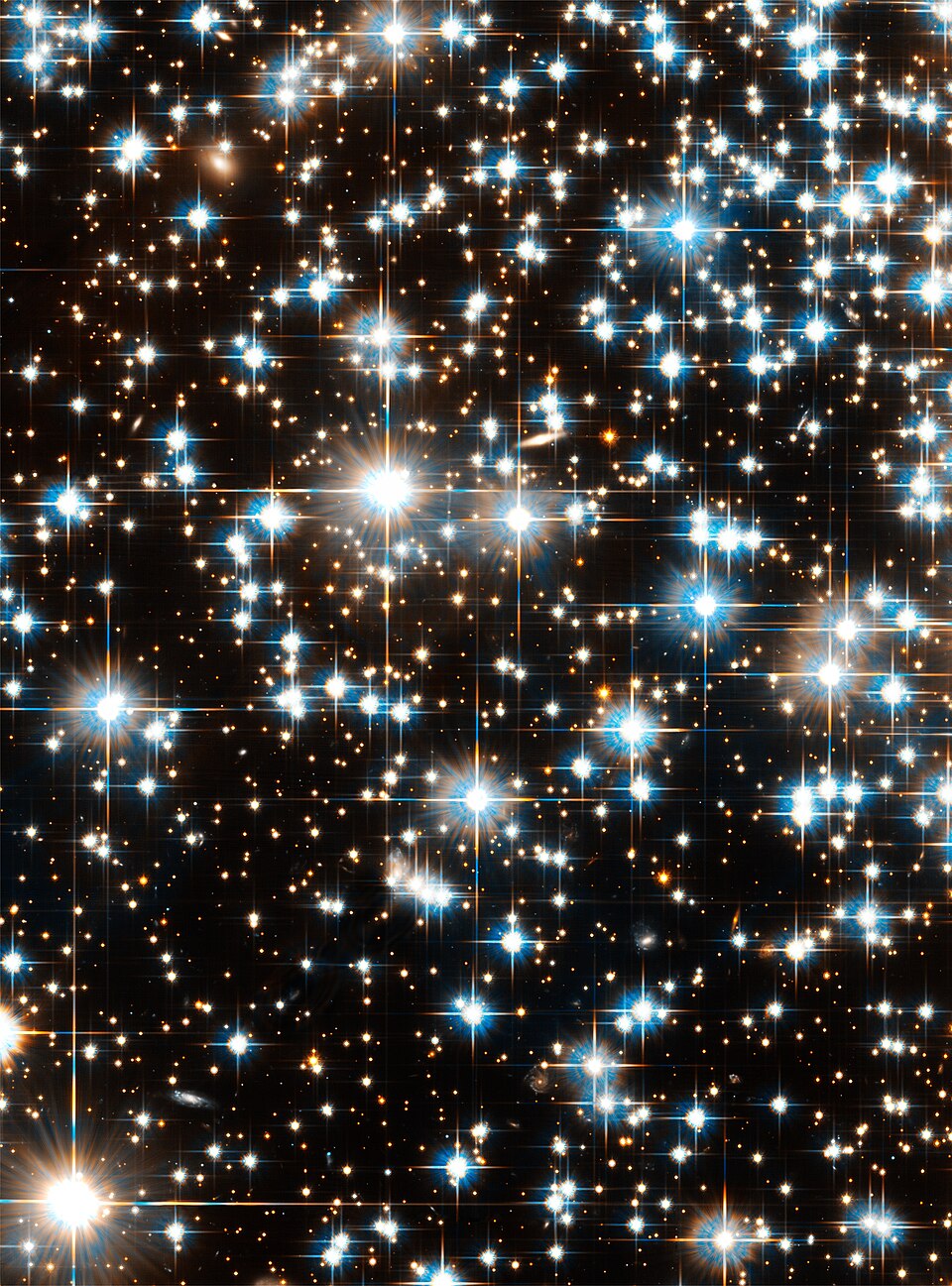
Globular clusters are dense enough that gravitational interactions between individual stars play a central role in their long-term evolution — a property that distinguishes them from galaxies, where the gravitational potential is smooth and two-body encounters are negligible. The timescale on which these encounters redistribute energy among the stars is called the relaxation time, and for most globular clusters it is significantly shorter than their age. This means that globular clusters have had time to evolve dynamically, erasing much of the memory of their initial conditions and approaching a state of quasi-thermal equilibrium in their cores.8
.jpg)
One of the most important consequences of two-body relaxation is mass segregation. Through repeated gravitational encounters, more massive stars tend to lose kinetic energy and sink toward the cluster center, while less massive stars gain kinetic energy and migrate outward. Over many relaxation times, this process produces a progressive concentration of the heaviest objects — including neutron stars, white dwarfs, and stellar-mass black holes — in the cluster core, while low-mass stars populate an extended halo from which some ultimately escape the cluster's gravitational influence altogether.8, 16
In clusters with sufficiently short relaxation times, the redistribution of energy leads to a runaway contraction of the core known as core collapse. As massive stars sink to the center and transfer energy to lighter stars that migrate outward, the core loses kinetic energy and contracts. This contraction increases the central density and collision rate, accelerating the process in a positive feedback loop. Theoretical calculations predict that an isolated cluster composed of identical-mass stars would undergo core collapse in roughly 15 to 20 initial relaxation times. For clusters with a realistic range of stellar masses, core collapse proceeds more rapidly because mass segregation accelerates the energy loss from the core.8 Observations suggest that approximately 20 percent of Milky Way globular clusters exhibit the steep central surface brightness cusps characteristic of post-core-collapse systems, including well-known clusters such as M15, M30, and NGC 6397.1, 8
Core collapse does not proceed to a singularity. Instead, it is halted and reversed by energy generated through binary star interactions in the dense core. When a binary star system undergoes a close gravitational encounter with a passing single star or another binary, the interaction can harden the binary — shrinking its orbit and releasing gravitational binding energy as kinetic energy of the departing star. This energy source, analogous to nuclear burning in a star, heats the core and arrests further contraction. The cluster subsequently undergoes a series of gravothermal oscillations, alternating between contraction and re-expansion as the binary energy source fluctuates.8
Blue stragglers
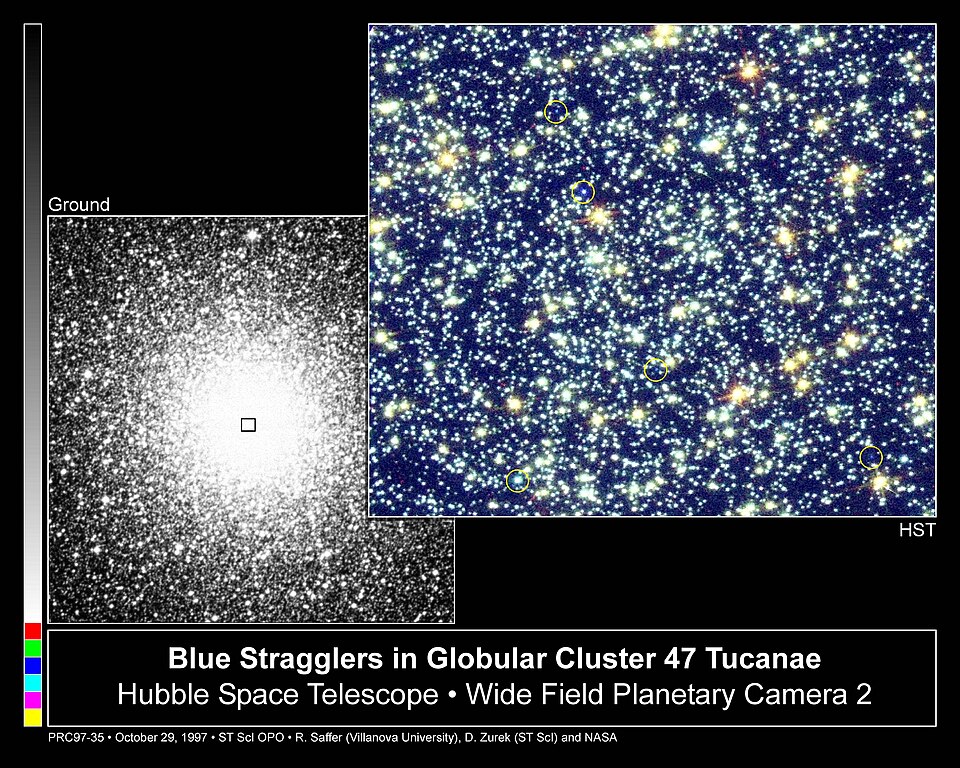
Among the most conspicuous anomalies in globular cluster CMDs are the blue straggler stars, first identified by Allan Sandage in 1953 in his CMD of M3. Blue stragglers are stars that appear brighter and bluer than the main-sequence turnoff — that is, they occupy a region of the CMD where no stars should exist if all cluster members formed simultaneously and have been evolving independently ever since. Their position implies that they are more massive than the turnoff mass, which in a cluster older than 10 billion years is roughly 0.8 solar masses.2, 9
.jpg)
Two principal formation mechanisms have been established for blue stragglers, and both are intimately connected to the dynamical environment of globular clusters. The first is the stellar collision pathway, in which two lower-mass stars physically merge during a close gravitational encounter, producing a single star with a mass exceeding the turnoff mass and therefore a rejuvenated position on the CMD. In the dense cores of globular clusters, where stellar densities can exceed 104 stars per cubic parsec, the rate of direct stellar collisions is sufficiently high to produce a significant population of collision-product blue stragglers.9 The second mechanism is mass transfer in binary systems, in which one component of a close binary accretes material from its companion, increasing its mass above the turnoff value. This process operates regardless of stellar density and can produce blue stragglers even in the uncrowded outer regions of clusters.
The radial distribution of blue stragglers within a cluster provides a powerful diagnostic of the cluster's dynamical state. In dynamically young clusters, blue stragglers are concentrated both in the core (where collisions are frequent) and in the periphery (where primordial binaries have not yet been disrupted or brought to the center), with a zone of avoidance at intermediate radii. In dynamically evolved clusters, mass segregation has drawn virtually all blue stragglers toward the center, erasing the bimodal distribution. Ferraro and collaborators (2012) demonstrated that the radial distribution of blue stragglers can serve as a dynamical clock, ranking clusters by the degree to which mass segregation has progressed and thus providing a purely observational measure of the cluster's dynamical age — the extent of its internal dynamical evolution, independent of its chronological age.10
The Milky Way globular cluster system
The Milky Way hosts approximately 150 known globular clusters, a number that has grown modestly over the past decade as infrared surveys have penetrated the dust-obscured regions near the galactic bulge and plane. The most comprehensive catalogue, compiled by William Harris and updated through 2010, lists fundamental parameters including distances, metallicities, structural properties, and integrated photometry for each cluster.1
The spatial distribution of the globular cluster system is roughly spherical, centred on the galactic center, and extending to galactocentric distances exceeding 100 kiloparsecs. The metal-poor clusters (those with [Fe/H] < −1.0) form a pressure-supported, slowly rotating halo, while the more metal-rich clusters are concentrated toward the galactic bulge and disk and show significant rotation about the galactic center. This kinematic distinction has long suggested that the two metallicity subpopulations have different origins.1, 13
Forbes and Bridges (2010) examined the age-metallicity relation of 93 Milky Way globular clusters and identified two distinct sequences. One branch consists of clusters with near-constant old ages of approximately 12.8 billion years across all metallicities — interpreted as clusters that formed in situ in the Milky Way's main progenitor halo. The other branch extends to younger ages at a given metallicity, consistent with clusters that formed in smaller satellite galaxies and were later accreted by the Milky Way through hierarchical merging. They estimated that roughly one-quarter to nearly half of the Milky Way's globular clusters may have been acquired through the accretion of six to eight dwarf galaxies.13
Selected Milky Way globular clusters and their properties1, 3
| Cluster | Distance (kpc) | [Fe/H] | MV | Age (Gyr) | Notable feature |
|---|---|---|---|---|---|
| Omega Centauri (NGC 5139) | 5.2 | −1.53 | −10.26 | ~12 | Most massive; possible stripped dwarf galaxy nucleus |
| 47 Tucanae (NGC 104) | 4.5 | −0.72 | −9.42 | ~12 | Second most luminous; metal-rich |
| M13 (NGC 6205) | 7.1 | −1.53 | −8.55 | ~12 | Great Cluster in Hercules |
| M3 (NGC 5272) | 10.2 | −1.50 | −8.93 | ~12.5 | Rich in RR Lyrae variables |
| M15 (NGC 7078) | 10.4 | −2.37 | −9.19 | ~13 | Core-collapsed; very metal-poor |
| M92 (NGC 6341) | 8.3 | −2.31 | −8.21 | ~13 | Among oldest known clusters |
| NGC 6397 | 2.3 | −2.02 | −6.64 | ~13 | Nearest core-collapsed cluster |
Globular clusters as dark matter tracers
The orbital motions of globular clusters around their host galaxies provide a powerful means of probing the distribution of dark matter in galactic halos. Because globular clusters are compact, luminous, and can be observed at large galactocentric distances where the enclosed dark matter mass dominates the total mass budget, their radial velocities and, increasingly, their proper motions serve as kinematic tracers of the gravitational potential out to distances far beyond the visible disk of the galaxy.12
The idea that globular clusters might have formed within their own dark matter mini-halos was proposed by Peebles (1984), who argued that in cold dark matter cosmologies, the first bound structures to collapse in the early universe would have been small dark matter halos with masses of roughly 106 to 108 solar masses — precisely the mass range appropriate for globular cluster formation. If globular clusters originated in such halos, some residual dark matter might remain associated with them today.15 However, observational searches for dark matter within globular clusters — using the velocity dispersions of their stars to infer the total enclosed mass and comparing it with the luminous mass — have generally found mass-to-light ratios consistent with purely stellar populations, with no significant excess attributable to dark matter. The most likely explanation is that tidal interactions with the host galaxy have stripped any primordial dark matter halos from the clusters over billions of years of orbital evolution.8, 15
Even without retaining their own dark matter, globular clusters serve as excellent tracers of the dark matter content of their host galaxies. The velocity dispersion of the globular cluster system as a whole, measured as a function of galactocentric radius, reflects the total gravitational potential and thereby constrains the dark matter halo mass. This technique has been applied to numerous elliptical galaxies, where the globular cluster systems extend to much larger radii than the diffuse stellar light, providing kinematic constraints at distances where no other tracers are available.12
Extragalactic globular cluster systems
Globular clusters are not unique to the Milky Way. Virtually every galaxy with a stellar mass exceeding roughly 109 solar masses possesses a system of globular clusters, and the properties of these systems vary systematically with the mass, morphology, and environment of the host galaxy. Giant elliptical galaxies in the centres of galaxy clusters can host prodigious globular cluster populations: the cD galaxy M87 in the Virgo Cluster, for example, contains an estimated 12,000 to 15,000 globular clusters, roughly one hundred times the Milky Way's complement.12
A ubiquitous feature of extragalactic globular cluster systems is color bimodality. When the integrated colors of a galaxy's globular clusters are measured and plotted as a histogram, two distinct peaks typically emerge: a blue (metal-poor) peak and a red (metal-rich) peak. This bimodality has been detected in galaxies spanning the full Hubble sequence, from dwarf ellipticals to the most massive brightesters. The blue clusters are generally more spatially extended and kinematically hotter, resembling the metal-poor halo clusters of the Milky Way, while the red clusters are more centrally concentrated and may show rotation, resembling the Milky Way's bulge and disk clusters.12
The total number of globular clusters in a galaxy, quantified by the specific frequency (the number of clusters normalized to the galaxy's luminosity), varies enormously. Dwarf galaxies and normal spiral galaxies like the Milky Way have relatively low specific frequencies (SN ≈ 1 to 2), meaning they have one to two globular clusters per unit galaxy luminosity (in appropriate units). Giant elliptical galaxies, particularly those at the centres of galaxy clusters, have much higher specific frequencies (SN ≈ 5 to 15), and a few extreme cases approach SN ≈ 20. The elevated specific frequencies of giant ellipticals are thought to reflect the accretion of globular clusters from numerous smaller galaxies during the hierarchical assembly of the host, supplemented by the formation of new clusters during major galaxy mergers.12
The study of extragalactic globular cluster systems has become one of the primary means of reconstructing the formation histories of distant galaxies. Because globular clusters are individually unresolvable in all but the nearest galaxies, analysis relies on integrated photometry and spectroscopy of the cluster populations as a whole. The metallicity distribution, spatial extent, kinematics, and age spread of a galaxy's globular cluster system collectively encode information about the number and masses of the progenitor galaxies that merged to form the present-day system, the epochs at which those mergers occurred, and the efficiency of star and cluster formation in different environments.12, 13
Open questions and ongoing research
Despite more than a century of intensive study, globular clusters continue to pose fundamental unsolved problems. The most pressing is the origin of multiple stellar populations. No proposed formation scenario yet explains all of the observed chemical patterns, the large fraction of enriched stars, the near-universality of the phenomenon among massive clusters, and the apparent absence of analogous multiple populations in young massive clusters observed forming in the local universe. Whether the conditions required for forming multiple populations existed only in the early universe, or whether current observational surveys have simply not yet detected nascent multiple populations in young clusters, remains an open question.6
The formation of globular clusters themselves is not fully understood. The oldest, most metal-poor clusters must have formed during or shortly after the epoch of reionization, within the first one to two billion years after the Big Bang. The physical conditions in the early universe that permitted the formation of such dense, massive, long-lived stellar systems — conditions that are apparently not replicated in the local universe, where young massive clusters are rare and appear to dissolve relatively quickly — are the subject of active theoretical investigation.6, 12
The role of globular clusters as hosts of exotic stellar populations has also grown in importance. The dense cores of globular clusters are now known to harbour significant populations of millisecond pulsars, low-mass X-ray binaries, and cataclysmic variables — all products of the close gravitational encounters that are unique to the cluster environment. The question of whether globular clusters retain populations of stellar-mass black holes, or whether these are ejected through dynamical interactions shortly after formation, has implications for gravitational wave astronomy, as merging black hole binaries formed dynamically in globular clusters may contribute to the signals detected by the LIGO-Virgo-KAGRA observatory network.8
The continued operation of the Hubble Space Telescope, the expanding capabilities of the James Webb Space Telescope in the near-infrared, and the precision astrometry of the Gaia mission are collectively driving a renaissance in globular cluster science. JWST is extending the study of multiple populations to the faintest cluster members — the lowest-mass dwarfs that retain the chemical imprints of their formation most faithfully — while Gaia's proper motions are enabling three-dimensional kinematic analyses of nearby clusters with unprecedented precision. The integration of photometric, spectroscopic, and dynamical data across these observatories promises to address many of the outstanding questions that have made globular clusters one of the most productive and challenging subjects in stellar astrophysics.5, 14
References
The Ages of 55 Globular Clusters as Determined Using an Improved ΔV Method along with Color–Magnitude Diagram Constraints
Multiple populations in globular clusters: Lessons learned from the Milky Way globular clusters
The Hubble Space Telescope UV Legacy Survey of Galactic Globular Clusters. I. Overview of the Project and Detection of Multiple Stellar Populations
Blue Stragglers and Other Stellar Anomalies: Implications for the Dynamics of Globular Clusters
Horizontal branch stars: the interplay between observations and theory, and insights into the formation of the Galaxy
The Hubble Space Telescope UV Legacy Survey of Galactic globular clusters. IX. The Atlas of multiple stellar populations