Overview
- Galaxy mergers are a fundamental process in hierarchical structure formation, driving the transformation of small, gas-rich spiral galaxies into the massive elliptical galaxies that dominate the cores of galaxy clusters today.
- Mergers trigger intense starbursts and funnel gas toward galactic centers, igniting active galactic nuclei and quasars, while tidal forces sculpt dramatic features such as tails, bridges, and shells that persist for hundreds of millions of years.
- The Milky Way and Andromeda galaxies are on a collision course and will merge in approximately 4.5 billion years, while the coalescence of their central supermassive black holes will produce gravitational waves detectable by future space-based observatories.
In the modern understanding of cosmic structure, galaxies do not form in isolation. They grow through a continuous process of accretion and collision, absorbing smaller systems and occasionally colliding with companions of comparable size. Galaxy mergers are among the most transformative events in astrophysics, reshaping the morphologies of the galaxies involved, triggering waves of new star formation, igniting luminous active galactic nuclei, and ultimately building the massive elliptical galaxies that anchor the densest regions of the cosmic web. The study of galaxy mergers sits at the intersection of gravitational dynamics, stellar physics, and cosmology, and has been central to understanding how the universe evolved from a nearly uniform primordial state into the richly structured cosmos observed today.3, 7
.png)
Hierarchical assembly and the role of dark matter
The prevailing cosmological model — Lambda Cold Dark Matter (ΛCDM) — predicts that cosmic structures formed hierarchically, with small objects merging to build progressively larger ones.17 In the early universe, dark matter collapsed into small halos with masses comparable to dwarf galaxies. These halos then merged with one another over billions of years, assembling the massive halos that today host galaxies like the Milky Way. The ordinary baryonic matter — gas, dust, and eventually stars — followed the gravitational scaffolding provided by these dark matter halos, cooling and condensing at their centers to form visible galaxies.16, 17
This bottom-up picture of structure formation means that galaxy mergers are not rare catastrophes but a routine feature of cosmic evolution. Every large galaxy in the observable universe has undergone multiple mergers throughout its history. The Milky Way itself bears the scars of past encounters: stellar streams threading through its halo trace the disrupted remains of dwarf galaxies absorbed over the past several billion years.7 Cosmological simulations such as the Millennium Simulation track the assembly histories of millions of dark matter halos through cosmic time, producing branching genealogies known as merger trees that record every accretion event from the earliest epochs to the present.7, 8
Major and minor mergers
Astronomers classify galaxy mergers by the mass ratio of the interacting systems. A major merger involves two galaxies of roughly comparable mass, typically defined as a mass ratio of 1:1 to about 1:4. A minor merger involves a substantially smaller companion falling into a larger host, with mass ratios ranging from roughly 1:4 to 1:10 or beyond.3 The distinction is physically significant because the two classes produce dramatically different outcomes.
Major mergers are violent, transformative events. When two massive spiral galaxies of similar size collide, their ordered disk structures are destroyed by the gravitational chaos of the encounter. Stars are flung onto randomized orbits, gas is driven inward by tidal torques, and the end product is typically a pressure-supported elliptical galaxy with little remaining rotational structure.2, 3 Minor mergers, by contrast, are more subtle. The smaller galaxy is tidally disrupted and absorbed into the larger host, which may retain its disk structure largely intact. The accreted stars contribute to the host's stellar halo and thick disk, gradually building up these components over many minor accretion events.3 Minor mergers are far more common than major mergers at all cosmic epochs, and their cumulative effect on galaxy growth is substantial.
Tidal tails, bridges, and morphological signatures
The most visually spectacular consequences of galaxy mergers are the elongated tidal features — tails, bridges, plumes, and shells — that extend far beyond the main bodies of the interacting systems. The foundational theoretical work on these structures was carried out by Alar and Juri Toomre in 1972, who used restricted three-body simulations to demonstrate that the long, narrow tails observed in interacting galaxy pairs arise naturally from tidal forces during close passages.1 When two disk galaxies approach each other, the differential gravitational pull across each disk draws material outward on the side facing away from the companion, producing sweeping tidal tails that can extend hundreds of thousands of light-years into intergalactic space. Simultaneously, material on the near side of each disk may be drawn toward the companion, forming a luminous bridge of stars and gas connecting the two galaxies.1
The Toomre brothers showed that the geometry and extent of tidal features depend sensitively on the orbital parameters of the encounter — the relative velocity, the angle between the orbital plane and each galaxy's disk, and the pericentric distance of closest approach. Prograde encounters, in which the orbital angular momentum is aligned with the spin of a galaxy's disk, produce the most prominent tails because the tidal forces resonantly extract angular momentum from the disk material.1 Retrograde encounters produce much weaker tidal features. These predictions have been confirmed by decades of subsequent numerical simulations with increasingly realistic galaxy models incorporating dark matter halos, gas dynamics, and star formation.3
The Antennae Galaxies: a case study
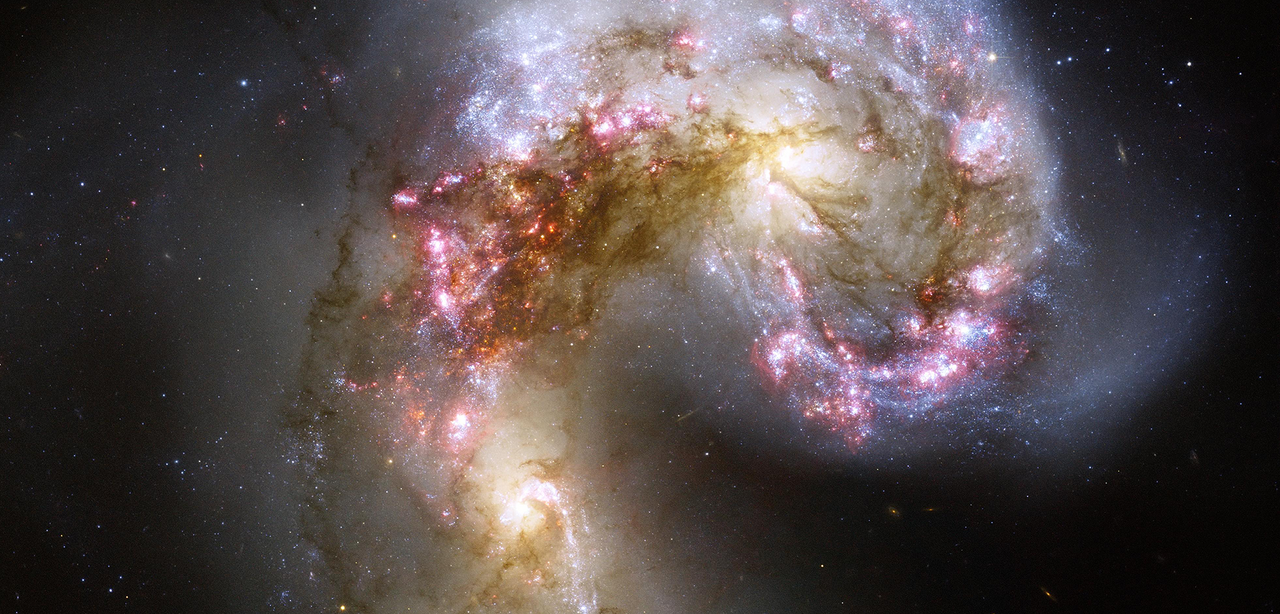
The Antennae Galaxies (NGC 4038/4039), located approximately 45 million light-years from Earth in the constellation Corvus, represent one of the nearest and best-studied examples of a major merger in progress. Named for the long, curving tidal tails that resemble the antennae of an insect, this system consists of two spiral galaxies in the late stages of their first close passage through each other.4 Observations with the Hubble Space Telescope have revealed thousands of young, massive star clusters forming in the overlap region where the two galaxies' gas disks have collided, many of them with ages of only a few million years.4 These clusters are far more luminous and massive than typical open clusters in the Milky Way, and some may evolve into globular clusters that will survive for billions of years.
The Antennae system serves as a powerful laboratory for studying merger-induced star formation. The collision has compressed the interstellar gas to densities far above those found in isolated galaxies, triggering a starburst with a star formation rate estimated at several tens of solar masses per year — roughly an order of magnitude higher than the Milky Way's current rate.4 Multi-wavelength observations spanning radio, infrared, optical, and X-ray wavelengths have mapped the distribution of molecular gas, young stellar populations, and hot plasma throughout the system, providing detailed constraints on how mergers convert gas into stars.4, 5
Starburst triggering
Galaxy mergers are the most efficient mechanism known for triggering intense bursts of star formation. During a merger, tidal torques and ram pressure from gas-on-gas collisions drive large quantities of interstellar gas toward the centers of the interacting systems, compressing it to the high densities required for gravitational collapse and star formation.5 The most extreme merger-driven starbursts are observed in ultraluminous infrared galaxies (ULIRGs), systems that radiate the bulk of their enormous luminosity — exceeding 1012 times the luminosity of the Sun — at far-infrared wavelengths. This infrared emission arises because the intense star formation is deeply embedded in thick clouds of gas and dust that absorb the ultraviolet and optical light of the young stars and re-radiate it as thermal infrared emission.5
Sanders and collaborators demonstrated in the late 1980s that virtually all ULIRGs show morphological evidence of recent or ongoing mergers, establishing a direct causal link between the merger process and the most extreme star-forming activity in the universe.5 The star formation rates in ULIRGs can reach several hundred solar masses per year, enough to consume the available gas supply in a few hundred million years. This rapid gas exhaustion is one mechanism by which mergers transform gas-rich star-forming spirals into gas-poor, quiescent ellipticals.
AGN and quasar triggering
The same gravitational torques that drive gas toward the center of a merging galaxy and fuel starbursts also funnel material toward the central supermassive black hole, potentially triggering an episode of vigorous accretion that manifests as an active galactic nucleus or, at its most luminous, a quasar.6 Hydrodynamic simulations by Di Matteo, Springel, and Hernquist showed that the merger of two gas-rich galaxies naturally produces a sequence in which a dusty starburst phase is followed by a luminous quasar phase as gas accumulates on the central black hole, and finally by quasar feedback that expels the remaining gas and quenches both star formation and further black hole growth.6
This merger-driven evolutionary sequence — from interacting spirals through ULIRG to quasar to quiescent elliptical — has become an influential framework for understanding the co-evolution of galaxies and their central black holes.5, 6 The energy released by the accreting black hole during the quasar phase is enormous, and simulations show that even a small fraction of this energy, if coupled to the surrounding gas, is sufficient to unbind the galaxy's entire gas reservoir and terminate star formation.6 This AGN feedback mechanism helps explain why the most massive elliptical galaxies in the present-day universe are virtually devoid of cold gas and young stars, despite sitting at the centers of the most massive dark matter halos where cooling flows should in principle supply abundant fuel for continued star formation.
Formation of elliptical galaxies
The hypothesis that elliptical galaxies form through the merger of spiral galaxies was first articulated by Alar Toomre in 1977, who noted that the number density of observed merger remnants was broadly consistent with the number density of elliptical galaxies, and proposed that the two populations were causally connected.2 This merger hypothesis has since been supported by extensive numerical simulations showing that the collision and coalescence of two roughly equal-mass disk galaxies produces a remnant whose structural and kinematic properties closely resemble those of observed elliptical galaxies: a smooth, centrally concentrated light distribution following a de Vaucouleurs profile, a velocity dispersion-supported rather than rotation-supported dynamical structure, and old stellar populations consistent with an early burst of star formation followed by quiescence.2, 3
The distinction between wet and dry mergers is important in this context. A wet merger involves gas-rich progenitors and is accompanied by a starburst that produces new stars during the coalescence. A dry merger involves gas-poor progenitors — typically elliptical galaxies that have already exhausted or expelled their gas — and proceeds without significant new star formation.3 Dry mergers are thought to be the primary growth mechanism for the most massive elliptical galaxies at late cosmic times, building their stellar mass through the accumulation of already-formed stars from smaller elliptical companions. This dry merging explains why the most massive galaxies have grown substantially in size since redshift z ≈ 2 without a corresponding increase in star formation activity.8
Dynamical friction and orbital decay
The physical mechanism that causes two galaxies to lose orbital energy and eventually coalesce is dynamical friction, a concept first described by Subrahmanyan Chandrasekhar in 1943.18 When a massive body moves through a background of lighter particles — stars or dark matter particles in the case of galaxy mergers — it gravitationally deflects the surrounding material, creating a trailing overdensity or gravitational wake behind it. This wake exerts a net retarding force on the moving body, causing it to decelerate and spiral inward.18, 11
The timescale for dynamical friction depends on the mass ratio of the interacting systems, the density of the background medium, and the orbital velocity. More massive satellites experience stronger friction and merge more quickly, while low-mass companions can orbit within a host galaxy's halo for many billions of years before being fully absorbed.18 In gas-rich environments, an additional contribution to dynamical friction arises from the response of the gaseous medium to the gravitational perturbation, which can significantly accelerate the orbital decay compared to the purely collisionless case.11 Dynamical friction is also the mechanism that ultimately brings the supermassive black holes of two merged galaxies close enough together to form a gravitationally bound binary, setting the stage for their eventual coalescence.
Merger rates across cosmic time
The rate at which galaxies merge has varied substantially over the history of the universe. Observational studies using morphological indicators of interaction — such as tidal tails, asymmetries, and double nuclei, quantified through systems like the CAS (concentration, asymmetry, clumpiness) parameters — as well as close-pair statistics from deep imaging surveys have established that the galaxy merger rate was significantly higher in the past than it is today.14, 15 Lotz and collaborators found that the major merger rate for massive galaxies increases steeply with redshift, scaling approximately as (1 + z)n with n ≈ 2–3 out to redshifts of z ≈ 3, meaning that massive galaxies experienced major mergers several times more frequently at cosmic noon (z ≈ 1–3) than they do in the present epoch.15
Cosmological simulations broadly reproduce this trend. The Illustris simulation, for example, tracks galaxy merger rates across cosmic time and finds that a typical Milky Way-mass galaxy has undergone roughly one major merger and numerous minor mergers since z ≈ 2.8 At higher redshifts, the merger rate continues to rise, consistent with the hierarchical assembly picture in which the earliest galaxies were small and merged frequently.7, 8 The decline in the merger rate toward the present day reflects the combined effects of cosmic expansion, which increases the typical separation between galaxies, and the progressive depletion of small companions in the local environment of massive galaxies.
Merger trees and cosmological simulations
The theoretical framework for understanding galaxy mergers relies heavily on numerical simulations. Modern cosmological simulations such as the Millennium Simulation, Illustris, and their successors evolve billions of dark matter particles (and, in hydrodynamic versions, gas cells) from initial conditions set by the cosmic microwave background through to the present day, self-consistently tracking the formation, growth, and merging of dark matter halos and the galaxies they host.7, 8
A central concept in these simulations is the merger tree, a branching diagram that records the complete assembly history of every halo in the simulation volume. Starting from the smallest resolved halos at early times, the tree traces how halos grow through smooth accretion and discrete merger events, eventually building up to the massive halos observed today. By coupling merger trees with semi-analytic models of galaxy formation — prescriptions for gas cooling, star formation, black hole growth, and feedback — researchers can predict the statistical properties of the galaxy population and compare them with observations.7 These models have been remarkably successful at reproducing the observed galaxy luminosity function, color distribution, and morphological mix, lending strong support to the hierarchical merger paradigm.7, 8
The Milky Way–Andromeda collision
The Milky Way and the Andromeda Galaxy (M31), the two most massive members of the Local Group, are approaching each other at approximately 110 kilometers per second and are expected to undergo their first close passage in roughly 4.5 billion years.10 Proper motion measurements from the Hubble Space Telescope, published by van der Marel and collaborators in 2012, provided the first direct determination of Andromeda's tangential velocity, confirming that the two galaxies are on a nearly head-on collision course with only a modest transverse component.10
Numerical simulations of the encounter predict that the two galaxies will make their first close approach, pass through each other, separate, and then fall back together over the course of approximately two billion years before finally coalescing into a single elliptical galaxy informally dubbed "Milkomeda."9 The merger will destroy the organized disk structures of both galaxies, scattering their stars onto randomized orbits. The Sun, currently located about 26,000 light-years from the Milky Way's center, is likely to be flung to a much larger galactocentric radius but is not expected to be ejected from the merged system entirely.9, 10 M33, the third-largest member of the Local Group, may also participate in the interaction, either merging with the combined system or being ejected onto a distant orbit.10
Gravitational wave signatures from black hole mergers
When two galaxies merge, their central supermassive black holes sink toward the center of the merged remnant through dynamical friction and eventually form a gravitationally bound binary.18 As this binary continues to harden through interactions with surrounding stars and gas, it enters a regime where the emission of gravitational waves becomes the dominant mechanism of energy loss, driving the two black holes into an inexorable inspiral that culminates in coalescence.12
The gravitational waves produced by merging supermassive black holes have frequencies in the millihertz to nanohertz range, far below the sensitivity band of ground-based detectors such as LIGO and Virgo. The planned Laser Interferometer Space Antenna (LISA), a space-based gravitational wave observatory consisting of three spacecraft in a triangular formation separated by 2.5 million kilometers, is designed specifically to detect these low-frequency signals.13 LISA is expected to observe supermassive black hole mergers out to very high redshifts, providing a direct census of galaxy merger activity across cosmic time that is complementary to electromagnetic observations.13 Additionally, pulsar timing arrays — networks of precisely timed millisecond pulsars distributed across the sky — are sensitive to the stochastic gravitational wave background produced by the superposition of signals from the entire cosmic population of inspiraling supermassive black hole binaries, and recent results from several pulsar timing collaborations have reported evidence for this background signal.12, 13
The detection of gravitational waves from supermassive black hole mergers will open an entirely new window on galaxy evolution, enabling direct measurements of black hole masses and spins at the moment of coalescence and providing constraints on the merger histories of galaxies that are inaccessible through traditional electromagnetic astronomy. Together with the electromagnetic signatures of merger-driven starbursts, AGN activity, and tidal morphological disturbances, gravitational wave observations promise a comprehensive, multi-messenger picture of how galaxies have assembled and transformed over the full span of cosmic history.12, 13
References
The Antennae Galaxies (NGC 4038/4039) Revisited: Advanced Camera for Surveys and NICMOS Observations
Energy input from quasars regulates the growth and activity of black holes and their host galaxies
The Millennium Simulation: Cosmological simulations of the formation of large-scale structure
The merger rate of galaxies in the Illustris simulation: a comparison with observations and semi-empirical models
The M31 velocity vector. III. Future Milky Way–M31–M33 orbital evolution, merging, and fate of the Sun
Gravitational Radiation from Post-Newtonian Sources and Inspiralling Compact Binaries
The Laser Interferometer Space Antenna: a cornerstone mission for the observation of gravitational waves
The relationship between stellar light distributions of galaxies and their formation histories