Overview
- The Hubble tuning fork, introduced by Edwin Hubble in 1926, classifies galaxies into ellipticals (E0–E7), lenticulars (S0), spirals (Sa–Sc and SBa–SBc), and irregulars — a scheme that remains the foundation of galaxy classification despite nearly a century of refinement and the discovery that it does not represent an evolutionary sequence.
- The morphology-density relation, established by Dressler in 1980, demonstrates that elliptical and lenticular galaxies dominate the dense cores of galaxy clusters while spirals are more common in low-density environments — a pattern that reflects the role of environment in transforming galaxy structure through processes such as ram pressure stripping, tidal interactions, and galaxy mergers.
- Modern classification schemes, including de Vaucouleurs’ revised system, quantitative morphology through Sérsic profiles, and machine-learning-based classification of millions of galaxies from large surveys, have extended Hubble’s framework to capture the full diversity of galaxy structure across cosmic time.
Galaxy morphology is the study and classification of galaxies according to their visual structure and shape. Since the earliest telescopic observations of “nebulae” revealed that these objects possess a striking diversity of forms — from featureless ellipsoids to tightly wound spirals to chaotic irregulars — astronomers have sought to organize this diversity into classification systems that might reveal the underlying physics of galaxy formation and evolution. The morphological classification of galaxies remains one of the most fundamental tools in extragalactic astronomy, serving as both a descriptive taxonomy and a gateway to understanding the physical processes that shape galaxies across cosmic time.1, 8
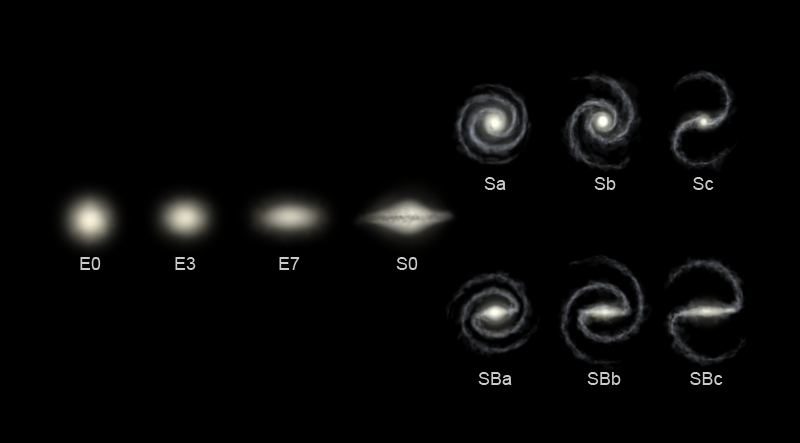

The Hubble tuning fork
The foundational scheme for galaxy classification was introduced by Edwin Hubble in 1926 and refined in his 1936 book The Realm of the Nebulae. Hubble arranged galaxies along a sequence now commonly depicted as a tuning fork diagram. The handle of the fork consists of elliptical galaxies, classified from E0 (nearly spherical) to E7 (highly elongated) based on their apparent ellipticity. At the junction where the fork splits sit the lenticular (S0) galaxies, which have a disk and a central bulge but lack prominent spiral arms. The two prongs of the fork represent spiral galaxies: normal spirals (Sa, Sb, Sc) on one branch and barred spirals (SBa, SBb, SBc) on the other, with the sequence running from tightly wound arms and a large bulge (Sa/SBa) to loosely wound arms and a small bulge (Sc/SBc). Galaxies that do not fit these categories were labeled as irregulars.1, 2
Hubble originally speculated that the sequence might represent an evolutionary progression, with ellipticals as “early types” evolving into spirals as “late types” — terminology that persists in astronomical usage despite being physically incorrect. It is now understood that elliptical galaxies are not younger than spirals; rather, the morphological sequence reflects differences in formation history, angular momentum, gas content, and environment. Nevertheless, the Hubble classification proved remarkably durable as a descriptive tool, and the broad categories of elliptical, lenticular, spiral, and irregular remain in universal use. Allan Sandage extended and refined Hubble’s system through decades of careful photographic work, subdividing categories and establishing the criteria more rigorously.3, 7
Elliptical and lenticular galaxies
Elliptical galaxies range from giant ellipticals containing trillions of stars in the centers of massive galaxy clusters to compact dwarf ellipticals with only a few billion. They are characterized by smooth, featureless light distributions with little or no ongoing star formation, a predominantly old stellar population, and modest amounts of interstellar gas and dust. Their surface brightness profiles are well described by the Sérsic law, with Sérsic indices typically between 4 and 8, reflecting the centrally concentrated light distributions first noted by de Vaucouleurs. Kinematically, ellipticals were once thought to be supported primarily by rotation, but observations have shown that most are pressure-supported systems in which the random motions of stars, rather than ordered rotation, maintain the galaxy’s shape. The most massive ellipticals are believed to have formed primarily through galaxy mergers, which scramble the ordered disk structure of the progenitor galaxies into a dispersion-dominated ellipsoid.10, 13
Lenticular galaxies occupy an intermediate position between ellipticals and spirals in the Hubble sequence. They possess a prominent stellar disk and a central bulge — and in some cases a bar — but lack the prominent spiral arms and active star-forming regions found in spiral galaxies. Their stellar populations tend to be older and redder than those of spirals, and they contain relatively little cold gas. The origin of lenticular galaxies has been linked to the environmental transformation of spiral galaxies: processes such as ram pressure stripping of gas as a galaxy moves through the hot intracluster medium, tidal interactions with neighboring galaxies, and the gradual exhaustion of gas supplies without replenishment can convert a gas-rich spiral into a gas-poor lenticular over time.9, 15
Spiral and irregular galaxies
Spiral galaxies, including the Milky Way, are rotationally supported disk systems with prominent spiral arms traced by young, blue stars, H II regions, and interstellar dust lanes. The spiral arms are density wave features — regions of enhanced density that propagate through the disk and trigger star formation as gas is compressed upon entering the wave. Along the Hubble sequence from Sa to Sc, the ratio of bulge to disk luminosity decreases, the spiral arms become more open and loosely wound, and the fraction of the galaxy’s mass in gas increases. Barred spirals, which contain an elongated stellar bar across the central region, make up roughly two-thirds of all disk galaxies in the local universe, and the bar appears to play a role in funneling gas toward the galactic center, fueling both star formation and, in some cases, nuclear activity.7, 3
Irregular galaxies lack the symmetry and well-defined structure of ellipticals or spirals. They are typically lower in mass and luminosity, rich in gas, and actively forming stars. The Large and Small Magellanic Clouds, satellite galaxies of the Milky Way, are nearby examples. Dwarf irregulars are the most numerous galaxy type by number in the local universe, though they contribute relatively little to the total stellar mass budget. Some galaxies classified as irregular owe their chaotic appearance to recent or ongoing gravitational interactions and mergers, rather than representing a distinct evolutionary class; these disturbed systems are sometimes designated as peculiar galaxies and include some of the most spectacularly structured objects in the sky, such as the Antennae galaxies.8, 12
The morphology-density relation
One of the most important empirical findings in galaxy morphology is the morphology-density relation, established by Dressler in 1980 through a survey of 55 galaxy clusters. Dressler demonstrated that the fraction of elliptical and lenticular galaxies increases dramatically with the local galaxy density: in the dense cores of rich clusters, ellipticals and lenticulars together account for 80–90% of the galaxy population, while spirals dominate in lower-density environments such as the field and the outskirts of clusters. This correlation is one of the strongest known relationships between galaxy properties and environment, and it implies that the physical processes operating in dense environments — including ram pressure stripping, galaxy harassment (repeated high-speed encounters), tidal stripping, and major and minor mergers — are effective at transforming galaxy morphology.9
Subsequent studies have shown that the morphology-density relation is already in place at redshifts of at least z ≈ 1, though the fraction of lenticular galaxies appears to increase at the expense of spirals between z ≈ 1 and the present day, consistent with the ongoing transformation of spirals into lenticulars within clusters. Disentangling the relative importance of the various environmental mechanisms remains an active area of research. Observations from large surveys such as the Sloan Digital Sky Survey (SDSS) and the Galaxy And Mass Assembly (GAMA) survey have confirmed and extended the morphology-density relation to a wide range of environments and have revealed that galaxy color — a proxy for star formation activity — correlates with environment at least as strongly as morphology does, suggesting that quenching of star formation and morphological transformation may be partially independent processes.15, 14
Modern classification and quantitative morphology
Modern approaches to galaxy morphology have extended Hubble’s visual classification in several directions. The de Vaucouleurs system, introduced in 1959, expanded the Hubble sequence into a three-dimensional classification volume by adding finer subdivisions of bar strength (from SA through SAB to SB), ring and lens structures, and a more detailed spiral arm characterization. This system is widely used for nearby galaxies where the structural detail is resolvable. For more distant galaxies, where fine morphological features are blurred by resolution and cosmological surface brightness dimming, quantitative methods based on measured parameters have become essential. The CAS system (concentration, asymmetry, smoothness), developed by Conselice, provides a non-parametric approach to morphology that can be applied consistently to galaxies across a wide range of redshifts and imaging conditions. Sérsic profile fitting, which characterizes the radial light distribution with a single index n, provides another quantitative axis: galaxies with n ≈ 1 have exponential disk profiles typical of spirals, while those with n ≈ 4 have the concentrated profiles of classical ellipticals.4, 11, 13
The era of large digital sky surveys has transformed morphological classification from a task performed by individual experts examining photographic plates to a statistical enterprise applied to millions of galaxies. The Galaxy Zoo project, launched in 2007, enlisted hundreds of thousands of citizen scientists to visually classify nearly a million galaxies from the SDSS, producing a morphological catalog of unprecedented size and enabling statistical studies of morphology across the full range of galaxy environments and stellar masses. Machine learning methods, including convolutional neural networks trained on Galaxy Zoo classifications and on expert-labeled samples, now achieve classification accuracy comparable to human experts and can process the enormous datasets expected from current and upcoming surveys such as the Vera C. Rubin Observatory’s Legacy Survey of Space and Time. These approaches are also being applied to galaxies at high redshift observed by JWST, where the morphological mix is dramatically different from the local universe — with a higher fraction of irregular and clumpy galaxies and fewer well-defined spirals — providing direct evidence for the morphological evolution of galaxies over cosmic time.6, 5, 14
References
Galaxy zoo: morphologies derived from visual inspection of galaxies from the Sloan Digital Sky Survey
Galaxy morphology in rich clusters: Implications for the formation and evolution of galaxies
A general photometric method for evaluating the concentration, asymmetry, and clumpiness of a galaxy’s light distribution