Overview
- The Norte Chico (Caral-Supe) civilization of coastal Peru, dating to approximately 3000–1800 BCE, is the oldest known complex society in the Americas and one of only a handful of independent centres of civilisational emergence worldwide, predating the Olmec by nearly two millennia.
- Centred on the Supe River valley and adjacent coastal areas, Norte Chico is characterised by monumental architecture including massive platform mounds and sunken circular plazas, an economy based on maritime fishing supplemented by irrigated agriculture, and a social complexity that developed without pottery, writing, or significant evidence of organised warfare.
- The site of Caral, the largest and best-studied Norte Chico settlement, covers approximately 66 hectares and features six large platform mounds, demonstrating a level of labour mobilisation and social organisation comparable to contemporary Old World civilisations in Mesopotamia and Egypt.
The Norte Chico civilization (also known as Caral or Caral-Supe) was a complex pre-ceramic society that developed along the arid Pacific coast of central Peru between approximately 3000 and 1800 BCE, making it the oldest known centre of civilisational emergence in the Western Hemisphere and roughly contemporary with the great urban societies of Sumer, dynastic Egypt, and the Indus Valley.1, 5 Concentrated in the Supe, Pativilca, and Fortaleza river valleys approximately 200 kilometres north of modern Lima, Norte Chico encompassed at least 30 major population centres featuring monumental platform mounds, sunken circular plazas, and extensive residential areas — all constructed without the benefit of pottery, weaving, or a writing system.4, 5 The discovery and dating of these sites, led primarily by the Peruvian archaeologist Ruth Shady Solís beginning in the 1990s, fundamentally reshaped scholarly understanding of the antiquity and origins of complex society in the Americas.1, 2

Discovery and dating
Although the monumental ruins of the Supe Valley had been noted by earlier researchers, the true antiquity and significance of the Norte Chico sites were not recognised until Ruth Shady Solís of the Universidad Nacional Mayor de San Marcos began systematic excavations at the site of Caral in 1994. Previous scholars had assumed that the large mounds were natural formations or dated to much later periods, and the absence of pottery — the standard chronological marker in Andean archaeology — made dating difficult by conventional means.1, 2
The breakthrough came in 2001, when Shady Solís and colleagues published radiocarbon dates from Caral in Science, demonstrating that the site's monumental architecture dated to between approximately 2627 and 2020 BCE, with the earliest dates pushing back to around 3000 BCE when calibrated. These dates placed Caral firmly within the Late Archaic period and established it as the oldest urban centre in the Americas by a margin of more than a thousand years.1, 3 Subsequent dating by Haas and Creamer in 2004, working in the neighbouring Pativilca and Fortaleza valleys, confirmed that monumental construction was widespread across the Norte Chico region by at least 3000 BCE, with some sites producing dates as early as the fourth millennium BCE.5
Caral: the principal site
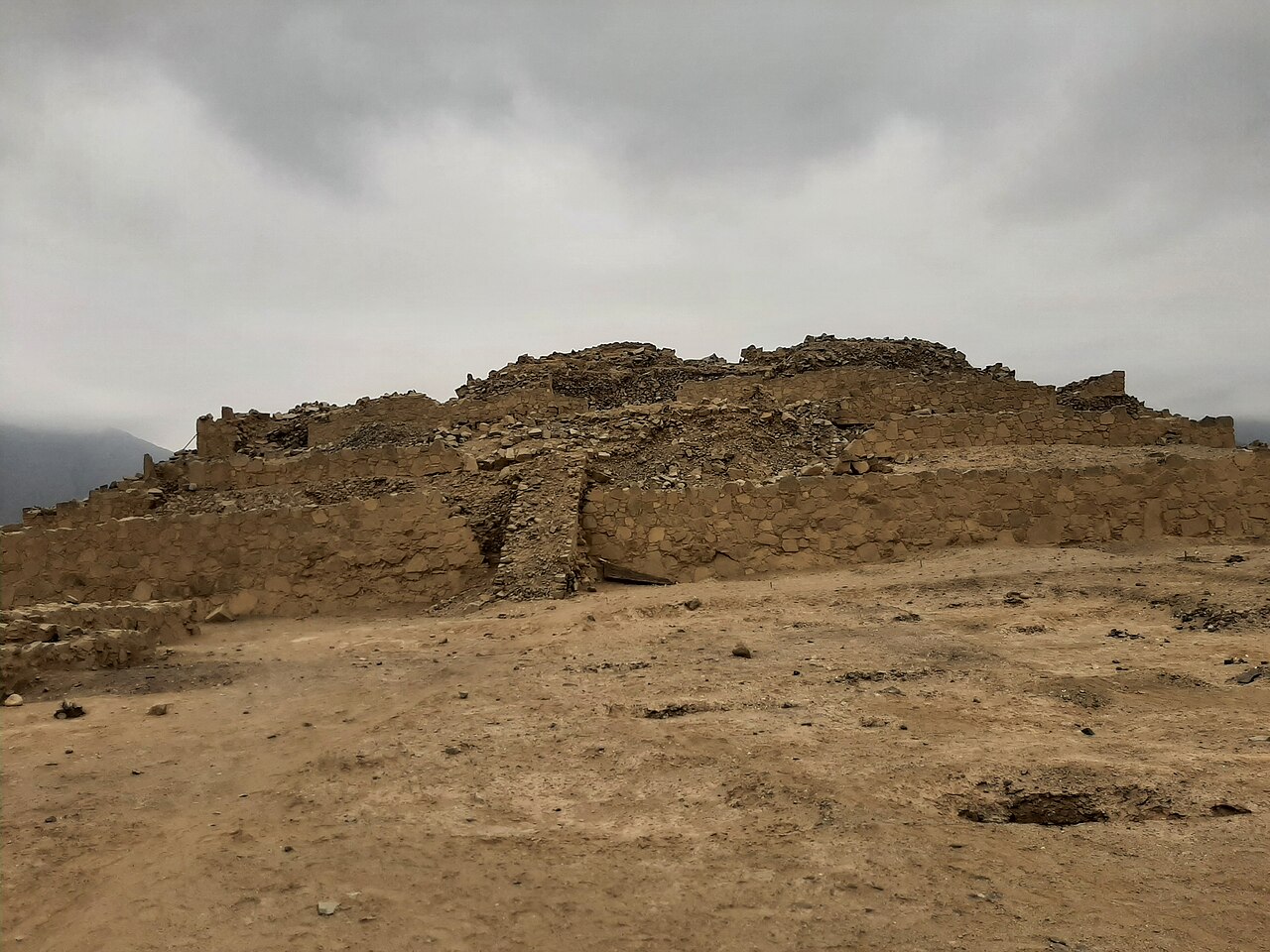
Caral, located approximately 23 kilometres from the Pacific coast in the middle Supe Valley at an elevation of about 350 metres, is the largest and most thoroughly investigated Norte Chico site. The settlement covers approximately 66 hectares and is dominated by six large platform mounds (sometimes called pyramids), the largest of which — the Pirámide Mayor — measures approximately 160 by 150 metres at its base and rises to a height of 18 metres. In addition to the major mounds, the site includes numerous smaller platform structures, at least two sunken circular plazas, residential areas of varying size and elaboration, and an amphitheatre-like structure that may have served a ceremonial function.1, 2, 9
The monumental architecture at Caral represents an enormous investment of organised labour. The platform mounds were constructed using a technique involving shicra bags — woven mesh bags filled with stones and rubble that served as modular building units, allowing rapid construction and periodic enlargement through successive phases of filling and resurfacing. This construction method, which is characteristic of Norte Chico architecture more broadly, has been interpreted as evidence of organised work parties, possibly drawn from different social groups, each contributing filled bags to a communal building project.2, 9
The sunken circular plazas, typically 20 to 40 metres in diameter and several metres deep, are among the most distinctive architectural features of Norte Chico settlements. These structures, which appear at multiple sites across the region, are thought to have served as ceremonial or public gathering spaces. Their sunken design would have created an amphitheatre-like setting in which participants stood or sat along the sloping walls while activities took place in the central floor area. Similar sunken circular plazas appear in later Andean architectural traditions, suggesting continuity of ritual practices over several millennia.2, 15
Maritime-agricultural economy
The economic basis of Norte Chico civilization has been one of the most debated aspects of the society, touching on fundamental questions about the relationship between subsistence strategies and the emergence of social complexity. In 1975, Michael Moseley proposed the influential Maritime Foundations of Andean Civilization (MFAC) hypothesis, arguing that the rich marine resources of the Peruvian coast — particularly anchovies and sardines, whose enormous abundance is driven by the cold, nutrient-rich Humboldt Current — provided a subsistence base sufficient to support sedentary communities and the development of complex social organisation without dependence on intensive agriculture.6, 7
Archaeological evidence from Norte Chico sites has broadly supported Moseley's hypothesis while adding important nuances. Faunal remains from Caral and other sites confirm that marine resources, particularly anchovies and shellfish, constituted a major component of the diet, even at inland sites located more than 20 kilometres from the coast. Cotton and gourds were among the most important cultivated plants, used not as food crops but as essential components of the fishing economy: cotton provided fibre for fishing nets and lines, while gourds served as net floats.1, 4 This interdependence between maritime fishing and agricultural production of industrial crops suggests a symbiotic economic relationship between coastal fishing communities and inland farming settlements, with exchange networks linking the two zones.4, 10
Food crops, including squash, beans, and achira (an edible root), supplemented the marine diet, and there is evidence of small-scale irrigation in the Supe Valley. Notably, maize — which would later become the staple crop of most Andean civilisations — is largely absent from Norte Chico deposits, indicating that complex society here developed on a fundamentally different subsistence base than the maize-dependent civilisations that emerged later in both the Andes and Mesoamerica.1, 12
Social organisation and the absence of warfare
The scale of monumental construction at Norte Chico sites implies a society capable of mobilising and coordinating the labour of hundreds or thousands of workers over extended periods, which in turn suggests some form of centralised authority or institutionalised leadership. However, the nature of that authority remains difficult to characterise given the absence of written records and the limited evidence for marked social stratification in residential architecture or burial practices during the earliest phases of occupation.4, 10
Haas and Creamer have argued that Norte Chico represents an early stage in the development of political authority in which leaders mobilised labour through ideological or religious persuasion rather than coercive force. This interpretation is supported by the prominent role of ceremonial architecture (particularly the sunken circular plazas and the central position of the platform mounds within settlements), the discovery of elaborate offerings and possible feasting debris in association with public architecture, and the finding of musical instruments — including 32 flutes carved from condor and pelican bones at Caral — that suggest organised ritual performance.2, 10
One of the most remarkable aspects of Norte Chico is the apparent absence of evidence for organised warfare or military conflict. Excavations at Caral and other sites have yielded no weapons, no defensive fortifications, no depictions of warfare, and no evidence of violent death in the limited skeletal remains that have been recovered. This pattern is striking given that warfare is commonly invoked as a primary driver of political centralisation in comparative models of state formation. If the absence of warfare evidence at Norte Chico is genuine rather than an artefact of incomplete excavation, it suggests that complex social organisation can emerge through cooperative mechanisms — economic interdependence, shared ritual practice, or communal construction projects — without the impetus of military competition.2, 9, 10
Technology and material culture
Norte Chico is classified as a pre-ceramic civilisation, meaning that its inhabitants did not manufacture fired pottery — an absence that is nearly unique among the world's early complex societies and that long obscured the antiquity of these sites from archaeologists accustomed to using ceramic typology as the primary tool of chronological classification. Food preparation relied instead on the roasting of foods in hearths and the use of gourds as containers for storage and possibly cooking using heated stones.1, 13
Norte Chico also lacked a writing system in any conventional sense. However, the discovery at Caral of a quipu — a recording device consisting of knotted strings suspended from a main cord — dating to approximately 2600 BCE represents the earliest known example of this technology, predating the well-documented Inca quipu system by roughly four thousand years. This finding, published by Shady Solís and colleagues in 2005, suggests that the quipu tradition has far deeper roots in Andean civilisation than previously recognised and raises the possibility that knotted-string recording served administrative or mnemonic functions even at this early stage of social complexity.11
Textile production, particularly the weaving of cotton into fishing nets and other utilitarian fabrics, was a central technology of Norte Chico society. The importance of cotton is reflected in both the archaeological record — where cotton seeds, fibres, and net fragments are among the most common plant remains — and in the agricultural economy, where the cultivation of cotton for industrial purposes appears to have taken precedence over food crop production.1, 4
Comparative significance
The Norte Chico civilisation is one of approximately six regions worldwide where complex, urbanised society is thought to have emerged independently, without significant influence from pre-existing civilisations. The others are Mesopotamia, Egypt, the Indus Valley, China, and Mesoamerica. The chronological overlap with Old World civilisations is striking: while the earliest Sumerian cities date to around 3500 BCE and the Egyptian state emerged around 3100 BCE, Norte Chico's monumental construction began by approximately 3000 BCE, making it nearly contemporary with these better-known developments despite being separated from them by thousands of kilometres of ocean.1, 14
Yet the specific trajectory of Norte Chico diverges from Old World patterns in important ways. The absence of pottery, writing, and intensive cereal agriculture — the three technologies most commonly associated with early complex societies in the Old World — challenges the assumption that these innovations are prerequisites for civilisational development. Norte Chico demonstrates that monumental architecture, organised religion, long-distance trade networks, and centralised political authority can emerge on a foundation of marine resources and industrial crop production, without the grain-based agricultural surplus that underpins most models of state formation derived from Mesopotamian and Egyptian evidence.7, 14
Decline and legacy
The Norte Chico civilisation declined and its major centres were abandoned by approximately 1800 BCE, a process that appears to have been gradual rather than catastrophic. The causes of the decline remain uncertain, but proposed factors include environmental changes such as El Niño-related disruptions to the marine ecosystem, the silting of irrigation canals, tectonic uplift affecting coastal water tables, and the possibility that the centre of gravity of Andean social development shifted to other regions as new subsistence strategies — particularly maize agriculture — became more productive.13, 15
The influence of Norte Chico on subsequent Andean civilisations is a subject of active investigation. Architectural features characteristic of Norte Chico — particularly the sunken circular plaza, the platform mound, and the U-shaped temple plan — recur in later Andean traditions, including the Initial Period temples of the central coast and highlands, the Chavín horizon, and ultimately the monumental architecture of the Inca Empire. Whether these continuities reflect direct cultural transmission from Norte Chico or independent reinvention of similar solutions to common problems remains debated, but the growing body of evidence suggests that Norte Chico established architectural and ceremonial templates that persisted in the Andean cultural tradition for millennia.2, 13, 15
Caral was inscribed as a UNESCO World Heritage Site in 2009, recognising its exceptional universal value as evidence of the earliest known complex society in the Americas. Ongoing excavations led by Shady Solís and her team continue to reveal new information about the extent, chronology, and social organisation of the Norte Chico sites, ensuring that this civilisation — unknown to scholarship just three decades ago — increasingly takes its place alongside the great foundational civilisations of the Old World in the comparative study of how and why human societies first became complex.2, 14