Overview
- The Silk Road was a network of overland and maritime trade routes connecting East Asia, Central Asia, South Asia, the Middle East, and the Mediterranean world from approximately the second century BCE through the fifteenth century CE, facilitating the exchange of commodities including silk, spices, precious metals, horses, and glass across distances exceeding 7,000 kilometers.
- Archaeological evidence from sites along the routes — including the cave temples of Dunhuang, the desert cities of Palmyra and Petra, and the trading posts of Samarkand and Bukhara — reveals that the Silk Road transmitted not only goods but also religions (Buddhism, Christianity, Islam, Manichaeism), technologies (papermaking, gunpowder, printing), languages, artistic styles, and disease pathogens across cultural boundaries.
- The term 'Silk Road' (*Seidenstrasse*) was coined by the German geographer Ferdinand von Richthofen in 1877 and, while useful as a shorthand, obscures the complexity of the actual networks, which comprised multiple shifting routes, seasonal caravan tracks, maritime corridors, and local exchange systems rather than a single continuous road.
The Silk Road refers to the network of overland and maritime trade routes that connected the civilizations of East Asia, Central Asia, South Asia, the Middle East, and the Mediterranean basin from the late second century BCE through the fifteenth century CE. These routes facilitated the long-distance exchange of silk, spices, precious metals, gemstones, horses, and manufactured goods across thousands of kilometers of steppe, desert, and mountain terrain.1, 2 The routes simultaneously served as corridors for the transmission of religions, technologies, languages, artistic traditions, and disease pathogens, making them among the most consequential channels of cross-cultural interaction in human history.2
The term Seidenstrasse ("Silk Road") was coined by the German geographer Ferdinand von Richthofen in 1877 to describe the ancient trade connections between China and the Roman world.16 While the name has become standard, it is misleading in several respects: the "road" was not a single route but a shifting network of paths; silk was only one of many commodities exchanged; and most merchants traveled only segments of the route, passing goods through a chain of intermediaries rather than journeying from one end to the other.1, 3

Origins and early routes
Long-distance exchange across Central Asia predates the historical Silk Road by millennia. Archaeological evidence of lapis lazuli from Afghanistan in Mesopotamian contexts dates to the fourth millennium BCE, and jade from the Khotan region of the Tarim Basin reached China's Central Plain during the Shang dynasty (c. 1600–1046 BCE).4 The formalization of regular diplomatic and commercial contact between China and the western regions is traditionally dated to the mission of Zhang Qian, dispatched by the Han Emperor Wu in 138 BCE to seek an alliance with the Yuezhi people against the Xiongnu confederation. Zhang Qian's journey, which lasted over a decade and took him through the Ferghana Valley and Bactria, provided the Han court with its first detailed knowledge of the peoples and products of Central and western Asia.7
Following Zhang Qian's reports, the Han dynasty established military garrisons and agricultural colonies along the corridor between the Gansu province and the Tarim Basin, creating the infrastructure that supported regular caravan traffic. The route from the Han capital at Chang'an (modern Xi'an) ran northwest through the Hexi Corridor to Dunhuang, where it divided into a northern route skirting the Taklamakan Desert along the Tian Shan mountain range and a southern route following the edge of the Kunlun Mountains. Both routes converged at Kashgar before crossing the Pamir Mountains into the Ferghana Valley and onward to Samarkand, Merv, and the Parthian Empire.1, 7
The western terminus of the overland routes reached the Roman Empire through intermediary Parthian and later Sasanian territories. Roman demand for Chinese silk, Indian spices, and Central Asian horses drove trade volumes, while Chinese markets valued Roman glass, gold coinage, and Mediterranean coral. Direct contact between Rome and China remained minimal — the Roman geographer Pliny the Elder (first century CE) knew of the "Seres" (silk people) only through intermediaries, and the Chinese Hou Hanshu records a Roman embassy reaching the Han court in 166 CE, though the account's reliability is debated.8
Key trading centers
The Silk Road's commercial activity concentrated at a series of oasis cities, caravan stations, and entrepots where routes converged and goods changed hands. Samarkand, located in the Zeravshan River valley of modern Uzbekistan, served as one of the most important nodes in the network. Under Sogdian control from the fifth through eighth centuries CE, Samarkand functioned as the commercial hub of Central Asia, and Sogdian merchants established trading colonies from China to Byzantium, becoming the principal intermediaries of overland Silk Road commerce.12
Dunhuang, at the eastern edge of the Taklamakan Desert, occupied a strategic position where the northern and southern routes around the desert converged before entering the Hexi Corridor toward China proper. The Mogao Caves near Dunhuang, constructed from the fourth through fourteenth centuries CE, contain nearly five hundred decorated cave temples with murals and sculptures reflecting Buddhist, Daoist, and Confucian traditions, along with manuscripts in Chinese, Tibetan, Sanskrit, Sogdian, Khotanese, and Uyghur — a testament to the linguistic and religious diversity of Silk Road traffic.6
In the western portion of the network, Palmyra in the Syrian Desert served as a crucial intermediary between the Roman Mediterranean world and Mesopotamian trade routes. Palmyrene merchants maintained trading stations at the head of the Persian Gulf and along the Euphrates, handling goods arriving from both overland Central Asian routes and maritime routes from India. The city's monumental colonnaded streets, temple complex, and elaborate tower tombs reflect the wealth accumulated through this commerce.11 Petra, capital of the Nabataean kingdom in modern Jordan, controlled trade routes linking the Arabian Peninsula with the Mediterranean, handling the incense trade from southern Arabia alongside goods arriving from India via the Red Sea.2
Commodities exchanged
Silk, produced in China through sericulture (the cultivation of silkworms, Bombyx mori), was the most iconic commodity moving westward along the routes. Chinese silk production was a closely guarded state monopoly for centuries, and the fabric reached Roman markets at prices comparable to gold by weight. Roman demand for silk was so significant that Pliny the Elder lamented the drain of Roman gold to pay for it.2, 8 The technology of silk production eventually diffused westward — according to the sixth-century historian Procopius, silkworm eggs were smuggled to the Byzantine Empire by monks concealing them in hollow canes during the reign of Justinian I (c. 552 CE).2
The movement of goods was bidirectional and diverse. Eastward-moving commodities included Roman glassware, gold and silver coins, Mediterranean coral, woolen and linen textiles, wine, and metalwork. Westward-moving goods included Chinese silk, lacquerware, and ceramics, as well as spices (pepper, cinnamon, cloves) from Southeast Asia and India, gemstones (rubies, sapphires, lapis lazuli) from mines in modern Afghanistan, Myanmar, and Sri Lanka, and horses from the Ferghana Valley, which the Chinese called "blood-sweating horses" (hanxue ma) and prized for military use.1, 4
Major commodities by direction of trade1, 2
| Direction | Commodity | Origin | Primary destination |
|---|---|---|---|
| East to West | Silk | China | Rome, Persia, Byzantium |
| East to West | Porcelain | China | Islamic world, Europe |
| East to West | Spices | India, Southeast Asia | Rome, Persia |
| West to East | Glassware | Roman Empire, Syria | China, Central Asia |
| West to East | Gold coinage | Rome, Byzantium | India, Central Asia |
| Central to East | Horses | Ferghana Valley | China |
| Central to all | Lapis lazuli | Badakhshan (Afghanistan) | Mesopotamia, Egypt, China |
Religion and cultural transmission
The Silk Road served as the primary conduit for the spread of Buddhism from India to Central and East Asia. Buddhist missionaries and merchants carried the religion along the trade routes beginning in the first century BCE, establishing monastic communities at oasis cities across the Tarim Basin. The cave temple complexes at Bamiyan (Afghanistan), Kizil (Xinjiang), and Dunhuang document the progressive transformation of Buddhist art as Indian iconographic traditions merged with Gandharan Greco-Buddhist styles and subsequently with Central Asian and Chinese artistic conventions.3, 6
Christianity spread eastward along the same routes. The Church of the East (often called Nestorian Christianity) established bishoprics across Persia, Central Asia, and eventually reached China, where a bilingual Chinese-Syriac stele erected in 781 CE at Chang'an records the arrival of the missionary Alopen in 635 CE and the establishment of a Christian community under Tang dynasty patronage. Manichaeism, the syncretic religion founded by the prophet Mani in third-century Persia, also traveled the Silk Road in both directions, gaining adherents from Roman North Africa to the Uyghur Khaganate of Mongolia.3, 4
Islam reached Central Asia through Arab conquests in the seventh and eighth centuries and subsequently spread along trade routes into western China, Southeast Asia, and sub-Saharan Africa. The Battle of Talas in 751 CE, in which Abbasid forces defeated a Tang Chinese army in modern Kazakhstan, is conventionally seen as a turning point in the religious and political orientation of Central Asia toward the Islamic world, though the process of conversion was gradual and extended over several centuries.4
Technology transfer
The transmission of technologies along the Silk Road had consequences that extended far beyond the exchange of material goods. Papermaking, developed in China during the Han dynasty (traditionally attributed to Cai Lun in 105 CE, though archaeological evidence suggests earlier origins), reached the Islamic world following the Battle of Talas in 751 CE. According to Arabic sources, Chinese prisoners of war brought papermaking knowledge to Samarkand, from which the technology spread to Baghdad, Damascus, Egypt, and eventually to medieval Europe via Islamic Spain and Sicily.13
Gunpowder, developed in China by the ninth century CE, traveled westward through the Mongol Empire and Islamic intermediaries, reaching Europe by the thirteenth century. Printing technology, including both woodblock printing (developed in China by the seventh century) and movable type (invented by Bi Sheng in the 1040s), also spread westward, though the relationship between East Asian printing and Gutenberg's fifteenth-century European invention remains debated.2, 13
Agricultural exchanges were equally transformative. Central Asian grapes, alfalfa, and sesame reached China during the Han dynasty. Chinese peach and apricot cultivars spread westward. The introduction of new crop varieties, irrigation techniques, and pastoral practices along the routes altered subsistence patterns across Eurasia over centuries of sustained contact.1, 4
The maritime Silk Road
Alongside the overland routes, maritime trade corridors connected the South China Sea, the Indian Ocean, the Persian Gulf, and the Red Sea in a complementary network of seaborne commerce. Maritime trade between China and Southeast Asia is attested from the Han dynasty, and by the Tang dynasty (618–907 CE), Chinese ceramics, silk, and manufactured goods reached East Africa, the Arabian Peninsula, and the Mediterranean through a chain of port cities including Guangzhou (Canton), Srivijaya (Sumatra), Quilon (India), Siraf (Persia), and Aden (Yemen).14
The maritime routes carried bulk commodities that were impractical to transport overland, including timber, metals, ceramic cargo, and large quantities of spices. Shipwreck archaeology has provided direct evidence of this trade: the Belitung shipwreck (c. 830 CE), an Arab dhow discovered off the coast of Indonesia, contained over 60,000 pieces of Changsha-produced ceramics and quantities of gold and silver destined for markets in the Abbasid caliphate.14
The maritime Silk Road gained increasing importance from the Song dynasty (960–1279 CE) onward, as China's economic center shifted southward and innovations in shipbuilding, navigation (including the magnetic compass), and maritime organization made sea transport more efficient than overland caravan traffic. By the fifteenth century, the Ming dynasty's maritime expeditions under the admiral Zheng He (1405–1433) demonstrated the reach of Chinese naval power across the Indian Ocean, though the voyages were subsequently curtailed and the maritime routes eventually came to be dominated by Portuguese, Dutch, and British commercial interests.2, 14
Disease and demographic impact
The same routes that transmitted goods, ideas, and technologies also served as corridors for the spread of infectious diseases. The Antonine Plague (165–180 CE), which killed an estimated five million people across the Roman Empire, is believed to have been carried westward along trade routes from Central or South Asia, possibly by Roman soldiers returning from campaigns in Mesopotamia.2 The Plague of Justinian (541–549 CE), caused by Yersinia pestis, reached Constantinople from Egypt and spread across the Mediterranean world, though recent paleogenomic and demographic research has produced divergent assessments of its overall mortality impact.9
The most devastating pandemic transmitted along Silk Road networks was the Black Death of the fourteenth century. Genomic analysis of Yersinia pestis strains has traced the origin of the medieval pandemic to Central Asia, from which it spread westward through Mongol-controlled trade routes to the Crimean port of Caffa and thence by ship to Mediterranean ports in 1347. The plague killed an estimated 30 to 60 percent of Europe's population and caused comparable devastation across the Middle East and Central Asia, disrupting trade networks and contributing to the decline of overland Silk Road commerce.10
Ancient DNA studies have also illuminated the demographic history of populations along the Silk Road corridors. A 2019 study analyzing ancient genomes from Central and South Asia spanning four millennia documented successive waves of genetic admixture associated with pastoralist migrations, Indo-European expansions, and sustained population contact along the routes, demonstrating that the Silk Road was not merely a conduit for goods and ideas but a zone of sustained human movement and genetic exchange.5
The Sogdians and merchant networks
The Sogdians, an Iranian-speaking people centered on the Zeravshan River valley (modern Uzbekistan and Tajikistan), were the dominant merchant community of the overland Silk Road from the fifth through eighth centuries CE. Sogdian trading colonies have been identified archaeologically from the Black Sea to China, forming a commercial diaspora that operated as a coherent network maintained through shared language, religion (primarily Zoroastrian, later also Manichaean and Buddhist), and kinship ties.12
The Sogdian Ancient Letters, a collection of correspondence dating to approximately 313 CE discovered near Dunhuang, provide a rare glimpse into the operations of Sogdian merchant networks in China. The letters describe commercial transactions, family obligations, and the disruption caused by Xiongnu raids, revealing a tightly organized community managing long-distance trade across political boundaries. Sogdian served as the lingua franca of Silk Road commerce, and Sogdian merchants acted as translators, diplomats, and cultural intermediaries between Chinese, Turkic, and Iranian civilizations.12
The Arab conquests of Central Asia in the seventh and eighth centuries and the subsequent Islamization of the region gradually displaced Sogdian commercial networks, though Sogdian cultural and linguistic influence persisted for centuries. The Sogdian merchant diaspora represents one of the clearest archaeological and textual examples of how Silk Road commerce was organized — not as a unified system managed by states but as overlapping networks of private merchants, caravan leaders, and local intermediaries operating across political and cultural frontiers.4, 12
Decline and legacy
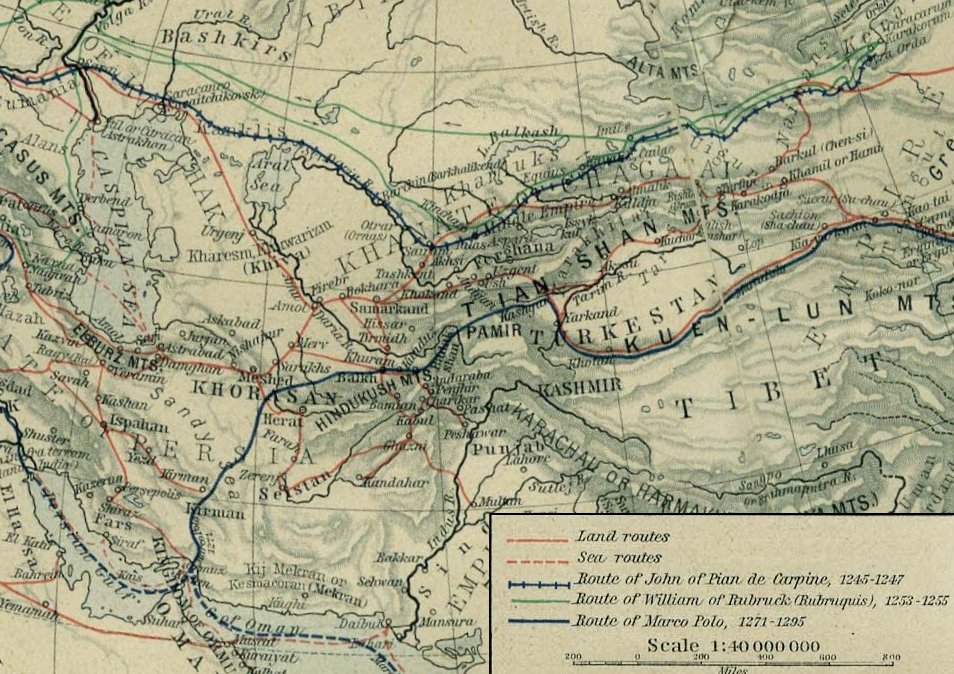
The overland Silk Road reached its greatest extent and most intensive use during the Mongol Empire (thirteenth–fourteenth centuries), when a single political authority controlled territory from China to eastern Europe and actively promoted trade, communication, and movement across the empire. The Pax Mongolica allowed travelers such as Marco Polo, the Franciscan friars William of Rubruck and John of Plano Carpini, and the Moroccan traveler Ibn Battuta to cross the full breadth of Eurasia under relatively safe conditions.2
The fragmentation of the Mongol Empire in the mid-fourteenth century, combined with the devastation of the Black Death, the rise of maritime commerce, and the increasing political instability of Central Asia under successor states, led to the gradual decline of overland Silk Road trade. The Portuguese discovery of a sea route to India around the Cape of Good Hope in 1498 and the subsequent establishment of European maritime empires in the Indian Ocean shifted the primary channels of Eurasian commerce from overland to oceanic routes.2, 14
The Silk Road's legacy extends far beyond its commercial function. UNESCO has designated sections of the route network as World Heritage Sites, recognizing their significance as corridors of cultural exchange that shaped the development of civilizations across Eurasia.15 Archaeological research continues to expand understanding of the routes' extent, the diversity of peoples who used them, and the mechanisms by which goods, technologies, and ideas traveled between distant societies over two millennia of sustained interaction.1, 3
References
Empires of the Silk Road: A History of Central Eurasia from the Bronze Age to the Present