Overview
- The Viking Age (c. 793–1066 CE) was a period of Scandinavian expansion driven by maritime technology, population pressure, and political fragmentation, during which Norse seafarers from modern Denmark, Norway, and Sweden established trade networks, raided coastal settlements, and founded permanent colonies from Iceland and Greenland to Normandy, the British Isles, and the Rus' territories of eastern Europe.
- Norse society was organized around kinship networks, legal assemblies (things), and a hierarchical system of kings, jarls, karls, and thralls, with social mobility achieved through trade, military service, and overseas settlement, while women held property rights and managed estates during male absence.
- Archaeological evidence from ship burials at Oseberg and Gokstad, urban centers at Birka and Hedeby, runic inscriptions, and ancient DNA studies has transformed understanding of the Viking Age from a narrative focused exclusively on raiding to a more complex picture encompassing long-distance trade, craft specialization, cultural exchange, and the gradual adoption of Christianity.
The Viking Age, conventionally dated from the raid on the monastery of Lindisfarne in 793 CE to the Battle of Stamford Bridge in 1066 CE, represents one of the most significant periods of Scandinavian cultural expansion in human history. During these three centuries, Norse-speaking peoples from the regions corresponding to modern Denmark, Norway, and Sweden established trade routes spanning from Baghdad to Newfoundland, founded lasting political entities across the North Atlantic and eastern Europe, and developed a literary and artistic tradition whose influence persists in European culture.1, 2
The popular image of Vikings as exclusively raiders and plunderers reflects the perspective of the monastic chroniclers who were their primary victims. Archaeological evidence, numismatic finds, and ancient DNA analysis have revealed a more complex reality in which raiding, trading, farming, and craft production were interwoven activities undertaken by the same populations and often by the same individuals at different stages of their lives.4, 3
Origins and causes of expansion
The causes of Scandinavian expansion in the late eighth century remain debated. No single factor adequately explains why populations that had occupied southern Scandinavia for millennia suddenly began projecting military and commercial power across vast distances. Several contributing factors have been proposed: population growth exceeding the agricultural carrying capacity of Scandinavian farmland, particularly in Norway's narrow coastal valleys; the development of the clinker-built sailing vessel, which gave Norse seafarers a decisive technological advantage in open-ocean navigation; political consolidation under emerging regional kings, which displaced rival chieftains and their followers; and the wealth of undefended monasteries and trading centers in western Europe, which provided both motive and opportunity for armed expeditions.2, 1
The maritime technology that made the Viking Age possible had deep roots in Scandinavian boat-building tradition. The Nydam ship (c. 310–320 CE) and the Sutton Hoo ship (early seventh century) document the development of clinker construction — overlapping strakes riveted together and attached to internal frames — centuries before the Viking Age. The critical innovation was the addition of a sail to this hull form, which appears to have occurred in Scandinavia during the seventh or early eighth century, though the precise date remains uncertain because early sails leave few archaeological traces.7 The resulting vessel — shallow-drafted, flexible, capable of both rowing and sailing, and light enough to be portaged overland — was equally suited to river navigation, coastal raiding, and open-ocean crossing.1
Social organization
Norse society was stratified into several broad categories. The Rígsþula, a mythological poem likely composed in the tenth century, describes a tripartite division into thralls (þrælar), free farmers (karlar), and nobles (jarlar), each descended from the god Ríg (identified with Heimdall) through unions with women of different social standing.7 In practice, social organization was more fluid. Kings (konungar) ruled over territories that were often contested and unstable. Jarls governed regions on behalf of kings or independently. The majority of the population consisted of free farmers (bóndi, plural bœndr) who owned land, bore arms, and participated in the legal assemblies that governed Norse communities.1
Thralls — enslaved persons — occupied the lowest social stratum. Slavery was integral to the Norse economy, and the slave trade was one of the most profitable commodities in Viking commerce. Captives taken in raids on the British Isles, the Frankish kingdoms, and the Slavic lands of eastern Europe were sold in markets at Hedeby, Birka, and ultimately in the Islamic world, where Scandinavian merchants exchanged human cargo for silver.2, 11 Ancient DNA evidence from Viking Age burials has confirmed the presence of individuals of non-Scandinavian genetic ancestry in Norse settlements, consistent with the textual evidence for enslaved populations brought from the British Isles and elsewhere.4
Women in Norse society held legal rights that were unusual by contemporary European standards. Free women could own property, initiate divorce, and inherit land. During the extended absences of men on trading or raiding expeditions, women managed farms and estates with full authority.13 The 2017 DNA analysis of a high-status warrior burial at Birka (grave Bj 581), originally excavated in the nineteenth century and long assumed to contain a male, revealed that the individual was female, prompting renewed debate about women's roles in Viking military culture.15
Thing assemblies and law
The þing (thing) was the central institution of Norse governance — a periodic assembly at which free men gathered to settle disputes, pronounce judgments, and make collective decisions. Things operated at multiple levels: local assemblies handled routine disputes, while regional and national assemblies addressed matters of broader significance.7 The Icelandic Althing, established around 930 CE at Thingvellir, is the best-documented example of this institution and continued to function as a legislative and judicial assembly into the modern period.14
Norse law was oral, preserved and recited by designated lawspeakers (lögsögumaðr) who memorized the legal code and recited portions of it at each assembly. The legal system was based on compensation rather than punishment: injuries, killings, and property disputes were resolved through negotiated payments (wergild or baugr) calibrated to the social status of the parties involved. When negotiation failed, disputes could escalate to formal dueling (hólmganga) or, in extreme cases, outlawry — the declaration that an individual was outside the protection of the law and could be killed without legal consequence.1, 7
Western expansion
The western expansion of Norse activity, dominated by Norwegians and Danes, proceeded in stages. The earliest documented raids struck monastic targets in the British Isles: Lindisfarne in 793, Iona in 795, and numerous Irish monasteries in the following decades.3 These raids evolved into seasonal campaigns, then into overwintering, and finally into permanent settlement. The Great Heathen Army that invaded England in 865 CE marked a transition from raiding to conquest, resulting in the establishment of the Danelaw — a region of eastern and northern England under Norse political and legal control.2
In the North Atlantic, Norse settlers colonized the Faroe Islands (c. 825 CE), Iceland (c. 870–930 CE), Greenland (c. 985 CE), and briefly established a presence at L'Anse aux Meadows in Newfoundland (c. 1000 CE), the westernmost point of pre-Columbian European contact with North America.16 The Icelandic settlement is the best documented through both archaeological and textual sources. The Landnámabók (Book of Settlements) records the names and genealogies of approximately 400 original settlers, many of them Norwegian chieftains displaced by the political consolidation of Harald Finehair.14
Major Norse settlements and colonies1, 12
| Region | Approximate date | Origin | Outcome |
|---|---|---|---|
| Faroe Islands | c. 825 CE | Norway | Permanent Norse settlement |
| Iceland | c. 870–930 CE | Norway, British Isles | Independent commonwealth, Althing est. c. 930 |
| Danelaw (England) | 865–954 CE | Denmark, Norway | Absorbed into English kingdom |
| Normandy | 911 CE (Treaty of Saint-Clair-sur-Epte) | Denmark, Norway | Duchy of Normandy, Frankish assimilation |
| Greenland | c. 985 CE | Iceland | Abandoned by c. 1450 CE |
| Vinland (Newfoundland) | c. 1000 CE | Greenland, Iceland | Brief occupation, abandoned |
| Kievan Rus' | c. 750–900 CE | Sweden (Svear) | Ruling dynasty, Slavic assimilation |
Eastern expansion and the Rus'
The eastern expansion of Norse activity was dominated by Swedes (primarily from the Svealand and Gotland regions) who penetrated the river systems of eastern Europe from the mid-eighth century onward. These groups, known in Slavic and Byzantine sources as Rus' (a term whose etymology remains debated, possibly derived from the Finnish Ruotsi, meaning "men who row"), established trading posts along the Volkhov, Dnieper, and Volga rivers, creating commercial networks that connected the Baltic with Constantinople and the Abbasid Caliphate.11
The Primary Chronicle, a twelfth-century compilation of earlier sources, records that in 862 CE the Slavic and Finnic tribes of the Novgorod region invited the Varangian (Norse) leader Rurik to rule over them, establishing the dynasty that governed the Kievan Rus' state until 1598. The historicity of this "invitation" narrative is debated, but the archaeological evidence from sites such as Staraya Ladoga, Gnezdovo, and the Ryurikovo Gorodishche settlement near Novgorod confirms a significant Scandinavian presence in the region from the mid-eighth century.11 Grave goods of Scandinavian type, including oval brooches, Thor's hammer pendants, and boat rivets, coexist with Slavic and Finnic material culture at these sites, indicating cultural interaction and gradual assimilation.1
The trade routes through eastern Europe brought vast quantities of Islamic silver to Scandinavia. Hoards of Abbasid and Samanid dirhams are among the most common coin finds in Viking Age Sweden, and the distribution of these hoards traces the commercial routes from the Caspian Sea through the Volga to Gotland and the Swedish mainland.6 This eastern silver flow peaked in the tenth century and declined sharply after the disruption of Central Asian silver mining, contributing to a reorientation of Scandinavian trade toward the west and the increasing use of western European coinage.2
Urban centers and trade
The emergence of proto-urban trading centers marks one of the defining economic developments of the Viking Age. Hedeby (Haithabu), located at the base of the Jutland peninsula in modern northern Germany, was the largest Scandinavian settlement of the period, occupying approximately 24 hectares within a semicircular rampart. Excavations have revealed densely packed plots with workshops for metalworking, glass bead production, comb making from antler, and textile production, indicating a high degree of craft specialization.6 Birka, situated on the island of Björkö in Lake Mälaren, Sweden, functioned as a major eastern trade hub from the mid-eighth to the late tenth century, with imports including Rhenish glass, Frankish weapons, and Islamic silver.6
Other significant trading centers included Kaupang in southern Norway (the only known Viking Age town in Norway), Ribe in Denmark (with evidence of seasonal trading activity from as early as the 700s), and Dublin, which Norse settlers transformed from a longphort (ship camp) into one of the most important commercial centers in the Irish Sea region.1, 3 These centers were points of cultural contact where Scandinavian, Frankish, Slavic, and Islamic material culture intersected, and their archaeological deposits provide the richest evidence for the daily life and economic activities of Viking Age populations.
Religion and conversion to Christianity
Pre-Christian Norse religion was polytheistic, centered on a pantheon of deities including Odin (the all-father, god of war, poetry, and wisdom), Thor (god of thunder and protector of the common people), Freyr and Freyja (fertility deities associated with the Vanir), and numerous other figures attested in the Eddic and skaldic poetic traditions.10 Religious practice included sacrificial offerings (blót), seasonal festivals, consultation of seers (völur), and the veneration of ancestors. There were no professional priesthoods or fixed temples in the Christian sense, though certain individuals — particularly chieftains — presided over communal rituals, and some sites (such as the temple described by Adam of Bremen at Uppsala) served as regional cult centers.10
The conversion of Scandinavia to Christianity was a gradual process spanning approximately two centuries (c. 960–1160 CE). Denmark was the first Scandinavian kingdom to adopt Christianity officially, under Harald Bluetooth around 965 CE, an event commemorated on the Jelling runestone, which proclaims that Harald "made the Danes Christian."8 Norway followed under Olaf Tryggvason (r. 995–1000) and Olaf Haraldsson (r. 1015–1028), though the process involved considerable coercion and political resistance. Sweden's conversion was the most protracted, with the temple at Uppsala reportedly still functioning into the late eleventh century.8
The conversion process was not a simple replacement of one belief system by another. Archaeological evidence from the conversion period reveals hybrid practices: Thor's hammer pendants and Christian crosses found in the same graves, molds capable of casting both hammer amulets and crucifixes, and runic inscriptions invoking both Christ and the old gods.9 Winroth has argued that Scandinavian leaders adopted Christianity in part because it offered access to the political networks, literacy, and administrative structures of Christendom, making conversion as much a political and economic decision as a spiritual one.8
Runic writing and literary culture
The runic alphabet (fuþark, named for its first six characters) was the indigenous writing system of the Germanic-speaking peoples. The Elder Futhark, consisting of 24 characters, was in use from the second century CE onward. During the Viking Age, Scandinavians employed the Younger Futhark, a reduced alphabet of 16 characters that paradoxically represented a wider range of phonemes through ambiguous letter values.9
Runic inscriptions appear on a wide variety of objects and surfaces: memorial stones, weapons, amulets, combs, coins, and wooden sticks. The majority of surviving runic inscriptions are memorial stones erected in the late Viking Age (tenth and eleventh centuries), particularly in the Uppland region of Sweden, where over a thousand such stones have been recorded. These inscriptions typically follow a formulaic pattern: the name of the commissioner, the relationship to the deceased, and occasionally information about the deceased's travels, military service, or manner of death.9 The inscription on the Rök stone in Östergötland (c. 800 CE), the longest known runic text, demonstrates that runic writing could also serve literary and commemorative purposes far beyond simple memorialization.1
The literary culture of the Viking Age is known primarily through texts written down in the twelfth and thirteenth centuries, after the conversion to Christianity introduced Latin literacy. The Eddic poems, the skaldic verse tradition, and the Icelandic sagas preserve oral traditions that originated in the Viking Age, though their written forms inevitably reflect the concerns and perspectives of their later scribes.10
Archaeological evidence and DNA studies
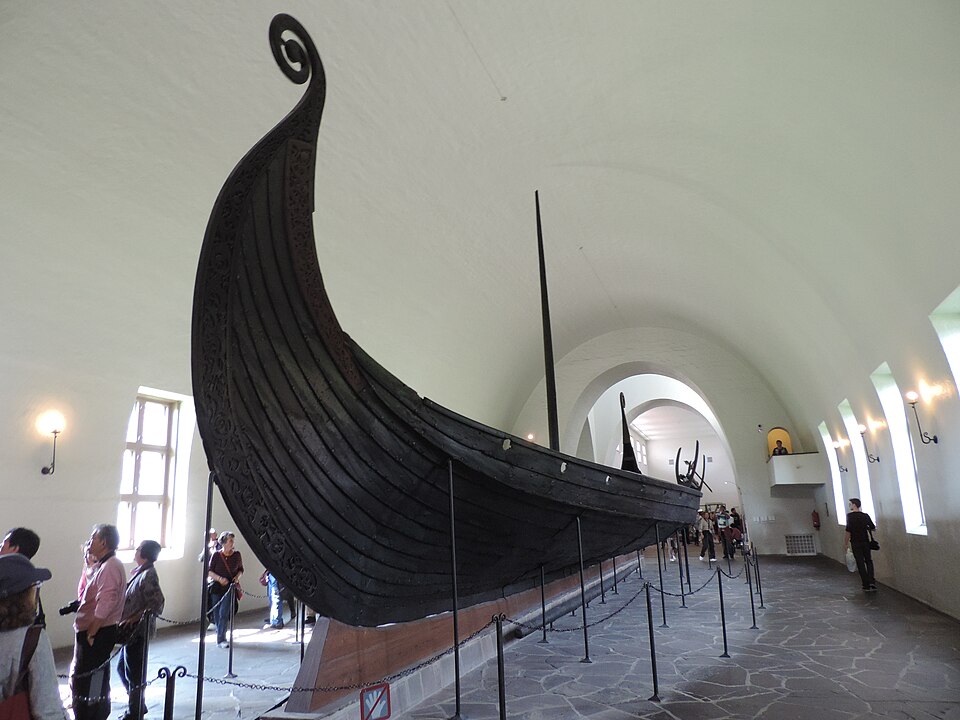
The material culture of the Viking Age is known from a rich and growing body of archaeological evidence. Ship burials represent the most spectacular funerary monuments of the period. The Oseberg ship burial (c. 834 CE), excavated in 1904 from a mound near Tønsberg, Norway, contained a richly carved clinker-built vessel along with a cart, sledges, textiles, wooden carvings, and the remains of two women — one aged approximately 50–60 years and the other approximately 25–30 years.5 The Gokstad ship (c. 900 CE), also from Vestfold, Norway, contained a male burial and a vessel of more seaworthy construction that was successfully replicated and sailed across the Atlantic in 1893.

A 2020 study published in Nature analyzed ancient DNA from 442 Viking Age individuals excavated across Scandinavia, the British Isles, Iceland, Greenland, and eastern Europe.4 The results demonstrated that Viking Age populations were genetically diverse, with significant gene flow from the British Isles, southern Europe, and central Asia. The study also revealed that the directional patterns of expansion correlated with geography: Danish Vikings predominantly raided and settled in England, Norwegian Vikings colonized the North Atlantic, and Swedish Vikings moved eastward into the Baltic and Russia. However, exceptions to these patterns were common, and the genetic data confirmed that Viking expeditions were not ethnically homogeneous — individuals of non-Scandinavian ancestry participated in raids and settlements alongside those of Scandinavian descent.4
Settlement archaeology has expanded understanding of everyday life beyond the elite burials and military campaigns emphasized in textual sources. Excavations at farmsteads throughout Scandinavia, Iceland, and the Norse colonies reveal longhouse construction, animal husbandry focused on cattle and sheep, barley and oat cultivation in favorable locations, and fishing and marine mammal hunting in coastal communities.1, 12 The archaeological record increasingly demonstrates that the Viking Age was not a sharp break from preceding periods but rather an intensification of trends — maritime expansion, long-distance trade, political centralization — that had been developing throughout the Scandinavian Iron Age.