Overview
- The Wari (also spelled Huari) Empire was a major pre-Inca Andean state centred in the highlands of south-central Peru near modern Ayacucho, flourishing from approximately 600 to 1000 CE and exercising political and cultural influence over a territory stretching more than 1,300 kilometres along the Andean cordillera.
- The Wari developed a system of administrative centres connected by road networks, standardised architectural compounds, and a distinctive tradition of polychrome ceramics and elite textiles, creating an infrastructure of imperial governance that in many respects anticipated and may have directly influenced the later Inca Empire.
- Contemporary with but culturally distinct from the Tiwanaku state centred at Lake Titicaca, the Wari represent one of two competing models of highland Andean statecraft during the Middle Horizon period, and recent archaeological discoveries — including the intact royal tomb at El Castillo de Huarmey — have dramatically expanded understanding of Wari elite culture, craft production, and mortuary practices.
The Wari Empire (also spelled Huari) was a pre-Columbian Andean state that flourished from approximately 600 to 1000 CE, centred at its capital city of Huari near modern Ayacucho in the south-central Peruvian highlands. At its greatest extent, the Wari polity controlled or influenced a territory stretching over 1,300 kilometres along the Andean cordillera, from the Moquegua Valley in the south to the Cajamarca region in the north, encompassing diverse ecological zones from the arid Pacific coast to the high-altitude puna grasslands.1, 2 The Wari are considered one of the first expansionist states in the Andean highlands, and their administrative practices — including the construction of standardised architectural compounds at provincial centres, the development of road networks, and the use of khipu (knotted-string recording devices) — established precedents that the Inca Empire, arising some four centuries later, would develop to an unprecedented scale.2, 12 Together with the contemporary Tiwanaku civilisation centred at Lake Titicaca, the Wari defined the Middle Horizon period (approximately 550–1000 CE) of Andean chronology, a transformative era of political consolidation, long-distance exchange, and ideological integration across the central Andes.4, 6
The capital at Huari
The site of Huari, located at approximately 2,800 metres above sea level in the Ayacucho Basin of the central Peruvian highlands, was one of the largest urban centres in the pre-Columbian Americas during its florescence. Covering an estimated 1,000 to 2,000 hectares at its maximum extent (estimates vary depending on how dispersed peripheral settlement is counted), Huari dwarfed all other contemporary Andean sites and may have housed a population of 20,000 to 40,000 inhabitants during the Middle Horizon.3, 4
The city was characterised by massive stone-walled compounds with walls reaching heights of up to 12 metres, enclosing a dense warren of rooms, corridors, plazas, and multi-storey structures. The architectural layout of Huari appears organic rather than strictly planned, reflecting centuries of incremental construction and modification, though individual compounds display internal regularity that suggests organised institutional functions. The compound known as Cheqo Wasi, for example, contained elaborate subterranean mortuary chambers with finely cut and polished stone-block construction, indicating that ancestor veneration and elite mortuary ritual were central activities at the capital.3, 5
The adjacent site of Conchopata, located approximately 10 kilometres from Huari, functioned as a major centre for the production of elaborate ceremonial ceramics and appears to have been the locus of large-scale ritual feasting. Excavations by Isbell and Cook revealed enormous deposits of deliberately smashed oversized ceramic vessels decorated with images of the Staff God and other Wari religious iconography, interpreted as the remains of ritualised destruction following communal feasting events that served to reinforce social cohesion and political authority.13
Territorial expansion and administration
The mechanisms by which the Wari expanded their political control across such a vast territory remain one of the central questions in Andean archaeology. Unlike later historical empires with documentary records, the Wari left no written accounts of their conquests or administrative practices, and the evidence for imperial control must be inferred from the distribution of Wari-style architecture, ceramics, and other material culture at sites throughout the Andes.2
The most compelling evidence for Wari imperial administration comes from a network of provincial centres that share a distinctive architectural template: rectangular compounds divided by high walls into a series of cellular rooms and courtyards, with a standardised layout that recurs at sites separated by hundreds of kilometres. These compounds, found at sites including Pikillaqta in the Cusco region, Viracochapampa in the northern highlands, and Azángaro in the Huánta Valley, were clearly built to a plan imposed from the centre rather than developing organically from local traditions. Their uniform design suggests a deliberate imperial strategy of establishing administrative nodes throughout the territory, staffed by officials who managed labour, stored and redistributed goods, and projected Wari authority into provincial settings.2, 3
Pikillaqta, the best-preserved Wari provincial centre, is a massive planned settlement covering approximately 50 hectares in the Lucre Basin near Cusco. Its regular grid of high-walled compounds, plazas, and storerooms was constructed in a single building episode and shows relatively little evidence of long-term habitation, suggesting it may have functioned primarily as an administrative and ceremonial centre rather than a residential city. The scale of construction at Pikillaqta — involving an estimated 4.5 million cubic metres of construction material — demonstrates the Wari state's capacity to mobilise enormous quantities of labour far from its capital.3, 12
Roads and infrastructure
The Wari constructed road networks connecting their administrative centres, and these roads represent some of the earliest evidence of state-sponsored transportation infrastructure in the Andes. Katharina Schreiber's surveys in the Carhuarazo Valley and adjacent areas identified segments of Wari-period roads that were later incorporated into the more extensive Inca road system (Qhapaq Ñan), suggesting continuity of route planning and infrastructure development across several centuries.14
The relationship between Wari and Inca road systems is a subject of considerable scholarly interest, as it bears on the larger question of how much Inca imperial organisation was genuinely innovative and how much it drew on earlier Middle Horizon precedents. Schreiber has argued that the Wari road network, while less extensive than the later Inca system, established the basic template of connecting administrative centres via constructed pathways that facilitated the movement of goods, information, and personnel across the empire's territory. The Inca, in this view, expanded and systematised a pre-existing infrastructure rather than creating it from scratch.14, 12
Relationship with Tiwanaku
The Wari and Tiwanaku civilisations were the two dominant political entities of the Middle Horizon Andes, and their relationship — whether competitive, complementary, or largely independent — has been debated for decades. The two states were roughly contemporary, with Tiwanaku's florescence at its capital on the southern shore of Lake Titicaca overlapping significantly with the Wari period. Both shared certain iconographic elements, most notably the Staff God motif that appears prominently in both Wari and Tiwanaku art, suggesting participation in a shared religious tradition or cosmological framework.6, 7
Despite these iconographic connections, the Wari and Tiwanaku were fundamentally different in their political organisation and territorial strategies. Tiwanaku appears to have exercised influence primarily through colonisation, establishing diaspora communities in distant ecological zones (particularly the western valleys of Bolivia and Chile) that maintained cultural ties to the homeland without the standardised administrative architecture characteristic of the Wari. The Wari, by contrast, imposed a more centralised administrative presence through their network of planned provincial centres, suggesting a more coercive or bureaucratic model of imperial control.2, 7
The two polities appear to have maintained a frontier zone in the Moquegua Valley of southern Peru, where both Wari and Tiwanaku colonies have been identified in close proximity. The nature of their interaction in this zone — whether peaceful coexistence, economic competition, or military confrontation — remains uncertain, but the archaeological evidence suggests that both states maintained distinct communities and material culture traditions within the same valley system.4, 7
Material culture and craft production
Wari material culture is characterised by a distinctive tradition of polychrome ceramics, elaborate textiles, and lapidary work that reflect both high technical skill and a coherent iconographic programme. Wari ceramics are among the most recognisable in the Andean archaeological record: large, often oversized vessels decorated with complex polychrome designs featuring geometric patterns, stylised animal and plant motifs, and depictions of supernatural beings, all rendered in a palette that typically includes red, white, black, orange, and purple on a burnished surface.1, 13
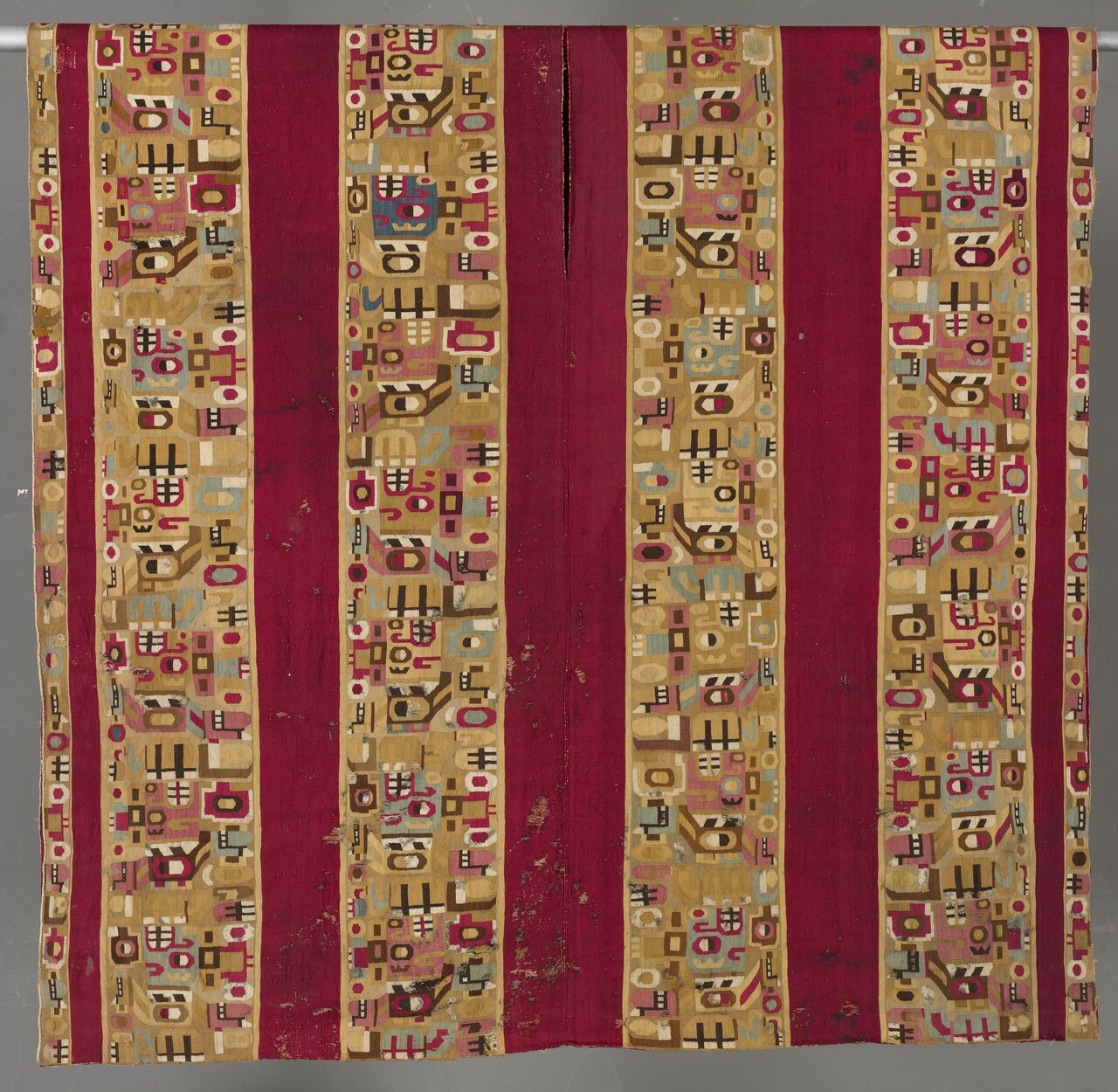
Wari textiles are considered among the finest products of the Andean weaving tradition, which is itself one of the most technically sophisticated textile traditions in human history. Using alpaca and cotton fibres dyed in brilliant colours, Wari weavers produced tapestry-woven garments of extraordinary complexity, with designs that required the coordination of hundreds of individual coloured weft threads to create intricate geometric and figurative compositions. These textiles appear to have served as markers of social status and political authority, with the finest examples found in elite burial contexts. The standardisation of certain textile designs across widely separated sites suggests that the Wari state controlled or regulated the production and distribution of high-status textiles as instruments of political integration.10, 1
Religion and iconography
The religious ideology of the Wari is known primarily through its iconographic expression in ceramics, textiles, and architectural sculpture. The central figure of Wari religious art is the Staff God, a frontal figure with an elaborate headdress, staring eyes, and outstretched arms holding staffs or other objects. This image, which also appears prominently in Tiwanaku art (most famously on the Gateway of the Sun at Tiwanaku), represents a shared Andean religious tradition whose roots extend back to the Chavín culture of the first millennium BCE and whose legacy persisted into Inca religion.11, 4
Cook has argued that the Staff God imagery served as a powerful tool of ideological legitimation for the Wari state, its consistent reproduction across widely separated sites functioning as a visual assertion of shared cosmological authority. The ritual destruction of oversized Staff God vessels at Conchopata and other sites suggests that the production, use, and destruction of these objects were integral to state-sponsored ceremonies that reinforced political and religious hierarchies.11, 13
The Wari are also associated with the early use of khipu, the knotted-string recording devices that the Inca later developed into a sophisticated system of accounting and possibly narrative communication. Gary Urton has identified khipu from Wari-period contexts, suggesting that the technology of encoding information in knotted strings was already in use during the Middle Horizon, providing the Wari administration with a means of record-keeping that did not depend on a written script.15
The royal tomb at El Castillo de Huarmey
One of the most significant recent discoveries in Wari archaeology is the intact royal tomb excavated at El Castillo de Huarmey on the Peruvian north coast, announced by Milosz Giersz and colleagues in 2013. The tomb, which had escaped looting, contained the remains of at least 58 individuals — including three elite women identified as probable queens or high-ranking nobles on the basis of their burial positions and associated offerings — along with more than 1,000 artefacts including gold and silver jewellery, elaborate bronze implements, alabaster drinking vessels, and some of the finest Wari textiles ever recovered.8, 9
The Huarmey discovery was transformative for several reasons. It provided the first intact elite burial context for the Wari, whose major sites in the Ayacucho heartland had been extensively looted over the centuries, depriving archaeologists of the contextual information needed to understand Wari social hierarchy and mortuary practices. The tomb demonstrated that the Wari elite invested enormous resources in funerary ritual and the provisioning of the dead, and the presence of elite female burials at the centre of the tomb complex suggested that women could hold high social and political status within the Wari hierarchy. The exceptional quality and diversity of the grave goods — which included objects of both highland and coastal origin — illustrated the breadth of the Wari exchange network and the capacity of the Wari state to concentrate wealth from across its territory.8, 9
Collapse and legacy
The Wari Empire collapsed around 1000 CE, a process that appears to have been relatively rapid and was broadly contemporaneous with the decline of Tiwanaku, suggesting that region-wide factors may have played a role. The capital at Huari was abandoned, and the provincial administrative centres were either abandoned or continued as independent local centres without their former connection to the imperial network. The causes of the collapse remain debated, but proposed factors include prolonged drought (ice core and other paleoclimate records indicate aridification in the central Andes during the tenth and eleventh centuries), internal political fragmentation, and the overextension of administrative capacity.4, 12
The centuries following the Wari collapse, known as the Late Intermediate Period (approximately 1000–1400 CE), saw the Andes revert to a patchwork of independent regional polities, many of which occupied former Wari territories and, in some cases, reused or were influenced by Wari architectural and administrative traditions. When the Inca began their imperial expansion from the Cusco region in the fifteenth century, they were not building in a political vacuum but rather reunifying a territory that had already experienced large-scale political integration under the Wari four centuries earlier.12, 2
The extent of direct Inca borrowing from Wari precedents is a subject of ongoing research. The parallels are striking: both empires were based in the highlands, both expanded along the Andean cordillera using road networks and administrative centres, both used khipu for record-keeping, and both employed standardised architectural templates at provincial installations. Whether these similarities reflect conscious Inca emulation of a remembered predecessor, the independent rediscovery of effective administrative solutions to common Andean geographical and logistical challenges, or some combination of both, the Wari Empire stands as a crucial chapter in the long history of political complexity in the Andes — a demonstration that the organisational achievements of the Inca, often presented as uniquely innovative, had deep roots in earlier Andean state traditions.2, 12, 14
References
The Wari Empire of Middle Horizon Peru: The Epistemological Challenge of Documenting an Empire without Documentary Evidence
Huari Administrative Structure: Prehistoric Monumental Architecture and State Government