Overview
- Brown dwarfs — substellar objects too low in mass to sustain hydrogen fusion — are classified into spectral types L, T, and Y based on their atmospheric properties, with effective temperatures ranging from roughly 2,200 K for the hottest L dwarfs down to below 300 K for the coldest known Y dwarfs, where ammonia ice and water ice clouds may form in atmospheres cooler than many planetary environments.
- The L-to-T spectral transition, occurring near 1,200–1,400 K, involves the dramatic clearing or disruption of silicate and iron cloud decks that dominate L dwarf atmospheres, revealing methane absorption bands that define the T spectral class — a rapid transformation whose physical mechanism remains one of the central unsolved problems in substellar atmosphere theory.
- Brown dwarf atmospheres serve as natural laboratories for understanding the atmospheric physics of giant exoplanets, since brown dwarfs share similar temperatures, compositions, and chemical processes but can be studied in isolation without the complication of host-star contamination, making them critical benchmarks for atmospheric models applied across the substellar mass range.
Brown dwarfs are substellar objects with masses between approximately 13 and 80 Jupiter masses — too low to sustain the hydrogen fusion that powers main-sequence stars, yet massive enough to have fused deuterium in their youth. Because they lack a sustained internal energy source, brown dwarfs cool continuously throughout their lifetimes, passing through a sequence of atmospheric states that give rise to the spectral types L, T, and Y. Their atmospheres are complex chemical and physical systems governed by molecular absorption, cloud formation, and atmospheric dynamics, sharing more in common with the atmospheres of giant planets than with those of ordinary stars. The study of brown dwarf atmospheres has become a cornerstone of both stellar classification at the bottom of the main sequence and the rapidly growing field of exoplanet atmospheric science.2, 14
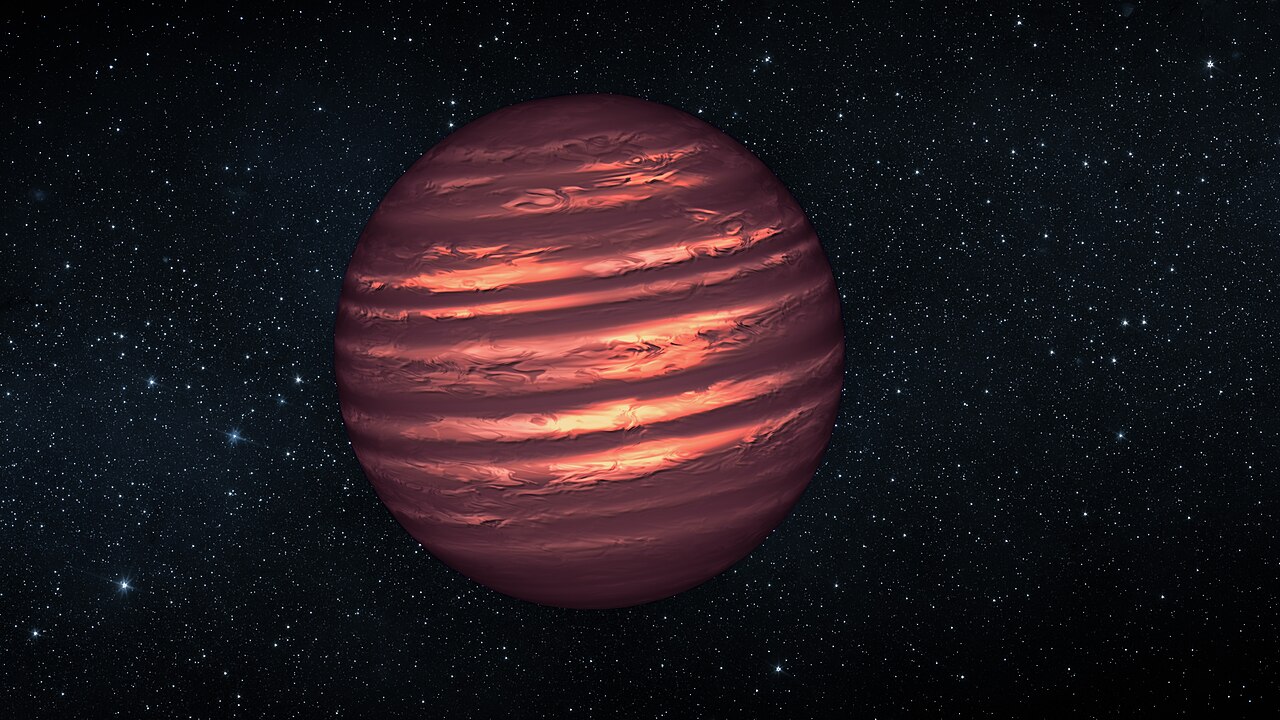

Spectral types L, T, and Y
The L spectral class, defined by Kirkpatrick and colleagues in 1999, encompasses objects with effective temperatures from approximately 2,200 K down to about 1,400 K. L dwarf spectra are dominated by absorption from metal hydrides (FeH, CrH) and alkali metals (sodium, potassium, rubidium, cesium) at optical wavelengths, with water vapor and carbon monoxide prominent in the near-infrared. The disappearance of the titanium oxide and vanadium oxide bands that characterize the coolest M-type stars marks the boundary between the M and L classes: at L dwarf temperatures, these refractory oxides condense into solid grains and are removed from the gas phase, fundamentally changing the atmospheric opacity structure. L dwarfs are correspondingly red in near-infrared color, owing to the combined effects of molecular absorption and the presence of condensate cloud layers in their upper atmospheres.2, 14
The T spectral class, spanning effective temperatures from roughly 1,400 K down to about 500 K, is defined by the appearance of strong methane absorption bands in the near-infrared — a feature first detected in the atmosphere of the brown dwarf Gliese 229B by Oppenheimer and colleagues in 1995, prior to the formal establishment of the T class. In T dwarf atmospheres, the chemical equilibrium shifts strongly in favor of methane over carbon monoxide as the dominant carbon-bearing molecule, producing deep absorption bands at 1.6 and 2.2 microns that give T dwarfs a dramatically bluer near-infrared color than L dwarfs. Water vapor absorption is also prominent, and the near-infrared spectral energy distribution is shaped into a series of flux peaks between the deep molecular absorption troughs.1, 3
The Y spectral class, the coolest currently recognized, was established for objects with effective temperatures below approximately 500 K, extending down to the coldest known brown dwarfs with temperatures near 250 K — cooler than the boiling point of water. The defining spectral feature of Y dwarfs is the appearance of ammonia absorption in the near-infrared, along with the continued strengthening of water and methane bands. The coldest Y dwarfs, discovered primarily by the Wide-field Infrared Survey Explorer (WISE), have atmospheric conditions in which water ice clouds may form, placing these objects in a temperature regime more commonly associated with the outer planets of the solar system than with stars. WISE J085510.83−071442.5, at approximately 250 K, is among the coldest known free-floating substellar objects.8, 15
Clouds and the L-to-T transition
Cloud formation is one of the most important physical processes shaping brown dwarf atmospheres. In L dwarfs, the atmospheres are warm enough that refractory species — including iron, silicates (enstatite, forsterite), and corundum (Al2O3) — condense into clouds of liquid and solid particles that form extensive cloud decks at altitudes where the temperature-pressure profile crosses the condensation curves of these species. These clouds are optically thick at near-infrared wavelengths and profoundly alter the emergent spectrum by suppressing molecular absorption features and reddening the spectral energy distribution. Cloud models must account for the microphysics of grain nucleation, growth, and sedimentation, as well as the competition between gravitational settling of cloud particles and upward mixing by atmospheric turbulence.7, 6
The transition from the cloudy L spectral class to the comparatively cloud-free T spectral class, occurring over a narrow temperature range near 1,200–1,400 K, is one of the most dramatic and least understood transformations in substellar atmosphere physics. Across this transition, the near-infrared colors shift rapidly from very red to relatively blue, the brightness at certain wavelengths changes non-monotonically, and the spectra transform from cloud-dominated to methane-dominated within a range of only 100–200 K in effective temperature. Several competing models have been proposed to explain this rapid transition. In the cloud-clearing or cloud-disruption scenario, the silicate and iron clouds break up into patchy coverage as the atmosphere cools, allowing flux to emerge from hotter, deeper layers through cloud holes. In the rainout scenario, the cloud particles grow large enough to sediment efficiently below the photosphere, removing the cloud deck from view. The rapidity of the color change and the apparent scarcity of objects at intermediate L/T types suggest that whatever physical process drives the transition operates as a threshold phenomenon rather than a gradual evolution.3, 7
Weather and atmospheric dynamics
Brown dwarfs exhibit photometric and spectroscopic variability on timescales of hours, consistent with rotational modulation of surface inhomogeneities — in essence, weather. The first clear detection of periodic variability attributed to weather patterns was reported for the L/T transition brown dwarf SIMP J013656.5+093347, which shows brightness variations of several percent over its approximately 2.4-hour rotation period. Subsequent monitoring campaigns using ground-based telescopes and the Spitzer and Hubble space telescopes have revealed that variability is common across the L, T, and Y spectral classes, with amplitudes ranging from less than 1% to over 10%. The variability is wavelength-dependent, with different infrared bands probing different atmospheric depths and thus different cloud structures, providing vertical information about the three-dimensional structure of the atmosphere.9, 10
Theoretical models of brown dwarf atmospheric dynamics predict that these objects should exhibit large-scale banded circulation patterns analogous to Jupiter’s zonal jets, driven by the combination of rapid rotation (most brown dwarfs have rotation periods of a few hours) and internal convective heat flux. General circulation models by Showman and Kaspi predict equatorial jets and mid-latitude bands with wind speeds of hundreds of meters per second. The observed variability, which evolves in amplitude and phase over multiple rotation periods, is consistent with the presence of time-variable cloud structures shaped by these atmospheric flows. The connection between observed variability patterns and the underlying circulation remains an active area of research, with multi-wavelength, time-resolved observations providing increasingly detailed constraints on the three-dimensional atmospheric structure.11, 13
Connection to giant planet atmospheres
Brown dwarf atmospheres span the same temperature range as the atmospheres of directly imaged giant exoplanets, and they share the same dominant chemical species: water, methane, carbon monoxide, ammonia, and alkali metals, with cloud layers of silicates, iron, and sulfides at appropriate temperatures. This overlap makes brown dwarfs invaluable benchmarks for testing the atmospheric models that are applied to characterize exoplanet atmospheres. Because brown dwarfs can be observed in isolation — without the overwhelming glare of a host star — their spectra can be measured at much higher signal-to-noise ratios than those of directly imaged planets, allowing more stringent tests of atmospheric retrieval techniques, opacity databases, and chemical equilibrium calculations.4, 5
Spectral retrieval methods, which use Bayesian inference to infer atmospheric temperature profiles, chemical abundances, and cloud properties from observed spectra, have been extensively developed and validated using brown dwarf observations. Line and colleagues demonstrated that retrieval analyses of T dwarf spectra can recover atmospheric compositions consistent with chemical equilibrium predictions, building confidence in the application of these methods to the sparser and noisier spectra of exoplanets. The same cloud physics that governs the L-to-T transition in brown dwarfs is expected to operate in giant exoplanet atmospheres at comparable temperatures, and the lessons learned from brown dwarf variability studies inform our expectations for weather and climate on directly imaged worlds. As JWST delivers high-quality spectra of both brown dwarfs and giant exoplanets across overlapping temperature ranges, the synergy between these two fields continues to deepen, with brown dwarfs serving as the foundational laboratory for understanding atmospheric physics across the entire substellar mass range.12, 6
References
The Y-type brown dwarfs: Estimates of mass and age from new astrometry, homogenized photometry, and near-infrared spectroscopy
Weather on other worlds. I. Detection of periodic variability in the L/T transition brown dwarf SIMP J013656.5+093347
The coldest brown dwarf (or free-floating planet)?: The 250 K object WISE J085510.83−071442.5