Overview
- Comets are small icy bodies left over from the formation of the outer Solar System whose volatiles sublime under solar heating to produce a vast coma and characteristic gas and dust tails when they approach the Sun.
- Spacecraft missions to comets Halley, Wild 2, Tempel 1, Hartley 2, and 67P/Churyumov-Gerasimenko have established that cometary nuclei are extremely dark, highly porous, low-density mixtures of ice, dust, and complex organics, with bulk densities near 500 kilograms per cubic metre and porosities of 70 to 85 percent.
- Two distinct dynamical reservoirs supply observed comets: the spherical Oort cloud at tens of thousands of astronomical units, source of long-period comets, and the trans-Neptunian scattered disk, source of the Jupiter-family comets that dominate close-in observations.
Comets are small bodies of ice, dust, and rock that originate in the cold outer reaches of the Solar System and develop spectacular extended atmospheres and tails when their orbits carry them close enough to the Sun for their volatile ices to sublime. They are among the most ancient and least altered objects in the Solar System, preserving in their nuclei a chemical record of the protoplanetary disk in which the planets formed roughly 4.5 billion years ago. The recognition that comets are physical bodies governed by gravity rather than atmospheric phenomena dates to the seventeenth century, but a coherent physical model of the cometary nucleus did not emerge until 1950, when Fred Whipple proposed that a comet is essentially an "icy conglomerate" — a single, solid object composed of frozen volatiles laced with refractory dust — whose sublimation drives the activity observed when a comet nears the Sun.1
In the seven decades since Whipple's model was published, direct exploration of half a dozen comets by spacecraft, ground-based and space-based spectroscopy of dozens more, and the dynamical mapping of the trans-Neptunian region have transformed comets from luminous curiosities into one of the most informative classes of objects in planetary science. They are simultaneously fossils of Solar System formation, vehicles for the delivery of water and organic molecules to the inner planets, and the products of dynamical processes that link the orbits of the giant planets to a vast spherical cloud surrounding the Sun.14, 23
Historical observation and the periodic nature of comets
Comets have been recorded as omens, portents, and astronomical phenomena for at least two and a half millennia. The earliest unambiguous record of a comet that can be identified with a modern object appears in the Chinese chronicle Records of the Grand Historian for the year 240 BC, describing what is now recognised as Halley's comet moving through the eastern sky.16 Subsequent Chinese, Babylonian, Korean, and European records preserve a nearly continuous catalogue of bright cometary apparitions through antiquity and the medieval period, providing a uniquely long observational baseline for any class of astronomical object.
The recognition that some comets are periodic returning bodies came only in 1705, when Edmond Halley used Newton's recently formulated law of universal gravitation to compute the parabolic orbits of two dozen comets seen between 1337 and 1698. Halley noted that the comets of 1531, 1607, and 1682 followed orbits with nearly identical elements and predicted that the same body would return in 1758 or 1759. Its recovery on Christmas night 1758, by an amateur astronomer in Saxony, was the first confirmed prediction of a cometary return and the first demonstration that at least some comets are bound members of the Solar System on closed elliptical orbits.16 The comet has since been identified in the historical record at every apparition back to 240 BC, with an orbital period that has varied between approximately 74 and 80 years depending on the gravitational perturbations the comet has received from the giant planets at each pass through the planetary region.
The catalogue of known comets has grown enormously since the introduction of photographic and then digital sky surveys. Modern surveys such as the Catalina Sky Survey, Pan-STARRS, and the Zwicky Transient Facility now discover dozens of new comets each year, and the total number of catalogued comets exceeds four thousand, of which roughly seven hundred have been observed at more than one apparition and assigned periodic designations.14
Whipple's icy conglomerate model
For most of the first half of the twentieth century the physical nature of cometary nuclei was unknown. The leading hypothesis, sometimes called the "sandbank" or "flying gravel bank" model, held that a comet was a loose swarm of small particles travelling together on a common orbit, with the gas in the coma supplied by trapped molecules slowly outgassing from the surfaces of these particles. This picture was difficult to reconcile with the persistent activity of comets that returned repeatedly to the inner Solar System and with the detection of nongravitational accelerations, small but systematic deviations from purely gravitational orbits exhibited by comets such as Encke.1
In a paper published in the Astrophysical Journal in March 1950, Fred Whipple of the Harvard College Observatory introduced a fundamentally different picture. He proposed that the nucleus of a comet is a single solid body, perhaps a few kilometres across, composed of frozen volatiles — principally water ice but also more volatile species such as carbon dioxide, carbon monoxide, methane, and ammonia — in which refractory grains of silicate dust are embedded like raisins in a pudding. Whipple called this configuration the "icy conglomerate" model, though it became more widely known by the informal name "dirty snowball."1
The crucial advantage of the model was its quantitative explanation of the nongravitational forces that perturb cometary orbits. Sublimation of ices from the sunward side of a rotating nucleus produces a directed jet of gas and dust that, by reaction, exerts a small but measurable thrust on the body. The direction and magnitude of this thrust depend on the rotation period and pole orientation of the nucleus and on the lag between local solar noon and the maximum of sublimation. Whipple was able to show that an icy conglomerate model could quantitatively reproduce the observed nongravitational acceleration of Comet Encke and predict similar effects for other comets.1 Direct spacecraft observations of cometary nuclei beginning in 1986 have confirmed the central premise of the model: real cometary nuclei are coherent solid bodies of mixed ice and dust, although they have proven to be substantially darker, more porous, and richer in dust relative to ice than Whipple originally envisioned.3, 5, 6
Anatomy of an active comet
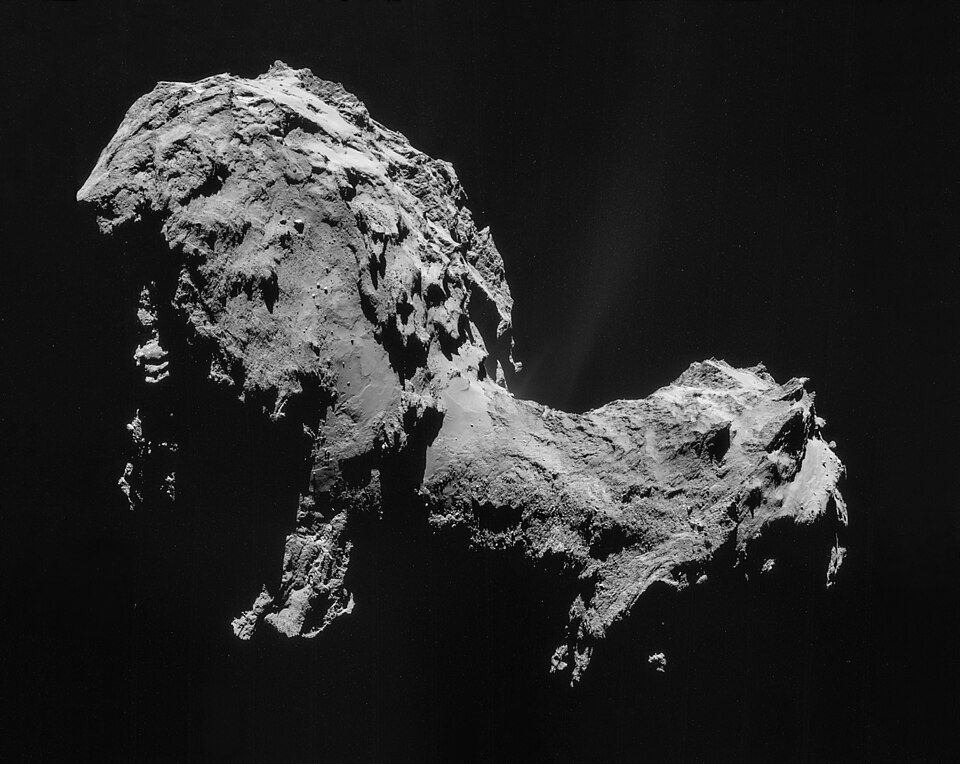
An active comet has a layered structure consisting of a small solid nucleus surrounded by a vast, transient atmosphere and tails. The nucleus is the only permanent component, typically a few kilometres in diameter and ranging from less than one kilometre to several tens of kilometres for the largest known examples. Cometary nuclei are extraordinarily dark; their surfaces have geometric albedos of only 3 to 6 percent, comparable to fresh asphalt and darker than coal, because solar irradiation of the original ice-dust mixture leaves behind a residue of carbonaceous and refractory material that absorbs most incident sunlight.5, 17

When sufficient solar heating drives sublimation of surface and near-surface ices, a comet develops a coma — a roughly spherical envelope of gas and entrained dust grains surrounding the nucleus. Comae can grow to enormous size, often exceeding a hundred thousand kilometres across and in extreme cases reaching dimensions comparable to the Sun itself. The coma is gravitationally unbound from the small nucleus and is continuously replenished by ongoing outgassing as the comet approaches and recedes from the Sun. Beyond the visible coma extends a vast, tenuous hydrogen envelope generated by the photodissociation of water molecules into hydrogen atoms and hydroxyl radicals. The hydrogen envelope of a bright comet such as Hale-Bopp can extend for tens of millions of kilometres and is detectable only at ultraviolet wavelengths corresponding to the Lyman-alpha line of atomic hydrogen.11
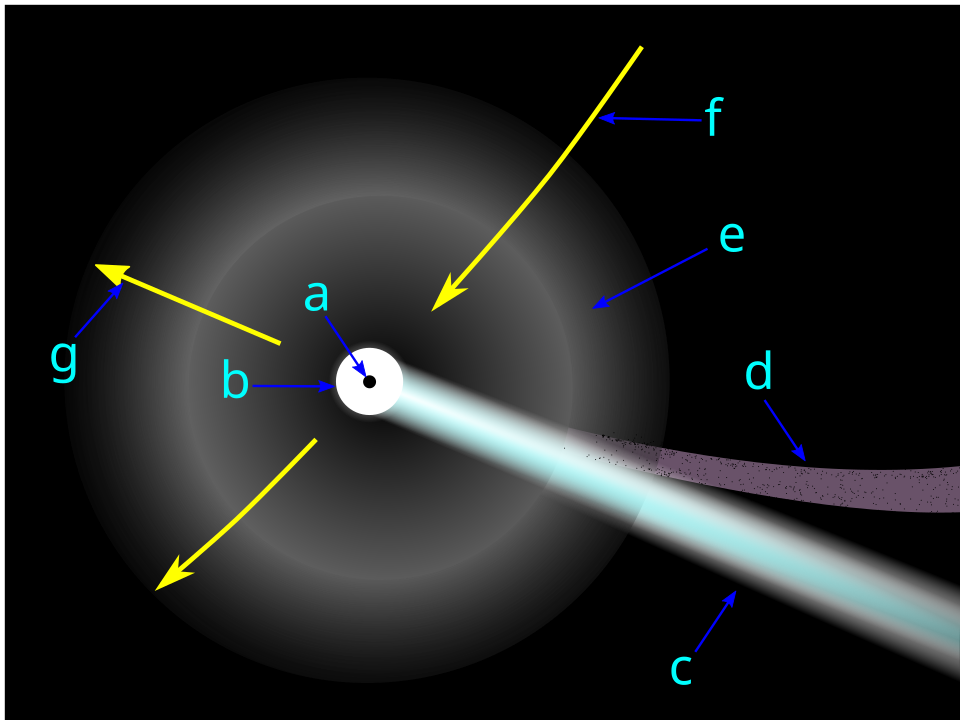

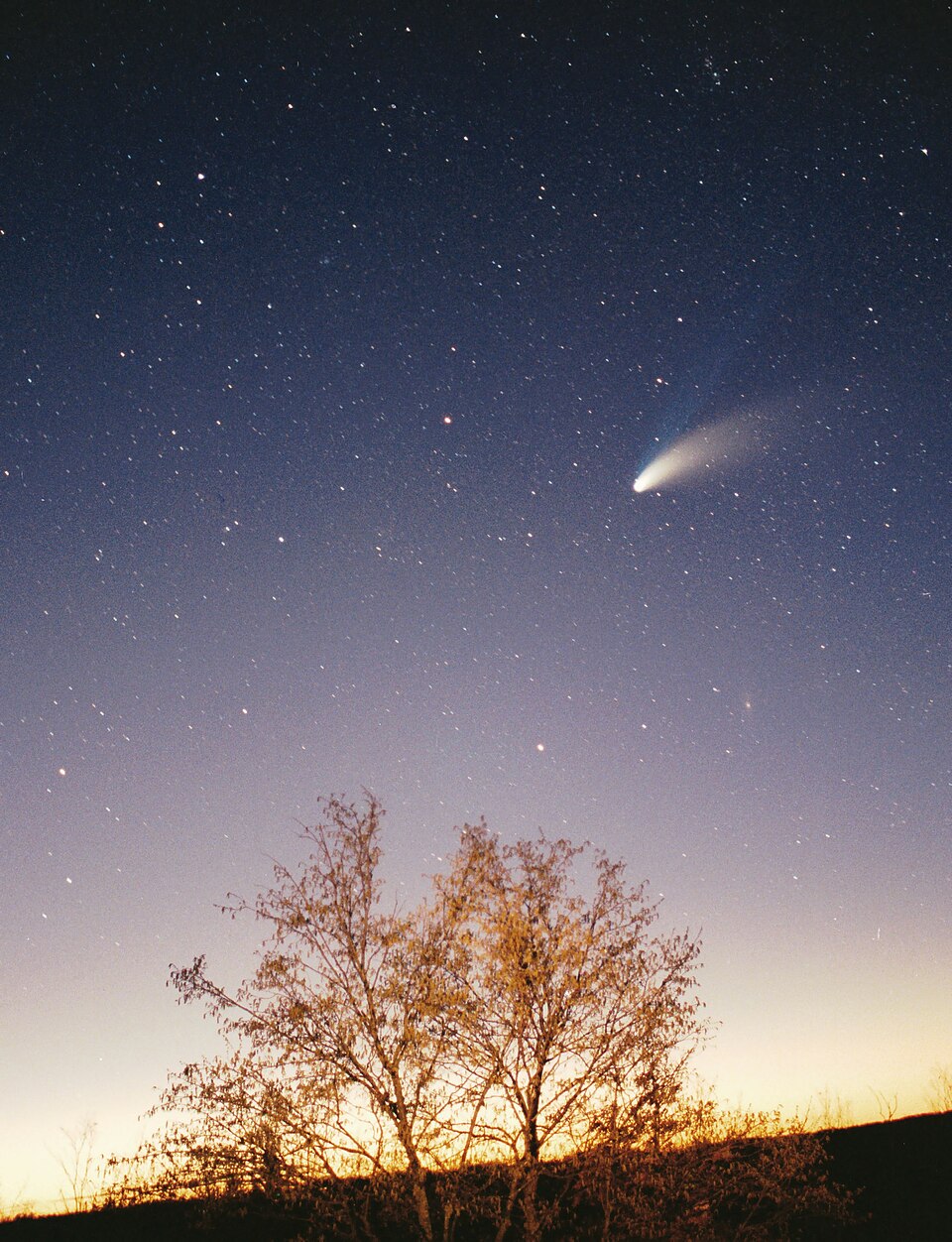
The most visually striking features of an active comet are its tails. Comets typically display two distinct tails of different physical origin and orientation. The dust tail consists of micrometre-sized solid grains released from the nucleus by escaping gas; once free, these grains are subject to solar gravity and the radiation pressure of sunlight, which together place them on slightly different heliocentric orbits than the nucleus itself. The dust tail therefore curves gently along the comet's orbit and appears yellowish-white because it shines by reflected sunlight. The ion tail or plasma tail consists of molecules ionised by solar ultraviolet radiation and swept directly antisolar by the magnetic fields embedded in the solar wind. It is straighter, narrower, and bluer than the dust tail, because the dominant ion CO+ fluoresces strongly in the blue region of the spectrum.11 Bright comets such as Hale-Bopp, observed in 1996 and 1997, also exhibit a third structure: a faint sodium tail consisting of neutral sodium atoms accelerated antisolar by resonant scattering of sunlight in the strong sodium D lines. This component was first identified during the Hale-Bopp apparition by Cremonese and colleagues using narrowband filters that isolated the sodium emission, and the resulting tail was traced to a length of approximately 50 million kilometres.12
Composition of cometary ices and dust
The chemical composition of cometary nuclei has been investigated through three complementary techniques: ground-based and space-based spectroscopy of the gases released into the coma, mass spectrometry from spacecraft flying through the coma in situ, and laboratory analysis of dust grains returned to Earth by sample-return missions. The combined picture is that of a body whose volatile inventory is dominated by water ice but contains a rich suite of more volatile species and a complex mixture of refractory minerals and organic compounds.
Water is by far the most abundant volatile in every comet examined, typically constituting 80 to 90 percent of the gas released within a few astronomical units of the Sun. The next most abundant species, in roughly the order they appear, are carbon monoxide and carbon dioxide (each at the 4 to 30 percent level relative to water, with strong variation between comets), methanol, methane, ammonia, formaldehyde, hydrogen sulfide, hydrogen cyanide, and the diatomic radicals CN, C2, and C3 that are produced by photodissociation of larger parent molecules in the coma.11 A review of remote-sensing measurements compiled by Bockelée-Morvan and Biver lists more than two dozen molecules detected in cometary atmospheres, including complex organics such as ethanol, glycolaldehyde, ethylene glycol, and methyl formate, several of which are also observed in dense interstellar molecular clouds and in protoplanetary disks. The chemical similarity supports the view that cometary ices preserve, at least in part, the composition of the molecular cloud material from which the Solar System formed.11
In situ mass spectrometry by the ROSINA instrument aboard the Rosetta orbiter at 67P/Churyumov-Gerasimenko added the unambiguous detection of the simplest amino acid, glycine, in the coma, accompanied by the related compounds methylamine and ethylamine and by phosphorus-bearing species. This was the first detection of an amino acid in a cometary atmosphere and the first detection of phosphorus in any comet, providing direct in situ evidence that the chemical building blocks of biologically relevant molecules are present in primordial Solar System ices.10 The dust component returned to Earth by NASA's Stardust mission from comet 81P/Wild 2 contained, in addition to expected interstellar grains, an abundance of high-temperature silicate minerals such as forsterite and enstatite that can only have formed in the hot inner regions of the protoplanetary disk and were subsequently transported outward to the comet-forming zone, demonstrating that the nebula was vigorously mixed during planet formation rather than chemically stratified.7
Dynamical populations and reservoirs
Observed comets fall into two broad dynamical classes that originate in physically distinct reservoirs. Long-period comets have orbital periods longer than 200 years, often by a wide margin, and arrive from random directions on the celestial sphere with no preference for the plane of the planets. Short-period comets have periods shorter than 200 years and overwhelmingly orbit prograde and close to the ecliptic plane. The boundary at 200 years is essentially conventional, but it captures a real distinction between two populations that arrive on observable orbits by very different routes.14
The reservoir of long-period comets was identified theoretically by the Dutch astronomer Jan Oort in 1950. Working with the original (pre-perturbation) orbital elements of nineteen long-period comets that had been computed with sufficient accuracy, Oort found that ten of them had aphelia clustered near 50,000 astronomical units, far beyond the orbit of Neptune but still gravitationally bound to the Sun. He inferred the existence of a vast spherical cloud of cometary nuclei extending from a few thousand to perhaps a hundred thousand astronomical units from the Sun, from which individual comets are perturbed onto sun-approaching orbits by passing stars, by giant molecular clouds, and by the gravitational tide of the Galaxy itself.2, 14 The Oort cloud, as the reservoir is now called, has never been observed directly — its members are too small, too distant, and too cold to be detected by current instruments — but its existence is required by the orbital statistics of long-period comets and by dynamical simulations of how the Solar System acquired its present architecture.
The reservoir of short-period comets is more accessible. The shortest-period subset, called the Jupiter-family comets (with periods less than about 20 years and orbits strongly influenced by Jupiter), originates in the trans-Neptunian region of the Solar System — specifically in the dynamically unstable scattered disk, a population of icy bodies on eccentric, inclined orbits that overlap with Neptune. Numerical integrations by Levison and Duncan in the 1990s demonstrated that gravitational scattering by Neptune extracts members of the scattered disk and passes them inward through encounters with the other giant planets, with a small fraction eventually reaching orbits of low perihelion where they can be observed as active comets.13, 14 The dynamical lifetime of a Jupiter-family comet on such an orbit is short — typically only thousands to a few hundred thousand years — before it is either ejected from the Solar System, impacts the Sun or a planet, or fades to inactivity, so the population must be continuously replenished from its source reservoir.
Major comet missions and their key findings5, 6, 7, 8, 17, 19
| Mission | Agency | Target | Encounter | Key result |
|---|---|---|---|---|
| Giotto | ESA | 1P/Halley | Mar 1986 | First close-up images of a nucleus; very dark, ~15×7 km |
| Vega 1 & 2 | USSR | 1P/Halley | Mar 1986 | Coma chemistry; nucleus shape and rotation |
| Deep Space 1 | NASA | 19P/Borrelly | Sep 2001 | Elongated nucleus; localised active regions |
| Stardust | NASA | 81P/Wild 2 | Jan 2004 | Sample return; high-temperature silicates in dust |
| Deep Impact | NASA | 9P/Tempel 1 | Jul 2005 | Impactor experiment; subsurface ice and organics; ~75% porosity |
| EPOXI | NASA | 103P/Hartley 2 | Nov 2010 | Peanut-shaped, hyperactive; CO₂-driven jets and ice grains |
| Rosetta / Philae | ESA | 67P/Churyumov-Gerasimenko | 2014–2016 | First orbit and landing; bilobed shape; D/H, glycine, porosity 70–85% |
A third dynamical class, the Halley-type comets (with periods between 20 and 200 years and often retrograde or highly inclined orbits, of which 1P/Halley itself is the prototype), is intermediate in character. Halley-type comets are thought to derive primarily from the Oort cloud but to have been captured into shorter-period orbits by close encounters with the giant planets, retaining the inclined orbital geometry characteristic of Oort cloud parents.14
Spacecraft exploration of comets
The first close-up exploration of a comet was the international "Halley armada" of 1986, a coordinated set of five spacecraft that intercepted comet 1P/Halley during its perihelion passage. The two Soviet Vega probes, originally launched to Venus, were redirected for Halley flybys at distances of 8,890 and 8,030 kilometres respectively, and carried imaging cameras, dust analysers, and mass spectrometers that provided the first in situ measurements of cometary coma composition. The two Japanese spacecraft Sakigake and Suisei, ESA's Giotto, and a more distant flyby by NASA's repurposed International Cometary Explorer at comet Giacobini-Zinner the previous year completed the international effort.17
The closest and most informative of the Halley encounters was Giotto, which approached the nucleus to within 596 kilometres on 14 March 1986. Its Halley Multicolour Camera returned the first images of a cometary nucleus, revealing an irregular, elongated body roughly 15 by 7 by 7 kilometres in dimension with a remarkably dark surface and several discrete jets of gas and dust emerging from localised active regions on the sunward side. Giotto also confirmed that water vapour is the dominant volatile in Halley's coma and detected complex carbon-bearing molecules (the so-called CHON particles) in the dust, providing the first direct evidence that comets carry refractory organic material in addition to ice and silicates.17 Fourteen seconds before closest approach, the spacecraft was struck by a large dust grain that destabilised it and damaged the camera, ending the imaging sequence near the moment of greatest spatial resolution.

The decades after the Halley armada saw a sequence of increasingly ambitious missions to other comets. NASA's Stardust spacecraft flew through the coma of 81P/Wild 2 in January 2004 at a relative velocity of 6.1 kilometres per second, capturing thousands of dust grains in panels of low-density silica aerogel and returning them to Earth in a sample-return capsule that landed in Utah in January 2006. Laboratory analysis of the recovered grains revealed silicate minerals that had formed at high temperatures in the inner Solar System, an unexpected discovery that established the importance of large-scale radial mixing in the protoplanetary disk.7 NASA's Deep Impact mission in 2005 deviated from passive observation in a more dramatic fashion: a 370-kilogram copper impactor was released from the main spacecraft and collided with the nucleus of 9P/Tempel 1 at 10.3 kilometres per second, excavating a crater approximately 150 metres across and ejecting a plume of material that the parent spacecraft analysed spectroscopically. The plume revealed a substantial increase in carbon-bearing material and water ice within the previously unexposed subsurface, demonstrated that the near-surface layer of the comet was extremely fine and weak, and established that the bulk of the nucleus is highly porous, with an estimated porosity of about 75 percent.6
The Deep Impact spacecraft was subsequently retargeted as the EPOXI mission and flew past the small comet 103P/Hartley 2 in November 2010. Hartley 2 turned out to be a peanut-shaped hyperactive nucleus only 2.25 kilometres long, with two distinct lobes joined by a narrower neck. Imaging revealed jets of gas and millimetre-sized icy grains emerging primarily from the rough end-lobes and apparently driven by sublimation of carbon dioxide rather than water, in striking contrast to other comets. The smooth waist between the lobes was found to be a deposit of fine material that had been ejected from the active end-lobes and fallen back to the lowest-gravity region of the nucleus.8
Rosetta and 67P/Churyumov-Gerasimenko
The most comprehensive investigation of any comet to date was carried out by the European Space Agency's Rosetta mission to comet 67P/Churyumov-Gerasimenko, a Jupiter-family comet with an orbital period of 6.45 years. Launched in 2004, Rosetta arrived at 67P in August 2014 after a ten-year cruise that included three Earth flybys, one Mars flyby, and two main-belt asteroid flybys. Rather than a fast flyby, Rosetta entered a series of bound orbits around the small nucleus and accompanied 67P for more than two years, from a heliocentric distance of 3.6 astronomical units inbound through perihelion at 1.24 astronomical units in August 2015 and back out to 3.8 astronomical units, before being deliberately set down on the nucleus surface at the end of mission operations on 30 September 2016.19, 23
The shape of 67P revealed by Rosetta's OSIRIS camera was unexpected. The nucleus consists of two distinct lobes — a larger "body" approximately 4.1 by 3.3 by 1.8 kilometres and a smaller "head" approximately 2.5 by 2.1 by 1.6 kilometres — joined by a narrow neck region named Hapi. The total volume is approximately 18.7 cubic kilometres.5 The bilobed morphology raised an immediate question: did the two lobes form together as part of a single body that was subsequently sculpted by erosion, or did they form independently and merge by collision? Stratigraphic analysis of layered terrains visible on each lobe demonstrated that the strata of the body and the strata of the head are inconsistent with one another and instead appear to be the truncated remains of two independent layered structures, supporting the contact-binary interpretation.20 Numerical simulations by Jutzi and Benz subsequently showed that bilobed shapes resembling 67P can readily form through low-energy, sub-catastrophic collisions between two cometesimals at relative velocities of a few metres per second, without producing the heating or compaction that would destroy the porous primordial structure of either body.18
Tracking of the Rosetta spacecraft's trajectory while in close orbit around 67P provided a precise determination of the comet's gravity field and hence its mass. Combined with the volume from imaging, this yielded a bulk density of 533 ± 6 kilograms per cubic metre — about half the density of solid water ice and far less than that of any rocky body in the Solar System.3 The low density implies a porosity of approximately 72 to 74 percent if the nucleus is a homogeneous mixture of dust and ice in the proportions inferred from coma measurements (with dust outweighing ice by a factor of about four). Radio sounding by the CONSERT experiment, which transmitted radio waves between the orbiter and the Philae lander on the comet's surface and through the small lobe, independently confirmed that the nucleus interior is uniformly low in density throughout, consistent with primordial accretion of small dust and ice particles at very low velocities and incompatible with significant subsequent compaction or heating.21
The Philae lander, which separated from Rosetta on 12 November 2014 and descended to the nucleus surface, was meant to deploy harpoons and ice screws to anchor itself on first contact, but both anchoring systems failed. Philae bounced twice across the surface, ultimately coming to rest in a shaded crevice approximately one kilometre from its intended landing site. Despite this misfortune, the lander completed approximately 80 percent of its planned First Science Sequence over the following 64 hours, returning measurements of the local gas environment, surface composition, and mechanical properties before its primary battery was exhausted. The MUPUS thermal probe penetrated only a few centimetres into the surface before encountering a hard layer, indicating that beneath a thin and friable dust mantle the cometary material is unexpectedly stiff — a "hardened facade" that may result from the recrystallisation of water ice over many cometary apparitions.23
One of Rosetta's most contentious results concerned the isotopic composition of the cometary water. The ROSINA mass spectrometer measured the deuterium-to-hydrogen (D/H) ratio of water in the 67P coma to be (5.3 ± 0.7) × 10−4, more than three times the terrestrial ocean value of 1.56 × 10−4.9 This was a striking result because 67P is a Jupiter-family comet, the dynamical class that some hydrodynamic models had favoured as the principal source of Earth's oceans, and the measurement directly contradicted the assumption that all Jupiter-family comets carry water with a terrestrial isotopic signature. Subsequent observations of other hyperactive Jupiter-family comets have found D/H values both above and below the terrestrial value, indicating that the dynamical class encompasses considerable isotopic diversity rather than a single water reservoir.22 The current consensus is that comets are unlikely to be the dominant source of Earth's water, with carbonaceous asteroids representing a better isotopic match.
Shoemaker-Levy 9 and the Jupiter impact
The most spectacular cometary event of the late twentieth century was the impact of comet Shoemaker-Levy 9 with Jupiter in July 1994. The comet had been discovered the previous year by Carolyn and Eugene Shoemaker and David Levy as a strange linear smudge of light on a photographic plate taken with the 0.4-metre Schmidt telescope at Palomar Observatory. Subsequent imaging by Hubble Space Telescope and ground-based observatories revealed that the smudge was a chain of more than twenty discrete fragments, the surviving pieces of a single comet that had been torn apart by Jovian tidal forces during a close approach to the planet two years earlier in July 1992. Orbit calculations showed that the entire chain of fragments was on a collision course with Jupiter and would impact in mid-July 1994.15
The impacts began on 16 July 1994 and continued for six days, with twenty-one identified fragments striking Jupiter at velocities of approximately 60 kilometres per second. Because all of the impacts occurred on the side of Jupiter facing away from Earth, they could not be observed directly from Earth-based telescopes, but the impact sites rotated into view within minutes and the resulting atmospheric disturbances were imaged extensively. Hubble Space Telescope observations led by Heidi Hammel revealed that even the medium-sized fragments produced atmospheric features — dark, complex, ring-like impact scars in Jupiter's upper atmosphere — thousands of kilometres across, persisting for weeks before the Jovian winds dispersed them.15 The largest impact, that of fragment G on 18 July, deposited an estimated energy of roughly 2 × 10²⁰ joules — equivalent to about 48 billion tonnes of TNT, or many times the combined yield of all nuclear weapons ever detonated — and produced a multiringed dark feature on Jupiter's cloud tops larger than the Earth. The impacts provided the first direct observational evidence that catastrophic collisions between Solar System bodies still occur on human timescales, and motivated the subsequent development of systematic surveys for potentially hazardous near-Earth objects.
Significance for planetary science and the origin of life
Comets are valuable to planetary science for two principal reasons. First, they are among the least altered bodies in the Solar System, having spent the great majority of the past 4.5 billion years in cold storage at distances where temperatures are too low for chemical processing of the constituent ices. The molecular and isotopic composition of cometary volatiles therefore preserves a near-primordial record of the chemistry of the protoplanetary disk and, perhaps, of the molecular cloud from which the disk formed. The detection in cometary ices of complex organic molecules — including the amino acid glycine and the nucleobase precursors — that are also observed in dense interstellar clouds supports a continuity between interstellar and cometary chemistry, with comets acting as cold reservoirs that preserve, rather than destroy, the organic complexity inherited from the parent cloud.10, 11
Second, comets are dynamic bodies that interact with the inner Solar System throughout its history and have plausibly delivered substantial quantities of water and organic material to the terrestrial planets. The relative contributions of comets and asteroids to Earth's volatile inventory remain debated, with the isotopic measurements at 67P indicating that Jupiter-family comets cannot be the dominant water source, but the qualitative point that early Earth received an external delivery of volatiles in the heavy bombardment phase between roughly 4.5 and 3.8 billion years ago is firmly established. To the extent that any of the prebiotic organic chemistry detected in modern cometary atmospheres was delivered to the surfaces of the early Earth, Mars, and the icy satellites of the outer planets, comets may have played a role in supplying the chemical inventory that subsequent processes converted into the first biologically relevant molecules.10, 23
The Rosetta mission marked the end of an exploratory phase that began with Whipple's 1950 model and the Halley armada and produced an unprecedented body of data on a single cometary nucleus. The next steps in cometary science will likely involve sample return from a Jupiter-family comet, in situ exploration of a long-period comet visiting the inner Solar System for the first time (a so-called dynamically new comet, whose volatiles have never been processed by previous solar heating), and continued spectroscopic surveys of comets across the dynamical populations to map the diversity and gradients of cometary chemistry. ESA's planned Comet Interceptor mission, scheduled for launch in 2029, is designed to be parked in solar orbit awaiting the discovery of a suitable target, which it would then intercept on a flyby trajectory. If a dynamically new comet from the Oort cloud passes through the inner Solar System during the mission's operational lifetime, Comet Interceptor will provide humanity's first close look at material that has remained essentially undisturbed since the formation of the planets.23
References
The structure of the cloud of comets surrounding the Solar System and a hypothesis concerning its origin
Prebiotic chemicals—amino acid and phosphorus—in the coma of comet 67P/Churyumov-Gerasimenko
From the Kuiper belt to Jupiter-family comets: the spatial distribution of ecliptic comets
Formation of bi-lobed shapes by sub-catastrophic collisions: a late origin of comet 67P's structure