Overview
- Cosmic rays are high-energy charged particles — predominantly protons, with smaller fractions of heavier nuclei and electrons — that arrive at Earth from space with energies spanning more than ten orders of magnitude, from roughly 109 eV to beyond 1020 eV, the most energetic particles ever observed.
- Victor Hess discovered cosmic rays in 1912 through balloon-borne electroscope experiments that showed ionizing radiation increases with altitude, demonstrating an extraterrestrial origin. Most galactic cosmic rays are now understood to be accelerated at supernova remnant shock fronts via diffusive shock acceleration, while the sources of the rarest ultra-high-energy cosmic rays remain an open question.
- Cosmic rays have far-reaching consequences beyond particle astrophysics: they drive spallation reactions that produce light elements such as lithium, beryllium, and boron; they generate extensive air showers that produce muons detectable at the Earth’s surface; and they influence atmospheric chemistry, cloud nucleation, and the production of cosmogenic isotopes used in radiometric dating.
Cosmic rays are high-energy charged particles that bombard Earth from every direction in space. Despite their name — a relic of early-twentieth-century uncertainty about their nature — they are not electromagnetic radiation but rather material particles, predominantly protons (~90%), with alpha particles (~9%) and heavier nuclei (~1%) making up the remainder, along with a small fraction of electrons and positrons. Their energies span an extraordinary range, from roughly a billion electron volts (109 eV) to beyond 1020 eV, the latter exceeding what any terrestrial accelerator can produce by a factor of a million. The study of cosmic rays has driven major advances in both particle physics and astrophysics, from the discovery of the positron and the muon to the identification of supernova remnants as particle accelerators.5, 1

Discovery: Hess and the balloon flights
By the early 1900s, physicists had noticed that sealed electroscopes slowly discharged even when shielded from known radioactive sources, indicating the presence of ambient ionizing radiation. The prevailing assumption was that this radiation came from radioactive elements in the Earth’s crust and should therefore decrease with altitude. In 1912, the Austrian physicist Victor Hess undertook a series of seven balloon ascents, carrying electroscopes to altitudes up to 5,350 meters. He found that the ionization rate initially decreased slightly with altitude but then rose dramatically above about 1,500 meters, reaching several times the ground-level value at the highest altitudes. Hess concluded that the radiation must have an extraterrestrial origin: “a radiation of very great penetrating power enters our atmosphere from above.”1
Hess’s finding was confirmed by Werner Kolhörster, who carried electroscopes to 9,300 meters in 1913–1914, measuring ionization rates five to six times the ground-level value. Robert Millikan, who initially doubted the results and repeated the measurements using unmanned balloons in the 1920s, eventually confirmed the extraterrestrial origin and coined the term “cosmic rays,” believing them to be gamma radiation produced during the synthesis of elements in interstellar space. It was not until the 1930s and 1940s, through the work of Arthur Compton and others using geomagnetic latitude surveys, that cosmic rays were shown to be predominantly charged particles rather than photons — their arrival rates varied with geomagnetic latitude, demonstrating deflection by Earth’s magnetic field.5
The energy spectrum and its features
The cosmic ray energy spectrum follows a remarkably featureless power law over more than ten decades of energy, with the flux falling as approximately E−2.7. At a flux level of roughly one particle per square meter per second at 109 eV, the spectrum plunges to about one particle per square kilometer per year at 1019 eV and beyond. Despite its overall smoothness, the spectrum contains two subtle but significant breaks. The knee, at approximately 3 × 10¹⁵ eV, marks a steepening of the spectrum from E−2.7 to E−3.1. The ankle, at approximately 5 × 10¹⁸ eV, marks a flattening back toward E−2.7. These features are widely interpreted as transitions between different source populations or confinement regimes: below the knee, galactic sources (primarily supernova remnants) dominate and cosmic rays are confined by the Milky Way’s magnetic field; above the ankle, extragalactic sources become dominant because the particles are too energetic to be confined by galactic magnetic fields.5, 2
At the highest energies, above approximately 5 × 10¹⁹ eV, the spectrum is predicted to be suppressed by the Greisen–Zatsepin–Kuz’min (GZK) effect. Protons at these energies interact with photons of the cosmic microwave background, producing pions through the Δ resonance and losing energy over distances of roughly 50 megaparsecs. This sets an effective horizon for the highest-energy cosmic rays: any source more distant than about 100 megaparsecs cannot contribute particles above the GZK threshold. Observations by the Pierre Auger Observatory and the Telescope Array have confirmed a spectral suppression near the predicted energy, though whether it is truly the GZK effect or reflects the maximum energy achievable by astrophysical accelerators remains debated.8, 9, 3
Acceleration mechanisms
The standard theory for the acceleration of galactic cosmic rays is diffusive shock acceleration (also called first-order Fermi acceleration), developed independently by Axford, Bell, Blandford, Krymsky, and Ostriker in the late 1970s. When a supernova remnant expands into the interstellar medium, it drives a strong shock wave. Charged particles scattering off magnetic turbulence on both sides of the shock can cross it repeatedly, gaining energy with each crossing. The process naturally produces a power-law energy spectrum close to E−2, which, after accounting for energy-dependent escape from the Galaxy, steepens to the observed E−2.7.6, 7
Observational support for supernova remnant acceleration comes from multiple lines of evidence. X-ray telescopes have resolved thin, synchrotron-emitting rims at the edges of young supernova remnants such as SN 1006, Cassiopeia A, and Tycho, indicating the presence of electrons accelerated to energies of at least 1014 eV. Gamma-ray observations by the Fermi Large Area Telescope and imaging Cherenkov telescopes (H.E.S.S., MAGIC, VERITAS) have detected supernova remnants as sources of TeV gamma rays, produced either by accelerated protons interacting with ambient gas (hadronic channel) or by inverse Compton scattering of accelerated electrons (leptonic channel). The detection of the characteristic spectral signature of pion decay in several remnants has provided the strongest evidence that protons, not just electrons, are accelerated to high energies in these environments.2, 4
The sources of ultra-high-energy cosmic rays (UHECRs) above 1018 eV remain more uncertain. Supernova remnant shocks cannot accelerate particles to these energies — they run out of confinement before the particle reaches sufficient energy. Candidate sources include the jets and lobes of active galactic nuclei, gamma-ray bursts, and starburst galaxies. In 2017, the Pierre Auger Observatory reported a statistically significant large-scale anisotropy in the arrival directions of cosmic rays above 8 × 10¹⁸ eV, with a dipole pattern pointing away from the Galactic center and consistent with an extragalactic origin. Earlier analyses had suggested correlations between the highest-energy events and the positions of nearby active galactic nuclei, though subsequent data have weakened the statistical significance of these correlations.3, 14
Air showers and detection
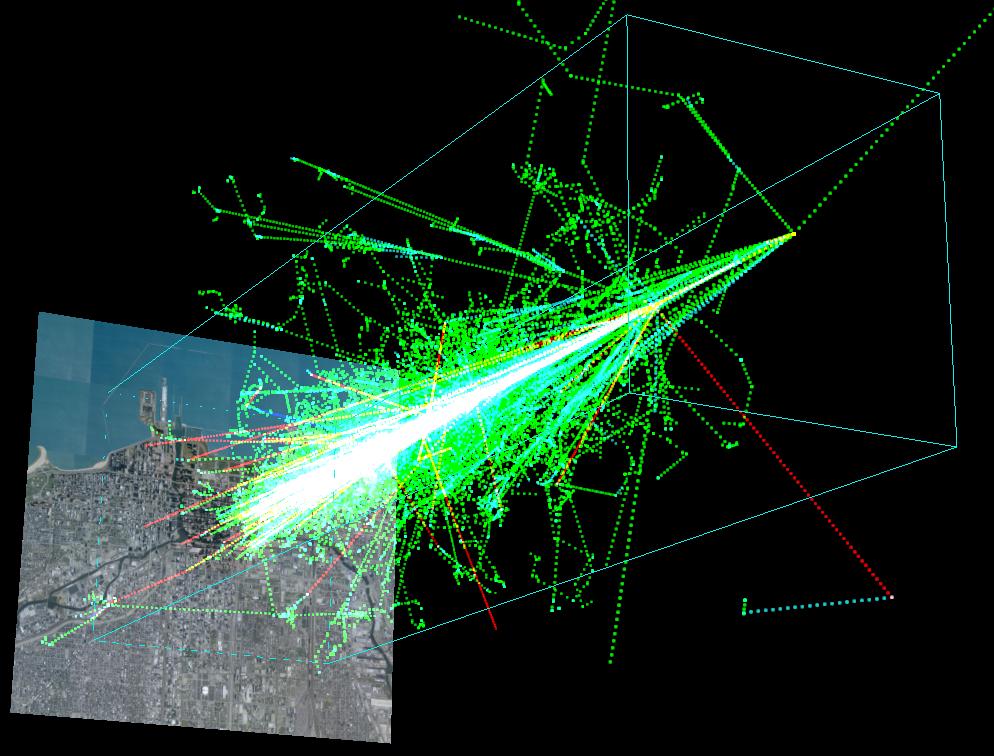
A cosmic ray particle entering the Earth’s atmosphere collides with an atmospheric nucleus at altitudes typically between 15 and 25 kilometers, initiating a cascade of secondary particles called an extensive air shower. The primary collision produces pions, kaons, and other hadrons; neutral pions decay almost immediately into gamma-ray photons, which produce electron–positron pairs, which radiate further photons, building an electromagnetic cascade. Charged pions and kaons decay into muons, which are sufficiently penetrating to reach the ground. A single cosmic ray with an energy of 1019 eV can produce an air shower containing billions of secondary particles spread over several square kilometers at ground level.5
Detection techniques exploit different components of the shower. Surface detector arrays — such as the 1,660 water Cherenkov tanks of the Pierre Auger Observatory, spread over 3,000 square kilometers in Argentina — sample the particle density at ground level to reconstruct the energy and arrival direction of the primary cosmic ray. Fluorescence detectors observe the ultraviolet light emitted by nitrogen molecules excited by shower particles, providing a near-calorimetric measure of the primary energy. Hybrid observatories that combine both techniques achieve the best energy calibration and angular resolution. Radio detection of air showers, which measures the coherent radio emission produced by the charge separation in the electromagnetic cascade in Earth’s magnetic field, has emerged as a complementary technique with excellent energy resolution.5, 3
Cosmic ray muons — the penetrating remnants of air shower cascades — reach sea level at a rate of roughly 10,000 per square meter per minute. These muons have been used for applications ranging from muon tomography of volcanoes and pyramids to calibration of underground neutrino detectors such as IceCube. The cosmic ray muon flux itself serves as a natural probe of atmospheric density and has been used to validate atmospheric models.11, 5
Solar cosmic rays and solar modulation
In addition to the galactic cosmic ray background, the Sun produces its own high-energy particles during solar flares and coronal mass ejections. These solar energetic particles (SEPs) are predominantly protons with energies typically below a few hundred MeV, though rare “ground-level enhancement” events can accelerate protons to several GeV, enough to produce secondary particles detectable at Earth’s surface. Solar cosmic rays pose a radiation hazard to astronauts outside the Earth’s magnetosphere and to electronics on spacecraft, and their prediction is a central goal of space weather forecasting.16
The flux of galactic cosmic rays at Earth is modulated by the solar wind and the Sun’s magnetic field. During periods of high solar activity, the expanded and more turbulent heliospheric magnetic field more effectively scatters incoming cosmic rays, reducing their flux at Earth. This solar modulation produces an anticorrelation between cosmic ray intensity and the 11-year solar cycle, with cosmic ray flux at Earth varying by roughly 20% between solar minimum and solar maximum at energies around 1 GeV. The effect diminishes at higher energies, becoming negligible above about 10 GeV where the particles are too rigid to be significantly deflected by heliospheric magnetic fields.16, 12
Spallation, cosmogenic isotopes, and broader impacts
Cosmic rays drive nuclear reactions with profound consequences for the chemical composition of the universe and for geoscience. When high-energy cosmic ray protons and alpha particles collide with heavier nuclei in the interstellar medium — principally carbon, nitrogen, and oxygen — they shatter them through spallation, producing lighter nuclei including lithium-6, lithium-7, beryllium-9, and boron-10 and boron-11. This process is the dominant source of these light elements in the universe; they are not produced in significant quantities by Big Bang nucleosynthesis or stellar fusion. The observed cosmic abundances of lithium, beryllium, and boron are in good agreement with predictions from cosmic ray spallation models, providing independent confirmation of the cosmic ray energy density and composition.10, 4
In the Earth’s atmosphere, cosmic ray interactions produce cosmogenic isotopes — radioactive nuclides such as carbon-14, beryllium-10, and chlorine-36 — that are incorporated into the biosphere and geosphere and serve as natural clocks. Carbon-14, produced when cosmic ray neutrons capture on nitrogen-14, is the basis of radiocarbon dating, the most widely used chronometric technique in archaeology and Quaternary geology. The production rate of cosmogenic isotopes depends on the cosmic ray flux at Earth, which in turn depends on solar activity and geomagnetic field strength, providing records of solar variability and geomagnetic field reversals that extend hundreds of thousands of years into the past.15
Cosmic rays also influence atmospheric chemistry and may play a role in cloud formation. The ionization produced by cosmic rays in the lower atmosphere has been proposed as a factor in the nucleation of aerosol particles, potentially modulating cloud cover and climate. While laboratory experiments have demonstrated that ionization can enhance aerosol nucleation, the magnitude of the effect under real atmospheric conditions remains debated, and most atmospheric scientists consider the climatic impact of cosmic ray variations to be small compared to greenhouse gas forcing. The cosmic ray–climate connection continues to be an active and contentious area of research.4, 13
References
Observation of a large-scale anisotropy in the arrival directions of cosmic rays above 8 × 10¹⁸ eV