Overview
- Eta Carinae is a binary system containing one of the most massive and luminous stars known, with a primary estimated at 100–120 solar masses and a bolometric luminosity of roughly 5 million solar luminosities — placing it near the theoretical upper limit for stellar mass and at the threshold of the Eddington luminosity, above which radiation pressure overcomes gravity.
- During the Great Eruption of 1837–1858, Eta Carinae expelled approximately 10–40 solar masses of material at speeds exceeding 600 km/s, briefly becoming the second-brightest star in the sky and producing the bipolar Homunculus Nebula — an event whose energy output rivaled a supernova yet left the star intact.
- Classified as a luminous blue variable, Eta Carinae is expected to end its life as a core-collapse supernova or hypernova within the next few hundred thousand years, making it one of the nearest potential supernova progenitors to Earth at a distance of approximately 2,300 parsecs.
Eta Carinae is a massive stellar system located approximately 2,300 parsecs (7,500 light-years) from Earth in the Carina Nebula, one of the largest and brightest star-forming regions in the Milky Way. The system contains one of the most luminous stars known, with a combined bolometric luminosity estimated at roughly 5 million times that of the Sun. Its primary component is thought to have a current mass of 100–120 solar masses, placing it near the theoretical upper mass limit for stars and making it a touchstone object for understanding the physics of the most massive stars and their violent endpoints.1, 2
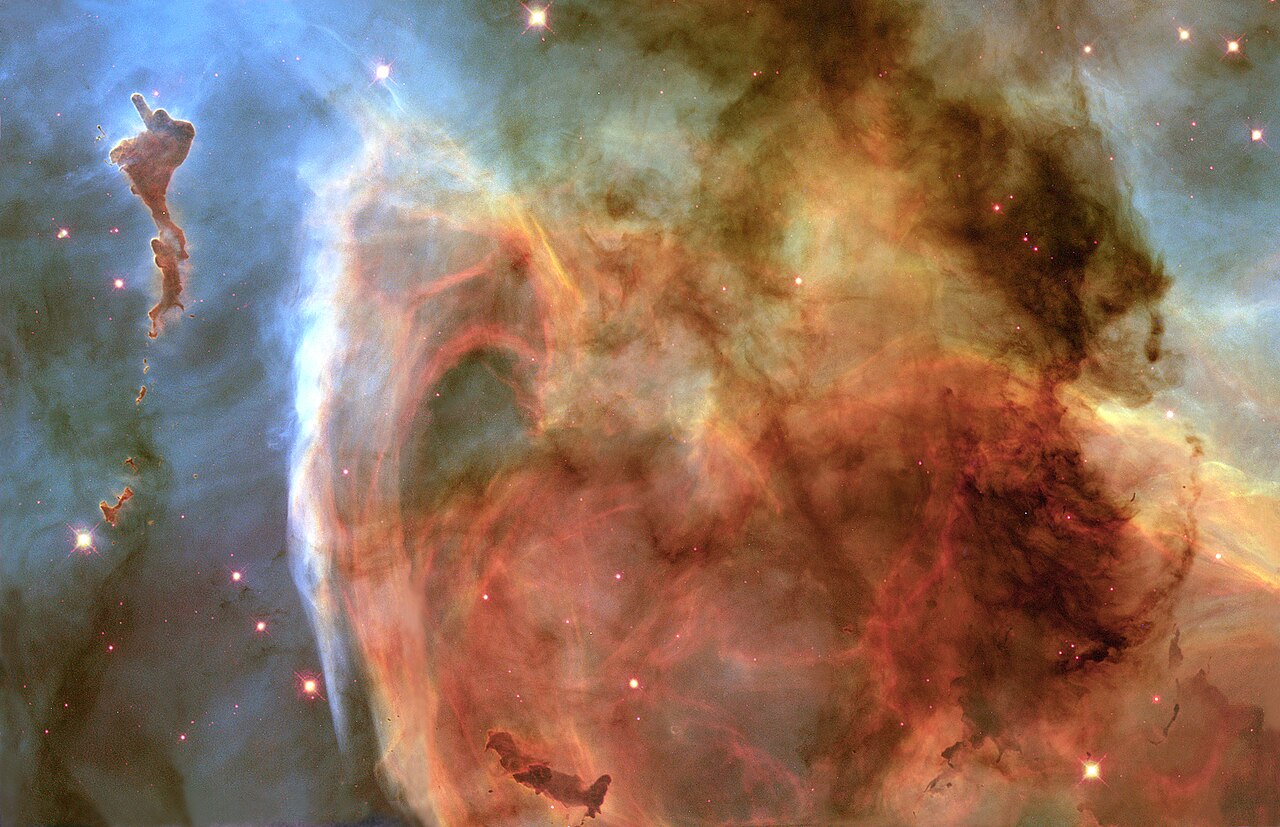

The binary system
Eta Carinae is a binary system with an orbital period of approximately 5.54 years. The primary star, Eta Carinae A, is a luminous blue variable (LBV) with an effective temperature of roughly 15,000–20,000 K and a mass-loss rate of approximately 10−3 solar masses per year through a dense, slow stellar wind. The companion, Eta Carinae B, is a hotter, less luminous star — likely an O-type or Wolf-Rayet star with a surface temperature of approximately 40,000 K and a faster, lower-density wind. The orbit is highly eccentric (e ≈ 0.9), bringing the two stars within roughly 1.5 astronomical units of each other at periastron, where their winds collide violently.3, 14
The wind-wind collision zone produces hard X-ray emission that has been monitored continuously since the 1990s. This X-ray emission follows a repeatable 5.54-year cycle: it rises as the stars approach periastron, undergoes a sharp minimum lasting several weeks as the companion plunges through the densest part of the primary’s wind, and then recovers. The periodicity of the X-ray cycle provided definitive confirmation of the binary nature of the system, which had been suspected but debated for decades. The wind-collision region also produces observable changes in the optical and ultraviolet spectrum at each periastron passage, as ionizing radiation from the companion is temporarily blocked by the primary’s dense wind.9, 11
The Great Eruption
Between approximately 1837 and 1858, Eta Carinae underwent a spectacular outburst known as the Great Eruption, during which it brightened to become the second-brightest star in the night sky despite its considerable distance. At its peak around 1843, it reached an apparent visual magnitude of approximately −1, rivaling Sirius. The total energy radiated during the eruption has been estimated at 1049.5 to 1050 erg — comparable to the energy of a faint supernova, yet the star survived. The mass ejected during the event has been estimated at 10–40 solar masses, expelled at velocities exceeding 600 km/s, making it one of the most extreme episodes of non-terminal mass loss ever observed from a single star.5, 4
Light echoes from the Great Eruption, detected by Rest and collaborators in 2012, provided a direct look at the spectrum of the event centuries after the fact. These light echoes revealed that the eruption spectrum resembled a relatively cool supergiant with an effective temperature of roughly 5,000 K — far cooler than expected for a supernova impostor. This finding challenged models that attributed the eruption primarily to a massive increase in the star’s bolometric luminosity, suggesting instead that the apparent brightening was partly caused by the formation of a dense, cool pseudo-photosphere in the expanding ejecta.12
The physical mechanism driving the Great Eruption remains actively debated. Proposed explanations include a continuum-driven super-Eddington wind, in which the star’s luminosity exceeded the Eddington limit and radiation pressure on the stellar continuum (rather than spectral lines) drove massive outflows. Other models invoke a binary merger event in a formerly triple system, a pulsational pair-instability episode in the stellar core, or a periastron interaction in the binary system that triggered enhanced mass loss. The extraordinary energy budget and mass involved make the Great Eruption difficult to explain with any single mechanism, and it may represent a phenomenon distinct from both steady stellar winds and terminal supernova explosions.13, 10, 15
The Homunculus Nebula
The material ejected during the Great Eruption formed the Homunculus Nebula, a striking bipolar structure approximately 0.3 parsecs (about 1 light-year) across. The nebula consists of two large, nearly symmetrical lobes oriented along a polar axis, with a thin equatorial skirt of denser material separating them. The lobes are expanding at roughly 650 km/s along the polar direction and somewhat slower in the equatorial plane, consistent with an ejection date in the 1840s. The total mass of the Homunculus has been estimated at 10–40 solar masses, making it one of the most massive circumstellar nebulae known.4, 8
The bipolar morphology of the Homunculus has been modeled as the result of an intrinsically latitude-dependent explosion, possibly shaped by rapid rotation of the primary star or by the gravitational influence of the binary companion during the eruption. Interacting-wind models, in which a fast polar wind sweeps up a slower equatorial wind, can reproduce the basic geometry. The equatorial skirt contains a complex network of streamers and condensations rich in dust and molecular gas, including detected emission from CO, CH, OH, and NH3 — an unexpectedly rich molecular inventory for circumstellar material around such a luminous star. Dust within the Homunculus absorbs much of the star’s optical and ultraviolet output, reradiating it at infrared wavelengths, which makes Eta Carinae one of the brightest infrared sources in the sky.8, 7
Luminous blue variable classification
Eta Carinae is the prototype of the luminous blue variable class, a rare and short-lived phase in the evolution of very massive stars. LBVs are characterized by irregular photometric and spectroscopic variability, dense stellar winds, and occasional giant eruptions that eject large amounts of mass. They occupy a distinctive region of the Hertzsprung-Russell diagram at high luminosity and intermediate temperature, bounded on the hot side by the S Doradus instability strip. The LBV phase is thought to last only tens of thousands of years, during which the star sheds a significant fraction of its hydrogen envelope before transitioning to a Wolf-Rayet phase or exploding directly as a supernova.1, 7
The relationship between LBVs and supernova progenitors has become a major question in massive star research. Traditional stellar evolution models predicted that LBVs were transitional objects on their way to becoming Wolf-Rayet stars, but several supernovae have been observed whose circumstellar environments show signatures of LBV-like eruptions occurring shortly before the terminal explosion. This has raised the possibility that some very massive stars may explode during or immediately after the LBV phase, bypassing the Wolf-Rayet stage entirely. If so, Eta Carinae itself could be closer to its terminal explosion than previously assumed.10, 15
Future fate
Eta Carinae A will inevitably exhaust the nuclear fuel in its core and undergo core collapse. Given its extreme mass, the most likely outcomes are a luminous Type IIn or Type Ib/Ic supernova, or potentially a hypernova accompanied by a gamma-ray burst. The presence of the dense Homunculus Nebula and ongoing stellar wind means that the eventual supernova ejecta will collide with this circumstellar material, producing a luminous and long-lasting display of the type classified as a Type IIn supernova, in which narrow emission lines arise from the interaction between the blast wave and the surrounding medium. The star’s high mass may also allow for a pair-instability or pulsational pair-instability supernova if conditions in the core reach the threshold for electron-positron pair production.15, 13
At a distance of approximately 2,300 parsecs, Eta Carinae is far enough from Earth that its eventual supernova would pose no direct threat to the biosphere, but it would be a spectacular naked-eye event, potentially visible in daylight for weeks. The system’s polar axis — along which any relativistic jet would be directed in a gamma-ray burst scenario — is oriented at a substantial angle away from Earth, further reducing any conceivable hazard. As the nearest example of a star approaching a violent death, Eta Carinae serves as a laboratory for understanding the final stages of massive stellar evolution, the physics of super-Eddington mass loss, and the connection between pre-supernova instabilities and the diverse endpoints of the most massive stars.1, 6
References
The central star of Eta Carinae. V. A model for the spectral properties of the binary system
Eta Carinae across the 2003.5 minimum: Spectroscopic evidence for massive binary interactions
Light echoes reveal an unexpectedly cool Eta Carinae during its 19th-century Great Eruption