Overview
- Wolf-Rayet stars are massive, evolved stars that have shed their outer hydrogen envelopes through powerful stellar winds or binary interactions, exposing their helium-, carbon-, or nitrogen-burning cores at surface temperatures of 30,000 to 200,000 K and luminosities exceeding 105 solar luminosities — making them among the hottest and most luminous stars known.
- The WR spectral class is divided into nitrogen-rich WN stars, which show products of CNO-cycle hydrogen burning, and carbon-rich WC and WO stars, which display products of helium burning, reflecting a progressive stripping of the stellar envelope that reveals successively deeper nucleosynthetic layers.
- Wolf-Rayet stars are the likely progenitors of hydrogen-stripped Type Ib and Ic supernovae and some long-duration gamma-ray bursts, and their intense ultraviolet radiation and chemical enrichment of the interstellar medium make them significant contributors to the evolution of galaxies — a role now being probed in the early universe by JWST spectroscopy.
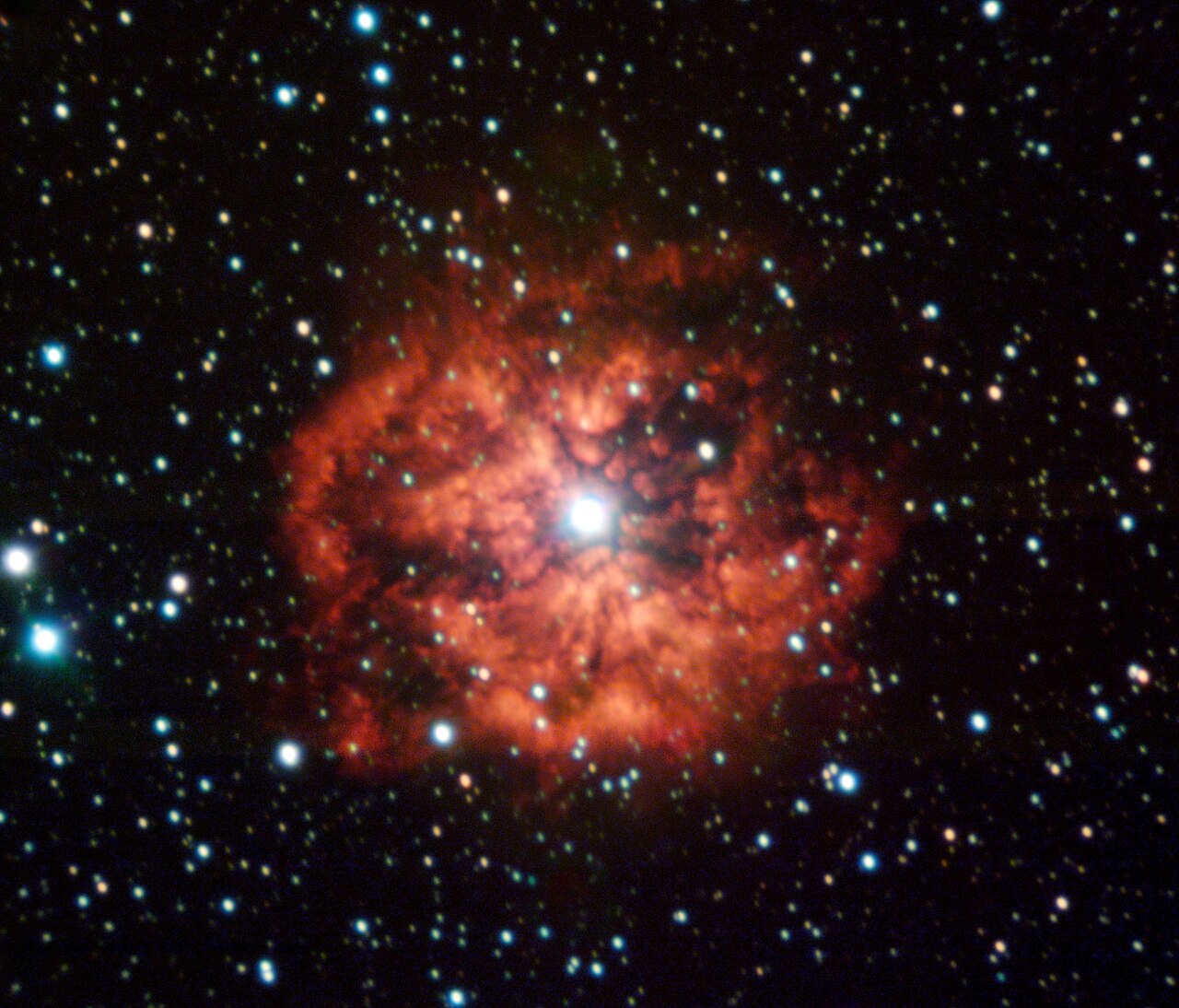
Wolf-Rayet stars are among the most extreme objects in stellar astrophysics: evolved, massive stars whose outer hydrogen envelopes have been stripped away — by ferocious stellar winds or by interaction with a binary companion — revealing the products of nuclear burning at their surfaces. With surface temperatures ranging from 30,000 to 200,000 K and luminosities exceeding 105 times that of the Sun, they are extraordinarily hot and bright. Their spectra are dominated by broad, intense emission lines of helium, nitrogen, carbon, and oxygen, a hallmark that distinguishes them from all other spectral types. First identified in 1867, Wolf-Rayet stars play a pivotal role in nucleosynthesis, the chemical enrichment of the interstellar medium, and the production of supernovae and compact remnants.1, 6

Discovery and classification
In January 1867, Charles Wolf and Georges Rayet, working at the Paris Observatory, observed three stars in the constellation Cygnus whose spectra contained broad, bright emission lines rather than the dark absorption lines characteristic of ordinary stars. The emission lines were later identified as coming from highly ionized helium, nitrogen, and carbon. These three stars — now catalogued as WR 134, WR 135, and WR 137 — became the prototypes of a new spectral class that would eventually encompass several hundred known members in the Milky Way alone.6, 2
Modern classification divides Wolf-Rayet stars into three principal subtypes based on the dominant emission features in their spectra. WN stars show strong emission lines of nitrogen and helium, reflecting the products of CNO-cycle hydrogen burning. They are further subdivided into early types (WN2–WN5, often called WNE), which show highly ionized species and typically lack hydrogen, and late types (WN6–WN11, or WNL), which may retain traces of hydrogen at their surfaces and tend to have lower surface temperatures. Detailed spectral analyses of Galactic WN stars using line-blanketed model atmospheres have refined the temperature, luminosity, and mass-loss parameters for each subtype.3 WC stars display prominent emission from carbon and helium, products of helium burning via the triple-alpha process. WO stars, the rarest subtype, show strong oxygen emission lines in addition to carbon, indicating that helium burning has progressed to an advanced stage. The sequence WN → WC → WO reflects the progressive peeling of the stellar envelope, with each stage exposing deeper nucleosynthetic layers.1, 4
Stellar winds and mass loss
The defining physical characteristic of Wolf-Rayet stars is their extraordinarily powerful stellar winds. Typical mass-loss rates range from 10−5 to 10−4 solar masses per year — roughly a billion times the mass-loss rate of the Sun’s solar wind — with terminal wind velocities of 1,000 to 3,000 km/s. These winds are so dense and optically thick that the photosphere is effectively hidden: the observed spectrum arises not from the stellar surface but from the extended, expanding atmosphere, which can span tens of stellar radii.7, 1
The winds are driven primarily by radiation pressure on spectral lines — the same line-driving mechanism that operates in O-type stars, but amplified by the extreme luminosity and the abundance of metal ions in the exposed stellar layers. Because the wind material is enriched in helium, carbon, nitrogen, and oxygen, it provides an exceptionally rich forest of spectral lines to absorb and scatter the outgoing radiation, maintaining the high mass-loss rate. The resulting momentum transfer from photons to ions, and from ions to the bulk gas through Coulomb collisions, launches material off the star at speeds that exceed the surface escape velocity by large factors.7, 8
The cumulative effect of this wind is enormous. Over a Wolf-Rayet lifetime of a few hundred thousand years, a star may shed 10 to 20 solar masses of material, enriching the surrounding interstellar medium with processed elements. The wind sweeps up ambient gas into shells and bubbles — ring nebulae that are often visible in narrowband images. NGC 6888, the Crescent Nebula, is a well-studied example: a shell of nitrogen-enriched gas approximately 25 light-years across, blown by the WN6 star WR 136 and sculpted by the interaction between the current fast wind and the slower wind from the star’s earlier red supergiant phase.10
Evolutionary pathways
Wolf-Rayet stars represent a late evolutionary phase of the most massive stars — those born with initial masses above roughly 25 solar masses at solar metallicity, though the threshold depends on metallicity and rotation. In the standard single-star evolutionary picture, a massive O-type star exhausts hydrogen in its core and evolves into a luminous blue variable or red supergiant, during which phase it loses mass at an elevated rate. As the hydrogen envelope is stripped away, the star contracts and heats, entering the Wolf-Rayet phase. The star first appears as a WN star (showing CNO-processed material), then evolves to the WC phase (as helium burning products reach the surface), and finally, in the most massive cases, to the WO phase. The entire Wolf-Rayet phase lasts only a few hundred thousand years — a small fraction of the star’s total lifetime.8, 14
Stellar rotation dramatically affects this evolutionary pathway. Rapidly rotating massive stars experience rotationally induced mixing that transports nuclear burning products from the core to the surface and fresh hydrogen from the envelope to the core. This homogeneous evolution can produce Wolf-Rayet-like surface compositions at lower initial masses and without passing through a red supergiant phase. Rotating stellar models by Georgy and collaborators have shown that stars as low as 20 solar masses can enter the WR phase if they are born with sufficiently high rotation rates, and that rotation extends the duration of the WR phase by increasing the total amount of mass available for nuclear burning.5
Binary interaction provides an alternative and possibly dominant channel for producing Wolf-Rayet stars. Surveys of massive O-type star populations have shown that the majority — roughly 70% — exist in binary systems close enough that mass transfer will occur during their lifetimes. Roche lobe overflow strips the hydrogen envelope of the primary star, exposing the helium core and creating a Wolf-Rayet star at initial masses too low for single-star winds to achieve the same effect. This binary channel may account for a substantial fraction of observed WR stars, particularly WN stars with relatively low luminosities that would be difficult to explain through single-star evolution.12, 11
Supernova progenitors and compact remnants
Wolf-Rayet stars end their lives as core-collapse supernovae. Because their hydrogen envelopes have been removed, they produce hydrogen-poor explosions classified as Type Ib (if helium lines are present in the supernova spectrum) or Type Ic (if helium is also absent, as expected from WC or WO progenitors). The connection between WR stars and stripped-envelope supernovae was proposed on theoretical grounds in the 1980s and has been supported by pre-explosion imaging that has occasionally identified a WR star at the position of a subsequent supernova, as well as by the detection of circumstellar material with WR-like composition around some Type Ib/Ic events.9, 1
A subset of Type Ic supernovae — the “broad-lined” Type Ic events (Ic-BL) — are associated with long-duration gamma-ray bursts, among the most energetic explosions in the universe. The collapsar model posits that these events occur when the core of a rapidly rotating Wolf-Rayet star collapses directly to a black hole, and the infalling material forms an accretion disk that powers relativistic jets along the rotation axis. The association between WR stars, stripped-envelope supernovae, and gamma-ray bursts connects the most massive stars to some of the most violent phenomena in astrophysics.9, 5
The compact remnant left behind depends on the final core mass. Cores below approximately 2 to 3 solar masses produce neutron stars; more massive cores collapse to black holes. The mass-loss history during the WR phase is therefore critical for determining the remnant mass: aggressive wind mass loss can reduce the core below the black hole threshold, while weaker winds or late-stage fallback can push it above. This interplay between stellar wind mass loss and final remnant mass is a key ingredient in population synthesis models that attempt to predict the rates and mass distributions of black hole and neutron star mergers detectable by gravitational wave observatories.1, 5
Chemical enrichment and galactic impact
The copious winds of Wolf-Rayet stars inject large quantities of helium, carbon, nitrogen, and oxygen into the interstellar medium, contributing significantly to the chemical evolution of galaxies. A single WR star can release several solar masses of carbon and oxygen over its wind lifetime, and the subsequent supernova deposits additional heavy elements synthesized in the final stages of nuclear burning. In regions of active star formation, WR stars and their supernovae are among the dominant sources of carbon enrichment, competing with asymptotic giant branch stars on longer timescales.1, 8
Wolf-Rayet stars are also prodigious sources of ionizing radiation. Their extreme surface temperatures produce copious ultraviolet photons capable of ionizing hydrogen and helium in the surrounding gas, creating H II regions and contributing to the ionization balance of the interstellar medium. Binary evolution channels further enhance the chemical yield: mass transfer in close binaries can strip stars that would otherwise retain their envelopes, increasing the total number of WR stars in a stellar population and extending the enrichment to lower initial masses than single-star evolution alone would predict.13 In starburst galaxies, the collective ultraviolet output of WR populations can be detected as a broad emission feature near 4686 angstroms — the “WR bump” — which provides a diagnostic of the massive star population in unresolved galaxies.15, 1
Wolf-Rayet stars in the early universe
At lower metallicity, radiation-driven winds are weaker because there are fewer metal ions to absorb photon momentum. This has long predicted that Wolf-Rayet stars in low-metallicity environments — such as those in the early universe — should lose less mass and retain more of their envelopes, potentially altering their spectral appearance and evolutionary endpoints. Some theoretical models predict that low-metallicity WR progenitors retain enough angular momentum to produce gamma-ray bursts preferentially in metal-poor galaxies, a prediction that has found some observational support.5, 14
JWST has opened a new window on massive stars at high redshift. Spectroscopic observations of galaxies in the first billion years of cosmic history have revealed emission features consistent with WR stellar populations, including the He II 1640 angstrom emission line that is a signature of very hot, helium-rich stellar atmospheres. These detections suggest that massive, chemically evolved stars formed early in the history of the universe and contributed to the reionization of the intergalactic medium through their intense ultraviolet output. The interplay between metallicity-dependent mass loss, binary evolution, and the early buildup of chemical elements remains one of the frontier questions connecting stellar astrophysics to galaxy evolution and cosmology.15, 1
References
The Galactic WN stars: Spectral analyses with line-blanketed model atmospheres versus stellar evolution models with and without rotation
Grids of stellar models with rotation. I. Models from 0.8 to 120 solar masses at solar metallicity
The massive star binary fraction in young open clusters. III. IC 2944 and the Cen OB2 association
The role of binaries in the enrichment of the early Galactic halo. III. Neutron-capture elements
Spectroscopy of broad emission-line galaxies and Wolf-Rayet features at high redshift