Overview
- Cosmic dawn refers to the epoch between the end of the cosmic dark ages (z ~ 30) and the completion of reionization (z ~ 5.5), during which the first stars, galaxies, and black holes formed and flooded the universe with light for the first time in hundreds of millions of years.
- The EDGES experiment reported a tentative detection of the 21-cm absorption signal from cosmic dawn at z ~ 17 in 2018, but subsequent experiments including SARAS 3 have been unable to confirm the result, and the anomalously deep absorption profile remains controversial and unresolved.
- JWST has discovered unexpectedly luminous galaxies at redshifts z > 10-14 through surveys such as JADES and GLASS, challenging pre-launch models of early galaxy formation and suggesting that star formation in the first few hundred million years was far more efficient than previously predicted.
In the standard cosmological model, the universe after the Big Bang passed through a prolonged epoch of darkness following the emission of the cosmic microwave background at recombination (z ~ 1100), during which no luminous sources existed. The end of this darkness — the period when the first stars, galaxies, and accreting black holes switched on and began illuminating the cosmos — is known as cosmic dawn. This epoch, spanning roughly from redshift z ~ 30 to z ~ 15, marks the transition from the featureless neutral universe of the dark ages to the complex, luminous, and increasingly ionized universe that would emerge during reionization.1, 5
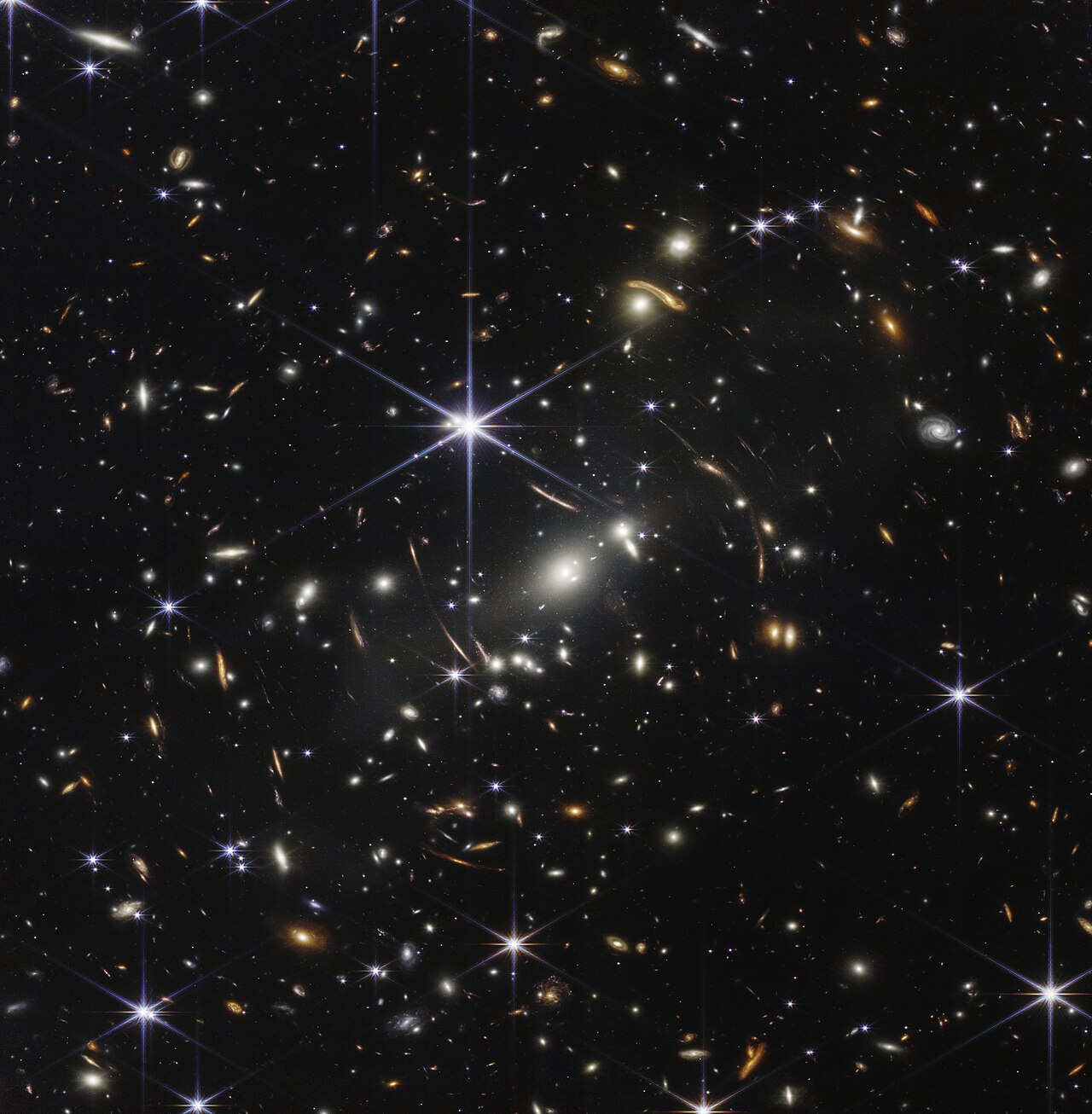

Cosmic dawn is among the most active frontiers in observational cosmology. The James Webb Space Telescope (JWST) has revealed galaxies at redshifts far higher than pre-launch models predicted, the EDGES experiment reported a controversial detection of the 21-cm hydrogen absorption signal from this era, and upcoming radio interferometers promise to map the neutral intergalactic medium in three dimensions. Together, these efforts are reshaping the understanding of how the first structures formed and how they transformed the universe around them.3, 8, 21
From the dark ages to first light
The cosmic dark ages began when the universe was approximately 380,000 years old, at the moment of recombination when free electrons combined with protons to form neutral hydrogen atoms. The resulting gas was transparent to CMB photons but contained no luminous objects. For the next hundred million years or more, the universe was filled with a nearly uniform sea of neutral hydrogen and helium, permeated by the invisible gravitational scaffolding of dark matter whose density fluctuations had been seeded during cosmic inflation.1, 12
During this interval, dark matter overdensities grew through gravitational instability, collapsing into progressively larger structures called halos. Ordinary baryonic matter fell into the gravitational potential wells of these halos, but without any heavy elements to serve as coolants, the gas could only radiate energy through molecular hydrogen (H2) rotational-vibrational transitions. This limited cooling mechanism set a minimum halo mass for gas collapse of roughly 105 to 106 solar masses — structures known as minihalos — which first assembled at redshifts z ~ 20–30, approximately 100 to 200 million years after the Big Bang.18, 2 The moment when gas within these minihalos cooled, condensed, and ignited as the first stars marks the beginning of cosmic dawn and the end of the dark ages.
Population III stars and the first light
The first generation of stars, designated Population III (Pop III), formed from gas of entirely primordial composition — hydrogen, helium, and trace amounts of lithium produced during Big Bang nucleosynthesis, with no heavier elements whatsoever. The absence of metals profoundly affected their properties. Without efficient metal-line and dust-grain cooling channels, primordial gas could cool only to approximately 200 kelvin through H2 transitions, resulting in much higher characteristic masses for the collapsing gas clumps than those typical of present-day star formation.2, 17
Hydrodynamical simulations predict that Pop III stars were extremely massive, with a top-heavy initial mass function spanning from roughly 10 to several hundred solar masses and a characteristic mass of approximately 10 to 50 solar masses.11 Their extreme masses and metal-free atmospheres produced surface temperatures exceeding 100,000 kelvin and luminosities of 105 to 107 solar luminosities, making them extraordinarily efficient producers of ionizing ultraviolet radiation. A single Pop III star of 100 solar masses could ionize a bubble of intergalactic hydrogen several kiloparsecs across, creating the first localised pockets of ionized gas in the neutral universe.2, 11
These stars burned through their nuclear fuel in only a few million years. Depending on their mass, they ended their lives as core-collapse supernovae that dispersed the first heavy elements into the surrounding gas, or — for the most massive examples above approximately 260 solar masses — collapsed directly into black holes without significant metal ejection. The supernovae enriched the primordial gas with carbon, oxygen, and other metals, crossing the critical metallicity threshold (roughly 10−4 to 10−3 solar metallicities) above which fine-structure line cooling enables the formation of lower-mass, longer-lived Population II stars.11, 2
The first galaxies
While individual Pop III stars formed in isolated minihalos, the assembly of the first true galaxies required the coalescence of many such halos into larger structures. When a dark matter halo reached a virial temperature of approximately 104 kelvin — corresponding to a mass of roughly 108 solar masses — infalling gas could cool through atomic hydrogen line emission (Lyman-alpha cooling), independent of the fragile H2 molecule. These atomic-cooling halos are considered the birthplaces of the first galaxies, capable of sustaining more vigorous and continuous star formation than their minihalo predecessors.1, 10
The first galaxies were small, irregular systems with stellar masses of perhaps 105 to 107 solar masses. Through hierarchical merging, these protogalactic fragments assembled into progressively larger systems, building up the galaxy population whose collective ultraviolet output would eventually drive reionization. The ultraviolet radiation from these early galaxies also exerted powerful feedback on the intergalactic medium, heating gas and suppressing further star formation in the smallest halos through photoevaporation of their gas reservoirs — a self-regulating process that modulated the pace of cosmic dawn itself.10, 1
Lyman-alpha emitters — galaxies identified by their strong emission in the Lyman-alpha line of hydrogen at 121.6 nanometres — have served as key tracers of the galaxy population during and immediately after cosmic dawn. Because Lyman-alpha photons are resonantly scattered by neutral hydrogen, the visibility of Lyman-alpha emission is sensitive to the neutral fraction of the intergalactic medium. The observed decline in the fraction of galaxies showing strong Lyman-alpha emission at redshifts beyond z ~ 6 has been interpreted as evidence for a substantially neutral intergalactic medium during the later stages of reionization.19 In a striking result, JWST detected Lyman-alpha emission from a galaxy at z = 13.0 through the JADES survey, suggesting that this galaxy had carved out a large enough local ionized bubble to transmit the emission through the otherwise largely neutral surrounding medium.14
First black hole seeds
The formation of the first supermassive black holes poses one of the most challenging problems connected to cosmic dawn. Observations of luminous quasars at redshifts z > 6 imply that black holes with masses exceeding 109 solar masses had already assembled within the first billion years of cosmic history — a timeline that is difficult to explain through the standard Eddington-limited accretion of stellar-mass black hole remnants.20
Several mechanisms have been proposed for the formation of massive black hole seeds during cosmic dawn. In the direct-collapse scenario, pristine gas in atomic-cooling halos exposed to a strong ultraviolet radiation field (which suppresses H2 cooling and prevents fragmentation) collapses monolithically into a supermassive star of 104 to 105 solar masses, which then rapidly collapses into a black hole of comparable mass. These direct-collapse black holes (DCBHs) provide much more massive seeds than Pop III stellar remnants and require less subsequent growth to explain the observed quasar population.20 Alternative pathways include the runaway merging of stars in dense primordial star clusters and the rapid growth of Pop III remnant black holes through super-Eddington accretion episodes. The relative importance of these channels remains an open question, but the existence of massive black holes at high redshift confirms that the processes of cosmic dawn extended beyond star formation to encompass the seeding of the structures that would power active galactic nuclei throughout cosmic history.20, 10
The 21-cm hydrogen signal
The most direct probe of the neutral intergalactic medium during cosmic dawn is the 21-cm line of neutral hydrogen, corresponding to the hyperfine spin-flip transition of the hydrogen atom at a rest-frame frequency of 1420 MHz. Because cosmic expansion redshifts this line to frequencies of approximately 50–200 MHz for the relevant redshift range (z ~ 6–30), observations of the redshifted 21-cm signal can in principle map the distribution and thermal state of neutral hydrogen throughout the dark ages, cosmic dawn, and the epoch of reionization.5
The 21-cm signal is observed either in emission or absorption against the cosmic microwave background, depending on whether the spin temperature of the hydrogen gas is above or below the CMB temperature. During the dark ages, the gas and CMB temperatures were coupled, producing no net signal. As the first stars formed during cosmic dawn, their Lyman-alpha radiation coupled the spin temperature to the kinetic temperature of the gas through the Wouthuysen-Field effect. Because the gas had cooled adiabatically below the CMB temperature by this epoch, the result was an absorption signal — a dip in the sky-averaged radio spectrum at frequencies corresponding to the redshift of first star formation.5, 1
In 2018, the Experiment to Detect the Global Epoch of Reionization Signature (EDGES) reported the detection of an absorption profile centred at 78 MHz, corresponding to redshift z ~ 17, in the sky-averaged radio spectrum. The profile was consistent with the expected timing of cosmic dawn but was approximately twice as deep as the maximum amplitude predicted by standard models, reaching an absorption depth of roughly 500 millikelvin compared to the expected maximum of approximately 200 millikelvin.3 If confirmed, the anomalous depth of the signal would require either that the gas was colder than expected during cosmic dawn (possibly due to interactions with dark matter) or that the radio background against which the absorption was measured was brighter than the CMB alone (possibly due to an excess radio background from early black holes or other exotic sources).3, 15
The EDGES result has remained highly controversial. Subsequent analyses raised concerns about the potential for systematic errors in the foreground modelling and instrumental calibration required to extract such a faint cosmological signal from astrophysical foregrounds that are several orders of magnitude brighter.15 Critically, the SARAS 3 experiment — an independent radiometer deployed on a lake in southern India to minimise ground-based systematics — reported in 2022 that it could not confirm the EDGES signal, finding results inconsistent with the best-fit EDGES profile at approximately 95.3 percent confidence.4 The Hydrogen Epoch of Reionization Array (HERA), a purpose-built interferometer in South Africa, has also placed increasingly stringent upper limits on the 21-cm power spectrum during the epoch of reionization, constraining models of X-ray heating and the thermal history of the intergalactic medium, though it has not yet reached the sensitivity needed to make a definitive detection of the cosmic dawn signal.21
The resolution of the EDGES controversy awaits confirmation or refutation by next-generation instruments. The Square Kilometre Array (SKA), currently under construction in Australia and South Africa, is expected to provide the sensitivity and angular resolution needed to image the 21-cm signal from cosmic dawn in three dimensions, potentially mapping the growth and merger of the first ionized bubbles and revealing the spatial distribution of the earliest luminous sources.5, 21
JWST and the discovery of early galaxies
The launch of the James Webb Space Telescope in December 2021 opened a direct observational window into cosmic dawn for the first time. Within months of beginning science operations, JWST's near-infrared imaging surveys identified galaxy candidates at redshifts far exceeding pre-launch expectations, including objects at z ~ 10–12 that appeared surprisingly luminous and massive for their epoch.6, 7
The GLASS-JWST Early Release Science programme, targeting the gravitational lensing cluster Abell 2744, identified several galaxy candidates at z > 10, including objects that appeared to have formed within the first 400 million years of cosmic history.16 The JADES (JWST Advanced Deep Extragalactic Survey) programme, combining deep NIRCam imaging with NIRSpec spectroscopy in the Hubble Ultra Deep Field and GOODS-South regions, has provided the most comprehensive census of early galaxies to date, spectroscopically confirming numerous objects at z > 10 and establishing the ultraviolet luminosity function of galaxies during the pre-reionization epoch.9, 7
Among the most remarkable findings have been the spectroscopic confirmations of galaxies at the highest known redshifts. Carniani et al. (2024) reported the spectroscopic confirmation of two luminous galaxies at z ~ 14, observed as they existed just 290 million years after the Big Bang. These objects displayed unexpectedly high stellar masses and star formation rates, suggesting that the processes of galaxy assembly began earlier and proceeded more efficiently than standard hierarchical models had predicted.8 Harikane et al. (2023) compiled a comprehensive sample of galaxies at z ~ 9–16 from early JWST data, finding that the ultraviolet luminosity function at z > 10 significantly exceeded predictions from most pre-JWST theoretical models, with an overabundance of bright galaxies by factors of several to an order of magnitude.7
Not all initial photometric candidates have survived spectroscopic scrutiny. Arrabal Haro et al. (2023) demonstrated that some high-redshift candidates identified from photometric data alone turned out to be lower-redshift interlopers whose spectral energy distributions mimicked those of very high-redshift objects, while others were confirmed at their originally estimated redshifts.13 This underscored the critical importance of spectroscopic confirmation and the need for caution in interpreting photometric redshifts at the frontier of cosmic dawn.
Implications for galaxy formation models
The abundance and luminosity of galaxies discovered by JWST at z > 10 have posed significant challenges to the standard Lambda-CDM framework of galaxy formation. Pre-launch models, calibrated to Hubble Space Telescope observations at z ~ 4–8 and extrapolated to higher redshifts, generally predicted a steep decline in the number density of bright galaxies beyond z ~ 10. The JWST observations have instead revealed a shallower decline or even a plateau in the bright end of the ultraviolet luminosity function, implying that the earliest galaxies converted their available gas into stars with higher efficiency than their lower-redshift counterparts.7, 6
Several explanations have been proposed. One possibility is that star formation efficiency in the first galaxies was genuinely higher than in later epochs, perhaps because the gas in pristine or minimally enriched halos was less susceptible to the feedback mechanisms (stellar winds, supernova explosions, radiation pressure) that regulate star formation in more evolved systems.10 Another possibility is that the initial mass function in early galaxies was more top-heavy than the canonical present-day form, producing more ultraviolet luminosity per unit stellar mass and making the galaxies appear brighter than their actual stellar masses would suggest.11 A third class of explanations invokes stochastic or bursty star formation, in which short-lived episodes of intense star formation produce temporarily elevated luminosities that are preferentially detected in flux-limited surveys, biasing the observed luminosity function upward.7
The tension between observations and models does not necessarily require modifications to the fundamental cosmological framework. Rather, it may indicate that the astrophysics of star formation and feedback in the earliest galaxies was qualitatively different from the conditions prevailing at lower redshifts — a finding that, if confirmed, would constitute one of the most significant insights to emerge from the JWST era. The transition from the pristine, metal-free conditions of the very first star formation through the progressive chemical enrichment and assembly of the first galaxies represents a period of rapid physical transformation that the current generation of observations is only beginning to probe in detail.8, 10
Transition to the epoch of reionization
Cosmic dawn does not have a sharp upper boundary but instead grades continuously into the epoch of reionization. As the first stars and galaxies accumulated, their collective ultraviolet output began ionizing the surrounding intergalactic medium, creating expanding bubbles of ionized hydrogen (H II regions) around each source. Initially small and isolated, these bubbles grew and merged as the galaxy population increased, eventually percolating through the intergalactic medium and completing the reionization of the universe by approximately z ~ 5.5–6.19, 12
The Planck satellite's measurement of the Thomson optical depth to the cosmic microwave background (τ = 0.054 ± 0.007) implies a midpoint of reionization at z ~ 7.7 ± 0.7, indicating that the bulk of reionization occurred between z ~ 10 and z ~ 6.12 The JWST detection of Lyman-alpha emission at z = 13.0 suggests that localised ionized bubbles existed much earlier, carved out by the most luminous early galaxies well before the process became widespread.14 Combining these observations with quasar absorption spectra and the statistics of Lyman-alpha emitters at z > 6 paints a picture in which cosmic dawn seeded the initial ionizing sources between z ~ 30 and z ~ 15, and reionization then proceeded as an extended, spatially inhomogeneous process over the following several hundred million years.19, 10
The study of cosmic dawn remains one of the most rapidly evolving fields in astrophysics. Each JWST observing cycle pushes the frontier of galaxy detection to higher redshifts, while ground-based and space-based 21-cm experiments approach the sensitivity thresholds needed to detect the diffuse neutral hydrogen signal from this epoch. Together, these complementary approaches are converging on a detailed understanding of how the universe transitioned from a cold, dark, featureless expanse of neutral gas into the luminous, structured cosmos observed today.5, 8, 21
References
A comprehensive study of galaxies at z ~ 9-16 found in the early JWST data: ultraviolet luminosity functions and cosmic star formation history at the pre-reionization epoch
GLASS-JWST. I. Magnified high-redshift galaxy candidates behind the galaxy cluster Abell 2744
Improved constraints on the 21 cm EoR power spectrum and the X-ray heating of the IGM with HERA Phase I observations