Overview
- Every star loses mass through outflowing streams of gas called stellar winds, ranging from the gentle breeze of the solar wind at roughly 10−14 solar masses per year to the fierce gales of Wolf-Rayet stars shedding more than 10−5 solar masses per year.
- The physical mechanism driving a stellar wind depends on the star's position on the Hertzsprung–Russell diagram—hot massive stars accelerate gas through radiation pressure on spectral lines, cool giants and AGB stars push dust grains that drag gas along, and solar-type stars are driven by thermal pressure from million-degree coronae.
- Stellar winds sculpt the interstellar medium into bubbles and shells, carry freshly synthesized heavy elements into the galaxy, regulate angular momentum loss through magnetic braking, and inflate the heliosphere that shields the solar system from galactic cosmic rays.
Introduction
A stellar wind is a continuous outflow of charged particles and gas from the atmosphere of a star. Every star with an atmosphere produces some form of wind, though the mass-loss rate, velocity, and driving mechanism vary enormously depending on the star’s mass, luminosity, temperature, and evolutionary stage.12 At one extreme, the Sun emits a relatively tenuous wind that carries away roughly 2–3 × 10⁻¹⁴ solar masses per year.1 At the other, the most luminous Wolf-Rayet stars shed more than 10−5 solar masses per year in dense, fast outflows that profoundly reshape both the star and its surroundings.4 Stellar winds are far more than a curiosity of individual stars. They enrich the interstellar medium with heavy elements produced by nucleosynthesis, drive the chemical evolution of galaxies, excavate vast wind-blown bubbles in the surrounding gas, and carry away angular momentum that governs how stars spin down over cosmic time.12, 13

The solar wind and Parker's prediction
The existence of a continuous particle outflow from the Sun was predicted theoretically by Eugene Parker in 1958, several years before it was confirmed by spacecraft measurements.1 Parker recognized that the solar corona—the outermost layer of the Sun’s atmosphere, heated to temperatures exceeding one million kelvin—could not remain in hydrostatic equilibrium. At such temperatures, the thermal pressure of the coronal gas exceeds the gravitational pull of the Sun at large distances, and the corona must expand supersonically outward into interplanetary space.1 Parker’s hydrodynamic model predicted a smooth acceleration from subsonic speeds near the solar surface to supersonic speeds of several hundred kilometers per second by the time the flow reaches Earth’s orbit. This prediction was confirmed in 1962 by the Mariner 2 spacecraft, which detected a persistent stream of protons and electrons flowing radially outward from the Sun at speeds between 300 and 800 km/s.12
The solar wind is not uniform. Observations by the Ulysses spacecraft, which flew over both solar poles, revealed a bimodal structure: a fast wind component emerging from coronal holes at approximately 750 km/s and a slow wind component originating near the streamer belt at around 400 km/s.14 The fast wind is comparatively steady, with low density and high proton temperatures, while the slow wind is denser, more variable, and compositionally distinct.9, 14 The precise origin and acceleration mechanism of the slow solar wind remain active areas of research, as do the processes responsible for heating the corona to temperatures far above those of the underlying photosphere.10
The coronal heating problem
The temperature of the solar photosphere is roughly 5,800 K, yet the corona immediately above it reaches 1–3 million kelvin. This dramatic temperature inversion, known as the coronal heating problem, has been one of the central unsolved questions in solar physics for more than seven decades.10 Because the corona is the reservoir of thermal energy that drives the solar wind, understanding coronal heating is inseparable from understanding the wind itself.
Two broad classes of mechanism have been proposed. The first involves the dissipation of magnetohydrodynamic (MHD) waves—particularly Alfvén waves—generated by convective motions at the solar surface. These waves propagate upward along magnetic field lines and deposit their energy in the corona through turbulent cascade, phase mixing, or resonant absorption.10 The second class relies on magnetic reconnection in the form of nanoflares: small, impulsive heating events that occur when stressed magnetic field lines rearrange and release stored energy. Both mechanisms likely contribute, with their relative importance varying across different coronal structures—open field regions that produce the fast wind versus closed loops that confine hot plasma.10, 9
Line-driven winds in hot massive stars
Stars of spectral type O and early B, with surface temperatures above roughly 25,000 K and luminosities exceeding 105 times that of the Sun, produce stellar winds driven by an entirely different mechanism than the solar wind. In these stars, ultraviolet photons from the intense radiation field are absorbed and scattered by millions of spectral lines—primarily those of partially ionized metals such as carbon, nitrogen, oxygen, and iron.2 Each absorption event transfers momentum from the photon to the ion, and Coulomb collisions distribute this momentum to the surrounding gas. Because the outflowing gas is Doppler-shifted relative to the underlying photosphere, ions continuously encounter fresh, unattenuated photons at frequencies that match their shifted line transitions, producing a self-amplifying acceleration known as the line-deshadowing instability.2
The theoretical framework for this process was formalized by Castor, Abbott, and Klein (CAK) in 1975.2 The CAK theory predicts that both the mass-loss rate and the terminal wind velocity scale as power laws of the stellar luminosity and effective temperature. Typical O-type supergiants drive winds with terminal velocities of 1,000–3,000 km/s and mass-loss rates of 10−7 to 10−5 solar masses per year.3 Because the driving force comes from metal-line opacity, the mass-loss rate depends on the stellar metallicity. At lower metallicity, fewer metal lines are available to intercept photons, and mass-loss rates decrease roughly as Z0.7, where Z is the metallicity relative to solar.3 This metallicity dependence has profound consequences for stellar evolution in low-metallicity environments, such as the early universe, where massive stars retained more of their mass and likely ended their lives with more massive cores.3
Wolf-Rayet winds
Wolf-Rayet (WR) stars represent a late evolutionary phase of the most massive stars, in which the hydrogen envelope has been stripped away—either by powerful stellar winds during earlier evolutionary stages or through binary mass transfer—exposing the helium-burning core.4 The spectra of WR stars are dominated by broad emission lines of helium, nitrogen (WN subtype), or carbon and oxygen (WC and WO subtypes), indicating dense, fast-moving outflows with terminal velocities of 1,000–5,000 km/s.4, 12
Mass-loss rates in WR stars are among the highest observed for any stellar type, typically ranging from 10−5 to 10−4 solar masses per year.4 These extreme outflows are driven primarily by radiation pressure, though the details differ from the standard CAK mechanism. The high helium and heavy-element surface abundances provide a dense forest of spectral lines, and the opacity in WR winds is sufficiently large that multiple scattering of photons contributes significantly to the total momentum transfer—the wind momentum can exceed the single-scattering limit L/c, where L is the luminosity and c the speed of light.4 The intense mass loss from WR stars ejects large quantities of carbon, oxygen, and heavier elements into the interstellar medium, contributing substantially to the chemical enrichment of galaxies even before these stars end their lives as supernovae.4, 13
Dust-driven winds of cool evolved stars
Stars on the asymptotic giant branch (AGB)—low- to intermediate-mass stars in the final stages of nuclear burning—lose mass through a mechanism fundamentally different from the radiation-driven winds of hot stars. AGB stars have extended, cool atmospheres (effective temperatures of 2,000–3,500 K) in which large-amplitude radial pulsations levitate gas to distances where temperatures drop below the condensation point of refractory solids.5 Dust grains—primarily silicates in oxygen-rich stars and amorphous carbon in carbon-rich stars—form in these elevated layers and absorb or scatter stellar photons very efficiently. The radiation pressure on the grains accelerates them outward, and collisional coupling between dust and gas drags the surrounding gaseous envelope along.5
This pulsation-enhanced, dust-driven mechanism produces slow, dense outflows with terminal velocities of only 5–30 km/s but mass-loss rates as high as 10−4 solar masses per year during the superwind phase at the tip of the AGB.5 Over the course of the AGB phase, a star may lose 50–80 percent of its total mass, leaving behind only a hot, compact core that ionizes the ejected material to form a planetary nebula.5, 12 AGB winds are a major source of dust and processed material returned to the interstellar medium, including carbon, nitrogen, and elements synthesized by the slow neutron-capture process (s-process).5, 13
Red giant and red supergiant stars that have not yet reached the AGB also experience mass loss, though at generally lower rates. The driving mechanisms for these winds are less well understood; they may involve a combination of Alfvén-wave pressure, acoustic wave dissipation, and radiation pressure on molecules in the chromosphere.15
Mass loss across the Hertzsprung–Russell diagram
Empirical surveys of mass-loss rates across the Hertzsprung–Russell diagram reveal a striking pattern: mass loss is negligible for main-sequence stars cooler than about spectral type B, moderate for hot O and B main-sequence stars, and dramatic for evolved stars of all masses.15 The de Jager, Nieuwenhuijzen, and van der Hucht (1988) compilation provided one of the first comprehensive empirical mappings of mass-loss rate as a function of effective temperature and luminosity, revealing that the highest rates are found among the most luminous cool supergiants and the hottest Wolf-Rayet stars.15
For solar-type main-sequence stars, the wind is so tenuous that cumulative mass loss over a stellar lifetime is negligible—the Sun has lost less than 0.01 percent of its mass to the solar wind over 4.6 billion years.1, 12 In contrast, a 60-solar-mass O-type star may lose 10–30 solar masses through winds during its main-sequence and post-main-sequence evolution, fundamentally altering its subsequent evolutionary path, its final mass at core collapse, and the type of compact remnant it produces.3, 15 Mass loss is therefore not merely a secondary process in stellar physics; for massive stars, it is one of the primary factors governing stellar evolution.12
Wind-blown bubbles and nebulae
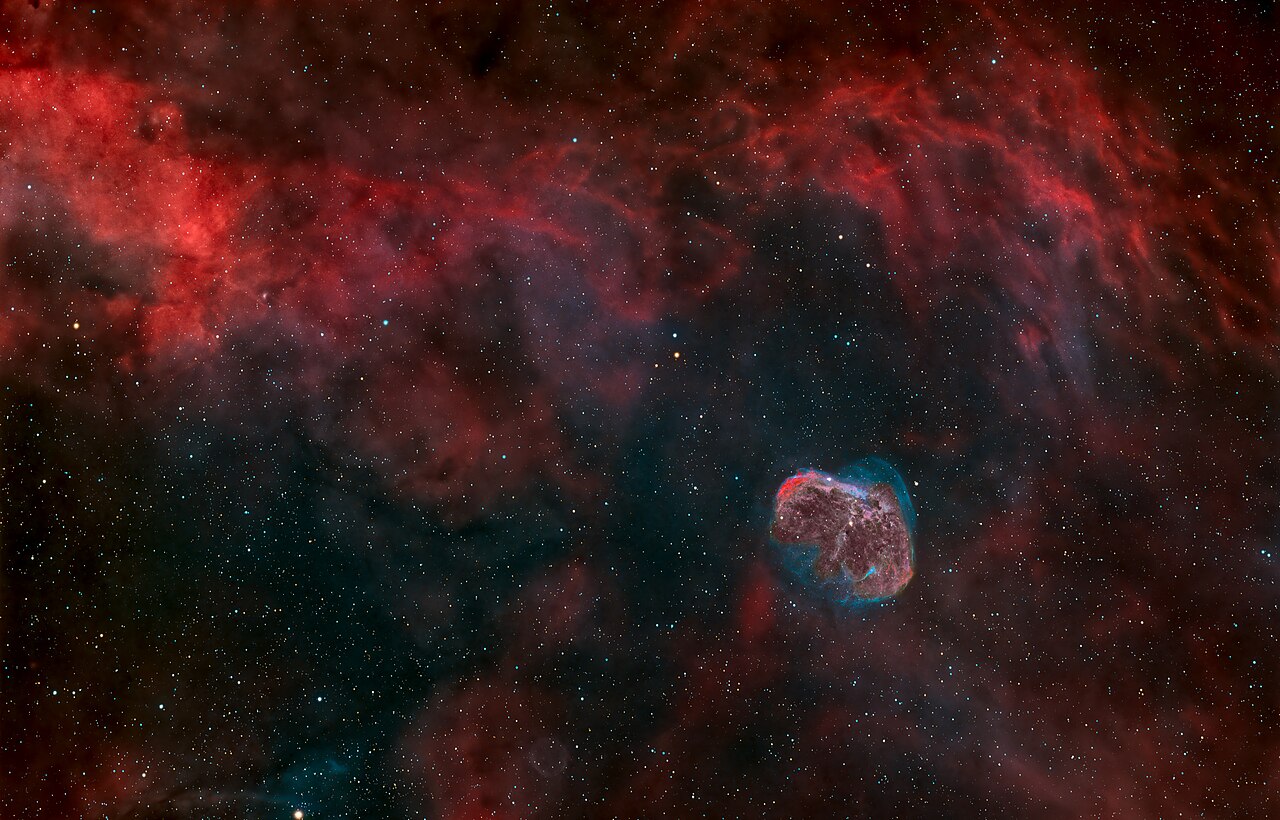
When a stellar wind collides with the surrounding interstellar medium, it sweeps up ambient gas into a dense shell and inflates a hot, low-density cavity known as a wind-blown bubble.6 The standard model developed by Weaver et al. (1977) describes the structure of such a bubble as consisting of four zones: the freely expanding wind, a region of shocked wind gas heated to temperatures of 106–108 K, a dense shell of swept-up interstellar material, and the undisturbed ambient medium beyond the shell.6
For massive O-type and Wolf-Rayet stars, these bubbles can grow to tens of parsecs in diameter over the star’s lifetime, and the cumulative action of many such stars within OB associations creates superbubbles that can extend hundreds of parsecs and even blow out of the galactic disk entirely.6 The ring nebulae frequently observed around Wolf-Rayet stars are a visible manifestation of the interaction between the current fast WR wind and the slower, denser material shed during earlier evolutionary phases.4, 6 These wind-blown structures play an important role in shaping the multiphase structure of the interstellar medium and may trigger or inhibit subsequent episodes of star formation in adjacent molecular clouds.6
Magnetized winds and angular momentum loss
For stars with surface magnetic fields—including the Sun and other cool, convective main-sequence stars—the wind carries away not only mass but also angular momentum. The mechanism, first described quantitatively by Weber and Davis (1967), arises because the outflowing plasma is forced to co-rotate with the stellar magnetic field out to the Alfvén radius, the distance at which the wind speed exceeds the Alfvén speed and the plasma decouples from the field.11 Because the effective lever arm for angular momentum removal extends to the Alfvén radius rather than the stellar surface, even a modest mass-loss rate can extract substantial angular momentum and spin the star down over time.11
This process, known as magnetic braking, explains why older solar-type stars rotate more slowly than younger ones—an observational relationship exploited in gyrochronology to estimate stellar ages from rotation periods.11, 12 The Sun’s current rotation period of roughly 25 days at its equator is a direct consequence of billions of years of angular momentum loss through the magnetized solar wind. Without this braking mechanism, the Sun would still be rotating several times faster, with significant implications for its magnetic activity, flare frequency, and the space environment experienced by the planets.11
The heliosphere and the heliopause
The solar wind inflates a vast cavity in the local interstellar medium called the heliosphere.7 As the solar wind flows outward, it eventually encounters the pressure of the surrounding interstellar gas and decelerates. The point where the supersonic solar wind abruptly slows to subsonic speeds is the termination shock, which Voyager 1 crossed in December 2004 at a distance of approximately 94 astronomical units from the Sun.7 Beyond the termination shock lies the heliosheath, a turbulent region of heated, compressed solar wind plasma. The outer boundary of the heliosphere—the heliopause, where solar wind pressure balances interstellar pressure—was crossed by Voyager 1 in August 2012 at a distance of about 121 AU, as confirmed by the detection of a dramatic increase in galactic cosmic ray intensity and plasma oscillations characteristic of the interstellar medium.8
Voyager 2 crossed the heliopause in November 2018 at approximately 119 AU, providing a second independent measurement and confirming that the heliosphere is not perfectly symmetric.8 The heliosphere shields the solar system from the full intensity of galactic cosmic rays, and its size and shape fluctuate with the solar cycle as the solar wind pressure varies. Understanding the heliosphere is not only important for solar physics but also for assessing the radiation environment experienced by spacecraft and, by extension, by any hypothetical biospheres around other stars with their own astrospheres.7, 8
Stellar wind contributions to interstellar enrichment
Stellar winds are one of the primary channels through which processed material is returned from stars to the interstellar medium, alongside supernova explosions and neutron star mergers.13 Massive stars, through their powerful line-driven and Wolf-Rayet winds, eject significant quantities of helium, carbon, nitrogen, and oxygen during their lifetimes, pre-enriching their surroundings even before the final supernova explosion.3, 4 AGB stars, meanwhile, are the dominant source of carbon and s-process elements (such as barium, strontium, and lead) returned to the interstellar medium through their dust-driven winds.5
The cumulative contribution of stellar winds to the chemical evolution of galaxies is substantial. Models of galactic chemical evolution that neglect pre-supernova wind mass loss from massive stars systematically underpredict the observed abundances of certain elements, particularly nitrogen and carbon, at intermediate metallicities.13 Furthermore, wind-ejected material is deposited gently into the interstellar medium over the star’s lifetime, in contrast to the explosive, shock-heated ejecta of supernovae. This gentler enrichment channel may be more efficiently incorporated into the next generation of star-forming clouds, making stellar winds a critical ingredient in the recycling of baryonic matter within galaxies.13, 12
References
Mass loss of stars on the asymptotic giant branch: mechanisms, models and measurements
Solar wind models from the Sun to 1 AU: constraints by in situ and remote sensing observations