Overview
- Magnetars are neutron stars with surface magnetic fields of 1014 to 1015 gauss—roughly 1,000 times stronger than ordinary pulsars—first proposed theoretically by Duncan and Thompson in 1992 and confirmed observationally by Kouveliotou and colleagues in 1998 through spin-down measurements of SGR 1806−20.
- The giant flare from SGR 1806−20 on 27 December 2004 released approximately 2 × 1046 erg in 0.2 seconds—more energy than the Sun emits in 250,000 years—and produced quasi-periodic oscillations interpreted as seismic vibrations of the neutron star crust, opening a new window on the interior physics of ultra-dense matter.
- In April 2020, the Galactic magnetar SGR 1935+2154 emitted a millisecond-duration radio burst (FRB 200428) bright enough to be detectable at extragalactic distances, establishing for the first time that magnetars can produce fast radio bursts and linking two of the most active fields in modern astrophysics.
Magnetars are neutron stars possessing the strongest magnetic fields known in the universe, with surface dipole strengths of 1014 to 1015 gauss—roughly a thousand times more powerful than those of ordinary radio pulsars and a quadrillion times the strength of Earth's magnetic field. These extraordinary objects manifest as two historically distinct observational classes, soft gamma-ray repeaters (SGRs) and anomalous X-ray pulsars (AXPs), now understood to be the same physical phenomenon viewed under different circumstances.6, 7 Unlike rotation-powered pulsars, whose luminosity derives from the spin-down of the neutron star, magnetars are powered primarily by the decay and instability of their colossal magnetic fields—a fundamentally different energy source that produces a remarkable array of violent transient phenomena including short X-ray bursts, prolonged outbursts, and rare giant flares of staggering power.3, 6
First proposed theoretically by Robert Duncan and Christopher Thompson in 1992, and confirmed observationally six years later, magnetars occupy an extreme corner of the neutron star parameter space. Approximately 30 confirmed magnetars are currently known in the Milky Way and its satellite galaxies, making them among the rarest classes of compact objects.1, 10 Their study has implications reaching far beyond neutron star physics: magnetar giant flares produce quasi-periodic oscillations that probe the interior structure of ultra-dense matter, and the 2020 detection of a fast radio burst from a Galactic magnetar has connected these objects to one of the most active frontiers in modern astrophysics.9, 13
Theoretical origins
The magnetar hypothesis emerged from theoretical work on the generation of magnetic fields in newly born neutron stars. In 1992, Robert Duncan and Christopher Thompson published a landmark paper arguing that neutron stars born with exceptionally rapid rotation—initial spin periods of approximately 1 millisecond—could amplify their magnetic fields to extraordinary strengths through the action of a convective dynamo operating in the first 10 to 30 seconds after gravitational collapse.1 During this brief interval, the proto-neutron star is convectively unstable: neutrino-driven convection churns the interior at velocities of order 108 cm/s, and the combination of rapid rotation and vigorous convection provides the ingredients for an α–Ω dynamo—the same class of mechanism responsible for the Sun's magnetic field, but operating under incomparably more extreme conditions.1, 2
Thompson and Duncan showed in 1993 that this dynamo could, in principle, amplify the magnetic field to strengths as high as 3 × 10¹⁷ gauss in the stellar interior, with surface dipole fields of 1014 to 1015 gauss.2 The critical requirement is that the nascent neutron star rotate rapidly enough—with a period of a few milliseconds—for the Rossby number (the ratio of rotational period to convective turnover time) to fall below unity, placing the system in the regime where rotation strongly organizes the convective flow and enables efficient large-scale dynamo action. Neutron stars born with slower rotation would instead produce ordinary pulsar-strength fields of order 1012 gauss.2
In a pair of papers published in 1995 and 1996, Thompson and Duncan developed the magnetar model into a comprehensive physical theory. They demonstrated that the decay of a 1015-gauss magnetic field could power the persistent X-ray emission observed from SGRs and AXPs, that sudden rearrangements of the internal field could fracture the neutron star crust and launch Alfvén waves into the magnetosphere producing the observed short bursts, and that catastrophic global reconfigurations of the external field could explain the rare giant flares.3, 4 The term "magnetar" itself was coined in these papers to describe this new class of magnetically powered neutron star.3
Modern three-dimensional magnetohydrodynamic simulations have broadly confirmed the Duncan-Thompson dynamo scenario. Raynaud and colleagues demonstrated in 2020 that a convective dynamo operating in a rapidly rotating proto-neutron star can indeed generate dipole fields exceeding 1014 gauss within seconds of core collapse, with the strongest fields produced when the initial rotation period is below approximately 4 milliseconds.16
Observational confirmation
The observational case for magnetars was built in stages across two decades. Soft gamma-ray repeaters had been known since the late 1970s as enigmatic sources of brief, intense bursts of soft gamma rays, but their physical nature remained disputed. Anomalous X-ray pulsars, discovered in the 1980s and 1990s, presented a different puzzle: they were slowly rotating X-ray pulsars (periods of 5 to 12 seconds) whose X-ray luminosities vastly exceeded what their spin-down energy could provide, and they showed no evidence of the binary companions expected if the X-rays were powered by accretion.7
The breakthrough came in 1998, when Chryssa Kouveliotou and colleagues used the Rossi X-ray Timing Explorer (RXTE) to detect coherent pulsations from SGR 1806−20 with a period of 7.47 seconds. Critically, they measured the spin-down rate at 2.6 × 10⁻³ seconds per year—an extremely rapid deceleration implying, under the standard magnetic dipole braking formula, a surface dipole field of approximately 8 × 10¹⁴ gauss.5 This was the first direct observational evidence that SGRs harbour the ultra-strong magnetic fields predicted by the magnetar model. The inferred characteristic age of roughly 1,500 years was consistent with the association of SGR 1806−20 with a young stellar cluster and a candidate supernova remnant.5
Subsequent spin-down measurements of other SGRs and AXPs yielded similarly extreme field strengths, and the growing observational overlap between the two classes—SGRs displaying persistent X-ray emission like AXPs, and AXPs occasionally producing SGR-like bursts—led to their unification under the magnetar framework by the mid-2000s.6, 7 The McGill Magnetar Catalog, maintained by Olausen and Kaspi, listed 26 confirmed and candidate magnetars as of its 2014 publication, with the number having since grown to approximately 30.10
Physical properties
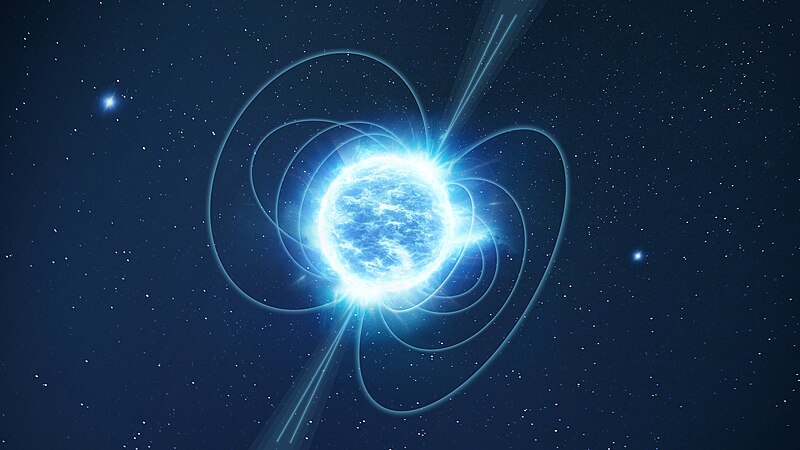
Magnetars share the fundamental properties of all neutron stars—masses of approximately 1.4 solar masses and radii of roughly 10 kilometres—but are distinguished by their magnetic fields and the consequences those fields produce.17
_(heic2504a).jpg)
Their surface dipole fields, inferred from spin-down measurements, range from about 6 × 10¹³ to 2 × 10¹⁵ gauss, though the internal fields may be several times stronger, particularly in toroidal configurations that do not contribute directly to the external dipole moment.6
Magnetars rotate slowly compared to ordinary pulsars, with spin periods clustered between 2 and 12 seconds. This is a direct consequence of the intense magnetic braking: a 1015-gauss dipole field extracts rotational energy far more rapidly than the 1012-gauss fields of normal pulsars, spinning the star down to long periods within thousands of years.6, 5 Their spin-down rates are correspondingly large, typically 10−13 to 10−10 seconds per second, yielding characteristic ages of 103 to 105 years—far younger than the million-year characteristic ages of the general pulsar population.6, 10
The persistent X-ray luminosities of magnetars range from approximately 1033 to 1036 erg per second, with typical values around 1035 erg/s.6 In many cases, these luminosities exceed the available spin-down power by factors of 10 to 100, providing the most direct evidence that the energy source is not rotation but rather the decay and dissipation of the magnetic field. The spectra of quiescent magnetars in the soft X-ray band (below 10 keV) are typically described by a blackbody component with a temperature of 0.3 to 0.6 keV and a power-law tail, with the blackbody emission originating from the magnetically heated neutron star surface. Many magnetars also exhibit a hard X-ray component extending above 100 keV, thought to arise from resonant Compton scattering in the twisted magnetosphere.6, 7
Properties of magnetars compared to other neutron star classes6, 10, 17
| Property | Magnetars | Normal pulsars | Millisecond pulsars |
|---|---|---|---|
| Surface B-field (G) | 1014–1015 | ~1012 | 108–109 |
| Spin period | 2–12 s | 0.03–8 s | 1–30 ms |
| Characteristic age | 103–105 yr | 105–108 yr | 109–1010 yr |
| Energy source | Magnetic field decay | Rotational energy | Rotational energy |
| Known population | ~30 | ~2,600 | ~500 |
Bursts and giant flares
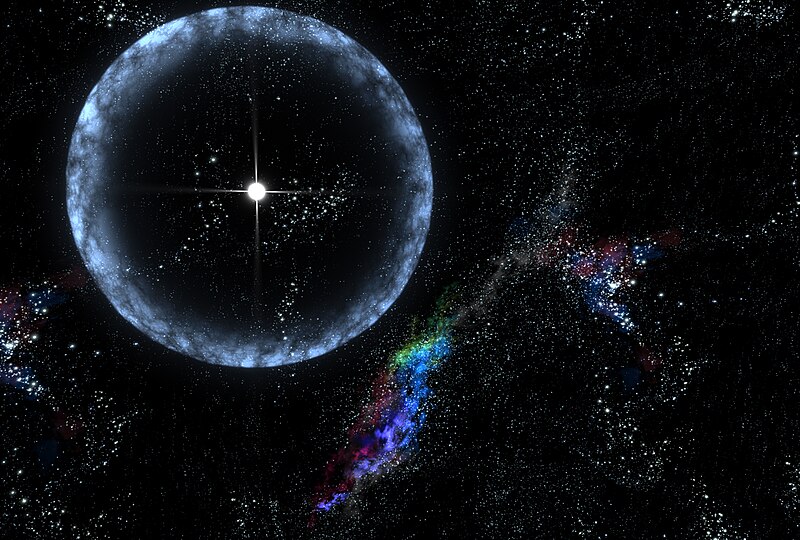
The most dramatic observational signatures of magnetars are their transient emissions, which span an enormous range of energies and timescales. At the lower end, magnetars produce short bursts lasting typically 0.01 to 1 second, with peak luminosities of 1038 to 1042 erg/s. These bursts are thought to originate from sudden fracturing of the neutron star crust as the internal magnetic field evolves and stresses the solid crystalline lattice beyond its yield strain. The cracking launches shear waves and Alfvén waves into the magnetosphere, where magnetic reconnection and particle acceleration produce the observed hard X-ray and soft gamma-ray emission.3, 6

At intermediate energies, magnetars undergo prolonged outbursts in which the persistent X-ray flux increases by factors of 10 to 1,000 over timescales of weeks to years before gradually returning to quiescence. These outbursts are often accompanied by enhanced burst activity, changes in the pulse profile, and increases in the spin-down rate—collectively suggesting a large-scale reconfiguration of the magnetic field structure, both internally and in the magnetosphere.6, 7
At the extreme end of the energy scale are the giant flares, the most energetic events ever observed from objects within the Milky Way. Only three have been recorded in the era of modern astronomy: from SGR 0526−66 on 5 March 1979, from SGR 1900+14 on 27 August 1998, and from SGR 1806−20 on 27 December 2004.6, 8 The 2004 event from SGR 1806−20 was by far the most powerful. It began with a brief initial spike lasting approximately 0.2 seconds, during which the isotropic-equivalent energy release reached approximately 2 × 1046 erg—more energy than the Sun radiates in 250,000 years, released in a fraction of a second.8 The gamma-ray flux was so intense that it saturated every gamma-ray detector in orbit, measurably ionized Earth's upper atmosphere despite the source lying approximately 15 kiloparsecs away, and was detected by instruments not even designed for gamma-ray observation.8
The initial spike was followed by a pulsating tail lasting several hundred seconds, modulated at the 7.56-second spin period of the magnetar. Thompson and Duncan's magnetar model interprets giant flares as catastrophic, global rearrangements of the external magnetic field, analogous to coronal mass ejections on the Sun but involving field energies a trillion times greater. The initial spike corresponds to the sudden release of magnetic energy, likely involving large-scale reconnection and the formation of a relativistically expanding fireball of electron-positron pairs trapped by the closed magnetic field lines near the stellar surface.3, 4, 8
Energy released in the three observed magnetar giant flares6, 8
Quasi-periodic oscillations and neutron star seismology
The pulsating tails of the 1998 and 2004 giant flares revealed an unexpected phenomenon: quasi-periodic oscillations (QPOs) at frequencies ranging from approximately 18 Hz to over 1,800 Hz, superimposed on the periodic modulation of the rotational signal.
Israel and colleagues discovered QPOs in the tail of the SGR 1806−20 hyperflare at frequencies of approximately 18, 30, and 92.5 Hz, detected beginning roughly 170 seconds after the flare onset.9 Subsequent analysis by Strohmayer and Watts identified additional oscillation frequencies at 150, 626, and 1,837 Hz in the same event, confirming a rich spectrum of discrete modes.20 Reanalysis of the 1998 giant flare from SGR 1900+14 revealed similar oscillations at 28, 54, 84, and 155 Hz.6
These QPOs are widely interpreted as torsional oscillations of the neutron star crust—global seismic vibrations excited by the violent magnetic reconfiguration that produced the giant flare. The neutron star crust is a solid crystalline lattice of neutron-rich nuclei, roughly 1 kilometre thick, overlying a liquid core of superfluid neutrons and superconducting protons.17 Torsional shear modes of this crust have eigenfrequencies that depend on the shear modulus of the crustal lattice, the density profile, the crust thickness, and the coupling between the crust and the core through the magnetic field. The observed QPO frequencies therefore provide direct constraints on the mechanical and magnetic properties of matter at supranuclear densities—a branch of research now known as neutron star seismology.6, 9
The lowest-frequency QPOs (below approximately 30 Hz) are consistent with the fundamental torsional modes of the crust, while the higher-frequency oscillations correspond to overtones. The coupling between crustal shear modes and Alfvén modes in the magnetized core complicates the picture considerably: the strong magnetic field threads both crust and core, creating a magneto-elastic system whose oscillation spectrum depends on the internal field geometry as well as the equation of state.6, 20 This coupling offers the tantalizing possibility that QPO observations can constrain not only the crustal properties but also the otherwise invisible internal magnetic field strength and configuration—information inaccessible by any other observational technique.9
Anomalous timing behaviour
Magnetars exhibit a richer and more erratic variety of rotational behaviour than any other class of neutron star. Their spin-down is generally unsteady, with substantial timing noise that far exceeds the levels seen in ordinary pulsars. Superimposed on the secular deceleration are sudden spin-up glitches similar to those observed in young pulsars, but magnetar glitches are frequently accompanied by radiative changes—X-ray bursts, flux enhancements, and pulse profile variations—suggesting a direct connection between the internal magnetic field dynamics and the rotational behaviour.6
Perhaps the most remarkable timing phenomenon in magnetars is the anti-glitch: a sudden spin-down event, the opposite of a conventional glitch. In 2012, Archibald and colleagues reported the first anti-glitch in the magnetar 1E 2259+586, detecting an abrupt decrease in the rotation frequency of Δν/ν ≈ −3.1 × 10⁻⁷, coincident with X-ray bursts and a brief enhancement in the persistent X-ray flux.12 Unlike conventional glitches, which can be explained by the transfer of angular momentum from a faster-spinning superfluid component to the crust, anti-glitches require a mechanism that removes angular momentum from the observable crust. Proposed explanations include the sudden enhancement of the external magnetic braking torque due to a magnetospheric reconfiguration, or the transfer of angular momentum from the crust to the interior through a rapid rearrangement of the internal magnetic field that recouples previously decoupled superfluid components.12, 6
Magnetars also show long-term variations in their spin-down rate that correlate with their radiative state. During outbursts, the spin-down rate typically increases, sometimes by factors of several, before gradually relaxing as the outburst subsides. This behaviour is consistent with the idea that outbursts involve the twisting of external magnetic field lines, which increases the open magnetic flux and thus the braking torque on the star. The gradual untwisting of the magnetosphere as currents dissipate then explains the slow recovery of the spin-down rate to its pre-outburst value.6
Challenging the dipole boundary
A key discovery that broadened the understanding of the magnetar phenomenon came in 2010, when Rea and colleagues reported that SGR 0418+5729—a source that had produced SGR-like bursts and displayed all the hallmarks of magnetar activity—had a dipole magnetic field no greater than 7.5 × 10¹² gauss, well within the range of ordinary radio pulsars.11 This "low-field magnetar" demonstrated that a high surface dipole field is not a necessary condition for magnetar-like behaviour. The implication is that the magnetic energy powering the activity may reside in strong multipolar or toroidal field components confined to the stellar interior and crust, which do not contribute to the externally measured dipole moment.11, 6
This discovery has significant consequences for the estimated magnetar population. If magnetar-like activity can occur in neutron stars with ordinary-looking dipole fields, then the true number of magnetars in the Galaxy may be substantially larger than the approximately 30 identified through high-dipole-field signatures alone. Population synthesis models suggest that magnetars may constitute 10 to 40 percent of all neutron stars born in the Milky Way, with many entering a quiescent phase after their active lifetime of roughly 104 years and becoming essentially undetectable.6, 10
The existence of low-field magnetars also strengthens the theoretical picture by confirming the importance of internal magnetic field topology. The total magnetic energy stored in the interior of a neutron star can vastly exceed the energy of the external dipole component, and it is this internal reservoir—particularly in the form of strong toroidal fields wound up during the proto-neutron star dynamo phase—that ultimately powers the magnetar phenomena.6, 16
Magnetars and fast radio bursts
Fast radio bursts (FRBs) are millisecond-duration radio pulses of extraordinary brightness, first detected in 2007 and now numbering in the thousands. Their extragalactic origins, enormous luminosities, and mysterious repetition patterns made them one of the most debated phenomena in astrophysics. Among the many proposed models, the magnetar hypothesis—that FRBs are produced by the extreme magnetic activity of magnetars—was prominent from early on, but direct evidence remained elusive until 2020.6, 13
On 28 April 2020, the Galactic magnetar SGR 1935+2154 produced a pair of millisecond-duration radio bursts simultaneously detected by the Canadian Hydrogen Intensity Mapping Experiment (CHIME) and the Survey for Transient Astronomical Radio Emission 2 (STARE2). The STARE2 detection measured a fluence exceeding 1.5 million Jy ms at 1.4 GHz—thousands of times brighter than any previously observed Galactic radio emission from a magnetar, though still 30 to 40 times fainter than the weakest known extragalactic FRBs.13, 14
Crucially, the radio burst was accompanied by a hard X-ray burst detected by multiple space-based instruments including INTEGRAL, Insight-HXMT, Konus-Wind, and AGILE, establishing an unambiguous temporal and spatial coincidence between the radio and X-ray emission.18 The X-ray burst was itself unremarkable by magnetar standards—a relatively ordinary short burst of the type SGR 1935+2154 had produced hundreds of times before. The radio component, however, was extraordinary: designated FRB 200428, it bridged a large fraction of the luminosity gap between ordinary magnetar radio emission and cosmological FRBs, demonstrating that magnetars can indeed produce FRB-like radio bursts.13, 14
Subsequent monitoring of SGR 1935+2154 by Kirsten and colleagues detected additional bright radio bursts in 2020, further supporting the association between magnetar activity and FRB-like emission.19 The magnetar-FRB connection does not necessarily imply that all FRBs originate from magnetars—the luminosity gap between FRB 200428 and extragalactic FRBs remains substantial, and some repeating FRB sources exhibit properties that may require additional physics beyond the standard magnetar burst model. Nevertheless, the detection of FRB 200428 established magnetars as a confirmed source class for at least some fraction of fast radio bursts and transformed the study of both phenomena.13, 14, 18
Magnetar wind nebulae
Rotation-powered pulsars are frequently surrounded by pulsar wind nebulae—extended structures of synchrotron-emitting relativistic particles confined by the surrounding medium. For magnetars, whose spin-down luminosities are typically much lower than their radiative output, the question of whether they could also power observable wind nebulae remained open for decades. In 2016, Younes and colleagues reported the discovery of an extended X-ray nebula surrounding the magnetar Swift J1834.9−0846, making it the first magnetar with a confirmed wind nebula.15
The nebula, detected in deep XMM-Newton observations, is centred on the magnetar and elongated toward the southwest, with a power-law spectrum consistent with synchrotron emission from relativistic particles. Its properties suggest that despite their low spin-down luminosities, magnetars can inject sufficient particle winds into their environments to inflate detectable nebulae, likely assisted by the additional energy input from magnetic field decay.15 The discovery opened a new channel for studying the interaction between magnetars and their surroundings and demonstrated that the distinction between rotation-powered and magnetically powered neutron stars is not as sharp as once supposed.6, 15
Ongoing questions
Despite three decades of theoretical and observational progress, fundamental questions about magnetars remain open. The precise mechanism by which the internal magnetic field decays and transfers energy to the stellar surface and magnetosphere is not fully understood. Hall drift and Ohmic dissipation in the crust are believed to drive the field evolution on timescales of 103 to 104 years, but the coupling between the crustal field and the potentially much stronger toroidal field in the liquid core involves complex magnetohydrodynamics that current simulations can model only approximately.6
The birth rate and progenitor properties of magnetars are also uncertain. The association of several magnetars with massive stellar clusters suggests progenitor masses above 30 to 40 solar masses, but other magnetars show no such associations, and the relationship between progenitor mass, initial rotation rate, and the strength of the resulting dynamo remains an active area of theoretical investigation.6, 16 Whether magnetic flux conservation from a strongly magnetized progenitor star can contribute to or even dominate over the proto-neutron star dynamo is debated, with the relative importance of these two channels likely depending on the specific properties of the progenitor.16
The connection between magnetars and gravitational waves represents a growing frontier. Deformations of the neutron star crust by the ultra-strong internal magnetic field could produce a non-axisymmetric mass distribution and continuous gravitational-wave emission, potentially detectable by current or next-generation interferometers. The rapid rotation required by the dynamo model at birth also raises the possibility that newly formed magnetars emit a transient burst of gravitational waves during the first seconds of their existence, coincident with the core-collapse supernova.6, 17 Future gravitational-wave observations may thus provide an entirely new probe of magnetar formation and interior physics, complementing the electromagnetic signatures that have defined the field for three decades.
References
Formation of Very Strongly Magnetized Neutron Stars: Implications for Gamma-Ray Bursts
The Soft Gamma Repeaters as Very Strongly Magnetized Neutron Stars — I. Radiative Mechanism for Outbursts
The Soft Gamma Repeaters as Very Strongly Magnetized Neutron Stars. II. Quiescent Neutrino, X-Ray, and Alfvén Wave Emission
An X-ray Pulsar with a Superstrong Magnetic Field in the Soft γ-ray Repeater SGR 1806−20
INTEGRAL Discovery of a Burst with Associated Radio Emission from the Magnetar SGR 1935+2154
The 2004 Hyperflare from SGR 1806−20: Further Evidence for Global Torsional Vibrations