Overview
- Fast radio bursts are millisecond-duration pulses of radio emission originating at cosmological distances, first discovered in 2007 by Duncan Lorimer in archival Parkes Observatory data; more than 800 distinct sources have been catalogued as of 2025, with roughly 5–10% observed to repeat.
- The April 2020 detection of FRB 200428 from the Galactic magnetar SGR 1935+2154 established a direct link between magnetars and at least some FRBs, though the full population likely involves multiple progenitor channels spanning young magnetars, neutron star–companion interactions, and possibly more exotic scenarios.
- The dispersion measures of localised FRBs follow the Macquart relation—a linear correlation between dispersion measure and redshift—providing a novel cosmological probe that has independently confirmed the cosmic baryon density and directly detected the “missing baryons” residing in the diffuse intergalactic medium.
Fast radio bursts (FRBs) are intense, millisecond-duration pulses of radio emission that arrive from cosmological distances, carrying signatures of the ionised matter they traverse on their journey to Earth.1, 13 First discovered in 2007 by Duncan Lorimer and colleagues in archival data from the Parkes radio telescope in Australia, FRBs have since become one of the most active frontiers in astrophysics, with more than 800 distinct sources catalogued by multiple survey instruments.1, 11, 19 Despite their brevity—typically lasting between 0.1 and 10 milliseconds—each burst releases as much energy in the radio band as the Sun emits across all wavelengths over the course of days to months, implying an extraordinarily energetic and compact emission mechanism.2, 13
The field underwent a transformative moment in April 2020, when a burst from the Galactic magnetar SGR 1935+2154 was simultaneously detected in radio and X-ray wavelengths, providing the first direct evidence that magnetars can produce FRB-like emission.8, 9 Beyond their astrophysical origins, FRBs have emerged as powerful cosmological probes: their dispersion measures—the integrated column density of free electrons along the line of sight—encode information about the distribution of ionised baryonic matter across the universe, enabling direct measurement of the cosmic baryon density and the detection of the so-called “missing baryons” that eluded observation for decades.12
Discovery and early history
The first fast radio burst was identified in 2007 by Duncan Lorimer, Matthew Bailes, and colleagues while searching archival data from a pulsar survey conducted at the Parkes 64-metre radio telescope. The burst, designated FRB 010724 after the date of its recording on 24 July 2001, appeared as a single dispersed pulse lasting less than 5 milliseconds with a dispersion measure (DM) of 375 pc cm−3—several times larger than the maximum DM expected from the Milky Way's free electron content along that line of sight. This excess dispersion strongly suggested an extragalactic, and potentially cosmological, origin at a redshift of approximately 0.3.1
.png)
.png)
The discovery was initially met with caution. The field had been burned by the detection of apparently similar signals later identified as perytons—terrestrial radio-frequency interference generated, as was eventually determined, by microwave ovens opened while still operating at the Parkes Observatory.13 However, the case for astrophysical FRBs was substantially strengthened in 2013 when Thornton and colleagues reported four additional high-DM bursts found in the same Parkes survey data, establishing that FRBs constitute a population of cosmological transients rather than isolated instrumental artefacts.2 These four bursts spanned DMs of 553 to 1,104 pc cm−3, corresponding to inferred redshifts between 0.5 and 1.0, and their sky positions were spread across different Galactic latitudes, arguing against a Galactic origin.2
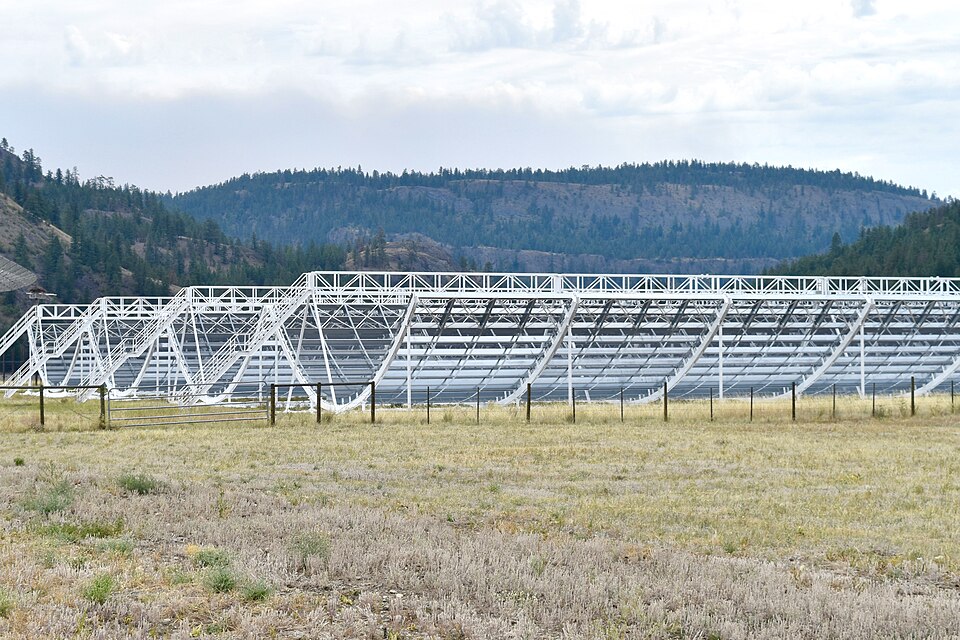
The rate of discovery accelerated dramatically with the commissioning of wide-field survey instruments. The Canadian Hydrogen Intensity Mapping Experiment (CHIME), a transit interferometer operating between 400 and 800 MHz in British Columbia, proved transformative. The CHIME/FRB project began detecting bursts in pre-commissioning observations in 2018, and by 2021 the collaboration published its first catalogue containing 536 FRBs detected during the telescope's first year of operation alone—an order of magnitude more events than had been accumulated in the preceding decade.11 This catalogue established the first large, uniformly selected sample of FRBs and enabled systematic population studies of burst properties including DM distributions, spectral structure, temporal morphology, and sky rates.11, 19
Observational properties
FRBs are characterised by several distinctive observational features. The bursts are brief, with observed durations typically ranging from roughly 0.1 to 10 milliseconds, though sub-millisecond structure and broader temporal envelopes have been documented in some sources.13 Their peak flux densities range from sub-jansky to hundreds of janskys, corresponding to isotropic-equivalent luminosities of 1038 to 1046 erg per second—a range spanning eight orders of magnitude that suggests either diverse source populations or a broad luminosity function within a single population.11, 13
The defining property that establishes FRBs as extragalactic is their dispersion measure. Radio waves travelling through ionised plasma are dispersed, with lower frequencies arriving later than higher frequencies by a delay proportional to the integrated free-electron column density along the path. The DMs of FRBs far exceed the maximum contribution from the Milky Way's interstellar medium (typically 30 to 300 pc cm−3 depending on Galactic latitude), with observed values ranging from roughly 100 to over 2,500 pc cm−3.1, 2, 11 The excess DM, once the Galactic contribution is subtracted, is attributed to electrons in the intergalactic medium, the host galaxy, and any intervening structures.12
Many FRBs exhibit complex spectro-temporal structure, including multiple sub-bursts, frequency-dependent temporal broadening (scattering), and a characteristic downward drift in frequency over time known as the “sad trombone” effect.13 A subset of bursts show high linear polarisation fractions, sometimes exceeding 90%, and the detection of large and variable Faraday rotation measures—most notably in the repeater FRB 121102, where values exceeding 105 rad m−2 were measured—indicates that some sources reside in extreme magneto-ionic environments.21 In 2022, the CHIME/FRB collaboration reported the detection of sub-second periodicity (approximately 217 milliseconds) within the burst envelope of FRB 20191221A, a pattern consistent with the rotational period of a neutron star and suggestive of a connection to pulsar-like emission processes.16
Repeaters and apparent non-repeaters
A pivotal advance came in 2016, when Spitler and colleagues reported that FRB 121102—originally detected at the Arecibo Observatory in 2012—had been observed to produce multiple bursts over several years, becoming the first confirmed repeating FRB source.3 The existence of repetition immediately ruled out cataclysmic, one-off progenitor models (such as neutron star mergers or collapsing objects) for at least this subset of the population, since the source must survive the emission process to burst again.3, 13
Localisation of FRB 121102 to sub-arcsecond precision using the Karl G. Jansky Very Large Array and the European VLBI Network placed the source in a low-metallicity, star-forming dwarf galaxy at a redshift of z = 0.19273, corresponding to a luminosity distance of roughly 970 megaparsecs.4, 5, 6 The burst coincided spatially with a compact, persistent radio source interpreted as a synchrotron nebula or wind from a young magnetar, strengthening the case for a neutron-star origin.4, 5 Subsequent monitoring revealed suggestive periodic windowing of activity, with a period of approximately 157 days within which bursts clustered, followed by extended quiescent intervals.15
As of the CHIME/FRB first catalogue, approximately 62 of the 536 detected bursts came from 18 previously identified repeating sources, while the remaining 474 appeared as one-off events.11 The repeating and apparently non-repeating populations show subtle statistical differences: repeaters tend to have broader burst durations, higher DMs, and narrower spectral bandwidths on average, suggesting either genuinely distinct source classes or observational selection effects that make repetition harder to detect in some sources.11, 13 Whether all FRBs repeat given sufficient monitoring time remains an open and vigorously debated question, with some analyses of the CHIME catalogue suggesting that the majority of apparently one-off sources may simply be infrequent repeaters whose recurrence falls below current detection thresholds.11
Key properties of notable FRB sources3, 5, 7, 8, 11
| Source | Year | DM (pc cm−3) | Repeating | Significance |
|---|---|---|---|---|
| FRB 010724 (Lorimer burst) | 2001 / 2007 | 375 | No | First FRB discovered |
| FRB 121102 | 2012 / 2016 | 557 | Yes | First repeater; localised to host galaxy |
| FRB 180924 | 2018 | 362 | No | First one-off FRB localised to a host |
| FRB 190523 | 2019 | 761 | No | Localised to a massive galaxy |
| FRB 200428 | 2020 | 333 | Yes | First Galactic FRB; from magnetar SGR 1935+2154 |
The magnetar connection
The question of what produces FRBs is among the most intensely studied problems in modern astrophysics. Dozens of theoretical models had been proposed by 2020, but the field was galvanised on 28 April of that year when the Galactic magnetar SGR 1935+2154 emitted a radio burst bright enough to have been detectable as an FRB at extragalactic distances.8, 9 The burst, designated FRB 200428, was detected independently by the CHIME and STARE2 radio arrays and was temporally coincident with a hard X-ray burst observed by several space-based telescopes including INTEGRAL, Insight-HXMT, and Konus-Wind.8, 9, 10
The radio fluence of FRB 200428 was approximately 1.5 million jansky milliseconds, making it at least 30 times more luminous than any previously observed radio emission from a magnetar, yet still roughly three orders of magnitude less energetic than the faintest extragalactic FRBs known at the time.8 This “luminosity gap” between the Galactic event and the cosmological population suggests either that FRB 200428 represents the low end of a continuous energy distribution, or that more luminous FRBs involve somewhat different physical conditions than the typical magnetar burst.8, 13
The simultaneous X-ray detection was crucial because it confirmed that the radio burst was produced during an episode of magnetar activity rather than by an unrelated foreground process. The X-ray burst from SGR 1935+2154 was consistent with the short bursts routinely observed from magnetars, though it was not among the most energetic; the ratio of radio to X-ray luminosity in FRB 200428 was far higher than in any previously observed magnetar burst, pointing to an unusually efficient coherent radio emission process during this particular event.10
Subsequent observations of SGR 1935+2154 detected additional, fainter radio bursts from the source, further solidifying the connection.17 In 2023, following a spin-down glitch, SGR 1935+2154 entered a phase of pulsed radio emission that lasted approximately one month—a mode of emission reminiscent of ordinary radio pulsars—before reverting to quiescence. Detailed timing analysis revealed that the FRB-like bursts occurred preferentially at specific rotational phases, offering clues about the magnetospheric geometry involved in the emission process.18
Progenitor models and emission mechanisms
While the magnetar connection is now well established for at least a subset of FRBs, the detailed physical mechanism that produces the coherent radio emission remains uncertain. Several classes of magnetar-based models have been proposed, broadly divided into two categories: those invoking emission near or at the magnetar surface (close-in models) and those placing the emission site far from the star in relativistic outflows or shocks (far-away models).13, 20
Close-in models typically invoke coherent curvature radiation by bunches of charged particles streaming along curved magnetic field lines in the inner magnetosphere, analogous to the mechanism thought to operate in ordinary pulsars but at far greater intensity. In this picture, sudden crustal fractures or magnetic reconnection events near the stellar surface accelerate particles that radiate coherently at radio wavelengths as they follow the field geometry.13, 18 Far-away models, by contrast, propose that the radio emission arises from synchrotron maser instabilities in ultrarelativistic magnetised shocks formed when a flare ejecta interacts with a pre-existing wind or ambient medium at distances of 1010 to 1014 centimetres from the neutron star.13
The question of whether all FRBs originate from magnetars, or whether multiple progenitor channels contribute to the observed population, remains open. Evidence from host-galaxy studies suggests diversity: while some FRBs (particularly repeaters like FRB 121102) are found in young, actively star-forming environments consistent with recently formed magnetars, several one-off FRBs have been localised to the outskirts of massive, quiescent galaxies with older stellar populations—environments where young magnetars would be unexpected.5, 6, 7 Proposed alternative progenitors include magnetars in binary systems with massive companions, where tidal or accretion interactions could trigger bursting activity, as suggested by evidence linking the repeater FRB 20201124A to a magnetar/Be star binary.14
Host galaxies and local environments
The localisation of FRBs to specific host galaxies has provided critical context for understanding their progenitors. The first host identification was achieved for the repeater FRB 121102, placed in a low-metallicity, star-forming dwarf galaxy at z = 0.19273 with a stellar mass of approximately 108 solar masses—an environment reminiscent of the hosts of long gamma-ray bursts, hydrogen-poor superluminous supernovae, and other transients associated with young, massive-star progenitors.5, 6 Within the host, the burst source coincides with a compact, persistent radio source with a luminosity of approximately 2 × 1029 erg s−1 Hz−1, interpreted as a magnetar wind nebula or the emission from an active galactic nucleus, though the nebular interpretation is favoured on energetic grounds.4, 5
The extreme magneto-ionic environment of FRB 121102 was revealed by polarimetric observations showing Faraday rotation measures (RM) exceeding 105 rad m−2—among the highest ever observed for any astrophysical source. The RM was also observed to decrease by roughly 10% over seven months, indicating a dynamic and evolving magneto-ionic medium surrounding the source, possibly a young supernova remnant or the expanding nebula driven by a central magnetar wind.21
By contrast, the first precisely localised one-off FRB, FRB 180924, was found to originate from the outskirts of a massive, relatively quiescent galaxy at z = 0.32, offset approximately 4 kiloparsecs from the galactic centre.7 Similarly, FRB 190523 was localised to a massive galaxy with low specific star formation rate at z = 0.66.7 This diversity of host environments strengthens the case that the FRB population is not monolithic: repeaters may preferentially arise from young magnetars in star-forming regions, while some apparently non-repeating sources could involve older neutron stars or distinct progenitor channels altogether.7, 13
Cosmological applications
Perhaps the most far-reaching consequence of FRB science lies not in identifying their sources but in exploiting them as cosmological probes. Because the dispersion measure of each burst encodes the total column density of free electrons between the source and the observer, FRBs with identified host galaxies and measured redshifts offer a direct means of weighing the ionised baryonic matter along each line of sight through the universe.12

In 2020, Macquart and colleagues demonstrated a linear correlation between the extragalactic component of the DM and the spectroscopically measured redshift for a sample of five localised FRBs—a relationship now known as the Macquart relation. This correlation arises because the density of ionised baryons in the intergalactic medium increases with path length in an expanding universe, and its slope is directly proportional to the cosmic baryon density parameter Ωb. The measured slope yielded a value of Ωb consistent with the independent determination from cosmic microwave background anisotropies and primordial nucleosynthesis, providing a completely independent confirmation of the cosmic baryon budget.12
Crucially, the Macquart relation also addressed one of the longstanding puzzles in cosmology: the “missing baryons” problem. Although the total baryon density of the universe is precisely known from observations of the cosmic microwave background and the light-element abundances produced during primordial nucleosynthesis, surveys of galaxies, galaxy clusters, and the cold interstellar medium at low redshift could account for only roughly half of the expected baryonic matter. The remainder was theorised to reside in a warm-hot intergalactic medium (WHIM) at temperatures of 105 to 107 kelvin—too cool to emit detectable X-rays and too diffuse to produce observable absorption lines. The DM–redshift relation measured with FRBs confirmed that these baryons are present and ionised, distributed throughout the cosmic web as predicted by cosmological simulations.12, 13
Growth of the localised FRB sample used for cosmological constraints12, 19
As the sample of localised FRBs has grown from the original five to more than one hundred, the precision of DM–redshift constraints has improved substantially. The scatter around the Macquart relation contains astrophysical information about the inhomogeneity of the intergalactic medium and the contribution of host-galaxy halos, which can in principle be used to map the distribution of baryonic matter across the large-scale structure of the universe.12, 19 Future surveys with instruments such as the Deep Synoptic Array (DSA-2000) and the Square Kilometre Array (SKA) are expected to localise thousands of FRBs per year, enabling FRBs to function as a new rung on the cosmic distance ladder and potentially contributing to independent measurements of the Hubble constant.13, 19
Current and future surveys
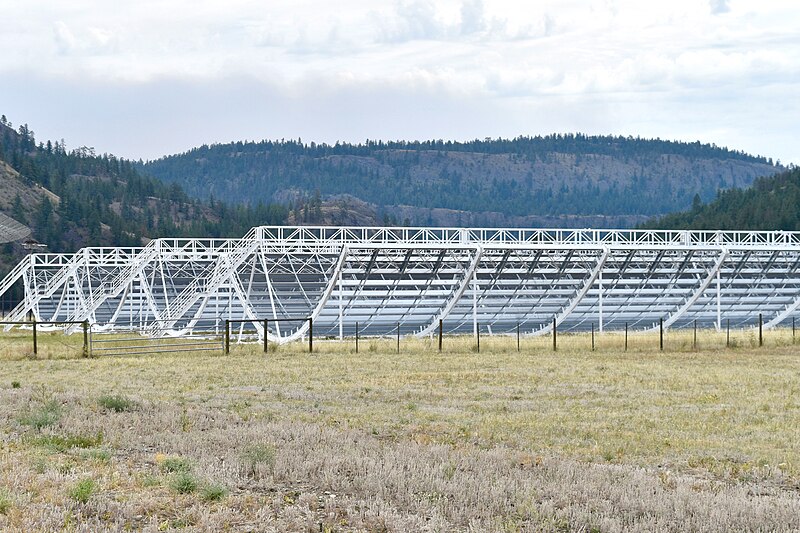
The study of fast radio bursts is now a major observational enterprise spanning multiple continents and wavelength regimes. CHIME remains the dominant discovery engine in the northern hemisphere, with its wide instantaneous field of view (approximately 200 square degrees) enabling the detection of multiple bursts per day.11 The Murriyang (Parkes) 64-metre telescope in Australia, where the field began, continues to contribute high-sensitivity detections and detailed follow-up studies using its ultra-wideband receiver.1, 2, 19 The Australian Square Kilometre Array Pathfinder (ASKAP) has proven especially valuable for localising one-off bursts to arcsecond precision through its fly's-eye mode and interferometric capabilities.7, 13
Dedicated real-time localisation arrays have begun operation, including the Deep Synoptic Array (DSA-110) in California, which was designed specifically to detect and localise FRBs to their host galaxies in a single observation.19 The Five-hundred-metre Aperture Spherical Telescope (FAST) in China, the largest single-dish radio telescope in the world, has contributed detailed burst morphology and polarimetry studies, particularly of prolific repeaters.13
Looking forward, the Square Kilometre Array (SKA), expected to achieve first light in the late 2020s, will transform FRB science through its unprecedented sensitivity and survey speed, enabling the detection and localisation of FRBs at high redshifts and faint luminosities currently inaccessible to existing instruments.13, 19 The anticipated leap in sample size—from hundreds to tens of thousands of localised sources—will enable precision cosmography with FRBs, including tomographic mapping of the intergalactic medium, constraints on the epoch of helium reionisation, and potentially competitive measurements of cosmological parameters that could contribute to resolving the Hubble tension.13, 19
Open questions
Despite rapid observational progress, fundamental questions remain. The physical mechanism responsible for the coherent radio emission in FRBs has not been identified with certainty; distinguishing between close-in magnetospheric models and far-away shock models requires multi-wavelength observations, high-time-resolution polarimetry, and larger samples of bursts with simultaneous radio and high-energy detections.13, 18 The relationship between repeating and apparently non-repeating FRBs is unresolved: whether they represent genuinely distinct source populations, different evolutionary stages of the same progenitor, or simply different activity levels of a single phenomenon remains a central question for population studies with growing catalogues.11, 13
The luminosity gap between the Galactic FRB 200428 and the faintest cosmological FRBs spans roughly three orders of magnitude. Whether this gap is real or an artefact of limited sensitivity and small number statistics is an important question, as a continuous luminosity function would strengthen the case that all FRBs are powered by magnetar activity, while a true gap might suggest distinct mechanisms operating at different energy scales.8, 13 The connection between magnetar activity and FRB emission also needs to be understood quantitatively: SGR 1935+2154 emitted thousands of X-ray bursts during its 2020 active episode, but only a tiny fraction were accompanied by detectable radio emission, implying that special conditions must be met for an FRB to be produced.8, 9, 17
As a cosmological tool, the full potential of FRBs remains to be realised. Current constraints on the Macquart relation are limited by the uncertainty in separating the host-galaxy DM contribution from the intergalactic component, and by the relatively small number of FRBs with both precise localisations and spectroscopic host redshifts.12 Overcoming these limitations will require not only larger samples but also systematic studies of FRB host galaxies to calibrate the host-galaxy DM distribution. The coming generation of radio survey instruments promises to deliver the data needed to address these questions, positioning fast radio bursts as both astrophysical puzzles and precision tools for understanding the structure and content of the universe.13, 19
References
INTEGRAL Discovery of a Burst with Associated Radio Emission from the Magnetar SGR 1935+2154
A Radio Pulsar Phase from SGR J1935+2154 Provides Clues to the Magnetar FRB Mechanism
An Extreme Magneto-ionic Environment Associated with the Fast Radio Burst Source FRB 121102