Overview
- Pulsar timing arrays use networks of millisecond pulsars — neutron stars rotating hundreds of times per second with extraordinary rotational stability — as a galaxy-scale gravitational wave detector, measuring the correlated deviations in pulse arrival times caused by passing gravitational waves with wavelengths of light-years.
- In June 2023, NANOGrav, EPTA, PPTA, and CPTA simultaneously announced compelling evidence for a nanohertz-frequency gravitational wave background, consistent with the signal expected from a cosmic population of merging supermassive black hole binaries and representing a fundamentally new window on the gravitational wave spectrum.
- The observed gravitational wave background opens a new regime of astrophysics inaccessible to ground-based detectors like LIGO, probing the population and merger history of supermassive black holes, galaxy assembly over cosmic time, and potentially exotic sources such as cosmic strings or phase transitions in the early universe.
A pulsar timing array (PTA) is a gravitational wave detector that uses a network of millisecond pulsars distributed across the sky as an ensemble of precision clocks. Gravitational waves passing through the Galaxy stretch and compress the spacetime between Earth and each pulsar, causing systematic deviations in the arrival times of radio pulses. By monitoring dozens of pulsars simultaneously over years to decades and searching for correlated timing residuals, PTAs are sensitive to gravitational waves at nanohertz frequencies — wavelengths of light-years — a regime inaccessible to ground-based interferometers like LIGO and Virgo or the planned space-based LISA mission. The concept was first proposed independently by Sazhin in 1978 and Detweiler in 1979, and has matured into one of the most productive frontiers in gravitational wave astronomy.14, 15

Millisecond pulsars as clocks
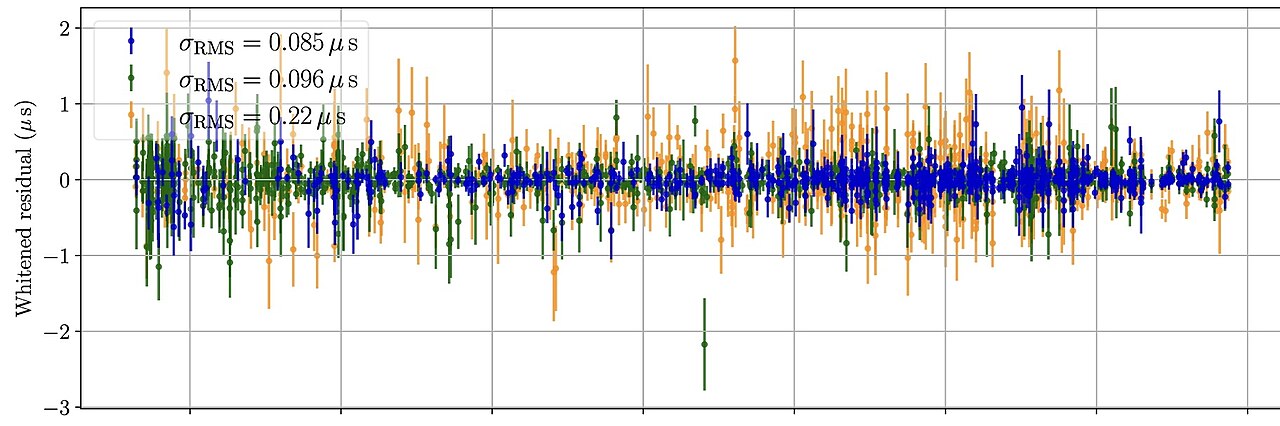
Millisecond pulsars are neutron stars that have been spun up to rotational periods of 1–10 milliseconds through accretion of mass and angular momentum from a binary companion. The first millisecond pulsar, PSR B1937+21 rotating at 642 Hz, was discovered by Backer and colleagues in 1982. These objects are extraordinarily stable rotators: after accounting for a slow, predictable spin-down due to magnetic dipole radiation, the best millisecond pulsars maintain timing stability comparable to atomic clocks, with root-mean-square residuals of order 100 nanoseconds or less over decade-long baselines. This stability is what makes them useful as gravitational wave detectors — any unmodeled, correlated perturbation in the arrival times of pulses from multiple pulsars can, in principle, be attributed to gravitational waves.10, 9
The timing model for each pulsar must account for a large number of astrophysical effects: the pulsar’s spin and spin-down, its astrometric position and proper motion, the orbital parameters of any binary companion, dispersion and scattering by the interstellar medium, the motion of the Earth around the Sun, and relativistic corrections in the solar system. After all known effects are subtracted, the remaining timing residuals are searched for the signature of gravitational waves. The sensitivity of a PTA improves with the number of pulsars in the array, the timing precision of each pulsar, the time span of observation, and the sky distribution of the array.8, 6
The Hellings-Downs correlation
The defining signature of a gravitational wave background in PTA data is the Hellings-Downs curve, a specific pattern of angular correlations between the timing residuals of pulsar pairs. Derived by Hellings and Downs in 1983, this curve predicts that pulsar pairs separated by small angles on the sky will show positively correlated residuals, pairs separated by roughly 90 degrees will show a slight anti-correlation, and pairs at larger separations will return to a weak positive correlation. The Hellings-Downs pattern arises from the quadrupolar nature of gravitational radiation and is distinct from other sources of correlated noise, such as errors in the solar system ephemeris or clock errors, which produce different angular correlation signatures. Detection of the Hellings-Downs correlation is therefore the gold standard for claiming a gravitational wave detection with a PTA.6, 7
The 2023 detection
In June 2023, four independent PTA collaborations announced evidence for a nanohertz gravitational wave background in near-simultaneous publications: the North American Nanohertz Observatory for Gravitational Waves (NANOGrav), using 15 years of data from 67 pulsars; the European Pulsar Timing Array (EPTA) combined with the Indian Pulsar Timing Array (InPTA); the Parkes Pulsar Timing Array (PPTA) in Australia; and the Chinese Pulsar Timing Array (CPTA). Each collaboration independently detected a common-spectrum red noise process — excess low-frequency noise with a power-law spectrum consistent with theoretical predictions — and NANOGrav reported evidence for the Hellings-Downs inter-pulsar correlations at a statistical significance of 3.5 to 4 sigma, the strongest evidence to date.2, 3, 4, 5
The amplitude and spectral shape of the detected signal are broadly consistent with the gravitational wave background expected from a cosmic population of supermassive black hole binaries. As galaxies merge over cosmic time, their central supermassive black holes form gravitationally bound pairs that spiral inward and emit gravitational waves at frequencies inversely proportional to their orbital periods. The superposition of gravitational waves from the entire population of such binaries across the observable universe produces a stochastic background concentrated at nanohertz frequencies. Theoretical models by Sesana and colleagues predicted the characteristic amplitude and spectral slope of this background, and the 2023 measurements are consistent with these predictions, though the observed amplitude sits at the upper end of the expected range.1, 2
Astrophysical implications
The detection of the nanohertz gravitational wave background carries profound implications for astrophysics. If the signal is indeed dominated by supermassive black hole binaries, its amplitude constrains the merger rate and mass distribution of the most massive black holes in the universe, the efficiency with which galaxy mergers drive black hole pairs to sub-parsec separations, and the role of environmental effects — such as stellar scattering and gas dynamics — in bridging the so-called final parsec problem, where the binary must lose angular momentum efficiently to enter the gravitational wave-dominated regime. The relatively high observed amplitude may indicate that supermassive black hole binaries are more massive, more numerous, or more efficiently driven to merger than some earlier models assumed.12, 1
As PTA datasets grow longer and include more pulsars, the signal-to-noise ratio of the background will improve, and it may become possible to resolve individual supermassive black hole binaries as continuous gravitational wave sources above the stochastic background. The most massive and nearby binaries — in galaxies within a few hundred megaparsecs — are the most promising candidates. Detection of individual binaries would enable measurement of their chirp masses, orbital frequencies, sky positions, and potentially their orbital evolution, providing a direct probe of supermassive black hole dynamics that is independent of electromagnetic observations.12, 13
Exotic sources and new physics
While supermassive black hole binaries are the most conventional astrophysical explanation for the observed signal, the 2023 data do not yet rule out contributions from more exotic sources. Cosmic strings — hypothetical one-dimensional topological defects from phase transitions in the early universe — would produce a gravitational wave background with a different spectral shape that could, in principle, be distinguished from the binary signal as the data improve. First-order cosmological phase transitions, such as those predicted in some extensions of the standard model of particle physics, could also generate a nanohertz background. The NANOGrav collaboration’s companion analysis examined these new-physics scenarios and found that while the binary hypothesis provides the best fit, exotic sources cannot yet be excluded at the current level of statistical precision.11
The future of pulsar timing arrays lies in the International Pulsar Timing Array (IPTA), which combines data from all regional collaborations to maximize sensitivity, and in next-generation radio telescopes such as the Square Kilometre Array (SKA) and its precursors. The SKA is expected to discover thousands of new millisecond pulsars and achieve timing precision below 100 nanoseconds for hundreds of them, dramatically increasing the sensitivity of the array. With these improvements, PTAs should be able to characterize the spectrum of the gravitational wave background in detail, resolve individual binary sources, and probe the nanohertz gravitational wave sky with a precision that complements LIGO at audio frequencies and LISA at millihertz frequencies, completing a multi-messenger picture of the gravitational wave universe across more than ten decades of frequency.8, 2
References
A Gravitational-wave Background from a Cosmic Population of Supermassive Black Hole Binaries
The second data release from the European Pulsar Timing Array. III. Search for gravitational wave signals
Searching for an Isotropic Gravitational Wave Background with the Chinese Pulsar Timing Array Data Release 1
Using pulsars to detect massive black hole binaries via gravitational radiation: sagittarius A* and nearby galaxies
The NANOGrav 15 yr Data Set: Bayesian Limits on Gravitational Waves from Individual Supermassive Black Hole Binaries
Gravitational radiation from post-Newtonian sources and inspiralling compact binaries