Overview
- Supernova remnants (SNRs) are the expanding shells of shocked gas, dust, and heavy elements ejected by stellar explosions—both core-collapse supernovae from massive stars and thermonuclear Type Ia detonations of white dwarfs—that interact with the surrounding interstellar medium over tens of thousands of years, passing through distinct evolutionary phases from free expansion through the Sedov-Taylor and radiative stages before ultimately merging with ambient gas.
- SNRs are the primary mechanism by which freshly synthesized heavy elements—including oxygen, silicon, iron, and calcium—are dispersed into the interstellar medium, enriching the raw material from which subsequent generations of stars and planets form; they are also the dominant source of galactic cosmic rays, accelerating charged particles to energies exceeding 1015 eV through diffusive shock acceleration at their expanding blast waves.
- Classified morphologically as shell-type, filled-center (plerions powered by central pulsar wind nebulae), or composite remnants, SNRs are observed across the electromagnetic spectrum from radio to gamma rays; landmark examples include the Crab Nebula (SN 1054), Cassiopeia A, Tycho’s SNR (SN 1572), Kepler’s SNR (SN 1604), the Vela SNR, and the expanding debris ring of SN 1987A in the Large Magellanic Cloud.
When a star ends its life in a supernova explosion—whether through the gravitational collapse of a massive star’s iron core or the thermonuclear detonation of a [white dwarf](/cosmology/white-dwarfs-and-planetary-nebulae)—the event does not simply dissipate into the void. The stellar debris, launched outward at thousands to tens of thousands of kilometers per second, slams into the surrounding [interstellar medium](/cosmology/interstellar-medium), sweeping up gas and dust into an expanding shell of shocked, heated material that can persist for tens of thousands of years. These structures, known as supernova remnants (SNRs), are among the most energetic and scientifically consequential objects in the galaxy. They are the principal agents by which heavy elements forged in stellar interiors are returned to the interstellar medium, seeding future generations of stars and planets with the chemical building blocks of rocky worlds and life. They are also the dominant accelerators of galactic [cosmic rays](/cosmology/cosmic-rays) and powerful sources of emission across the entire electromagnetic spectrum, from radio waves to gamma rays.1, 2

Formation and origins
Supernova remnants originate from two fundamentally different explosion mechanisms, corresponding to the two broad classes of [supernovae](/cosmology/supernovae-and-stellar-remnants). Core-collapse supernovae (Types II, Ib, and Ic) occur when a massive star—typically exceeding eight solar masses—exhausts its nuclear fuel and its iron core can no longer support itself against gravity, collapsing to form a [neutron star](/cosmology/neutron-stars) or black hole. The infalling outer layers rebound off the stiffened core and are expelled at velocities of 5,000–10,000 km/s, carrying roughly 1051 ergs of kinetic energy (the canonical “one Bethe” of supernova energy) and several solar masses of processed material.3, 12
Type Ia supernovae, by contrast, involve the thermonuclear disruption of a carbon-oxygen white dwarf that approaches or exceeds the Chandrasekhar limit through accretion from a companion star or through merger with another white dwarf. The entire star is consumed in a detonation wave that synthesizes approximately 0.6 solar masses of radioactive nickel-56, whose decay powers the optical light curve. Type Ia remnants expand into a circumstellar environment shaped by the progenitor binary system rather than by stellar winds from a massive star, producing distinct density profiles and chemical signatures. The ejecta velocities in Type Ia events are somewhat higher than in core-collapse supernovae, typically reaching 10,000–15,000 km/s, and the ejecta are dominated by iron-group elements rather than the lighter elements characteristic of core-collapse debris.1, 12
Regardless of the explosion mechanism, the subsequent interaction between the ejected material and the surrounding gas follows a broadly similar hydrodynamic evolution, though the details—such as the density profile of the ejecta and the structure of the ambient medium—differ between core-collapse and Type Ia remnants and give rise to observable morphological differences.3
Evolutionary phases
The dynamical evolution of a supernova remnant proceeds through several well-defined phases, each governed by different physical processes. This sequence was first outlined in broad terms by Lev Sedov and Geoffrey Taylor in the context of blast wave theory and has since been developed into a comprehensive framework for understanding SNR evolution.4, 5
In the free expansion phase, which lasts for roughly the first few hundred years, the ejected material expands nearly unimpeded into the surrounding medium. The ejecta mass far exceeds the mass of swept-up interstellar gas, so the expansion velocity remains approximately constant. During this phase, a reverse shock propagates inward through the ejecta (in the frame of the contact discontinuity between ejecta and swept-up material), heating the inner debris to X-ray-emitting temperatures, while a forward shock or blast wave races ahead into the ambient medium. Young remnants such as Cassiopeia A and Tycho’s SNR are observed in or near the end of this phase, with both the forward and reverse shocks clearly resolved in X-ray observations.1, 6
The transition to the Sedov-Taylor phase (also called the adiabatic or blast-wave phase) occurs when the mass of swept-up interstellar material becomes comparable to the ejected mass. At this point, typically a few hundred to a thousand years after the explosion, the dynamics become governed by the conserved explosion energy and the ambient density rather than by the properties of the ejecta. The remnant’s radius grows as t2/5, where t is the time since the explosion—the famous Sedov-Taylor self-similar solution. Radiative energy losses remain negligible, and the interior of the remnant is filled with hot, tenuous gas at temperatures of millions of kelvin. This phase persists for roughly 10,000–20,000 years and encompasses the majority of well-studied SNRs in the Galaxy.4, 5, 2
As the blast wave decelerates and the post-shock temperature drops below approximately 106 kelvin, radiative cooling becomes efficient and the remnant enters the radiative (snowplow) phase. A thin, dense, rapidly cooling shell forms behind the blast wave, while the hot interior continues to exert pressure that drives the shell outward. The shell accumulates interstellar material like a snowplow, and the radius grows approximately as t2/7 in the pressure-driven snowplow model. Strong optical emission lines—particularly from oxygen, sulfur, and hydrogen—characterize this phase, making older remnants prominent in optical surveys. Many of the large, filamentary structures seen in the Milky Way, such as the Cygnus Loop (the Veil Nebula), are remnants in this late evolutionary stage.2, 3
Eventually, after roughly 100,000 years or more depending on the ambient density, the expansion velocity of the shell drops to the local sound speed of the warm interstellar medium (approximately 10 km/s), and the remnant can no longer be distinguished from the general turbulent motions of the interstellar gas. At this point the remnant merges with the ISM, having distributed its energy, momentum, and nucleosynthetic products throughout a volume spanning tens of parsecs. This final dispersal is the mechanism by which supernova-processed heavy elements become available for incorporation into new molecular clouds and, ultimately, new stars and planetary systems.2, 1
Morphological classification
Supernova remnants are classified into three morphological types based on their appearance at radio and X-ray wavelengths. Shell-type remnants display a limb-brightened ring or partial ring of emission, produced by the shocked gas at the expanding blast wave. These are the most common type and account for roughly 80 percent of known Galactic SNRs. The emission arises from both synchrotron radiation (produced by relativistic electrons spiraling in amplified magnetic fields at the shock front) and thermal radiation from hot shocked gas. Tycho’s SNR and the remnant of SN 1006 are classic examples of shell-type morphology.1, 16
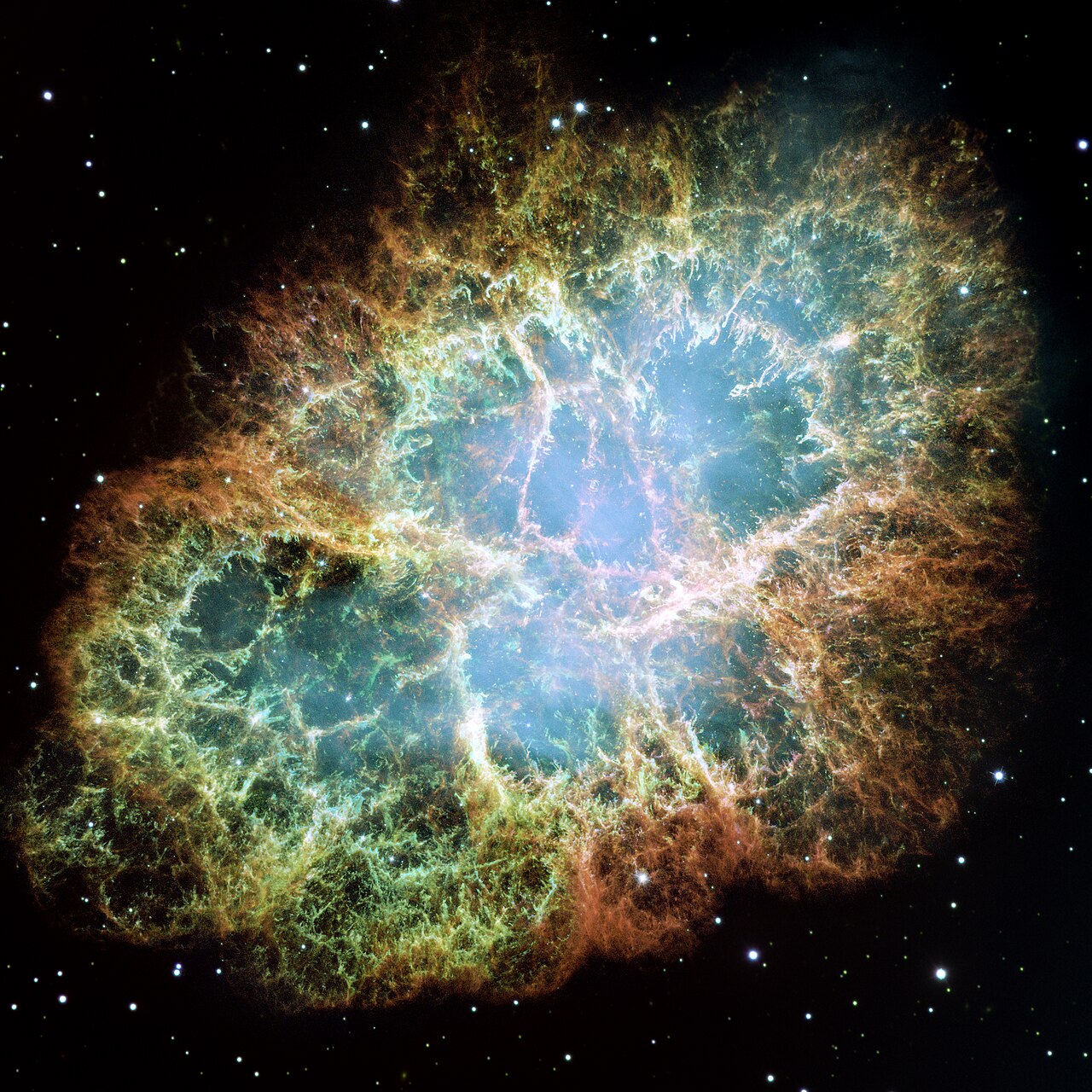
Filled-center remnants, also called plerions or [pulsar wind nebulae](/cosmology/pulsars), are powered not by the expanding blast wave but by a rapidly rotating [neutron star](/cosmology/neutron-stars) at the remnant’s center. The pulsar drives a relativistic wind of electrons and positrons into the surrounding medium, producing a bubble of synchrotron-emitting plasma that fills the interior of the remnant. The Crab Nebula is the prototypical plerion: its centrally concentrated, polarized synchrotron emission from radio through X-rays is powered entirely by the spin-down luminosity of the Crab pulsar (PSR B0531+21), which injects approximately 5 × 1038 erg/s into the nebula. Plerions show a characteristic flat radio spectral index (typically α ≈ 0.0–0.3, compared to α ≈ 0.4–0.7 for shell-type remnants) and no limb brightening.7, 9, 18
Composite remnants exhibit features of both types: a shell-type outer rim produced by the blast wave interacting with the ISM, and a filled interior powered by a central pulsar wind nebula. The Vela SNR is a well-known composite, with a faint radio and X-ray shell encompassing the Vela pulsar and its surrounding plerion. The distinction between these categories is not always sharp, and multiwavelength observations sometimes reveal structure not apparent in a single band—a remnant that appears shell-type in radio may show a filled center in X-rays if a pulsar wind nebula is present but too faint to detect at lower energies.9, 1
Famous supernova remnants
Several supernova remnants hold outsized importance in astrophysics, either because their parent supernovae were observed historically or because their physical properties make them particularly instructive.
The Crab Nebula (SN 1054). The supernova that produced the Crab Nebula was recorded by Chinese astronomers in July 1054 as a “guest star” visible in daylight for 23 days and to the naked eye at night for nearly two years. Japanese and possibly Arabic records corroborate the sighting. The Crab Nebula was identified as the remnant of this event in the early twentieth century and has since become one of the most studied objects in all of astronomy. It is a filled-center (plerion) remnant powered by the Crab pulsar, a neutron star rotating 30 times per second. The nebula’s synchrotron emission spans the entire electromagnetic spectrum, and its filamentary structure contains helium, carbon, and oxygen-rich material from the progenitor star’s processed layers.7, 21, 15
Cassiopeia A. At an estimated age of roughly 340 years (the supernova likely occurred around 1681, though it was not widely recorded), Cassiopeia A (Cas A) is the youngest known supernova remnant in the Milky Way. It is the brightest extrasolar radio source in the sky and one of the most intensively studied remnants at X-ray wavelengths. Chandra X-ray Observatory images have resolved individual knots of ejecta rich in silicon, sulfur, argon, calcium, and iron, providing direct evidence for the stratified [nucleosynthesis](/cosmology/nucleosynthesis) that occurred in the progenitor’s final burning stages. The NuSTAR telescope mapped the distribution of radioactive titanium-44 in Cas A, revealing strong asymmetries in the explosion that constrain models of the core-collapse mechanism.8, 6, 1
Tycho’s SNR (SN 1572). The supernova observed by the Danish astronomer Tycho Brahe in November 1572 was a landmark event in the history of science. Brahe’s meticulous observations of the “new star” in Cassiopeia, published in De nova stella, demonstrated that the object lay far beyond the Moon and thus contradicted the Aristotelian doctrine of celestial immutability. The remnant is now identified as a Type Ia supernova based on its X-ray spectrum, which is dominated by iron-group and intermediate-mass elements with no evidence of a central compact object. Chandra observations have resolved the contact discontinuity between the ejecta and the swept-up interstellar material with remarkable clarity.15, 1
Kepler’s SNR (SN 1604). The last supernova observed in the Milky Way by naked eye was recorded by Johannes Kepler in October 1604, only 32 years after Tycho’s supernova. Like Tycho’s remnant, Kepler’s SNR is classified as a Type Ia event based on its X-ray spectral properties, though its circumstellar environment is more complex, suggesting interaction with dense material shed by the progenitor system. The remnant exhibits a pronounced north-south brightness asymmetry attributed to a density gradient in the surrounding medium.15, 1
The Vela SNR. Located approximately 250 parsecs from Earth, the Vela SNR is one of the nearest and largest supernova remnants, spanning roughly 8 degrees on the sky (corresponding to a physical diameter of about 40 parsecs). It is a composite remnant approximately 11,000 years old, harboring the Vela [pulsar](/cosmology/pulsars) (PSR B0833−45) at its center, which rotates once every 89 milliseconds. The Vela remnant’s proximity makes it an important laboratory for studying the interaction between a pulsar wind nebula and the surrounding supernova shell, as well as the late-phase evolution of the remnant itself.9, 16
SN 1987A: the modern benchmark
The most scientifically productive supernova in modern history was SN 1987A, which appeared in the Large Magellanic Cloud on 23 February 1987. As the nearest supernova to Earth since Kepler’s event of 1604, it was the first to be studied with the full arsenal of modern astronomical instrumentation, and it has been monitored continuously for nearly four decades. The detection of a burst of roughly two dozen neutrinos by the Kamiokande-II and IMB detectors, arriving several hours before the optical brightening, provided dramatic confirmation that core-collapse supernovae are powered by the release of gravitational binding energy, with ~99% of the roughly 3 × 1053 ergs emitted as neutrinos.13
The evolution of SN 1987A from supernova to supernova remnant has been observed in real time. The ejecta, expanding at roughly 3,000 km/s, began to collide with a pre-existing equatorial ring of circumstellar material—likely ejected by the progenitor star (the blue supergiant Sanduleak −69°202) during a prior mass-loss episode roughly 20,000 years before the explosion. By the mid-1990s, bright hot spots appeared around the ring as individual dense clumps were overtaken by the blast wave, and by the 2010s the entire ring was illuminated. This collision has heated the ring material to X-ray-emitting temperatures and provides a real-time example of the blast wave–ISM interaction that defines all supernova remnants. Observations by the Hubble Space Telescope, the Chandra X-ray Observatory, and the Atacama Large Millimeter Array (ALMA) continue to track the remnant’s expansion and the evolution of its emission, including the detection of newly formed dust within the ejecta—supporting the hypothesis that supernovae are significant contributors to the interstellar dust budget.14, 13
Despite extensive searches, no compact remnant (neutron star or pulsar) has been conclusively identified at the center of SN 1987A as of 2025, though indirect evidence from ALMA observations of a compact thermal source and excess infrared emission has been interpreted as possible signatures of a dust-enshrouded neutron star. The question of whether the collapse produced a neutron star or a black hole remains one of the outstanding puzzles of the SN 1987A system.14
Particle acceleration and cosmic rays
Supernova remnants have long been recognized as the most likely sources of the bulk of galactic [cosmic rays](/cosmology/cosmic-rays)—the high-energy charged particles that permeate the Milky Way with an energy density of roughly 1 eV per cubic centimeter. The argument, first advanced by Vitaly Ginzburg in the 1950s, is based on energetics: the power required to maintain the observed cosmic ray population against escape from the Galaxy (~1041 erg/s) is roughly 10 percent of the kinetic energy input from Galactic supernovae (roughly three events per century, each releasing ~1051 ergs), a plausible conversion efficiency.10, 11
The mechanism by which SNR shocks accelerate particles to cosmic ray energies is diffusive shock acceleration (DSA), also known as first-order Fermi acceleration. In this process, charged particles scatter repeatedly across the shock front by interacting with magnetic turbulence on both sides. Each crossing imparts a fractional energy gain proportional to the shock velocity, and because the process is stochastic and ongoing, it naturally produces the power-law energy spectrum (dN/dE ∝ E−2 at the shock) characteristic of the observed cosmic ray spectrum. The theory was independently developed by Axford, Leer, and Skadron; Krymsky; Bell; and Blandford and Ostriker in the late 1970s and remains the standard framework for cosmic ray acceleration.10, 11
Observational evidence strongly supports the DSA picture. The detection of X-ray synchrotron emission from the thin rims of young SNRs such as SN 1006, Cas A, and Tycho’s SNR demonstrates the presence of electrons accelerated to energies of 10–100 TeV at the blast wave. These narrow filaments, only a few arcseconds wide, indicate rapid synchrotron energy losses and imply magnetic fields amplified to 100–500 microgauss—far stronger than the ambient interstellar field of a few microgauss—consistent with theoretical predictions that the cosmic ray streaming instability amplifies the upstream magnetic field. Gamma-ray observations by Fermi-LAT and ground-based Cherenkov telescopes (H.E.S.S., MAGIC, VERITAS) have detected GeV and TeV emission from numerous SNRs, though disentangling hadronic emission (from cosmic ray protons interacting with ambient gas to produce neutral pions, which decay into gamma rays) from leptonic emission (inverse Compton scattering by relativistic electrons) remains an active area of research.19, 10, 1
The maximum energy to which SNR shocks can accelerate particles is a critical question. Standard estimates suggest that young SNRs can accelerate protons to energies of roughly 1014–1015 eV, approaching the “knee” of the cosmic ray spectrum. Whether they can reach the knee itself (~3 × 10¹⁵ eV) or whether an additional source class is required at higher energies remains debated. Recent gamma-ray observations of several remnants interacting with molecular clouds have provided evidence for hadronic cosmic ray acceleration at energies exceeding 100 TeV, lending support to the SNR origin hypothesis for cosmic rays up to or near the knee.11, 19
Chemical enrichment of the interstellar medium
One of the most consequential roles of supernova remnants is the dispersal of freshly synthesized heavy elements into the [interstellar medium](/cosmology/interstellar-medium), a process central to the chemical evolution of galaxies. During the final stages of massive [stellar evolution](/cosmology/stellar-evolution), successive nuclear burning phases produce concentric shells of increasingly heavy elements: hydrogen and helium in the envelope, then carbon, neon, oxygen, silicon, and finally an iron core. The supernova explosion ejects these processed layers, along with additional elements synthesized during the explosion itself (including radioactive species such as nickel-56, titanium-44, and aluminum-26), into the surrounding space.12, 3
Core-collapse supernovae are the dominant producers of the alpha elements—oxygen, neon, magnesium, silicon, sulfur, and calcium—which are synthesized during pre-supernova hydrostatic burning and explosive nucleosynthesis in the shock-heated layers. A single core-collapse event from a 25-solar-mass progenitor ejects roughly 2–3 solar masses of oxygen, making supernovae the principal source of the most abundant metal in the universe. Type Ia supernovae, by contrast, produce the bulk of the iron-peak elements (iron, nickel, cobalt, manganese, and chromium), with each event synthesizing approximately 0.6–0.8 solar masses of iron through the decay of nickel-56. The distinct nucleosynthetic yields of the two supernova types imprint characteristic abundance patterns on the interstellar medium: the ratio of alpha elements to iron in stellar atmospheres serves as a fossil record of the relative contributions of core-collapse and Type Ia supernovae over cosmic time.12
X-ray spectroscopy of supernova remnants provides direct measurements of these [nucleosynthesis](/cosmology/nucleosynthesis) products. Chandra and XMM-Newton observations of Cas A have mapped the spatial distribution of silicon, sulfur, argon, calcium, iron, and titanium in the ejecta, revealing an “onion-skin” structure that has been partially inverted by hydrodynamic instabilities during the explosion—iron-rich ejecta are found in some cases at larger radii than silicon-rich material, evidence of large-scale overturn driven by convective instabilities in the first seconds after core bounce. The detection of radioactive titanium-44 (half-life ~60 years) in Cas A by the NuSTAR telescope further constrains the mass cut between material that fell back onto the neutron star and material that was ejected.8, 1
Supernova remnants are also implicated in the production of interstellar dust. Observations of SN 1987A by ALMA and Herschel have detected approximately 0.5 solar masses of cold dust within the ejecta, consistent with theoretical predictions that supernovae can condense significant quantities of silicate and carbon grains in their expanding, cooling debris. Whether this dust survives passage through the reverse shock to enter the interstellar medium in significant quantities remains an open question, but if even a fraction persists, core-collapse supernovae could be major contributors to the dust budget of young galaxies at high redshift, where the timescales for dust production by asymptotic giant branch stars are prohibitively long.14, 12
Multiwavelength observations
Supernova remnants are intrinsically multiwavelength objects, and the development of radio, X-ray, and gamma-ray astronomy has been intimately connected with SNR research. At radio wavelengths, the synchrotron emission from relativistic electrons spiraling in the remnant’s magnetic field produces the characteristic non-thermal spectrum by which most SNRs are catalogued. The Green catalogue, the standard reference for Galactic SNRs, lists approximately 300 confirmed remnants, identified primarily through radio surveys, though the actual number in the Galaxy is estimated to be far higher—perhaps 1,000 or more—with many obscured by confusion along the Galactic plane or too old and faint to detect.16
Radio observations by the Very Large Array (VLA) and other interferometers have resolved the detailed morphology of dozens of remnants, revealing thin filaments at the blast wave, complex interior structure, and the interaction signatures where shocks encounter dense molecular clouds. Radio polarimetry maps the magnetic field geometry, showing radial fields in young remnants (consistent with Rayleigh-Taylor instabilities at the contact discontinuity) that become tangential in older remnants (consistent with compression of the ambient field by the expanding shell).19, 1
X-ray observations have revolutionized the study of SNRs since the launch of the Einstein Observatory in 1978 and especially with the sub-arcsecond imaging of the Chandra X-ray Observatory (launched 1999) and the spectroscopic capabilities of XMM-Newton (launched 1999). X-ray emission from remnants comes in two forms: thermal emission from shock-heated gas at temperatures of 106–108 kelvin, rich in spectral lines of highly ionized metals (O, Ne, Mg, Si, S, Ar, Ca, Fe), and non-thermal synchrotron emission from ultrarelativistic electrons at the blast wave. Chandra’s angular resolution has allowed the separation of ejecta from swept-up material in remnants like Cas A, Tycho, and Kepler, enabling direct comparison of observed abundance ratios with nucleosynthesis models.1, 19
At gamma-ray energies, both space-based (Fermi-LAT) and ground-based (H.E.S.S., MAGIC, VERITAS) telescopes have detected emission from more than two dozen SNRs. Gamma-ray observations are critical for establishing whether SNRs accelerate hadronic cosmic rays (protons and heavier nuclei) in addition to the electrons whose synchrotron emission dominates at radio and X-ray wavelengths. The characteristic spectral signature of pion-decay gamma rays—a steep rise below ~200 MeV followed by a spectral hardening—has been identified in several remnants interacting with molecular clouds, providing the most direct evidence to date that SNRs accelerate cosmic ray protons.19, 1
Triggering star formation
The expanding shock waves of supernova remnants can compress nearby interstellar gas to densities sufficient to initiate gravitational collapse, thereby triggering the formation of new stars. This process links stellar death to stellar birth in a feedback loop that is central to the self-regulating ecology of the [interstellar medium](/cosmology/interstellar-medium). When an SNR blast wave encounters a pre-existing molecular cloud, the ram pressure of the shock can compress the cloud’s outer layers, increasing the density beyond the Jeans criterion for gravitational instability and initiating collapse that would not have occurred spontaneously.20
Observational evidence for triggered [star formation](/cosmology/star-formation) around SNRs includes the detection of young stellar objects and compact H II regions at the peripheries of several remnants, spatially correlated with dense molecular gas that has been compressed by the passing shock. Numerical simulations confirm that the interaction between an SNR blast wave and a nearby cloud can produce dense, gravitationally unstable fragments on timescales of roughly 105–106 years, consistent with the ages of the youngest stars observed near remnant boundaries. The enrichment of these compressed clouds with freshly synthesized heavy elements from the supernova ejecta means that stars triggered by this mechanism are born from material that is chemically distinct from the ambient ISM, with elevated abundances of short-lived radioactive isotopes such as aluminum-26. The presence of decay products of aluminum-26 in the oldest inclusions of the solar system’s meteorites has led to the hypothesis that the formation of the Sun itself may have been triggered—or at least influenced—by a nearby supernova roughly 4.6 billion years ago.20, 12
Historical supernovae
The identification of supernova remnants has been enriched immeasurably by the historical record of supernovae observed by naked-eye astronomers across multiple civilizations. The earliest reliably documented supernova is the event of 185 CE, recorded in Chinese court chronicles as a “guest star” in the constellation Nanmen (Centaurus) that remained visible for eight months. The remnant RCW 86 has been identified as its probable relic. Chinese astronomers were the most consistent recorders of transient celestial phenomena, compiling systematic observations of guest stars in official dynastic histories spanning more than two millennia.15, 21
The supernova of 1006, one of the intrinsically brightest in the historical record, was widely documented across Chinese, Japanese, Arabic, and European sources. The Egyptian-Iraqi scholar Ali ibn Ridwan described it as an object in the southern sky roughly two to three times the apparent diameter of Venus, visible for several months. Its remnant, SN 1006, is a large, nearly circular shell-type remnant whose bilateral symmetry in X-rays has been attributed to preferential particle acceleration at regions of the blast wave where the magnetic field is quasi-parallel to the shock normal.15, 19
The supernova of 1054—progenitor of the Crab Nebula—was recorded by Chinese and Japanese astronomers but apparently went unrecorded in Europe, a notable absence that has been the subject of extensive scholarly discussion. Conversely, the supernovae of 1572 and 1604 were thoroughly observed by European astronomers. Tycho Brahe’s careful positional measurements of SN 1572 demonstrated the immutability of its position among the fixed stars, directly challenging the Aristotelian-Ptolemaic cosmology that held the heavens to be unchanging. Kepler’s observations of SN 1604, similarly detailed, occurred at a time of heightened astronomical attention in the wake of Tycho’s work. No supernova has been observed in the Milky Way since 1604, though Cas A’s supernova around 1681 was apparently missed or went unrecorded, possibly due to heavy interstellar dust obscuration along the line of sight.15, 21
Connection to neutron stars and pulsars
Core-collapse supernova remnants frequently harbor [neutron stars](/cosmology/neutron-stars) at or near their geometric centers—the compact remnants of the collapsed stellar core. The association between neutron stars and SNRs was established definitively in 1968 when a [pulsar](/cosmology/pulsars) was discovered at the center of the Crab Nebula, confirming the theoretical prediction that rapidly rotating, highly magnetized neutron stars should reside within supernova debris. The Crab pulsar (PSR B0531+21), with a rotation period of 33 milliseconds and a spin-down luminosity of approximately 5 × 1038 erg/s, powers the entire Crab Nebula through its relativistic particle wind.17, 7
Not all SNRs contain detectable pulsars, however, and not all pulsars are found within identifiable remnants. Several factors contribute to this mismatch. Pulsars receive natal kicks during the supernova—typically 200–500 km/s and in some cases exceeding 1,000 km/s—that can carry them far from the remnant center over the remnant’s lifetime, particularly for older remnants. A pulsar may also be beamed away from Earth, rendering it undetectable despite its presence. Type Ia supernovae, which completely destroy the white dwarf progenitor, leave no compact remnant at all, so their remnants are expected to be empty. Approximately 10–15 percent of known Galactic SNRs have confirmed associations with pulsars or other central compact objects.9, 1
The interaction between a pulsar wind nebula and the surrounding supernova remnant is a dynamic, evolving system. In the early phases, the pulsar wind inflates a bubble of relativistic particles and magnetic field (the plerion) inside the freely expanding ejecta. When the reverse shock of the remnant reaches the plerion—typically thousands of years after the explosion—it compresses and distorts the nebula, often displacing it from the geometric center of the remnant. The Vela pulsar wind nebula, offset from the center of the Vela SNR, is a clear example of this process. In some cases, the disrupted plerion develops a cometary morphology as the pulsar’s space velocity carries it through the slowly expanding remnant interior. The Chandra X-ray Observatory has resolved the fine structure of several pulsar wind nebulae, revealing jet-torus morphologies (as in the Crab and Vela pulsars) that encode information about the pulsar’s spin axis and the physics of relativistic magnetohydrodynamic winds.9, 18
Broader significance
Supernova remnants occupy a central position in the ecology of the Milky Way and of galaxies in general. Their combined mechanical and thermal energy input—roughly 1042 erg/s for the Galaxy—is the dominant source of energy that shapes the structure and dynamics of the [interstellar medium](/cosmology/interstellar-medium), driving turbulence, excavating hot cavities and superbubbles, and regulating the rate at which gas cools and collapses to form new stars. The hot phase of the ISM (the coronal gas at temperatures above 106 kelvin that fills much of the Galactic disk’s volume) is maintained almost entirely by overlapping supernova remnants, as described in the McKee-Ostriker three-phase model of the ISM.2, 1
The chemical enrichment driven by supernova remnants is responsible for the progressive metallicity increase observed in successive stellar generations. The oldest stars in the Galaxy, formed from nearly pristine Big Bang material, contain iron abundances less than one-thousandth of the solar value. Each generation of supernovae has added heavy elements to the interstellar reservoir, producing the solar-metallicity gas from which the Sun and its planetary system formed 4.6 billion years ago. The oxygen in Earth’s atmosphere, the silicon in its mantle, the iron in its core, and the calcium in human bones were all forged in the interiors of massive stars and dispersed by their supernova remnants—a connection between stellar astrophysics and terrestrial chemistry that underscores the fundamental importance of these objects.12, 3
Looking forward, the study of supernova remnants continues to advance with each new generation of observational facilities. The James Webb Space Telescope has begun providing unprecedented infrared views of remnants such as Cas A, revealing the spatial distribution of dust and molecules in the ejecta at a level of detail previously unattainable. Current and forthcoming X-ray missions, including XRISM and the planned Athena observatory, promise high-resolution spectroscopy that will enable precise measurements of elemental abundances, ionization states, and plasma dynamics in remnants across the Galaxy. In the radio domain, the Square Kilometre Array (SKA) will detect hundreds of previously unknown remnants, particularly old and faint objects that are missed by current surveys. These advances will deepen understanding of how supernova remnants transform stellar death into the raw material of new worlds.1, 16
References
The Guest Star of AD 1054: Far Eastern Records and the Identification with the Crab Nebula