Overview
- Evolutionary theories of aging explain senescence not as an adaptive programme but as a consequence of weakening natural selection with age: Medawar's mutation accumulation, Williams's antagonistic pleiotropy, and Kirkwood's disposable soma theory each describe distinct but complementary mechanisms by which deleterious late-acting effects evade purifying selection.
- Empirical support comes from experimental evolution in Drosophila, life-history shifts in guppies and opossums under varying predation regimes, and the discovery of species exhibiting negligible senescence, including certain tortoises, rockfish, and the naked mole-rat.
- The evolutionary framework generates testable predictions — that reduced extrinsic mortality should select for longer lifespan, that trade-offs between early reproduction and late survival should be detectable, and that no single gene programme for death should exist — all of which have been broadly confirmed by comparative and experimental studies.
The evolution of aging — the progressive decline in physiological function with age, leading ultimately to increased mortality — poses a fundamental paradox for evolutionary biology. If [natural selection](/evolution/natural-selection) favours traits that enhance survival and reproduction, why do organisms senesce and die? The resolution, developed across the second half of the twentieth century, lies not in any adaptive benefit of death itself but in the declining power of natural selection to act on traits expressed late in life. Three complementary theories — Medawar's mutation accumulation, Williams's antagonistic pleiotropy, and Kirkwood's disposable soma — collectively form the modern evolutionary framework for understanding why aging exists and why it varies so dramatically across the tree of life.1, 2, 3
_(19759926624).jpg)
The declining force of natural selection
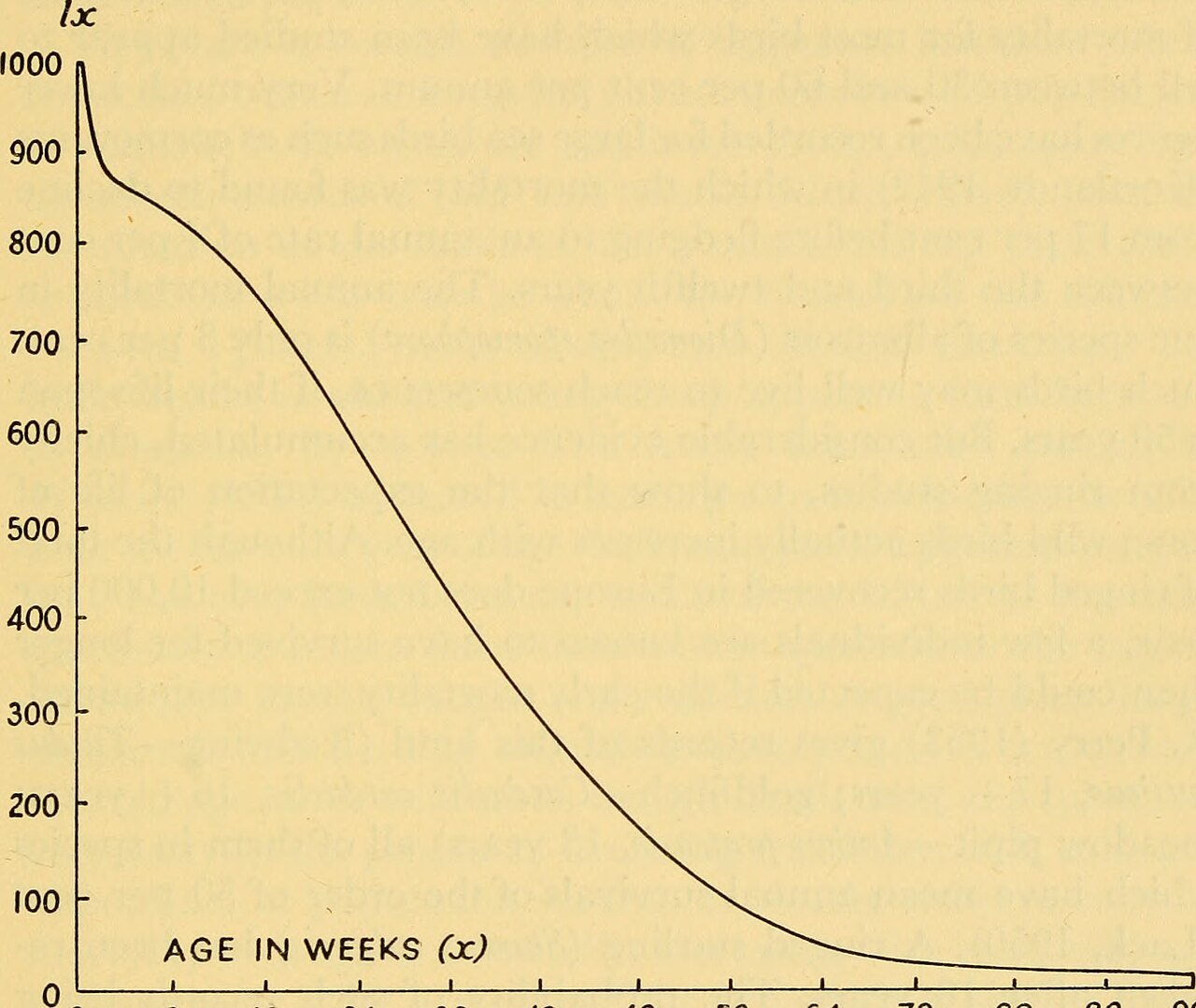
The theoretical foundation for all evolutionary theories of aging rests on a demographic insight first clearly articulated by J. B. S. Haldane and later formalised by Peter Medawar and W. D. Hamilton: natural selection becomes progressively weaker at later ages because fewer individuals survive to experience those ages.1, 4 In any population subject to extrinsic mortality — predation, disease, accidents — the proportion of individuals alive declines with age even in the absence of senescence. A gene whose deleterious effects manifest only at age 80 experiences far less selective pressure than one whose effects appear at age 20, simply because fewer individuals are alive at 80 for selection to act upon. Hamilton demonstrated this mathematically in 1966, showing that the sensitivity of fitness to age-specific changes in mortality or fertility declines monotonically after the onset of reproduction.4
This declining force of selection creates what amounts to a selective shadow at late ages — a domain where deleterious genetic effects can accumulate because selection is too weak to purge them. The three major theories of aging differ in how they propose this selective shadow is populated with damage, but all share the same underlying logic: aging is not an adaptation but a byproduct of selection's inability to maintain function indefinitely against the pressure of late-acting deleterious alleles.4, 5
Mutation accumulation
The mutation accumulation theory, proposed by Medawar in his 1952 lecture "An Unsolved Problem of Biology," represents the simplest application of the declining-force principle. Medawar argued that mutations with deleterious effects confined to late ages would be nearly invisible to natural selection. Such mutations would arise at the normal rate but would not be efficiently removed because their carriers would already have reproduced before the harmful effects appeared. Over evolutionary time, these late-acting deleterious mutations would accumulate in the genome, collectively producing the syndrome of physiological decline that we recognise as aging.1
Under this model, aging is essentially a genetic junkyard — the accumulated debris of mutations that selection was too weak to clean up. The theory predicts that genetic variation for late-life fitness should be greater than genetic variation for early-life fitness, because purifying selection is more effective against early-acting mutations. This prediction has been tested in Drosophila populations, where several studies have confirmed that genetic variance in mortality rates increases with age, consistent with a greater accumulation of conditionally neutral mutations acting late in life.5, 9
The mutation accumulation theory also predicts that the onset of senescence should roughly coincide with the age at which extrinsic mortality has reduced the surviving cohort to a small fraction of its original size, leaving selection too weak to oppose degenerative mutations. While broadly consistent with observed patterns, mutation accumulation alone may be insufficient to explain the full magnitude of aging in most species, leading to the development of additional theoretical frameworks.5, 14
Antagonistic pleiotropy
George C. Williams proposed a more powerful mechanism in his influential 1957 paper. Williams argued that some genes have pleiotropic effects — they influence more than one trait — and that natural selection could favour alleles with beneficial effects early in life even if those same alleles produced harmful effects later. Because early-life fitness contributions are weighted more heavily by selection than late-life contributions, the net effect would be positive selection for the allele despite its late-acting costs. Williams called this antagonistic pleiotropy: the early benefit and the late harm are opposing effects of the same gene.2
Unlike mutation accumulation, which posits passively accumulated junk, antagonistic pleiotropy implies that aging is partly a consequence of active selection for vigorous youth. Genes that enhance early reproduction, immune function, or competitive ability at the cost of accelerated deterioration later would be positively selected precisely because the early benefits outweigh the late costs in fitness terms. This creates an intrinsic trade-off between early performance and late survival that no amount of further selection can resolve, because the late-acting costs are inseparable from the early-acting benefits.2, 10
Molecular evidence consistent with antagonistic pleiotropy has accumulated across diverse organisms. The p53 tumour suppressor gene in mammals provides a potential example: enhanced p53 activity reduces cancer risk (an early-life benefit) but appears to accelerate cellular senescence and tissue aging (a late-life cost). In Caenorhabditis elegans, mutations in the insulin/IGF-1 signalling pathway can dramatically extend lifespan but often reduce early fecundity, illustrating the kind of trade-off that Williams predicted.15, 16 Partridge and Barton's experimental studies in Drosophila demonstrated that lines selected for increased late-life reproduction showed reduced early fecundity, directly confirming the existence of antagonistic genetic correlations between early and late fitness components.10
The disposable soma theory
Thomas Kirkwood's disposable soma theory, introduced in 1977, reframed the aging question in terms of energy allocation. Kirkwood argued that organisms face a fundamental trade-off in how they allocate limited metabolic resources between reproduction and somatic maintenance (DNA repair, antioxidant defences, protein turnover, and other processes that preserve cellular integrity). Natural selection should optimise this allocation not by maximising longevity but by maximising lifetime reproductive output.3
In environments with significant extrinsic mortality, investing heavily in somatic maintenance yields diminishing returns: an organism that builds an indestructible body gains little advantage if it is likely to be killed by a predator or disease before that investment pays off. It is more efficient, in evolutionary terms, to invest in rapid reproduction and accept the gradual accumulation of unrepaired damage that eventually produces senescence. The soma is "disposable" in the sense that it is an expendable vehicle for the germ line, worth maintaining only insofar as maintenance supports reproduction.3, 12
The disposable soma theory makes specific predictions about the relationship between extrinsic mortality, reproductive effort, and the rate of aging. Species facing high extrinsic mortality should invest less in maintenance and age faster, while species in protected environments should invest more in maintenance and age more slowly. Kirkwood and Holliday formalised these predictions mathematically, showing that the optimal level of somatic maintenance is always less than that required for indefinite survival, ensuring that aging emerges as a necessary consequence of optimal resource allocation.3, 11, 12
Empirical evidence
The evolutionary theories of aging generate several testable predictions that have been examined in both laboratory and natural populations. One central prediction — that reduced extrinsic mortality should lead to the evolution of slower aging and longer lifespan — has been tested in multiple systems with generally supportive results.
Steven Austad's study of Virginia opossums (Didelphis virginiana) on Sapelo Island, Georgia, provided a natural experiment. The island population had been isolated from mainland predators for approximately 4,500 years. Compared with mainland opossums, island opossums showed slower rates of collagen aging, later onset of reproductive decline, and longer lifespans — precisely the pattern predicted if relaxed extrinsic mortality allows selection to favour greater somatic maintenance.8
David Reznick and colleagues studied Trinidadian guppies (Poecilia reticulata) from streams with high and low predation pressure. Guppies from high-predation sites matured earlier and invested more in reproduction at the expense of growth and survival, while those from low-predation sites showed the opposite pattern. When populations were transplanted between environments, evolutionary changes in life-history traits occurred within detectable timeframes, confirming that predation-mediated mortality drives the evolution of aging-related trade-offs.6
Laboratory evolution experiments in Drosophila melanogaster have provided perhaps the most direct tests. Michael Rose selected fruit fly populations for late-life reproduction by allowing only late-reproducing individuals to contribute offspring to the next generation. After many generations, these lines evolved significantly extended lifespans compared with controls, but at the cost of reduced early fecundity — exactly the trade-off predicted by antagonistic pleiotropy.5, 9
Jones and colleagues' comprehensive 2014 analysis of mortality and fertility patterns across 46 species spanning the tree of life revealed extraordinary diversity in aging trajectories. While many species showed the classic pattern of increasing mortality with age, others displayed flat or even declining mortality. Certain long-lived species, including some tortoises, rockfish, and the naked mole-rat, exhibit what has been termed negligible senescence — no detectable increase in age-specific mortality or decline in reproductive output with age.7 The naked mole-rat (Heterocephalus glaber), the longest-lived rodent at over 30 years, shows remarkable resistance to cancer, maintains reproductive function throughout life, and exhibits mortality rates that do not increase with age across the measured lifespan, challenging simple predictions from evolutionary aging theory.13
Negligible senescence and exceptions
The existence of species with negligible senescence does not refute the evolutionary theory of aging but rather highlights the importance of ecological context in shaping optimal resource allocation. Species that exhibit negligible senescence tend to share certain life-history characteristics: they often grow indeterminately (continuing to increase in body size throughout life), face low extrinsic mortality due to protective shells, deep-water habitats, or social structures, and show increasing fecundity with body size, such that older, larger individuals produce more offspring than younger ones.7, 14
Under these conditions, the selective value of survival at late ages does not decline as steeply as Hamilton's model would predict for organisms with fixed body size and constant fecundity. When fecundity increases with age, the fitness contribution of surviving to old age remains substantial, maintaining strong selection for somatic maintenance throughout life. This is consistent with the evolutionary framework: negligibly senescent species are not violating the theory but rather illustrating a parameter regime where selection favours unusually high investment in maintenance.4, 7
Some organisms appear to have evolved specific mechanisms to sustain somatic integrity. The naked mole-rat possesses unusually effective DNA repair mechanisms, high-fidelity protein synthesis, and elevated levels of the cytoprotective molecule hyaluronan, all of which contribute to its remarkable resistance to age-related disease. These adaptations are interpretable within the disposable soma framework as the result of selection for increased somatic maintenance investment in a species with exceptionally low extrinsic mortality (naked mole-rats live in underground burrows largely free from predation) and a eusocial structure that extends reproductive opportunity over long timescales.13
Synthesis and current understanding
The three classical theories of aging — mutation accumulation, antagonistic pleiotropy, and disposable soma — are not mutually exclusive. Contemporary evolutionary biology treats them as complementary mechanisms that likely all contribute to aging in most species, with their relative importance varying depending on the organism and its ecological context. Mutation accumulation may dominate in traits where there is little opportunity for pleiotropic trade-offs, while antagonistic pleiotropy may be more important for central metabolic and signalling pathways that affect multiple fitness components. The disposable soma theory provides an overarching optimality framework that encompasses both genetic mechanisms by specifying the conditions under which investment in maintenance, and hence in longevity, is or is not favoured by selection.11, 14
Molecular genetics has enriched but not replaced the evolutionary framework. The discovery of single-gene mutations that dramatically extend lifespan in model organisms — particularly mutations in the insulin/IGF-1 signalling pathway in C. elegans, Drosophila, and mice — initially seemed to challenge the notion that aging is a complex, multi-gene process. However, these long-lived mutants typically show reduced early reproduction or other fitness costs, consistent with antagonistic pleiotropy, and the pathways involved regulate the trade-off between growth, reproduction, and somatic maintenance that the disposable soma theory predicts should be central to the evolution of longevity.15, 16
The evolutionary perspective remains essential for understanding why aging occurs. Proximate mechanisms — telomere shortening, oxidative damage, cellular senescence — describe how organisms deteriorate with age, but only the evolutionary theories explain why natural selection has not eliminated these vulnerabilities. The answer, consistent across all three theories, is that selection cannot maintain perfect somatic function at ages that few individuals reach in nature, and that the genetic architecture of fitness creates unavoidable trade-offs between the vigour of youth and the integrity of old age.5, 11, 14