Overview
- Eusociality — characterised by cooperative brood care, overlapping generations, and reproductive division of labour with a largely sterile worker caste — represents the most advanced form of animal social organisation and has evolved independently at least a dozen times, most prominently in the Hymenoptera (ants, bees, wasps), termites, and the naked mole-rat.
- W. D. Hamilton's kin selection theory, formalised as Hamilton's rule (rb > c), provided the first widely accepted explanation for eusociality: in haplodiploid Hymenoptera, sisters share 75% of their genes, making it genetically profitable for females to raise sisters rather than produce their own offspring — though the haplodiploidy hypothesis has been challenged by the recognition that workers also rear brothers (relatedness 25%) and that eusociality has evolved in diploid organisms.
- Alternative and complementary explanations include multilevel (group) selection, parental manipulation of offspring, ecological constraints on independent reproduction, and the 'point of no return' hypothesis in which the evolution of an obligate sterile caste irreversibly commits a lineage to the eusocial pathway once colony-level selection dominates individual-level selection.
Eusociality is the most complex and cooperative form of social organisation in the animal kingdom, defined by three diagnostic features: cooperative care of offspring (including the brood of other individuals), overlapping generations of adults within a colony, and a reproductive division of labour in which some individuals reduce or forfeit their own reproduction to assist the reproduction of others.3, 8 The existence of largely sterile worker castes that devote their lives to raising the offspring of a queen poses a profound challenge to evolutionary theory, because natural selection is expected to favour genes that increase their own transmission, not genes that cause their bearers to forgo reproduction. Charles Darwin himself recognised the sterile castes of social insects as "one special difficulty, which at first appeared to me insuperable, and actually fatal to my whole theory."3 Explaining how and why eusociality evolves has been one of the central problems in evolutionary biology for over half a century, generating some of the field's most productive and contentious theoretical debates.1, 4, 6
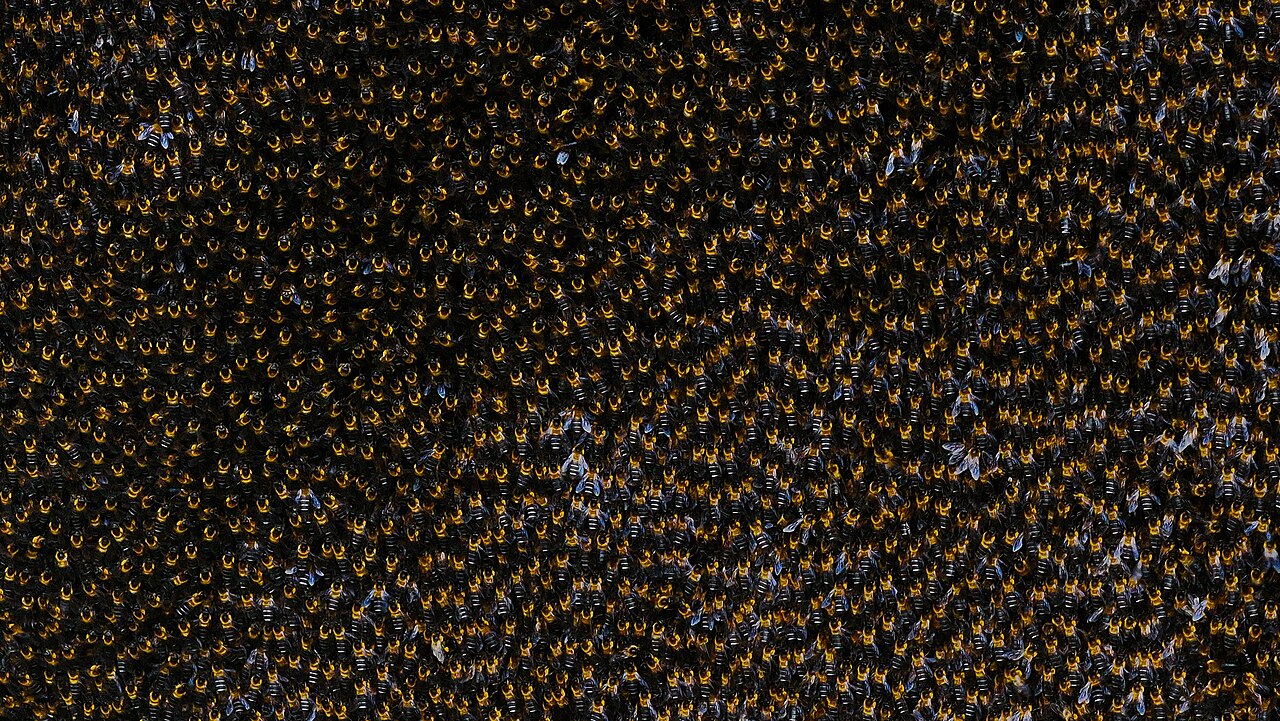

Kin selection and the haplodiploidy hypothesis
The first rigorous theoretical framework for the evolution of eusociality was provided by W. D. Hamilton's theory of kin selection, published in two landmark papers in 1964. Hamilton's insight was that a gene causing an individual to help a relative can spread if the fitness benefit to the recipient, devalued by the coefficient of relatedness between actor and recipient, exceeds the fitness cost to the actor. This condition is formalised as Hamilton's rule: rb > c, where r is the genetic relatedness between actor and recipient, b is the reproductive benefit to the recipient, and c is the reproductive cost to the actor.1, 2
Hamilton observed that the haplodiploid sex-determination system of the Hymenoptera (ants, bees, and wasps) creates unusual asymmetries in relatedness. In haplodiploid species, females develop from fertilised (diploid) eggs and males from unfertilised (haploid) eggs. Because a haploid father transmits his entire genome to each daughter, full sisters share all of their father's genes and, on average, half of their mother's genes, producing an average relatedness of 0.75 between sisters. By contrast, the relatedness of a mother to her daughters is the standard diploid value of 0.50. Hamilton suggested that this asymmetry might predispose haplodiploid lineages to evolve eusociality, because a female worker can transmit more copies of her genes to the next generation by helping her mother produce sisters (relatedness 0.75) than by producing her own daughters (relatedness 0.50).1, 2
The haplodiploidy hypothesis was enormously influential, but subsequent analysis revealed complications. Workers in haplodiploid colonies also raise brothers, to whom they are related by only 0.25. If the sex ratio of reproductive offspring is equal, the average relatedness of workers to siblings is 0.50, identical to the relatedness of a mother to her offspring, and the advantage of haplodiploidy vanishes. Workers can gain an advantage only if the colony's sex ratio is biased toward females, a condition predicted by Robert Trivers and Hope Hare's sex-ratio theory and confirmed empirically in some ant species but not universally.9 Furthermore, eusociality has evolved in diploid organisms — most notably the termites and the naked mole-rat — demonstrating that haplodiploidy is not a necessary condition, though the disproportionate concentration of eusocial origins in the Hymenoptera suggests it may be a facilitating factor.3, 14
Alternative and complementary hypotheses
The limitations of the haplodiploidy hypothesis led to the development of alternative and complementary explanations for eusociality. The parental manipulation hypothesis, proposed by Richard Alexander, argues that eusociality can evolve when parents are able to coerce offspring into helping rather than dispersing to breed independently, and that the helpfulness of workers may initially be enforced by parents rather than voluntarily adopted.3 In many eusocial insects, the queen controls worker reproduction through pheromonal or behavioural dominance, and in some species workers that attempt to lay eggs are policed by nestmates who destroy worker-laid eggs, as demonstrated by Ratnieks and Visscher in honeybees.10
The ecological constraints hypothesis emphasises that eusociality is most likely to evolve when ecological conditions make independent reproduction costly or impossible. If suitable nest sites are scarce, predation on solitary individuals is high, or the costs of dispersal are prohibitive, offspring may gain higher fitness by remaining in the natal nest and helping than by attempting to breed independently. Gadagkar formalised this as the "assured fitness returns" model, arguing that a worker gains a reliable fitness return by contributing to the survival of an existing colony, whereas an independently breeding female faces substantial risk of failure.11 In the naked mole-rat (Heterocephalus glaber), the only eusocial mammal besides the Damaraland mole-rat, the harsh subterranean environment of arid East Africa imposes severe constraints on independent breeding, favouring group living and cooperative foraging for the widely dispersed, energy-rich tubers on which the animals depend.12
In 2010, Nowak, Tarnita, and Wilson published a controversial paper arguing that inclusive fitness theory is neither necessary nor sufficient to explain eusociality, and that standard natural selection models incorporating population structure and ecological parameters can account for the evolution of sterile worker castes without invoking kin selection.4 They proposed that eusociality evolves through a series of stages: first, a species evolves a "springboard" phenotype (such as nest construction) that creates the conditions for group living; then, selection at the level of the group favours alleles that induce workers to remain and help; and finally, the colony becomes an integrated superorganism subject to colony-level selection. The paper provoked a sharp response from over 130 signatories who defended inclusive fitness theory and argued that Nowak and colleagues had mischaracterised the mathematical framework.15 The debate remains unresolved, though most evolutionary biologists continue to regard kin selection as an important, if not always sufficient, factor in the evolution of eusociality.6
Taxonomic distribution
Eusociality has evolved independently at least a dozen times across the animal kingdom, though the vast majority of eusocial species belong to the insect order Hymenoptera, which includes all known species of ants (approximately 22,000 species, all eusocial), many bees (including honeybees, bumblebees, and the stingless bees), and numerous wasp lineages.3, 7 Within the Hymenoptera, phylogenetic analyses indicate that eusociality has evolved independently multiple times, including at least four times in the bees and several times in the vespid wasps, suggesting that the haplodiploid genetic system and the ecological preadaptation of nest-building have made this lineage particularly prone to transitions to eusociality.5
Outside the Hymenoptera, the most prominent eusocial lineage is the termites (order Blattodea, formerly Isoptera), which are diploid and represent a completely independent origin of eusociality. Termite colonies feature a king and queen, and workers of both sexes, in contrast to the Hymenoptera where workers are exclusively female. Phylogenetic analyses have placed termites firmly within the cockroach order Blattodea, revealing that eusociality in termites evolved from a subsocial cockroach ancestor that lived in family groups within decaying wood.14 Among mammals, only two species are currently recognised as eusocial: the naked mole-rat (Heterocephalus glaber) and the Damaraland mole-rat (Fukomys damarensis), both of which live in underground colony systems with a single breeding female (the queen), one to three breeding males, and non-reproductive workers that dig tunnels and maintain the nest.12 Eusociality has also been documented in a snapping shrimp (Synalpheus regalis), which lives in colonies within sponges on Caribbean coral reefs, with a single reproductive female defended by a retinue of non-reproductive colony members.13
Colony-level selection and the superorganism
Once eusociality is established, the colony becomes a unit upon which selection acts, analogous to the way selection acts on individual organisms. E. O. Wilson and Bert Hölldobler have argued that mature eusocial insect colonies function as "superorganisms," with the queen serving as the germline, the workers as the soma, and the colony's division of labour analogous to the functional specialisation of cell types in a multicellular organism.3, 7 Colony-level selection favours traits that increase colony fitness — efficient foraging, effective nest defence, optimal sex ratios in reproductive offspring — even when these traits are expressed by sterile workers who gain no direct reproductive benefit. The parallel to the evolution of multicellularity is instructive: in both cases, formerly independent reproductive units (cells, or individual insects) became integrated into a higher-level entity, surrendering individual reproduction in exchange for the efficiencies of specialisation and cooperation.7, 16
However, conflicts of interest within colonies prevent them from functioning as perfectly integrated organisms. Workers in many species retain the ability to lay unfertilised eggs that develop into males, creating a conflict between the queen (who benefits from monopolising reproduction) and workers (who may gain fitness by producing sons). Worker policing — the destruction of worker-laid eggs by other workers — has been documented in honeybees, many ant species, and some wasps, and serves as a mechanism that suppresses intracolonial conflict and maintains the reproductive monopoly of the queen.10 The balance between cooperation and conflict within eusocial colonies continues to shape their evolution, and understanding how that balance is maintained remains a central question in the study of social evolution.6, 9