Overview
- All great apes—like chimpanzees, gorillas, and orangutans—have 48 chromosomes (24 pairs), but humans only have 46 (23 pairs). Based on evolution, scientists predicted that two ape chromosomes must have fused together to form a single human chromosome.
- That prediction was proven true. Human chromosome 2 is the exact match of two chimpanzee chromosomes joined end-to-end. It even has the leftover, broken parts of the original chromosome ends (telomeres) and middle sections (centromeres) stuck inside it.
- This fusion is one of the clearest and most literal pieces of genetic evidence for the shared ancestry between humans and other great apes.
If humans and the other great apes both evolved from a common ancestor, there is a very obvious riddle that scientists needed to solve: human beings have 46 chromosomes, but chimpanzees, gorillas, and orangutans all have 48.1, 2 Where did the missing pair of chromosomes go? Losing a whole chromosome would involve losing hundreds of important genes, which is almost always deadly. Because of this, evolutionary biologists predicted long ago that instead of being lost, two of the ancestor's chromosomes must have fused together into a single, larger chromosome at some point in human history.
In the early 1980s, scientists discovered that human chromosome 2 looks exactly like two separate chimpanzee chromosomes stacked on top of each other.1 Over the following decades, as genetic technology advanced, scientists zoomed in and found the exact molecular "scar" where the two ape chromosomes joined together. The story of human chromosome 2 is one of the clearest examples of a scientific prediction being completely proven by modern genetics.2, 3
The missing chromosome puzzle
Chromosomes are the structures inside your cells that hold your DNA. Humans have 23 pairs of chromosomes (making 46 in total), a fact first firmly established in 1956.4 However, all other great apes—including chimpanzees, bonobos, gorillas, and orangutans—have 24 pairs (making 48 in total).1, 5 Because so many other monkey and ape species also have 48 chromosomes, scientists concluded that having 48 chromosomes was the original trait for the ancestors of all great apes.5
Since overwhelming evidence from fossils, anatomy, and genetics shows that humans and chimpanzees share a common ancestor, the reduction from 48 to 46 chromosomes had to happen after human ancestors split off from chimpanzee ancestors. The simplest explanation is that two chromosomes joined end-to-end to create one big chromosome, lowering the total count by one pair.2, 3
Chromosome counts across the great apes1, 5
| Species | Common name | Total Number |
|---|---|---|
| Homo sapiens | Human | 46 |
| Pan troglodytes | Chimpanzee | 48 |
| Pan paniscus | Bonobo | 48 |
| Gorilla gorilla | Gorilla | 48 |
| Pongo pygmaeus | Orangutan | 48 |
The first clue: chromosomal bands
The first major clue came from simply looking at chromosomes under a microscope. When scientists dye chromosomes with specific stains, they show unique patterns of light and dark bands, like a barcode. These barcode patterns are very consistent and can be used to compare chromosomes from different species.1, 5

In 1982, a groundbreaking study compared the "barcodes" of humans, chimpanzees, gorillas, and orangutans. They found that human chromosome 2 is an almost perfect match for two separate chimpanzee chromosomes placed end-to-end.1 (These chimp chromosomes are often called 2A and 2B.) The same match holds true for gorillas and orangutans, which means the fusion happened specifically in our human ancestors.1, 5
While this barcode match was a huge discovery, it was still circumstantial evidence. The true test would come years later when scientists could read the actual DNA letters to see if they could find the exact spot where the chromosomes glued together.2
Finding the genetic scar
To understand what scientists were looking for, you have to know how a chromosome is built.
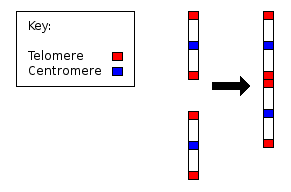

At the very tip of every chromosome is a protective cap called a telomere. Telomeres are made of a specific sequence of DNA letters (TTAGGG) repeated thousands of times. Their job is to keep the ends of the chromosome from fraying or sticking to other chromosomes.2, 3
If two chromosomes fused end-to-end, the telomere caps from both of them would be trapped in the middle of the newly formed chromosome. Because they joined head-to-head, you would expect to find the repeated letters running in one direction, and then immediately running in the opposite direction.2
In 1991, an incredible discovery confirmed this prediction. A team of scientists found exactly this signature right in the middle of human chromosome 2. They found two inverted arrays of the telomere sequence, sitting head-to-head, surrounded by DNA that is normally only found at the very tips of chromosomes.2 The scientists stated safely that this was "the point at which two ancestral ape chromosomes fused to give rise to human chromosome 2."2 This molecular scar sat exactly where the old barcode studies predicted the fusion would be.1, 2
The broken, leftover center
There's another major structural piece to the puzzle. Every normal chromosome has a pinched middle section called a centromere. The centromere is crucial because it acts like a handle that the cell "grabs" to pull the chromosome apart during cell division.7
A chromosome with two centromeres is dangerous because the cell might grab both handles and accidentally rip the chromosome in half. If two ape chromosomes joined together, the new human chromosome 2 would have had two centromeres. To survive, it had to turn one of them off.7, 8
In 1992, researchers proved that this is exactly what happened. Human chromosome 2 has one normal, working centromere (which matches the centromere from the first ape chromosome). But further down the chromosome, researchers found the broken, leftover DNA of a second centromere.7 This second "handle" is completely inactive and broken, but the genetic remnants are still sitting there, exactly where the centromere of the second ape chromosome used to be. A detailed 2017 study confirmed how this old centromere mutated and shut down over the last few million years to keep the newly fused chromosome stable.8
Reading the entire genome
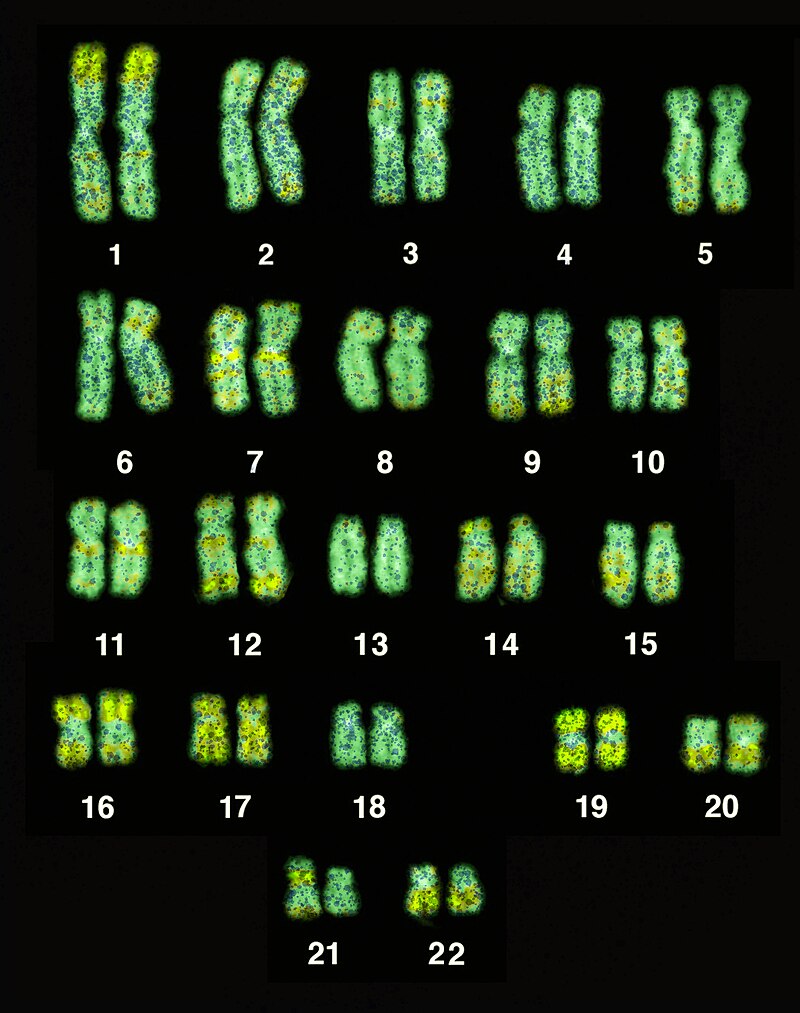

When the Human Genome Project was completed, scientists finally had the ability to read the entire DNA sequence letter by letter. In 2005, scientists published the complete sequence of human chromosome 2, which is over 237 million letters long.10
That same year, the first draft of the chimpanzee genome was published. When scientists compared the two, they found that the human chromosome 2 sequence aligned perfectly with chimpanzee chromosomes 2A and 2B. Not only did they see the genetic "scar" where the telomeres mashed together, but they also found that the rest of the DNA sequence had barely changed. The order of the genes is almost identical, and analysis of the gene content at the fusion site confirmed that genes flanking the ancestral telomere-telomere junction remain functional on both sides of the scar.3, 6, 9, 11
Did other ancient humans have this?
Interestingly, modern humans aren't the only ones with this fused chromosome. When scientists sequenced DNA from ancient, extinct human relatives—like Neanderthals and Denisovans—they found the exact same genetic scar.12, 13
Because Neanderthals and Denisovans split off from our ancestors hundreds of thousands of years ago, the fact that we all share this fused chromosome proves that the fusion happened deep in the past, long before modern humans existed. In 2022, scientists analyzed the mutation rates around the fusion site and estimated that the chromosomes actually merged roughly 900,000 years ago.14 This means the fusion was already present in the common ancestor of all humans, Neanderthals, and Denisovans.
A proven prediction
The story of human chromosome 2 is one of the greatest triumphs of evolutionary science because it perfectly followed the rules of making a scientific prediction and then proving it.1, 2, 6
The logic was simple: since humans have 46 chromosomes and apes have 48, one of our chromosomes must be made of two ape chromosomes stuck together. If this was true, we should be able to find a chromosome with repeating end-caps stuck in the middle, and the broken remnants of an extra center.1, 2
Decade after decade, as technology improved, every single prediction came true. Today, human chromosome 2 stands as a literal, readable genetic monument to the shared ancestry between humans and the rest of the great apes.6
References
Genomic structure and evolution of the ancestral chromosome fusion site in 2q13–2q14.1 and paralogous regions on other human chromosomes
Fluorescence in situ hybridization to chromosomes as a tool to understand human and primate genome evolution
Centromere destiny in dicentric chromosomes: New insights from the evolution of human chromosome 2 ancestral centromeric region
Gene content and function of the ancestral chromosome fusion site in human chromosome 2q13–2q14.1 and paralogous regions