Overview
- The creationist claim that biological evolution violates the second law of thermodynamics rests on a fundamental misunderstanding: the second law states that entropy increases in isolated systems, but Earth is an open system continuously receiving energy from the Sun, which powers the local decreases in entropy that characterize all life.
- Local decreases in entropy are routine in nature — ice crystallizes from liquid water, snowflakes self-assemble, embryos develop from single cells, and plants convert solar energy into complex organic molecules — none of which violate any thermodynamic law, because they are coupled to larger entropy increases elsewhere.
- Despite being universally rejected by physicists and thermodynamicists, the argument persists in creationist literature because it trades on public unfamiliarity with the technical meaning of entropy, conflates thermodynamic entropy with information-theoretic entropy, and carries rhetorical force that belies its scientific vacuity.
One of the most persistent arguments in creationist literature against biological evolution is the claim that it violates the second law of thermodynamics. The argument, in its simplest form, asserts that because the second law requires entropy—a measure of disorder—to increase over time, the emergence of complex, highly ordered living organisms from simpler precursors is thermodynamically impossible. This claim has been advanced by prominent creationists including Henry Morris, Duane Gish, and organizations such as Answers in Genesis, and it continues to circulate in popular anti-evolution discourse despite being universally rejected by physicists and chemists.7, 8, 18 The argument rests on a fundamental misunderstanding of what the second law actually states, the distinction between open and isolated systems, and the thermodynamic conditions under which organized complexity can and routinely does arise.
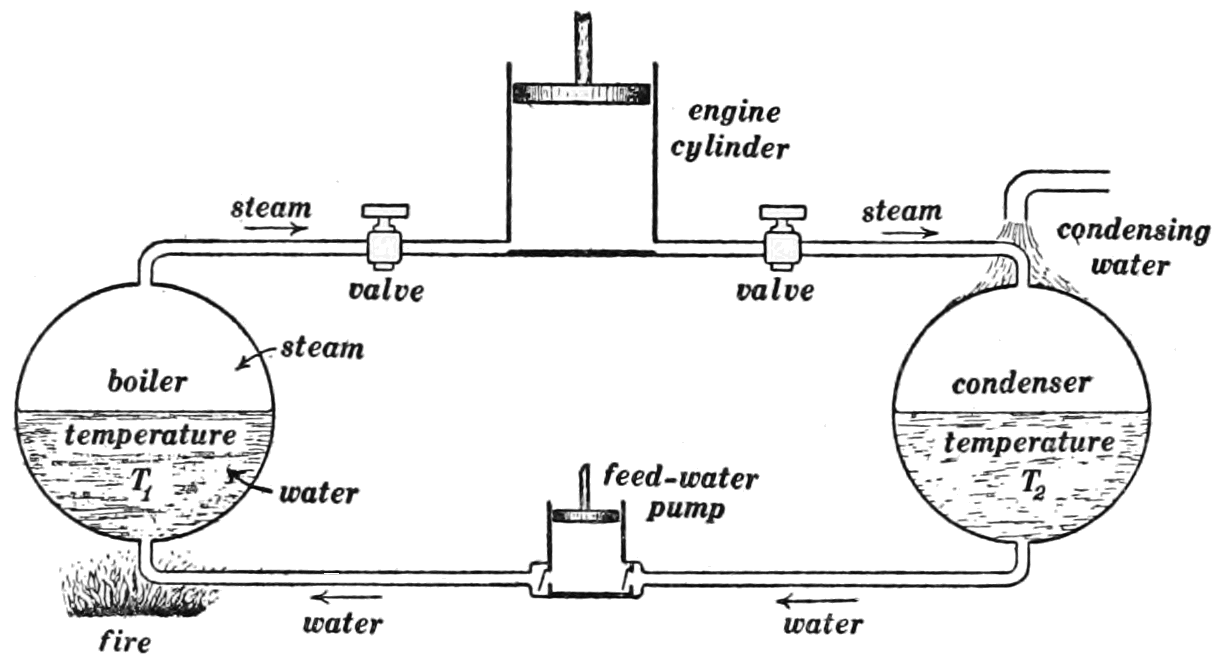

The second law of thermodynamics
The second law of thermodynamics, formulated in the nineteenth century by Rudolf Clausius, Lord Kelvin, and others, can be stated in several equivalent ways. Clausius’s formulation holds that heat cannot spontaneously flow from a colder body to a warmer one. An equivalent statistical formulation, developed by Ludwig Boltzmann, states that isolated systems tend toward the macrostate with the greatest number of accessible microstates—that is, toward maximum entropy.2, 21 Entropy, in this thermodynamic sense, is a precisely defined quantity related to the number of microscopic configurations consistent with a system’s macroscopic properties (temperature, pressure, volume). The crucial qualifier in every rigorous statement of the second law is that entropy increases—or remains constant—in an isolated system: one that exchanges neither energy nor matter with its surroundings.21
The second law does not state that entropy must increase everywhere at all times. It does not prohibit the local emergence of order. It does not say that complexity cannot arise. What it says is that in a thermally isolated system, the total entropy of that system will not decrease. In an open system—one that exchanges energy or matter with its environment—local entropy can decrease freely, provided the entropy of the surroundings increases by at least as much, so that the total entropy of system plus surroundings does not decrease.21, 10 This distinction between open and isolated systems is the crux of the entire matter, and it is the distinction that the creationist argument either misunderstands or deliberately ignores.
Earth as an open system
Earth is emphatically not an isolated system. It receives approximately 1.74 × 10¹⁷ watts of energy from the Sun—a continuous, enormous influx of low-entropy energy in the form of visible-spectrum photons. This energy drives virtually all of the planet’s geological, meteorological, and biological processes. Plants capture a fraction of this solar energy through photosynthesis, converting carbon dioxide and water into glucose and oxygen, building complex organic molecules from simpler inorganic precursors. The entropy decrease associated with the assembly of these complex molecules is more than compensated for by the entropy increase in the Sun itself, which converts hydrogen to helium through nuclear fusion and radiates vast quantities of high-entropy thermal radiation into space.10, 14
Daniel Styer calculated the entropy changes explicitly in a 2008 paper in the American Journal of Physics. He estimated the entropy decrease associated with the evolution of all life on Earth over its entire history and compared it to the entropy increase associated with the solar energy flowing through the Earth system. The entropy decrease due to evolution is negligible—roughly 10-11 of the entropy increase produced by the Sun’s radiation absorbed and re-emitted by Earth. Evolution does not come close to threatening the second law; the thermodynamic “budget” available from solar energy is so overwhelmingly large that the local ordering represented by biological complexity is thermodynamically trivial.10
Local entropy decrease in everyday phenomena
If the creationist version of the second law were correct—that entropy must increase everywhere, in every subsystem, at all times—then a vast number of ordinary physical and chemical processes would be impossible. Water freezes into ice crystals, which are vastly more ordered than liquid water: a local decrease in entropy, driven by the release of latent heat to the surroundings. Snowflakes self-assemble into elaborate hexagonal structures from water vapor. Crystals of sodium chloride precipitate from saturated solutions in highly regular lattice arrangements. A fertilized egg develops into a complex multicellular organism through a sequence of precisely regulated cell divisions.5, 15
None of these processes violate the second law, because none occur in isolated systems. In each case, the local decrease in entropy is coupled to a larger increase in entropy elsewhere—typically through the release of heat to the surrounding environment. Erwin Schrödinger recognized this as early as 1944 in What Is Life?, where he argued that living organisms maintain their organized states by feeding on “negative entropy” (or “negentropy”)—importing free energy from their environments and exporting entropy in the form of waste heat and disordered byproducts.5 A living cell is a thermodynamic engine that maintains its internal order by continuously degrading external energy sources and increasing the entropy of its surroundings.
Self-organization and dissipative structures
Far from prohibiting the emergence of organized complexity, the laws of thermodynamics can actively drive it. Ilya Prigogine, who received the Nobel Prize in Chemistry in 1977, demonstrated that systems far from thermodynamic equilibrium can spontaneously develop organized structures—what he called “dissipative structures”—as a means of more efficiently dissipating energy gradients. These structures maintain their organization by continuously importing energy and exporting entropy; they are sustained by the very thermodynamic flows that the creationist argument claims should destroy them.3, 17
Examples of dissipative structures abound in nature. Bénard convection cells form spontaneously in a fluid heated from below: as the temperature gradient exceeds a critical threshold, the disordered motion of fluid molecules self-organizes into a regular pattern of hexagonal convection rolls. Belousov–Zhabotinsky chemical reactions produce striking oscillating patterns of color as reagents cycle through periodic states far from equilibrium. Hurricanes, tornadoes, and ocean currents are all large-scale dissipative structures that arise because they are thermodynamically efficient ways to redistribute energy from warm to cool regions.3, 17 These phenomena demonstrate a fundamental principle: energy flow through a system can create order, not merely destroy it.
Stuart Kauffman extended these ideas to biology in The Origins of Order (1993), arguing that self-organization is a fundamental force in evolution alongside natural selection. Kauffman showed through computational models that networks of interacting molecules can spontaneously achieve ordered, self-sustaining dynamics—a form of “order for free” that does not require natural selection to explain its initial emergence. While natural selection refines and channels this order, the raw capacity for self-organization is an inherent property of complex chemical systems operating far from equilibrium.4
More recently, Jeremy England has developed theoretical frameworks showing that self-replication itself may be a thermodynamically favored process under certain conditions. His work demonstrates that groups of molecules driven by an external energy source will tend, over time, to restructure themselves in ways that increasingly dissipate energy—and self-replicating systems are particularly effective at doing so. This suggests that the emergence of life-like self-replicating chemistry is not improbable in thermodynamic terms but may be a natural consequence of physics in energy-rich environments.11, 20
Information theory and entropy
A significant source of confusion in the creationist argument is the conflation of thermodynamic entropy with information-theoretic entropy. Claude Shannon introduced the concept of information entropy in 1948 as a measure of uncertainty or unpredictability in a message—the average number of bits required to encode symbols drawn from a probability distribution.6 Shannon himself acknowledged that his use of the term “entropy” was partly due to the mathematical similarity of the formula to Boltzmann’s entropy equation, and partly on the advice of John von Neumann, who reportedly quipped that the word would give Shannon an advantage in debates because “nobody really knows what entropy is.”
Although the mathematical formalism is similar, thermodynamic entropy and Shannon entropy measure fundamentally different things. Thermodynamic entropy quantifies the number of microstates accessible to a physical system at a given energy. Shannon entropy quantifies the amount of information (or uncertainty) in a message or signal. The second law of thermodynamics governs the behavior of physical systems exchanging heat and work; it says nothing directly about the “information content” of DNA sequences or the “specified complexity” of biological structures.6, 12
Creationist authors frequently slide between these two meanings, arguing that because biological information is “complex” and “specified,” it represents a form of low entropy that cannot increase through natural processes. This conflation is illegitimate. The information encoded in DNA is maintained and modified through well-understood biochemical processes—replication, mutation, recombination, and selection—all of which are thermodynamically permissible in open systems. Hubert Yockey, who analyzed biological information rigorously in terms of Shannon theory, concluded that the information-theoretic analysis of molecular biology is fully consistent with evolutionary theory and thermodynamics.12 Computational experiments by Christoph Adami and colleagues have further demonstrated that digital organisms subject to mutation and selection spontaneously increase in genomic complexity over evolutionary time, in full compliance with thermodynamic constraints.13
Creationist formulations of the argument
The thermodynamic argument against evolution has a long history in creationist literature and has been advanced in several distinct forms. Understanding these formulations is important for grasping why the argument continues to circulate despite its scientific inadequacy.
Henry Morris, founder of the Institute for Creation Research (ICR) and one of the most influential figures in the history of creationism, made the second law argument a centerpiece of his case against evolution. In The Troubled Waters of Evolution (1974) and numerous ICR publications, Morris argued that evolution requires a net increase in order and complexity, which he claimed was flatly prohibited by the second law. Morris acknowledged that local decreases in entropy are possible in open systems but insisted that a mere energy source was insufficient—that what was needed was a “conversion mechanism” and an “information program” to direct the energy into constructive channels. Without these, he argued, raw energy would be destructive rather than constructive, as “the Sun beating down on a dead stick does not make it grow.”7, 9
This “conversion mechanism” argument, while more sophisticated than the simple isolated-system confusion, is equally flawed. The conversion mechanisms and information programs Morris demanded already exist in biology: they are called biochemistry. Photosynthesis is precisely a mechanism that converts solar energy into chemical energy stored in complex organic molecules. The molecular machinery of the cell—enzymes, ribosomes, DNA polymerases, the citric acid cycle—constitutes exactly the kind of energy-directing apparatus that Morris claimed was missing. The argument amounts to demanding that biology explain how biology works, and then declaring evolution impossible when the explanation involves biological mechanisms.10, 15
Duane Gish, Morris’s colleague at the ICR and a prolific debater, employed a simpler version of the argument in Evolution? The Fossils Say No! (1979) and in numerous public debates. Gish typically asserted that the second law proved that “disorder always increases” and that evolution, as a process that generates order from disorder, was therefore physically impossible. Gish rarely engaged with the open-system distinction and generally dismissed it as an inadequate response.8, 18
Answers in Genesis (AiG), the organization founded by Ken Ham, has perpetuated the argument in articles on its website and in publications such as The New Answers Book. AiG authors typically acknowledge the open-system distinction but argue, following Morris, that energy flux alone is insufficient without a pre-existing mechanism to harness it. Some AiG formulations further assert that the second law applies to information as well as thermodynamic entropy, claiming that genetic information cannot increase through mutation and selection. This claim conflates Shannon entropy with thermodynamic entropy and is contradicted by extensive empirical evidence of new genetic information arising through gene duplication, horizontal gene transfer, and de novo gene origination.13, 18
Mathematician Granville Sewell has offered a more technical version of the argument, claiming that the second law can be generalized to prohibit increases in “order” of any type—not just thermodynamic entropy—in open systems. Sewell argued that just as one would not expect a diffusion equation to run backward (unmixing a dissolved substance), one should not expect biological complexity to increase spontaneously. However, Sewell’s argument was rejected by the journal Applied Mathematics Letters after peer review, and subsequent analyses demonstrated that his generalization of the second law was physically unfounded: the second law constrains thermodynamic entropy specifically, not an undefined concept of “order” in general.19, 15
Scientific responses
The scientific response to the creationist thermodynamic argument is comprehensive and effectively unanimous. No scientific organization, no physics textbook, and no peer-reviewed journal has ever supported the claim that evolution violates the second law. The rebuttal proceeds on several levels.
First, the definitional level: the second law governs isolated systems. Earth is not an isolated system. Therefore, the second law does not prohibit local decreases in entropy on Earth. This alone is sufficient to refute the argument in its simplest form.21, 10
Second, the quantitative level: even when the bookkeeping is done carefully for the Earth system as a whole, the entropy decrease associated with biological evolution is infinitesimal compared to the entropy increase generated by the absorption and re-radiation of solar energy. Styer’s 2008 calculation demonstrated this with explicit numerical estimates, showing that Earth’s entropy budget has an enormous surplus that could accommodate biological ordering many orders of magnitude beyond what has actually occurred.10 Emory Bunn’s 2009 analysis further clarified the probabilistic formulation of the argument, showing that even when framed in terms of the statistical improbability of entropy decrease, the numbers overwhelmingly favor the thermodynamic permissibility of evolution.15
Third, the mechanistic level: the thermodynamics of biological systems are well understood. Living organisms are far-from-equilibrium dissipative structures that maintain their internal order by coupling to external energy sources, exactly as Schrödinger, Prigogine, and countless subsequent researchers have described.5, 3, 14 The biochemical pathways by which organisms capture, store, and utilize energy are characterized in exquisite detail. Photosynthesis, cellular respiration, and the ATP cycle are among the most thoroughly studied processes in all of science. There is no “missing mechanism”—the mechanisms are known, quantified, and entirely consistent with thermodynamic law.
Fourth, the theoretical level: far from being in tension with the emergence of complexity, thermodynamics may actively favor it. Schneider and Sagan have argued that living systems can be understood as structures that arise because they are effective at degrading energy gradients—that life exists because it accelerates entropy production in the universe at large.14 Adeshina Pross has developed a framework for understanding the thermodynamic driving forces behind the transition from chemistry to biology, showing that the emergence of self-replicating chemical systems is thermodynamically coherent.16 England’s statistical-mechanical work on self-replication further reinforces this picture, demonstrating that the laws of physics do not merely permit the emergence of life-like complexity but may promote it under appropriate conditions.11, 20
History of the argument in creationist literature
The thermodynamic argument against evolution appears to have originated in the mid-twentieth century, gaining prominence through the work of Henry Morris and John Whitcomb. Morris introduced the argument in The Genesis Flood (1961) and developed it more fully in subsequent publications through the 1970s and 1980s. As Ronald Numbers documents in The Creationists (2006), the second law argument became one of the three or four core scientific-sounding claims in the young-earth creationism repertoire, alongside arguments about the fossil record, radiometric dating, and the origin of information.18
The argument achieved its widest circulation during the “scientific creationism” movement of the 1970s and 1980s, when Morris, Gish, and other ICR figures promoted it in public debates, textbooks (such as Scientific Creationism, 1974), and legal proceedings surrounding the teaching of creationism in public schools. During the 1981 McLean v. Arkansas trial, which struck down an Arkansas law requiring “balanced treatment” of evolution and creation science, the thermodynamic argument was among the scientific claims evaluated and rejected by the court.18
Despite its refutation, the argument has proven remarkably durable. It continues to appear in ICR and AiG publications, in online creationist resources, in intelligent design literature, and in informal debates. Its persistence owes much to its rhetorical structure: the second law of thermodynamics is a genuine and important physical law, entropy is a concept that many people find counterintuitive, and the argument has a superficial plausibility that can be difficult to rebut in the compressed format of a public debate or social media exchange. The fact that professional physicists consider the argument trivially wrong does not diminish its persuasive power among audiences unfamiliar with thermodynamics.18, 15
Why the argument persists
Several factors explain the durability of the thermodynamic argument against evolution despite its complete rejection by the scientific community. First, entropy is genuinely difficult to understand. Even physics students frequently harbor misconceptions about what the second law does and does not forbid, and popular characterizations of entropy as “disorder” are misleading oversimplifications that make the creationist version of the argument seem intuitive. The colloquial equation of entropy with disorder suggests that any process producing order must violate the second law, a conclusion that does not follow from the actual mathematical formulation.21, 15
Second, the argument exploits a genuine asymmetry in explanatory burden. Stating that “evolution violates the second law” is simple and memorable. Explaining why it does not requires distinguishing between open and isolated systems, discussing energy flows, and often introducing quantitative reasoning—a level of technical detail that is difficult to convey in popular formats. This asymmetry gives the argument a persistent rhetorical advantage even when the science is settled.10
Third, the conflation of thermodynamic entropy with information, disorder, and complexity provides a constantly renewable source of confusion. Because these concepts are loosely related in everyday language but technically distinct in their respective scientific frameworks, creationist authors can shift between them in ways that obscure the precise nature of the second law’s constraints. A claim that “information cannot arise from disorder” sounds thermodynamic but is actually an information-theoretic assertion that the second law does not address.6, 12
Fourth, the argument serves an important rhetorical function within creationist apologetics: it allows creationists to claim the authority of physics against biology. By framing evolution as being in conflict with one of the most fundamental laws of physics, creationists can position evolutionary biology as violating not just their religious convictions but the very foundations of physical science. This framing is powerful precisely because it is false—there is no such conflict—but the claim of conflict between disciplines carries persuasive weight with audiences who are not in a position to evaluate its accuracy.18
Thermodynamics and the origin of life
It is worth distinguishing the thermodynamic argument against evolution from thermodynamic questions about the origin of life. The origin of the first self-replicating chemical systems from prebiotic chemistry is a genuinely open scientific question, and thermodynamic considerations are relevant to understanding how it may have occurred. However, the relevant question is not whether the origin of life violates the second law—it does not, for the same open-system reasons that apply to evolution—but rather what specific thermodynamic pathways could have facilitated the transition from nonliving chemistry to living systems.16, 14
Prigogine’s work on dissipative structures, Kauffman’s work on self-organizing chemical networks, and England’s statistical-mechanical framework for self-replication all contribute to a growing understanding of how thermodynamic driving forces may have promoted the emergence of life. These are active areas of scientific research, and much remains to be discovered. But the direction of research is clear: thermodynamics is part of the explanation for how life arose, not an obstacle to it. The second law does not prohibit the origin of life any more than it prohibits the formation of snowflakes; it constrains the pathways by which such events can occur and requires that they be coupled to sufficient entropy production elsewhere.3, 4, 20
Conclusion
The claim that biological evolution violates the second law of thermodynamics is one of the most frequently encountered and most thoroughly refuted arguments in the creationism-evolution controversy. It fails at every level of analysis: definitional (the second law applies to isolated systems; Earth is not one), quantitative (the entropy budget of the Earth system can accommodate biological evolution many times over), mechanistic (the biochemical pathways by which organisms capture and utilize energy are well characterized), and theoretical (modern thermodynamics shows that energy flow through open systems can drive, not merely permit, the emergence of organized complexity). The argument persists not because of any scientific merit but because it exploits widespread public misunderstanding of entropy, trades on the authority of physics, and is easier to state than to rebut in popular discourse. Among working physicists, chemists, and biologists, the matter is not controversial: evolution is fully consistent with the second law of thermodynamics.10, 15, 14
References
Self-organization in nonequilibrium systems: from dissipative structures to order through fluctuations