Overview
- Hydrothermal vents are openings in the seafloor where geothermally heated, chemically altered seawater discharges into the ocean, first discovered on the Galapagos Rift in 1977 and found predominantly along mid-ocean ridges where magmatic heat drives convective circulation through permeable oceanic crust.
- Vent systems produce two principal types of discharge — black smokers emitting superheated fluid up to 400 degrees Celsius laden with metal sulfides, and white smokers emitting cooler fluid enriched in silica and barium — and support chemosynthetic ecosystems entirely independent of sunlight, including giant tube worms, vent mussels, and specialized shrimp.
- Hydrothermal circulation exerts a first-order influence on ocean chemistry by cycling the entire volume of the world's oceans through mid-ocean ridge systems every 10 to 20 million years, deposits volcanogenic massive sulfide ore bodies that are mined on land as sources of copper, zinc, and gold, and at alkaline vent sites such as Lost City provides conditions considered among the most plausible settings for the origin of life on Earth.
Hydrothermal vents are openings in the seafloor through which geothermally heated, chemically transformed seawater discharges into the ocean. Found predominantly along mid-ocean ridges, back-arc basins, and submarine volcanic arcs, these systems are driven by the heat of shallow magma chambers that warm infiltrating seawater to temperatures exceeding 400 °C and strip metals, sulfur, and other elements from the surrounding rock.3, 9 Their discovery in 1977 on the Galapagos Rift was one of the most consequential findings in twentieth-century Earth science, revealing an entirely unexpected mode of biological productivity independent of sunlight and fundamentally revising scientific understanding of ocean chemistry, ore formation, and the possible settings for the origin of life.1, 6
Hydrothermal vents produce striking geological structures — towering chimneys of precipitated metal sulfides known as black smokers and white smokers — and support dense biological communities sustained by chemosynthetic microorganisms rather than photosynthesis. The minerals deposited at vent sites are the modern analogues of volcanogenic massive sulfide (VMS) ore deposits found in ancient rocks on land, while the chemical fluxes from hydrothermal circulation profoundly influence the composition of seawater over geological time.10, 11
Discovery of hydrothermal vents
The existence of submarine hydrothermal vents had been predicted on theoretical grounds well before they were directly observed. Geophysicists recognised that the measured heat flow at mid-ocean ridges was far lower than expected from models of cooling oceanic lithosphere, implying that a large fraction of the heat was being removed by convective circulation of seawater through the permeable upper crust rather than by conduction alone.9 The first indirect evidence came in 1977, when bottom-water temperature anomalies and chemical signatures detected by towed instruments indicated the presence of warm fluid emanating from the ocean floor along the Galapagos Rift in the eastern Pacific.
The decisive discovery followed almost immediately. In February and March of 1977, scientists aboard the deep-diving submersible Alvin descended to the Galapagos Rift at approximately 2,500 metres depth and directly observed warm springs discharging fluid at temperatures of 8 to 17 °C — modestly above the ambient bottom-water temperature of about 2 °C — surrounded by dense communities of organisms including giant clams, mussels, and previously unknown species of large tube worms.1 The biological abundance was astonishing. The seafloor at these depths was generally considered a biological desert, with sparse populations of organisms sustained by the slow rain of organic particles from the sunlit surface waters above. Instead, the Galapagos vents supported biomasses comparable to the most productive shallow-water ecosystems, all in complete darkness and at crushing pressures. The discovery, published by John Corliss and colleagues in 1979, fundamentally expanded the known boundaries of habitable environments on Earth.1
Two years later, a second expedition to the East Pacific Rise at 21° N latitude made an even more dramatic discovery. In 1979, scientists found superheated fluid jetting from chimney-like structures at temperatures exceeding 350 °C — far hotter than anything observed at the Galapagos Rift. The fluid was opaque and dark, laden with fine particles of precipitated metal sulfide minerals, and the structures from which it emerged were soon christened black smokers.2 The discovery of black smokers by the RISE expedition, reported by Fred Spiess and colleagues in 1980, established that hydrothermal circulation at mid-ocean ridges operates at far higher temperatures and involves far more extensive chemical exchange between seawater and rock than the lower-temperature Galapagos springs had suggested. These two expeditions — to the Galapagos Rift in 1977 and to the East Pacific Rise in 1979 — constitute the founding discoveries of deep-sea hydrothermal vent science.1, 2
Geology of vent formation
Hydrothermal vents form wherever permeable oceanic crust lies above a heat source of sufficient magnitude to drive convective circulation of seawater. The most common setting is along mid-ocean ridges, where tectonic spreading creates new oceanic crust and underlying magma chambers provide the thermal energy. The circulation system operates through a straightforward mechanism. Cold, dense seawater (~2 °C) infiltrates the upper crust through fractures, fissures, and the porous network of pillow basalts and sheeted dikes that constitute the upper layers of the oceanic lithosphere. As the water descends toward the heat source, it is progressively heated, undergoing dramatic chemical reactions with the surrounding basalt.3, 10
At depth, the fluid reaches temperatures of 350 to over 400 °C. Under the enormous hydrostatic pressure of 2,000 to 3,000 metres of overlying ocean (approximately 250 to 350 atmospheres), the water remains in the liquid phase despite being heated far above its boiling point at the surface. During its passage through the hot rock, the seawater undergoes a series of chemical transformations: it loses virtually all its dissolved magnesium and sulfate through precipitation as secondary minerals in the rock, gains dissolved metals including iron, manganese, copper, and zinc leached from the basalt, becomes enriched in hydrogen sulfide (H2S) from the reduction of seawater sulfate by ferrous iron in the rock, and shifts from slightly alkaline seawater (pH ~8) to strongly acidic (pH 3 to 4).3 The heated, chemically transformed fluid is now far less dense than the surrounding cold seawater and rises buoyantly back to the seafloor, discharging through focused vents at the surface.
The distribution of vent fields along mid-ocean ridges is not uniform. Hydrothermal activity is concentrated at segments where magma supply is robust and shallow, particularly at fast-spreading ridges such as the East Pacific Rise, where continuous magma lenses have been seismically imaged at depths of only 1 to 2 kilometres below the seafloor.16 Slow-spreading ridges such as the Mid-Atlantic Ridge have more sporadic magma supply but can still host major vent fields, particularly at segment centres where magmatism is focused. Surveys of hydrothermal plumes in the water column above mid-ocean ridges have revealed that the incidence of hydrothermal venting correlates positively with spreading rate: fast ridges host more vent fields per unit length of ridge than slow ridges, though significant venting occurs at all spreading rates.16 Beyond mid-ocean ridges, hydrothermal vents also occur at back-arc spreading centres, submarine volcanic arcs, and intraplate volcanic seamounts, demonstrating that any submarine setting with adequate heat and permeability can support hydrothermal circulation.11
Black smokers and white smokers
The most visually striking products of hydrothermal venting are the chimney structures built by mineral precipitation at the seafloor. These fall into two principal categories distinguished by the temperature, chemistry, and mineral composition of their effluent.
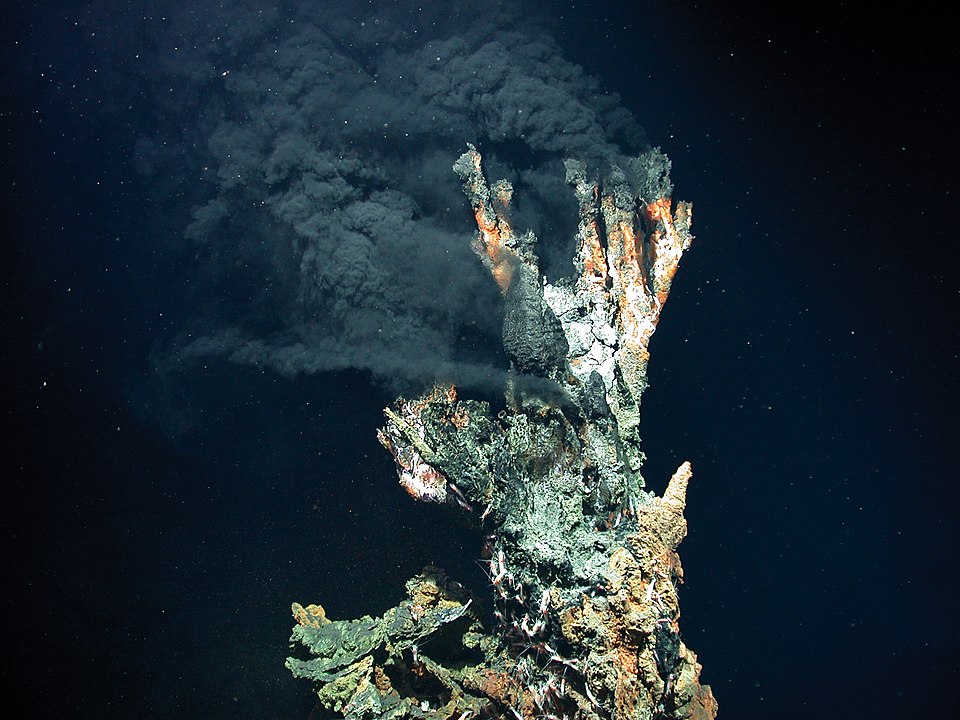

Black smokers are the highest-temperature vents, discharging fluid at 350 to 405 °C through chimneys composed primarily of metal sulfide minerals. When the superheated, acidic, metal-laden vent fluid exits the chimney and contacts the near-freezing (2 °C), alkaline ambient seawater, the dissolved metals precipitate instantaneously as fine-grained sulfide particles, producing an opaque, dark plume that resembles billowing smoke.2, 3 The principal minerals in black smoker chimneys include pyrite (FeS2), chalcopyrite (CuFeS2), sphalerite (ZnS), and pyrrhotite (Fe1-xS), often accompanied by anhydrite (CaSO4) in the outer walls of the chimney.4, 10
Rachel Haymon's detailed study of chimney growth, published in 1983, revealed that black smoker chimneys develop through two major stages. In the initial stage, a porous anhydrite-dominated wall forms when calcium and sulfate from the ambient seawater precipitate around the hot fluid conduit. As the chimney wall thickens and becomes less permeable, the interior is progressively sealed from the surrounding ocean, allowing temperatures inside the chimney to rise. Metal sulfides then replace the anhydrite from the inside outward, producing a mineralogically zoned structure with a copper-rich interior (chalcopyrite and cubanite) grading to a zinc-rich exterior (sphalerite and wurtzite).4 Individual chimney structures can grow at rates of several centimetres per day and may reach heights of 10 metres or more before becoming unstable and toppling, after which new chimneys rapidly grow in their place.
White smokers emit lower-temperature fluids, typically 100 to 300 °C, that have a different chemical composition from black smoker fluids. These fluids may represent black smoker fluids that have cooled and undergone subsurface mixing with ambient seawater before reaching the surface, precipitating much of their dissolved metal sulfide content below the seafloor and emerging enriched in lighter-coloured minerals such as anhydrite, barite (BaSO4), and amorphous silica.3, 10 White smoker chimneys are typically smaller and more delicate than their black smoker counterparts. Between focused high-temperature vents, extensive areas of the seafloor surrounding vent fields emit lower-temperature diffuse flow — warm, shimmering water at 5 to 50 °C seeping through cracks and biological mats — which may account for a significant fraction of the total hydrothermal heat output at a vent field.9
Comparison of black smoker and white smoker characteristics3, 10
| Feature | Black smokers | White smokers |
|---|---|---|
| Fluid temperature | 350–405 °C | 100–300 °C |
| Fluid pH | ~3–4 (strongly acidic) | ~5–6 (mildly acidic) |
| Plume colour | Black (metal sulfide particles) | White (silica, anhydrite, barite) |
| Dominant minerals | Pyrite, chalcopyrite, sphalerite | Anhydrite, barite, amorphous silica |
| Chimney height | Up to 10+ metres | Generally <5 metres |
| Metal content | High (Fe, Cu, Zn, Mn) | Lower (metals precipitated subsurface) |
Vent fluid chemistry and temperature gradients
The chemistry of hydrothermal vent fluids reflects the extent and nature of water-rock interaction during the passage of seawater through hot oceanic crust. Karen Von Damm's landmark 1990 review established the systematic chemical signatures that distinguish vent fluids from ambient seawater and demonstrated that fluid chemistry varies predictably with temperature, host-rock composition, and the depth and duration of circulation.3
The most characteristic chemical change is the near-complete removal of magnesium from the circulating fluid. Seawater contains approximately 53 millimoles per kilogram of dissolved magnesium, but this is quantitatively consumed by reactions with basalt at temperatures above about 150 °C, forming secondary magnesium-silicate and magnesium-hydroxide minerals in the rock. The depletion of magnesium to effectively zero in end-member vent fluids is so reliable that it serves as the standard tracer for identifying pure hydrothermal fluid and calculating the degree of subsurface mixing with ambient seawater in lower-temperature samples.3 Seawater sulfate (~28 mmol/kg) is similarly removed, partly by precipitation as anhydrite at temperatures above 150 °C and partly by reduction to hydrogen sulfide (H2S) through reaction with ferrous iron in the basalt.
In exchange, the fluid gains dissolved metals at concentrations orders of magnitude higher than ambient seawater. Iron concentrations in black smoker fluids typically range from 0.1 to 25 millimoles per kilogram, compared with less than one nanomole per kilogram in normal seawater — an enrichment of six to ten orders of magnitude. Manganese, copper, and zinc are similarly enriched, leached from primary basaltic minerals during high-temperature alteration.3, 10 The fluid also becomes enriched in dissolved silica, hydrogen sulfide, hydrogen gas, and helium-3 (a primordial isotope trapped in the mantle), while the pH drops from seawater values of approximately 8 to strongly acidic values of 3 to 4.3
Temperature exerts a first-order control on fluid chemistry. Below about 150 °C, water-rock reactions are sluggish and produce fluids only modestly different from seawater. Between 150 and 250 °C, anhydrite precipitation and the onset of magnesium removal begin to alter the fluid significantly. Above 350 °C, the most aggressive leaching of metals from basalt occurs, and the fluid approaches the chemical composition characteristic of end-member black smoker discharge.3, 9 The thermal gradient between the superheated vent fluid and the 2 °C ambient seawater creates an extreme mixing zone at the vent orifice — a temperature drop of more than 300 °C occurring over a distance of centimetres — which drives the rapid mineral precipitation that builds chimney structures and supports the chemosynthetic microbial communities that colonise the interface.
Chemosynthetic ecosystems
The biological communities discovered at hydrothermal vents represent one of the most profound findings in the history of biology: complex, productive ecosystems sustained entirely by chemical energy rather than sunlight. At the base of these food webs are chemosynthetic bacteria and archaea that derive metabolic energy from the oxidation of reduced chemical compounds — principally hydrogen sulfide (H2S), but also hydrogen gas (H2) and methane (CH4) — dissolved in the vent fluids. These microorganisms use the energy released by these oxidation reactions to fix inorganic carbon (CO2) into organic matter, a process analogous to photosynthesis but powered by chemical rather than light energy.7
_(Ifremer_00568-67973_-_32842).jpg)
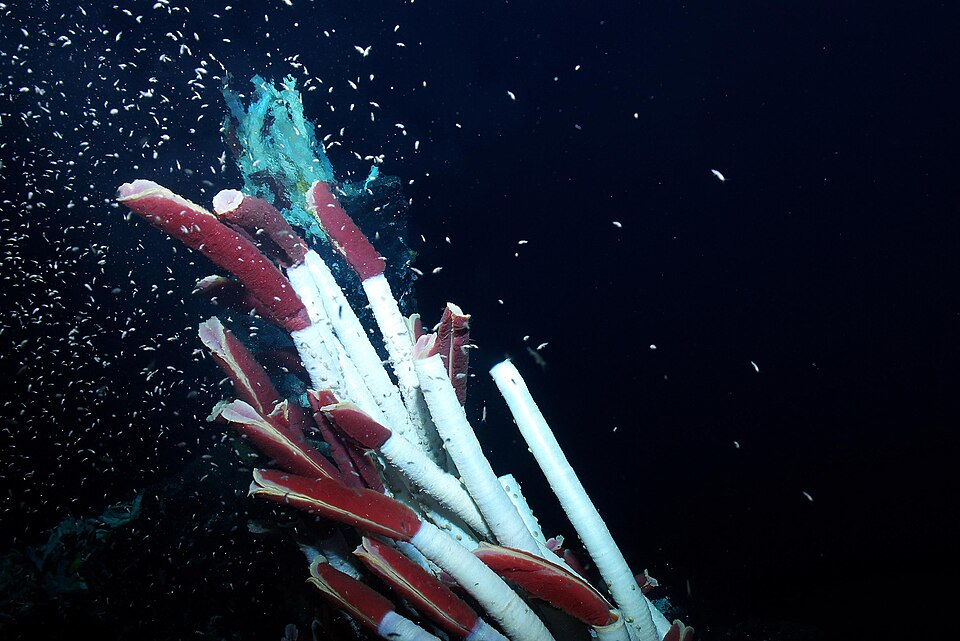
The most iconic organism of hydrothermal vent ecosystems is the giant tube worm Riftia pachyptila, which can grow to lengths exceeding 1.5 metres and forms dense thickets around active vents on the East Pacific Rise. Riftia lacks a mouth, gut, and anus; it is nourished entirely by billions of intracellular chemosynthetic bacteria housed in a specialised organ called the trophosome. In a landmark 1981 study, Colleen Cavanaugh demonstrated that the trophosome cells of Riftia contained dense populations of sulfur-oxidising prokaryotes, establishing the first confirmed case of chemoautotrophic endosymbiosis.8 The worm delivers hydrogen sulfide and oxygen to its bacterial symbionts via a specialised haemoglobin capable of binding both gases simultaneously — an adaptation unique among known haemoglobins — and receives organic carbon synthesised by the bacteria in return.14
Beyond tube worms, vent ecosystems support a remarkable diversity of organisms adapted to these extreme environments. Giant clams of the genus Calyptogena and bathymodioline mussels (Bathymodiolus) harbour chemosynthetic endosymbionts in their gills and can reach shell lengths of 20 to 30 centimetres. Vent shrimp of the genus Rimicaris, dominant at many Mid-Atlantic Ridge vent sites, carry dense bacterial colonies on their gill chambers and possess a novel photoreceptor organ on their carapace, hypothesised to detect the faint thermal radiation emitted by black smokers.14 Polychaete worms, limpets, amphipods, and crabs fill additional ecological niches. Free-living bacterial and archaeal mats blanket rocks near diffuse flow areas, providing food for grazers. The overall biomass at active vent sites can reach 10 to 500 times the levels found on the surrounding abyssal seafloor, making vent fields biological oases in the deep ocean.7, 14
Vent ecosystems are ephemeral on geological timescales. Individual vent fields may remain active for decades to thousands of years, but as tectonic processes shift the locus of magmatic heat, vents wane and new ones open. The organisms that inhabit vents must therefore be capable of dispersing larvae through the deep ocean to colonise newly active sites, a biogeographic challenge that has shaped their reproductive biology and distribution patterns.14
Role in ocean chemistry
Hydrothermal circulation at mid-ocean ridges constitutes a major geochemical flux between the solid Earth and the ocean, profoundly influencing the chemical composition of seawater over geological time. Henry Elderfield and Adam Schultz estimated in 1996 that the total hydrothermal heat flux from mid-ocean ridges is approximately 2 to 4 terawatts (1012 W) from axial high-temperature systems alone, with the total including lower-temperature off-axis circulation reaching perhaps 9 ± 2 terawatts — a significant fraction of the total oceanic heat budget.9
The chemical exchange associated with this enormous fluid flux operates in both directions. Hydrothermal circulation removes magnesium and sulfate from seawater, incorporating them into secondary minerals within the altered oceanic crust. At the same time, it adds iron, manganese, lithium, rubidium, helium-3, hydrogen sulfide, and dissolved silica to the ocean in quantities that constitute a first-order term in the oceanic budget of these elements.9 The hydrothermal flux of dissolved iron, for example, is now recognised as a significant contributor to the global oceanic iron budget, with iron from vent plumes transported thousands of kilometres from its source in some ocean basins, potentially influencing biological productivity in iron-limited surface waters.9
The rate at which seawater cycles through mid-ocean ridge hydrothermal systems is remarkable. Estimates based on geophysical heat-flow measurements and geochemical mass-balance calculations suggest that the entire volume of the world's oceans passes through mid-ocean ridge hydrothermal systems every approximately 10 to 20 million years.9 Over geological timescales, this cycling rate is sufficient to buffer the concentrations of several major and trace elements in seawater, making hydrothermal processes a fundamental control on ocean chemistry alongside continental weathering and river input. The recognition of hydrothermal fluxes as a major term in global geochemical cycles was a significant advance of the 1980s and 1990s, enabled by direct sampling of vent fluids and plume chemistry following the discovery of black smokers.3, 9
Volcanogenic massive sulfide deposits
The mineral deposits formed at modern hydrothermal vents are the present-day equivalents of volcanogenic massive sulfide (VMS) deposits, one of the world's most important classes of metal ore. VMS deposits are stratiform accumulations of sulfide minerals — primarily pyrite, chalcopyrite, sphalerite, and galena — that form on and immediately beneath the seafloor through the discharge and subsurface mixing of metal-laden hydrothermal fluids. When preserved in the geological record by burial under subsequent volcanic and sedimentary sequences, these deposits become economically valuable sources of copper, zinc, lead, gold, and silver.11
Ancient VMS deposits have been mined for centuries. The Rio Tinto mines of southwestern Spain, exploited since at least Phoenician times, are hosted in Carboniferous-age massive sulfide deposits formed at an ancient seafloor hydrothermal system. The copper mines of Cyprus, whose name derives from the Latin aes cyprium (metal of Cyprus), are hosted in the Troodos ophiolite, a fragment of Cretaceous oceanic crust in which the VMS deposits formed at an ancient mid-ocean ridge or back-arc spreading centre.11 Major VMS mining districts exist in Canada (the Abitibi greenstone belt of Ontario and Quebec, the Bathurst camp of New Brunswick), Australia (the Mount Read Volcanics of Tasmania), Japan, and Scandinavia. These deposits collectively represent billions of tonnes of sulfide ore and have produced a substantial fraction of the world's historical copper and zinc output.11
On the modern seafloor, Hannington and colleagues estimated in 2011 that the total accumulation of massive sulfide in the easily accessible neovolcanic zones of mid-ocean ridges, back-arc basins, and submarine volcanic arcs amounts to approximately 600 million tonnes, containing roughly 30 million tonnes of copper and zinc combined.12 More than 300 sites of high-temperature hydrothermal venting have been identified since the discovery of black smokers, but significant massive sulfide accumulation has been found at only a fraction of these. Models based on plume surveys and deposit occurrence rates suggest that the total number of vent fields on the global ocean floor may range from 500 to 5,000, many of them yet to be discovered.12
Estimated global seafloor massive sulfide tonnage by tectonic setting12
Lost City and alkaline hydrothermal vents
In December 2000, a research expedition to the Mid-Atlantic Ridge discovered a hydrothermal field unlike any previously known. Located at 30° N on the Atlantis Massif, approximately 15 kilometres from the ridge axis, the Lost City hydrothermal field is driven not by magmatic heat but by the exothermic chemical reaction of seawater with exposed mantle peridotite in a process called serpentinisation.5 When olivine and pyroxene in the ultramafic mantle rock react with water, they produce serpentine minerals, magnetite, and substantial quantities of hydrogen gas and heat. The resulting hydrothermal fluids are warm (40 to 91 °C), highly alkaline (pH 9 to 11), and rich in dissolved hydrogen, methane, and small organic molecules — a chemical environment radically different from the hot, acidic, metal-laden fluids of black smoker systems.5
The mineral chimneys at Lost City are composed principally of carbonate minerals (aragonite and calcite) and brucite (Mg(OH)2), rather than the metal sulfides of black smokers. Some of these carbonate towers reach extraordinary heights; the tallest documented chimney, named Poseidon, stands approximately 60 metres tall, making it far larger than any black smoker chimney.5 The biological communities at Lost City are dominated by archaea rather than bacteria: dense biofilms of methanogenic archaea (which produce methane from hydrogen and CO2) and methane-oxidising archaea colonise the porous carbonate structures. Bacteria oxidising hydrogen and sulfur are also present, but the overall ecosystem is sustained primarily by hydrogen and methane rather than hydrogen sulfide.5, 6
The discovery of Lost City had profound implications for origin-of-life research. Michael Russell and Allan Hall had proposed as early as 1997 that life originated at submarine alkaline hydrothermal vents, where the chemical and thermal gradients between warm, alkaline, hydrogen-rich vent fluid and the cooler, mildly acidic early ocean could have provided both the energy and the compartmentalisation necessary for prebiotic chemistry.13 In their model, naturally occurring iron-sulfide membranes forming at the interface between the two fluids acted as proto-cell walls and catalytic surfaces, concentrating reactants and driving the synthesis of organic molecules. The subsequent discovery that Lost City provides exactly the conditions Russell and Hall had predicted — alkaline, hydrogen-rich fluids interfacing with ocean water across mineral membranes — lent substantial empirical support to the alkaline hydrothermal vent hypothesis for the origin of life.6, 13
William Martin and colleagues argued in 2008 that alkaline vents present striking parallels to the core energy metabolism of modern cells. The proton gradient across the vent-ocean interface resembles the proton-motive force that drives ATP synthesis in all living cells, and the chemical reactions at alkaline vents — the reduction of CO2 by H2 to produce organic molecules — mirror the acetyl-CoA pathway used by the most ancient lineages of bacteria and archaea.6 While the origin of life remains an open question with multiple competing hypotheses, the alkaline hydrothermal vent model has become one of the leading frameworks in the field, and sites like Lost City serve as natural laboratories for testing its predictions.
Global distribution and diversity of vent fields
Since the initial discoveries of the late 1970s, hydrothermal vents have been identified along mid-ocean ridges in every major ocean basin, as well as in back-arc basins, on submarine volcanic arcs, and at intraplate volcanic centres. Edward Baker and Christopher German compiled global survey data in 2004 showing that the frequency of hydrothermal venting along mid-ocean ridges scales with magma supply, which in turn correlates with spreading rate.16 Fast-spreading ridges such as the East Pacific Rise, where robust and nearly continuous magma chambers lie at shallow depths, host the greatest density of vent fields. Slow-spreading ridges such as the Mid-Atlantic Ridge have fewer vent fields but can host exceptionally large and long-lived systems, including the TAG (Trans-Atlantic Geotraverse) and Rainbow vent fields, some of which have been active for tens of thousands of years.11, 16
Ultraslow-spreading ridges, once thought to be too magma-poor to support hydrothermal activity, have also yielded vent discoveries. Expeditions to the Arctic Gakkel Ridge and the Southwest Indian Ridge found active venting despite spreading rates of less than 20 millimetres per year, demonstrating that even minimal magmatic heat can drive hydrothermal circulation where tectonic faulting provides sufficient permeability.16 The diversity of tectonic settings hosting hydrothermal vents continues to expand. Submarine calderas, such as Brothers Volcano on the Kermadec Arc north of New Zealand, and sedimented ridges, such as the Guaymas Basin in the Gulf of California, host chemically distinctive vent systems whose fluid compositions reflect interaction with different host rocks and sedimentary material.11
The biological communities at vent sites also vary geographically in ways that reflect the evolutionary history and dispersal limitations of vent-endemic species. Biogeographic provinces have been delineated for the global vent fauna, with distinct species assemblages on the East Pacific Rise, the Mid-Atlantic Ridge, the western Pacific back-arc basins, and the Indian Ocean ridges.14 Giant tube worms of the family Siboglinidae dominate Pacific vent communities, whereas Rimicaris shrimp are the signature organisms of Atlantic vent sites. These biogeographic patterns reflect the physical barriers to larval dispersal — transform faults, continental landmasses, and the vast abyssal distances between vent fields — and the geological history of the ocean basins in which the vent lineages evolved.14
Deep-sea mining controversies
The mineral wealth concentrated at hydrothermal vent sites — polymetallic sulfide deposits rich in copper, zinc, gold, and silver — has attracted increasing commercial interest in deep-sea mining. As terrestrial ore grades decline and global demand for metals rises, several nations and private companies have explored the feasibility of extracting seafloor massive sulfide deposits from both active and inactive vent fields. The International Seabed Authority (ISA), established under the United Nations Convention on the Law of the Sea, has issued exploration contracts for polymetallic sulfide deposits in international waters, and national licensing has proceeded in the exclusive economic zones of countries including Papua New Guinea, Tonga, and New Zealand.15
The prospect of mining hydrothermal vent sites has generated substantial scientific concern. Active vent fields support unique chemosynthetic ecosystems with high rates of species endemism — many vent species are known from only one or a few vent fields globally — and the physical destruction of chimney structures and surrounding habitat by mining equipment would eliminate both the geological substrate and the biological communities it supports. Recovery of vent ecosystems after disturbance is uncertain; while new chimneys can regrow relatively quickly at active vents, the recolonisation of vent fauna depends on larval supply from other active sites, which may be separated by hundreds or thousands of kilometres of abyssal seafloor.14, 15
Cindy Van Dover and an international team of scientists argued in 2018 that active hydrothermal vent ecosystems should be excluded from mineral extraction on the basis of their unique biological value, the limited mineral resource they represent relative to inactive deposits, and the international legal obligations for environmental protection under the UN Convention on the Law of the Sea and the Convention on Biological Diversity.15 They noted that the non-extractive values of active vents — as sites of fundamental scientific discovery, as natural laboratories for studying extremophile biology and prebiotic chemistry, and as ecosystems with intrinsic conservation value — substantially outweigh the relatively modest mineral tonnage available at any individual active vent field. Mining of inactive vent deposits, where hydrothermal activity has ceased and the chemosynthetic communities have died off, presents a different set of environmental considerations, though sediment plumes generated by extraction could still affect neighbouring ecosystems over wide areas.15
As of the mid-2020s, no commercial-scale mining of seafloor massive sulfide deposits has commenced, though pilot extraction tests have been conducted. The regulatory framework being developed by the ISA remains a subject of intense debate among member states, scientists, environmental organisations, and industry, with fundamental disagreements over whether adequate environmental protections can be implemented for an activity whose ecological consequences in the deep ocean remain poorly understood.15
Significance for Earth science
The discovery and study of hydrothermal vents has transformed multiple fields of Earth and life science. In geology and geochemistry, the recognition that hydrothermal circulation at mid-ocean ridges is a first-order control on ocean chemistry resolved long-standing imbalances in elemental budgets for the ocean and provided a unifying explanation for the formation of volcanogenic massive sulfide ore deposits spanning more than three billion years of Earth history.9, 11 In biology, the discovery of chemosynthetic ecosystems fundamentally expanded the known limits of life, demonstrating that complex ecological communities can thrive without any input from solar energy and leading to the identification of new extremophile organisms — hyperthermophilic archaea and bacteria capable of growth at temperatures exceeding 100 °C — that reshaped understanding of the tree of life and the thermal limits of biological function.7, 14
In astrobiology, hydrothermal vent systems have become central to the search for life beyond Earth. The subsurface oceans of Jupiter's moon Europa and Saturn's moon Enceladus are believed to be in contact with rocky mantles where serpentinisation-driven hydrothermal activity analogous to Lost City could provide the energy, chemical gradients, and organic chemistry necessary to support microbial life.6 The Cassini spacecraft's detection of hydrogen gas, silica nanoparticles, and simple organic molecules in the plumes of Enceladus has been interpreted as evidence for active hydrothermal venting on that moon's ocean floor, making the study of terrestrial hydrothermal vent systems directly relevant to the design and interpretation of future missions to the outer solar system.6
Perhaps most profoundly, the alkaline hydrothermal vent hypothesis for the origin of life has placed vent systems at the centre of one of science's deepest questions: how non-living chemistry gave rise to the first living cells on the early Earth. The chemical and energetic parallels between alkaline vent environments and the core metabolism of the most ancient microbial lineages suggest that life may have emerged not in a warm surface pond struck by lightning, as earlier hypotheses proposed, but in the dark, hydrogen-rich, mineral-walled chambers of an ancient submarine vent — a setting that continues to operate on the modern seafloor and may operate on other worlds as well.6, 13
References
Prokaryotic cells in the hydrothermal vent tube worm Riftia pachyptila Jones: possible chemoautotrophic symbionts
The emergence of life from iron monosulphide bubbles at a submarine hydrothermal redox and pH front
Scientific rationale and international obligations for protection of active hydrothermal vent ecosystems from deep-sea mining