Overview
- A mineral is a naturally occurring, inorganic solid with a definite chemical composition and an ordered atomic structure, and the approximately 6,000 known mineral species arise from the systematic ways atoms pack together under varying conditions of temperature, pressure, and chemical availability.
- Crystallography — the study of how atoms arrange themselves into repeating three-dimensional lattices — underpins all of mineralogy, and the 230 space groups derived from symmetry theory describe every possible way atoms can be arranged in a crystal, a framework confirmed experimentally by X-ray diffraction since 1912.
- Silicate minerals, built on the SiO₄ tetrahedron, constitute over 90 percent of Earth's crust by volume and are the principal building blocks of igneous, sedimentary, and metamorphic rocks, making their crystal chemistry fundamental to understanding the rock cycle, plate tectonics, and planetary evolution.
Minerals are the fundamental building blocks of rocks and, by extension, of the solid Earth itself. A mineral is defined as a naturally occurring, inorganic solid that possesses a definite (but not necessarily fixed) chemical composition and a characteristic internal arrangement of atoms — a crystal structure.1 This definition, formalized by the International Mineralogical Association, distinguishes minerals from synthetic compounds, biological materials such as bone and shell (though these may contain mineral phases), glasses that lack long-range atomic order, and liquids such as water and mercury at room temperature.18 As of 2024, the IMA recognizes approximately 6,000 distinct mineral species, with 30 to 50 new species approved each year, though a small number of minerals — perhaps two dozen — make up the overwhelming majority of the rocks exposed at Earth's surface.22, 16
Crystallography, the science of crystal structure, provides the theoretical and experimental framework for understanding why minerals have the compositions and properties they do. By determining how atoms pack into three-dimensional repeating arrays, crystallography explains why diamond and graphite, both pure carbon, have utterly different hardnesses, why quartz grows in hexagonal prisms, and why the same chemical compound can form multiple minerals depending on the pressure and temperature conditions under which it crystallizes.4, 14
What defines a mineral
The formal definition of a mineral rests on five criteria, each of which must be satisfied: the substance must be naturally occurring, inorganic, solid under normal conditions, possess a definite chemical composition, and have an ordered atomic arrangement (a crystal structure).1 The requirement for natural occurrence excludes laboratory-synthesized compounds, even if they are structurally identical to known minerals. The inorganic criterion has been somewhat loosened in modern practice — some organic crystals formed by geological processes, such as whewellite (calcium oxalate) found in hydrothermal veins, are accepted as minerals — but biological secretions such as bone apatite and mollusc aragonite are classified as biominerals rather than minerals in the strict sense.14
The requirement for a definite chemical composition does not mean that a mineral must have a single fixed formula. Most minerals are solid solutions in which one element substitutes for another within the crystal structure. Olivine, for example, ranges continuously in composition between the magnesium end-member forsterite (Mg2SiO4) and the iron end-member fayalite (Fe2SiO4), because Mg2+ and Fe2+ have similar ionic radii and charges and can freely replace one another in the crystal lattice.1, 14 The composition must, however, be expressible as a chemical formula, even if that formula contains variable proportions of certain elements.
The final criterion — an ordered atomic arrangement — is what distinguishes a mineral from a mineraloid, an amorphous or poorly crystalline natural substance that otherwise resembles a mineral. Volcanic glass (obsidian), opal (hydrated silica with only short-range order), and jet (fossilized wood) are mineraloids because their atoms do not form the periodic three-dimensional lattice that defines a crystal.1
Crystal systems and symmetry
The internal atomic order of a mineral is described by its crystal structure, the three-dimensional pattern in which its constituent atoms, ions, or molecules are arranged. This pattern repeats in space, and the smallest repeating unit is called the unit cell. The geometry of the unit cell — its edge lengths and the angles between its edges — determines the crystal system to which a mineral belongs. There are seven crystal systems, defined by their characteristic symmetry elements, ranging from the highly symmetric cubic (isometric) system, in which all three axes are equal and mutually perpendicular, to the triclinic system, in which no axes are equal and no angles are 90 degrees.4, 1
Within these seven systems, the combination of rotational symmetry axes, mirror planes, and inversion centres produces 32 possible point groups (also called crystal classes), which describe the external symmetry that a macroscopic crystal can exhibit. When translational symmetry elements — glide planes and screw axes — are added to account for the repeating nature of the lattice, the 32 point groups expand into 230 space groups, which describe every mathematically possible arrangement of atoms in a three-dimensional periodic lattice.4 This derivation, completed independently by Fedorov, Schoenflies, and Barlow in the 1890s, was a triumph of mathematical crystallography that preceded experimental confirmation by two decades.4
The experimental breakthrough came in 1912, when Max von Laue, Walter Friedrich, and Paul Knipping demonstrated that crystals diffract X-rays, producing interference patterns whose geometry reflects the internal atomic arrangement of the crystal.2 The following year, William Henry Bragg and William Lawrence Bragg showed that the relationship between the X-ray wavelength, the spacing between atomic planes in the crystal, and the angle of diffraction could be described by a simple equation now known as Bragg's law (nλ = 2d sinθ), enabling the direct determination of crystal structures from diffraction data.3 X-ray diffraction remains the definitive method for identifying minerals and solving crystal structures, and the Braggs' work earned them the Nobel Prize in Physics in 1915.
| Crystal system | Axes | Angles | Common minerals |
|---|---|---|---|
| Cubic (isometric) | a = b = c | α = β = γ = 90° | Diamond, halite, garnet, pyrite |
| Tetragonal | a = b ≠ c | α = β = γ = 90° | Zircon, rutile, cassiterite |
| Orthorhombic | a ≠ b ≠ c | α = β = γ = 90° | Olivine, topaz, aragonite |
| Hexagonal | a = b ≠ c | α = β = 90°, γ = 120° | Quartz, beryl, apatite |
| Trigonal | a = b ≠ c | α = β = 90°, γ = 120° | Calcite, dolomite, corundum |
| Monoclinic | a ≠ b ≠ c | α = γ = 90°, β ≠ 90° | Orthoclase, gypsum, augite |
| Triclinic | a ≠ b ≠ c | α ≠ β ≠ γ ≠ 90° | Plagioclase feldspar, kyanite |
Physical properties and identification
Because a mineral's physical properties are direct consequences of its crystal structure and chemical composition, those properties serve as diagnostic tools for identification. The most commonly assessed properties include hardness, cleavage, fracture, lustre, colour, streak, specific gravity, and crystal habit.1, 20


Hardness measures a mineral's resistance to scratching and is quantified using the Mohs scale, a relative ranking devised by the German mineralogist Friedrich Mohs in 1822. The scale assigns integers from 1 (talc, the softest) to 10 (diamond, the hardest), where each mineral can scratch those below it and is scratched by those above it.13 Hardness reflects the strength and density of chemical bonds in the crystal structure: diamond, in which every carbon atom is bonded to four neighbours in a rigid tetrahedral network, is the hardest known natural substance, whereas talc, a phyllosilicate in which layers are held together only by weak van der Waals forces, is so soft it can be scratched with a fingernail.1, 13
Cleavage is the tendency of a mineral to break along specific crystallographic planes where bonding is weakest. Mica cleaves into thin, flexible sheets because its crystal structure consists of strongly bonded silicate layers separated by planes of weakly bonded potassium ions. Halite (NaCl) cleaves in three mutually perpendicular directions, producing cubic fragments, because the Na-Cl bonds are equally strong in all three dimensions of the cubic lattice but are weakest along the {100} planes.1 Minerals that lack well-defined planes of weakness break along irregular surfaces described as fracture; quartz, for instance, exhibits conchoidal (shell-shaped) fracture because its three-dimensional framework of Si-O bonds has approximately equal strength in all directions.14
Lustre describes how light interacts with a mineral's surface and is classified as metallic (like pyrite or galena), vitreous (like quartz), adamantine (like diamond), pearly, silky, or earthy, among other terms.1 Colour, while often the most immediately striking property, is frequently an unreliable diagnostic tool because trace impurities can produce dramatic colour variations in a single mineral species: corundum (Al2O3) is colourless when pure, red when trace chromium substitutes for aluminium (ruby), and blue when iron and titanium are present (sapphire).14 Streak, the colour of a mineral's powder produced by dragging it across an unglazed porcelain plate, is more reliable because it eliminates the effects of surface reflection and large-scale crystal imperfections.1
For definitive identification beyond hand-specimen observation, mineralogists employ optical microscopy using thin sections (slices of rock ground to a standard thickness of 30 micrometres) viewed in transmitted or reflected polarized light.19 The optical properties of minerals — refractive index, birefringence, extinction angle, and interference figure — are direct expressions of crystal symmetry and composition and allow identification of minerals too small or too intergrown to assess by hand. X-ray diffraction, electron microprobe analysis, and Raman spectroscopy provide further precision for research-level identification and compositional analysis.14, 20
Mineral classification
The modern classification of minerals is based primarily on chemical composition, specifically on the dominant anion or anionic group in the mineral's formula. This approach, developed by James Dwight Dana in the mid-nineteenth century and refined by Hugo Strunz in the twentieth, organizes minerals into classes that reflect fundamental differences in bonding, crystal chemistry, and geological occurrence.21, 15 The major classes, in the Strunz-Dana system, include native elements, sulfides, oxides and hydroxides, halides, carbonates, sulfates, phosphates, and silicates, along with several smaller groups.15
Native elements are minerals composed of a single element, such as gold (Au), silver (Ag), copper (Cu), sulfur (S), and the carbon polymorphs diamond and graphite.1 Sulfides, in which metals bond with sulfur, include many of the world's most economically important ore minerals: galena (PbS), sphalerite (ZnS), chalcopyrite (CuFeS2), and pyrite (FeS2).9 Oxides, in which metals bond with oxygen, include hematite (Fe2O3), magnetite (Fe3O4), and corundum (Al2O3).1 Carbonates, built around the planar CO32− group, include calcite (CaCO3) and dolomite (CaMg(CO3)2), which together form the bulk of the rock cycle's sedimentary limestone and dolostone.1, 14
By far the most abundant and geologically significant class is the silicates, which constitute over 90 percent of the minerals in Earth's crust by volume.5 Because of their importance, silicates are discussed in detail in the following section.
Silicate minerals and the SiO₄ tetrahedron

The fundamental structural unit of all silicate minerals is the silicon-oxygen tetrahedron (SiO4)4−, in which a central silicon atom is bonded to four oxygen atoms arranged at the corners of a tetrahedron. This unit is extraordinarily stable because the Si-O bond is among the strongest in geochemistry, with a bond energy of approximately 452 kilojoules per mole, and because the small, highly charged Si4+ ion fits neatly into the tetrahedral void between four oxygen anions.6, 14
The vast diversity of silicate minerals arises from the different ways in which SiO4 tetrahedra link together by sharing oxygen atoms at their corners, a process called polymerization. The degree of polymerization provides the basis for the structural classification of silicates into six major groups.6
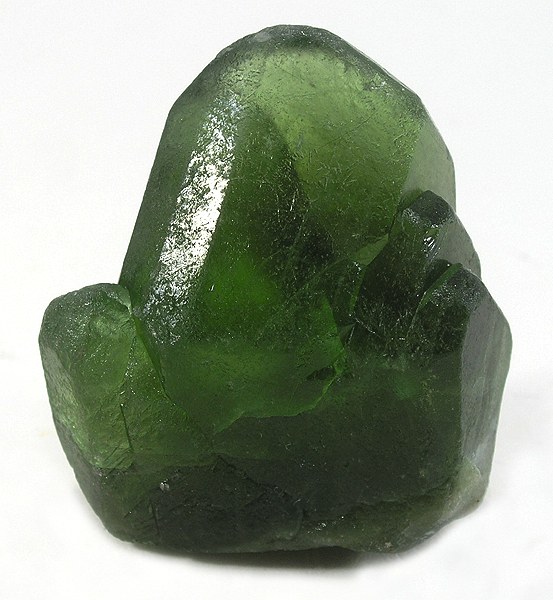
Nesosilicates (island silicates) contain isolated SiO4 tetrahedra that share no oxygen atoms with neighbouring tetrahedra, linked instead through intervening cations. Olivine ((Mg,Fe)2SiO4) and garnet are characteristic nesosilicates. Because every oxygen is bonded to both silicon and a metal cation, nesosilicates tend to be dense and hard, and olivine is the dominant mineral of the upper mantle.6, 14
Sorosilicates (double island silicates) contain pairs of tetrahedra sharing one bridging oxygen, producing the Si2O7 group. Epidote is the best-known sorosilicate and is common in metamorphic rocks.6 Cyclosilicates (ring silicates) contain tetrahedra linked into rings of three, four, or six units. Beryl (Be3Al2Si6O18), the mineral species that includes emerald and aquamarine, is a six-membered ring silicate, and tourmaline is built on a three-membered ring.1, 6
Inosilicates (chain silicates) contain tetrahedra linked into continuous chains. Single-chain inosilicates, in which each tetrahedron shares two of its four oxygens with neighbours, form the pyroxene group (e.g., augite, enstatite), with a silicon-to-oxygen ratio of SiO3. Double-chain inosilicates, in which alternating tetrahedra share two and three oxygens, form the amphibole group (e.g., hornblende, tremolite), with a ratio of Si4O11. Pyroxenes and amphiboles are the principal dark-coloured (mafic) minerals in igneous and metamorphic rocks and are important constituents of Earth's internal structure at mantle depths.6, 7
Phyllosilicates (sheet silicates) contain tetrahedra linked into continuous two-dimensional sheets in which each tetrahedron shares three of its four oxygens. The resulting sheets have a silicon-to-oxygen ratio of Si2O5 and are bonded to octahedral layers of aluminium, magnesium, or iron hydroxide to produce layered structures. The micas (muscovite, biotite), the clay minerals (kaolinite, montmorillonite, illite), talc, and serpentine are all phyllosilicates.6, 8 The sheet structure explains the perfect basal cleavage of mica and the platy habit and swelling behaviour of clay minerals, properties that have enormous practical consequences for soil science, engineering geology, and the ceramic industry.8
Tectosilicates (framework silicates) contain tetrahedra in which every oxygen is shared between two silicon atoms, producing a fully three-dimensional framework with the formula SiO2. Quartz, the second most abundant mineral in the continental crust, is the archetypal tectosilicate. When aluminium substitutes for some silicon in the framework, a charge deficit is created that is balanced by the incorporation of large cations such as potassium, sodium, or calcium, producing the feldspar group — the single most abundant mineral group in the crust, comprising roughly 50 percent of crustal rocks by volume.5, 14 The feldspathoids (nepheline, leucite) and the zeolites, prized for their open frameworks and ion-exchange properties, are also tectosilicates.6
Estimated volume proportions of major mineral groups in the continental crust5, 16
Polymorphism and phase transitions
A single chemical compound can crystallize in more than one structural arrangement depending on the conditions of temperature and pressure, a phenomenon called polymorphism. Each distinct structural form is called a polymorph, and because the polymorphs of a compound have different crystal structures, they are classified as different mineral species despite having identical chemical formulae.10, 14
Carbon provides the most dramatic example: at low pressures, carbon crystallizes as graphite, a hexagonal phyllosilicate-like structure in which carbon atoms are arranged in strongly bonded sheets held together by weak van der Waals forces, resulting in a soft, opaque, electrically conductive material with a Mohs hardness of 1 to 2. At pressures exceeding approximately 4.5 gigapascals, carbon crystallizes as diamond, a cubic framework in which every atom is covalently bonded to four neighbours in a rigid tetrahedron, producing the hardest known natural material (Mohs 10), transparent and electrically insulating.23, 1
Silica (SiO2) is polymorphic in a geologically consequential way. At surface conditions, quartz is the stable polymorph. At elevated temperatures, quartz transforms to tridymite and then to cristobalite. At extremely high pressures, such as those found in the deep mantle or generated by meteorite impacts, SiO2 adopts the dense rutile-type structure called stishovite, in which silicon is coordinated by six oxygen atoms rather than the usual four — a transformation that increases density by approximately 46 percent.12 The discovery of stishovite in impact craters provided one of the earliest lines of evidence for shock metamorphism associated with bolide impacts.12
At the extreme pressures of the lower mantle (above 660 kilometres depth), the dominant mineral is bridgmanite, a magnesium-iron silicate perovskite (MgSiO3) that constitutes roughly 70 to 80 percent of the lower mantle by volume and is therefore the most abundant mineral in the Earth as a whole, though it is unstable at surface pressures and has never been observed in hand specimen under normal conditions.11 At pressures near the core-mantle boundary (approximately 125 gigapascals), bridgmanite transforms to a post-perovskite phase, a discovery made in 2004 that provided new insight into the seismic properties of the D″ layer at the base of the mantle.11
How minerals form
Minerals form through a variety of geological processes that can be broadly grouped into crystallization from a melt, precipitation from solution, and solid-state transformation. Each process produces characteristic mineral assemblages that record the conditions under which they formed.14, 20
Crystallization from magma is the principal mechanism by which igneous minerals form. As a body of molten silicate rock (magma) cools, minerals crystallize in a sequence governed by their melting points and the evolving composition of the remaining liquid. N. L. Bowen's reaction series, established through laboratory experiments in the early twentieth century, describes this sequence for common igneous minerals: olivine and calcium-rich plagioclase crystallize first at the highest temperatures, followed by pyroxene, amphibole, biotite, and sodium-rich plagioclase at intermediate temperatures, and finally muscovite, quartz, and potassium feldspar at the lowest temperatures.7 This sequential crystallization, combined with processes such as fractional crystallization and magma mixing, explains the compositional diversity of igneous rocks from basalt to granite.7, 20
Precipitation from aqueous solution produces evaporite minerals such as halite (NaCl) and gypsum (CaSO4·2H2O) when bodies of water evaporate, and hydrothermal minerals such as native gold, sulfide ores, and quartz veins when hot, mineral-laden fluids circulating through the crust cool and deposit their dissolved load.9, 14 Carbonate minerals, including calcite and aragonite, precipitate both inorganically and through the metabolic activity of organisms (biomineralization), forming the limestone and chalk that are major components of the sedimentary record.14
Solid-state transformation (metamorphism) occurs when pre-existing minerals are subjected to changes in temperature, pressure, or chemical environment and recrystallize into new mineral phases without passing through a liquid stage. The conversion of clay minerals to mica, of limestone to marble (recrystallized calcite), and of quartz-feldspar sandstone to quartzite are familiar examples. Metamorphic mineral assemblages are sensitive indicators of the pressure-temperature conditions experienced by a rock, and their systematic study forms the basis of metamorphic petrology.10, 20
Mineral evolution and Earth history
In 2008, Robert Hazen and colleagues introduced the concept of mineral evolution, proposing that the diversity of mineral species on Earth has increased dramatically over geological time in response to changing physical, chemical, and biological conditions at the planet's surface and interior.17

_3.jpg)
According to this framework, the earliest solids to condense from the solar nebula approximately 4.56 billion years ago comprised only about 60 mineral species, dominated by refractory oxides, silicates, and metal alloys found today in primitive meteorites (chondrites).17
The accretion and differentiation of Earth produced new environments — a metallic core, a silicate mantle, and a primitive crust — that expanded the mineral inventory to perhaps 250 species through igneous and metamorphic processes. The onset of plate tectonics and the emergence of granitic continental crust introduced further diversity by enabling hydrothermal circulation, pegmatite formation, and the concentration of rare elements in evolved magmas, raising the total to approximately 1,500 species.17
The most dramatic expansion, however, is attributed to the rise of atmospheric oxygen produced by photosynthetic cyanobacteria during the Great Oxidation Event approximately 2.4 billion years ago. Oxygen reacted with previously reduced elements at Earth's surface — iron, manganese, copper, uranium, and others — to generate thousands of new oxide, hydroxide, carbonate, and sulfate minerals that could not have existed in a reducing atmosphere.17 Hazen and colleagues estimate that roughly two-thirds of all known mineral species owe their existence, directly or indirectly, to biological processes, particularly the oxygenation of the atmosphere and the biologically mediated precipitation of carbonates and phosphates.17, 16 This perspective reframes mineralogy as an evolving planetary phenomenon intimately linked to the co-evolution of the geosphere and the biosphere.
Economic and practical significance
Minerals are the raw materials of civilization. Metallic ore minerals — including hematite and magnetite (iron), chalcopyrite (copper), galena (lead), sphalerite (zinc), and native gold — are the sources of the metals on which industrial economies depend.9 Non-metallic industrial minerals such as gypsum (for plaster and drywall), halite (for road salt and chemical feedstock), and the clay minerals kaolinite and bentonite (for ceramics, drilling fluids, and pharmaceutical applications) are equally indispensable, though less conspicuous.8, 20
Gemstones are minerals valued for their beauty, durability, and rarity, and their properties are direct expressions of crystal chemistry. The hardness of diamond (Mohs 10) and corundum (Mohs 9) makes them suitable for both jewellery and industrial cutting applications. The vivid colours of gemstones arise from the interaction of light with trace impurities or structural defects: the red of ruby results from crystal-field transitions of Cr3+ substituting for Al3+ in the corundum lattice, while the green of emerald arises from Cr3+ in the beryl structure, where the different crystal field environment shifts the absorption spectrum toward different wavelengths.14
Beyond extraction and ornamentation, minerals are increasingly important in advanced technology. Lithium-bearing minerals such as spodumene and lepidolite are critical sources of lithium for rechargeable batteries. Rare-earth-element minerals, particularly bastnaesite and monazite, provide the neodymium, dysprosium, and other rare earths essential for permanent magnets, catalytic converters, and phosphor coatings. The growing demand for these minerals has made their geological distribution and extraction a matter of geopolitical significance in the twenty-first century.20