Overview
- The rock cycle is the continuous set of processes by which Earth's three fundamental rock types — igneous, sedimentary, and metamorphic — are created, transformed into one another, and recycled through the crust and mantle over timescales ranging from thousands to billions of years.
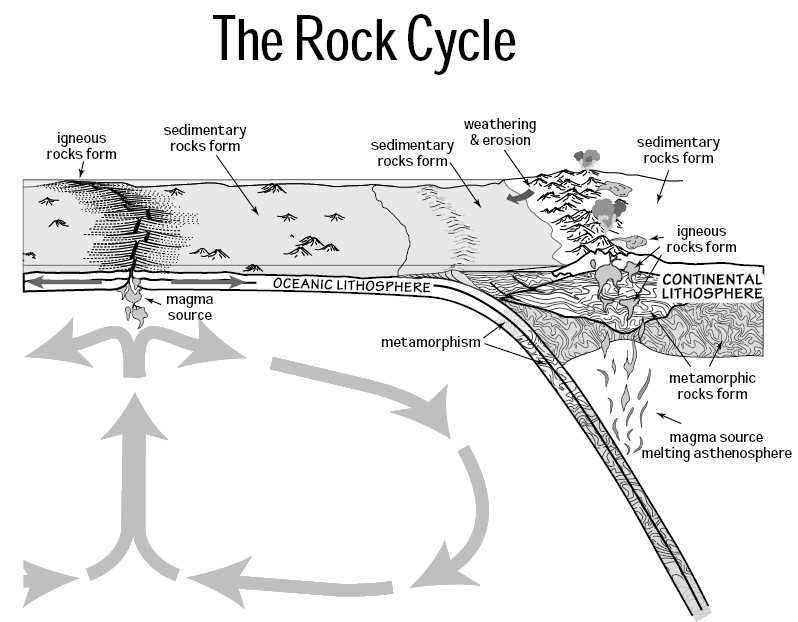
- Plate tectonics is the engine that drives the rock cycle: seafloor spreading generates new igneous crust, subduction carries rocks into the mantle where they melt or metamorphose, and mountain building exposes deep rocks to weathering and erosion at the surface.
- The rock cycle is intimately coupled to the long-term carbon cycle through silicate weathering, which draws down atmospheric CO₂ and deposits it as carbonate sediment on the seafloor, functioning as a planetary thermostat that has maintained habitable surface temperatures for over four billion years.
The rock cycle is the continuous set of geological processes by which Earth's three fundamental rock types — igneous, sedimentary, and metamorphic — are created, destroyed, and transformed into one another over time. First conceptualized by James Hutton in 1788, the rock cycle describes how rocks at the surface are broken down by weathering and erosion, transported and deposited as sediment, buried and lithified into sedimentary rock, transformed by heat and pressure into metamorphic rock, or melted to produce magma that solidifies into new igneous rock.1 Each of these transitions can proceed in multiple directions: a sedimentary rock can be metamorphosed, an igneous rock can be weathered directly into sediment, and a metamorphic rock can melt to yield magma, so the cycle is not a single fixed loop but a web of interconnected pathways operating simultaneously across the planet.
The rock cycle is driven fundamentally by two energy sources: Earth's internal heat, which powers plate tectonics, mantle convection, volcanism, and metamorphism; and solar energy, which drives the hydrological cycle responsible for weathering, erosion, and sediment transport at the surface.6, 12 The rock cycle is also intimately connected to the long-term carbon cycle, because the chemical weathering of silicate minerals consumes atmospheric carbon dioxide and ultimately deposits it as carbonate sediment on the ocean floor, while volcanic and metamorphic degassing returns carbon dioxide to the atmosphere — a feedback loop that has regulated Earth's surface temperature over billions of years.4, 5
Hutton and the original concept
The idea that rocks are not permanent but are continuously created and destroyed in a repeating cycle was first articulated by the Scottish naturalist James Hutton in his 1788 paper "Theory of the Earth," presented to the Royal Society of Edinburgh. Hutton proposed that the same processes observable in the present day — the slow weathering of exposed rock, the transport of sediment by rivers to the sea, the consolidation of sediment into new rock, and the subsequent uplift of that rock by subterranean heat — had operated throughout Earth's history, and that no fundamentally different processes were required to explain the geological past.1 This principle, later termed uniformitarianism by Charles Lyell, became the philosophical foundation of modern geology.
Hutton's key insight was cyclical: he recognized that the erosion of existing continents provided the raw material for new sedimentary rocks, which were then consolidated and uplifted to form future landmasses, which would themselves be eroded in turn. In his famous closing passage, Hutton declared that he found "no vestige of a beginning, no prospect of an end," emphasizing the indefinitely long and repetitive nature of geological processes.1 His fieldwork at Siccar Point on the Berwickshire coast, where he observed steeply tilted greywacke beds overlain by horizontal red sandstone separated by an angular unconformity, provided dramatic visual evidence that multiple cycles of deposition, lithification, uplift, erosion, and renewed deposition had occurred at a single location. While Hutton did not use the term "rock cycle," his description of the cyclical destruction and renewal of the Earth's surface constitutes the first articulation of the concept.
The three rock types
All rocks on Earth belong to one of three categories defined by their mode of formation: igneous, sedimentary, and metamorphic. The relative proportions of these types vary depending on whether one considers the entire crust by volume or only the rocks exposed at the surface. By volume, igneous and metamorphic rocks dominate the crust, with sedimentary rocks constituting only approximately 5 to 8 percent of the total crustal volume, yet sedimentary rocks cover roughly 66 percent of Earth's land surface as a thin veneer overlying the crystalline basement.18, 10

Igneous rocks form by the cooling and crystallization of molten material, either magma beneath the surface or lava erupted at the surface. Intrusive (plutonic) igneous rocks, such as granite, gabbro, and diorite, cool slowly at depth within the crust, allowing large crystals to develop. Extrusive (volcanic) igneous rocks, such as basalt, andesite, and rhyolite, cool rapidly at or near the surface, producing fine-grained or glassy textures.12 The composition of an igneous rock is determined by the chemistry of the parent magma and the conditions under which it crystallized, as described by Bowen's reaction series.
Sedimentary rocks form from the accumulation and lithification of sediment derived from the weathering and erosion of pre-existing rocks, from the precipitation of minerals from solution, or from the accumulation of biological material. Clastic sedimentary rocks such as sandstone, shale, and conglomerate consist of fragments of older rocks. Chemical sedimentary rocks such as limestone and evaporites precipitate directly from water. Organic sedimentary rocks such as coal form from accumulated plant material.22, 21 Although sedimentary rocks constitute a small fraction of the total crust by volume, they are of outsized geological importance because they preserve the fossil record, record past environments and climates, and host most of the world's petroleum, natural gas, and groundwater resources.
Metamorphic rocks form when pre-existing rocks — whether igneous, sedimentary, or previously metamorphosed — are subjected to temperatures and pressures significantly different from those under which they originally formed, causing their mineralogy and texture to change without complete melting. Common metamorphic rocks include slate (from shale), marble (from limestone), quartzite (from sandstone), schist, and gneiss.3, 12 Metamorphism occurs in a variety of tectonic settings, including convergent plate boundaries where rocks are buried to great depths, contact zones around igneous intrusions, and fault zones where intense deformation generates frictional heat.
Bowen's reaction series and igneous crystallization
The diversity of igneous rocks is governed in large part by the sequence in which minerals crystallize from a cooling magma, a relationship first systematically described by the Canadian petrologist Norman L. Bowen in his landmark 1928 work The Evolution of the Igneous Rocks. Through a series of laboratory experiments at the Carnegie Institution of Washington, Bowen demonstrated that common silicate minerals crystallize from basaltic magma in a predictable order as temperature decreases, a sequence now known as Bowen's reaction series.2
The series has two branches. The discontinuous branch describes a sequence of ferromagnesian minerals — olivine, pyroxene, amphibole, and biotite mica — in which each mineral reacts with the remaining melt at a specific temperature to produce the next mineral in the series, provided equilibrium is maintained. The continuous branch describes the plagioclase feldspars, which form a continuous solid-solution series from calcium-rich anorthite at high temperatures to sodium-rich albite at lower temperatures. As crystallization proceeds along both branches, the remaining melt becomes progressively enriched in silica, sodium, and potassium, and depleted in iron, magnesium, and calcium. The last minerals to crystallize, at the lowest temperatures, are potassium feldspar, muscovite, and quartz.2, 12
Bowen proposed that the process of fractional crystallization — in which early-formed crystals are physically separated from the melt by gravitational settling or other mechanisms before they can react with the liquid — could drive the progressive evolution of a single basaltic parent magma toward increasingly silica-rich compositions, ultimately producing granitic magma. While subsequent research has shown that the full range of igneous rock compositions cannot be explained by fractional crystallization of basalt alone, and that processes such as partial melting of the crust, magma mixing, and assimilation of country rock also play critical roles, Bowen's reaction series remains the foundational framework for understanding igneous petrology.2, 12
Bowen's reaction series: mineral crystallization sequence from basaltic magma2, 12
| Temperature range | Discontinuous branch | Continuous branch | Associated rock type |
|---|---|---|---|
| ~1200 °C | Olivine | Ca-plagioclase (anorthite) | Peridotite, gabbro |
| ~1100 °C | Pyroxene | Ca-Na plagioclase (bytownite–labradorite) | Gabbro, basalt |
| ~1000 °C | Amphibole | Na-Ca plagioclase (andesine) | Diorite, andesite |
| ~800–900 °C | Biotite | Na-plagioclase (oligoclase–albite) | Granodiorite |
| ~600–750 °C | K-feldspar, muscovite, quartz | Granite, rhyolite | |
Metamorphic facies and grade
Metamorphic rocks record the conditions of temperature and pressure under which they formed, and the systematic classification of these conditions is essential for understanding the rock cycle's subsurface pathways. In 1893, the British Geological Survey geologist George Barrow mapped a series of metamorphic zones in pelitic (clay-rich) rocks of the Scottish Highlands, defined by the progressive appearance of characteristic index minerals — chlorite, biotite, garnet, staurolite, kyanite, and sillimanite — that form at increasingly higher temperatures and pressures.3 These Barrovian zones, as they came to be known, represent a gradient of increasing metamorphic grade, from low-grade greenschist facies conditions (~300–450 °C) to high-grade amphibolite facies conditions (~550–700 °C).
In 1915 and 1920, the Finnish petrologist Pentti Eskola extended this concept by introducing the idea of metamorphic facies, which groups rocks not by their individual index minerals but by their complete mineral assemblages as a function of pressure and temperature. Eskola defined a metamorphic facies as a set of mineral assemblages that are in chemical equilibrium under a specific range of pressure-temperature conditions, regardless of the rock's original composition.3, 12 The principal metamorphic facies recognized today include the zeolite, prehnite-pumpellyite, greenschist, amphibolite, granulite, blueschist, and eclogite facies, each corresponding to a distinct domain in pressure-temperature space.
The tectonic setting in which metamorphism occurs determines the specific pressure-temperature path that a rock follows. At convergent plate boundaries, rocks may be buried rapidly to great depths along the descending slab, experiencing high-pressure, low-temperature conditions that produce blueschist and eclogite facies assemblages. In continental collision zones such as the Himalayas, the thickening of the crust produces the classical Barrovian sequence of intermediate-pressure metamorphism. Around igneous intrusions, contact metamorphism generates high-temperature, low-pressure assemblages. Each of these metamorphic pathways represents a different route through the rock cycle, transforming existing rocks into new mineral assemblages without passing through a molten stage.3
Weathering, erosion, and sedimentary processes
The surface portion of the rock cycle begins with weathering, the in-place breakdown of rock by physical and chemical processes. Physical weathering, also called mechanical weathering, fractures rock without changing its chemical composition, through processes including frost wedging, thermal expansion and contraction, root growth, and pressure release as overlying material is removed. Chemical weathering dissolves or alters the minerals in rock through reactions with water, oxygen, carbon dioxide, and organic acids. The rate of chemical weathering depends strongly on temperature, precipitation, and the mineralogy of the parent rock: mafic silicates such as olivine weather far more rapidly than quartz, a relationship that mirrors the order of Bowen's reaction series in reverse — the minerals that crystallize first at the highest temperatures are the least stable at Earth's surface conditions.14, 12
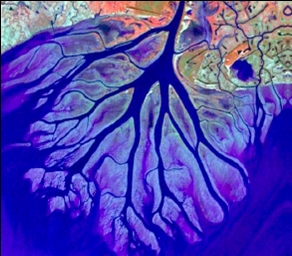

Erosion is the physical removal and transport of weathered material by water, wind, ice, or gravity. Rivers are the dominant agent of sediment transport on Earth, carrying approximately 20 billion tonnes of sediment to the oceans each year, a figure that human activities such as agriculture and deforestation have roughly doubled relative to pre-anthropogenic rates.23 Glaciers, wind, and coastal waves also transport significant volumes of sediment, each producing distinctive deposits and landforms.
Once transported sediment comes to rest, the process of lithification transforms loose sediment into coherent sedimentary rock. Lithification proceeds through two principal mechanisms: compaction, in which the weight of overlying sediment squeezes out pore water and reduces porosity, and cementation, in which dissolved minerals, most commonly silica, calcite, or iron oxides, precipitate in the remaining pore spaces and bind the grains together.21, 22 The total set of physical, chemical, and biological changes that affect sediment after deposition but before metamorphism is called diagenesis, and it encompasses compaction, cementation, dissolution, replacement, and recrystallization over timescales ranging from years to hundreds of millions of years.
Sedimentary rocks are described in terms of their facies, a concept first introduced by the Swiss geologist Amanz Gressly in 1838, which refers to the sum of lithological and biological characteristics that reflect the depositional environment in which a rock formed. Fluvial facies, deltaic facies, shallow marine facies, deep marine facies, and aeolian facies each have distinctive grain sizes, sedimentary structures, and fossil assemblages that allow geologists to reconstruct past landscapes and environments from the sedimentary record.22
Plate tectonics as the driving engine
Although weathering and erosion at the surface can operate independently of plate tectonics, the full rock cycle — with its deep burial, metamorphism, melting, and return of material to the surface — is fundamentally driven by the movement of lithospheric plates. At divergent plate boundaries, such as the Mid-Atlantic Ridge, hot mantle material rises by decompression melting to create new basaltic oceanic crust, injecting fresh igneous rock into the cycle. This new crust moves away from the ridge axis, accumulates a veneer of sediment, and eventually reaches a convergent boundary, where it is subducted into the mantle.6
Subduction carries oceanic crust, its sedimentary cover, and entrained seawater to depths of 100 to 200 kilometres, where increasing temperature and pressure drive metamorphic reactions that transform basalt into eclogite and release water into the overlying mantle wedge. The released water lowers the melting point of the mantle peridotite, generating arc magmas that rise to form volcanic arcs and plutonic intrusions — new igneous rocks added to the crust.20 At still greater depths, subducted material may melt entirely, contributing to the chemical recycling of the mantle over billions of years. Plate collision at convergent margins also generates the compressional forces that build mountain belts, uplifting deeply buried metamorphic and igneous rocks to the surface where they are exposed to weathering and erosion, restarting the surface portion of the cycle.
The Wilson cycle, named after the Canadian geophysicist J. Tuzo Wilson, describes the repeated opening and closing of ocean basins over hundreds of millions of years as a consequence of plate tectonics. Wilson proposed in 1966 that the Atlantic Ocean had closed during the formation of the Appalachian-Caledonian mountain belt in the Paleozoic and then reopened along approximately the same line during the Mesozoic breakup of Pangaea.7 Each phase of the Wilson cycle — rifting, ocean basin formation, subduction, and collision — drives different stages of the rock cycle. Continental rifting exposes deep crustal rocks to weathering; the opening ocean accumulates sedimentary sequences on passive margins; subduction generates metamorphic and igneous rocks at active margins; and continental collision produces high-grade metamorphism and orogenic uplift. The Wilson cycle thus provides the tectonic framework within which the rock cycle operates on the grandest spatial and temporal scales.7, 15
Estimated timescales of major rock cycle processes6, 12, 22
The carbon cycle and the silicate weathering thermostat
The rock cycle is inextricably linked to the long-term carbon cycle, the set of processes that transfer carbon among the atmosphere, oceans, biosphere, and lithosphere over timescales of millions to billions of years.


In 1981, Walker, Hays, and Kasting proposed that silicate weathering functions as a negative feedback mechanism — a planetary thermostat — that stabilizes Earth's surface temperature over geological time. The logic is straightforward: when atmospheric CO2 rises and global temperatures increase, the rates of chemical weathering accelerate (because weathering reactions proceed faster at higher temperatures and under wetter conditions), drawing down more CO2 and cooling the planet. Conversely, when CO2 falls and temperatures decrease, weathering slows, allowing volcanic CO2 emissions to accumulate and warm the planet back toward equilibrium.4 This feedback has operated for more than four billion years, maintaining surface temperatures within the range compatible with liquid water despite a roughly 30 percent increase in solar luminosity since the formation of the solar system.
Berner, Lasaga, and Garrels quantified this feedback in their influential 1983 BLAG model, which coupled silicate weathering rates to atmospheric CO2, temperature, and tectonic degassing rates to reconstruct the history of atmospheric carbon dioxide over the past 100 million years.5 Subsequent work has refined the model substantially. Gaillardet and colleagues measured global silicate weathering fluxes from the chemistry of the world's 60 largest rivers, finding that the total CO2 consumption by silicate weathering is approximately 11.7 × 10¹² moles per year, with the highest fluxes concentrated in warm, wet, tectonically active regions such as Southeast Asia and the volcanic arcs of the western Pacific.8 Dessert and colleagues further demonstrated that basaltic rocks, despite covering only about 5 percent of the continental surface, account for 30 to 35 percent of the total CO2 consumed by continental silicate weathering, because basalt weathers far more rapidly than granite under equivalent climatic conditions.9
More recent research has complicated the simple temperature-weathering feedback. Maher and Chamberlain showed in 2014 that hydrology — specifically, the amount of water flowing through the weathering zone and the residence time of that water in contact with reactive minerals — may exert a stronger control on weathering rates than temperature alone, and that weathering fluxes reach a plateau at high erosion rates regardless of climatic forcing.11 A 2023 study by Hakim and colleagues confirmed that temperature-dependent silicate weathering does operate as a thermostat, but demonstrated that the sensitivity of the feedback varies with tectonic setting and lithology, with volcanic arc regions responding more strongly than cratonic interiors.17 These findings underscore the complexity of the coupling between the rock cycle and the carbon cycle, and the importance of understanding both geological and hydrological controls on weathering.
Volcanic degassing and the return of carbon
The silicate weathering thermostat can only function because carbon sequestered in sedimentary rocks is continuously returned to the atmosphere through volcanic and metamorphic degassing, completing the long-term carbon cycle. At subduction zones, carbonate sediments and organic carbon carried on the descending slab are heated and decarbonated at depth, releasing CO2 that migrates upward and is emitted through arc volcanoes.19, 20 At mid-ocean ridges, mantle degassing releases CO2 that was stored in the mantle from previous cycles of subduction. Continental rifts, hotspot volcanoes, and metamorphic decarbonation of limestone in orogenic belts also contribute to the total volcanic CO2 flux.
Estimates of the total geological CO2 flux from these sources range from approximately 6 to 16 × 1012 moles per year, broadly comparable to the silicate weathering sink, indicating that the long-term carbon cycle is approximately in steady state on timescales of millions of years.24, 19 However, the balance is not always exact. Periods of enhanced volcanic activity, such as the emplacement of large igneous provinces, can temporarily overwhelm the weathering feedback and cause rapid greenhouse warming, while periods of enhanced weathering, such as the tropical weathering of the basaltic Deccan Traps, can accelerate CO2 drawdown and contribute to global cooling.16 The rock cycle thus exerts a first-order control on Earth's climate over geological time, not through any single process, but through the dynamic balance between the rates of carbon burial and carbon release.
Timescales of the rock cycle
The rock cycle operates across an extraordinary range of timescales, from the days or hours required for a lava flow to solidify into basalt to the billions of years over which the entire continental crust is recycled through the mantle and regenerated. At the fastest end of the spectrum, extrusive igneous rocks crystallize within days to months of eruption, and individual sediment grains can be transported from mountain to ocean basin in years to centuries.12 At the slowest end, the oldest known terrestrial material — detrital zircon crystals from the Jack Hills of Western Australia — dates to approximately 4.4 billion years ago, demonstrating that some components of the crust have survived nearly the entire history of the planet through multiple passages of the rock cycle.13
The timescales of specific rock cycle processes are constrained by a variety of geological observations. Radiometric dating of plutonic intrusions indicates that large granitic bodies cool and crystallize over periods of 10,000 to several million years. The lithification of sediment into sedimentary rock through compaction and cementation requires burial to depths of at least several hundred metres, a process that typically takes millions to tens of millions of years depending on the rate of sediment accumulation.22 Regional metamorphism associated with continental collision operates over similar timescales of tens of millions of years, as tectonic forces slowly bury and heat crustal rocks before eventual exhumation. The complete erosion of a mountain belt, from initial uplift to the reduction of the mountains to a low-relief peneplain, requires roughly 100 to 200 million years at typical denudation rates of 0.01 to 0.1 millimetres per year.23
The oceanic crust provides a particularly well-constrained timescale for one passage through the rock cycle. New oceanic crust is created at mid-ocean ridges, moves laterally as part of a tectonic plate, accumulates sediment, and is eventually subducted back into the mantle. The age of the oldest oceanic crust currently preserved on the seafloor is approximately 200 million years, in the western Pacific, reflecting the average residence time of oceanic lithosphere before subduction.6 Continental crust, by contrast, is too buoyant to be efficiently subducted and can persist at the surface for billions of years, though it is continuously reworked by metamorphism, partial melting, erosion, and re-sedimentation. The average age of the continental crust is estimated at approximately 2 billion years, suggesting that the continents are, on average, recycled through the rock cycle on timescales roughly ten times longer than the oceanic crust.10
The coupling of the rock cycle to the carbon cycle also introduces important timescales. The residence time of a carbon atom in the atmosphere-ocean system is on the order of 100,000 to 200,000 years before it is incorporated into carbonate or organic sediment, but once locked in sedimentary rock, that carbon may remain buried for tens to hundreds of millions of years before being released by metamorphic decarbonation or subduction-related volcanism.24, 5 The operation of the silicate weathering thermostat is therefore a slow process: significant adjustments to atmospheric CO2 through changes in weathering rates require hundreds of thousands to millions of years to take effect, which is why this mechanism is effective at stabilizing climate over geological time but offers no meaningful response to the rapid CO2 emissions of the modern anthropogenic era.16
References
Theory of the Earth; or an investigation of the laws observable in the composition, dissolution, and restoration of land upon the globe
A negative feedback mechanism for the long-term stabilization of Earth's surface temperature
The carbonate-silicate geochemical cycle and its effect on atmospheric carbon dioxide over the past 100 million years
Global silicate weathering and CO₂ consumption rates deduced from the chemistry of large rivers
Evidence from detrital zircons for the existence of continental crust and oceans on the Earth 4.4 Gyr ago