Overview
- In 1971, W. Jason Morgan proposed that narrow columns of anomalously hot rock rise from the core-mantle boundary to the base of the lithosphere, producing volcanic hotspots that remain roughly stationary as tectonic plates drift overhead, generating age-progressive island and seamount chains.
- The Hawaii-Emperor chain is the classic example: radiometric dating reveals a continuous age progression from the active volcanoes of Kilauea (0 Ma) to the 82-million-year-old Meiji Seamount, with a prominent bend at 47 Ma recording a major change in Pacific Plate motion.
- The plume hypothesis remains vigorously debated, with critics proposing shallow upper-mantle alternatives, but whole-mantle seismic tomography has imaged broad low-velocity anomalies beneath many hotspots, and the geochemical signatures of ocean island basalts require deep mantle reservoirs distinct from the mid-ocean ridge source.
Not all volcanism on Earth is confined to the boundaries of tectonic plates. A significant fraction of the planet's volcanic activity occurs thousands of kilometres from any plate margin, in the interiors of oceanic and continental plates. These intraplate volcanic centres, termed hotspots, produce distinctive age-progressive chains of islands and seamounts, anomalous topographic swells, and some of the largest volcanic outpourings in the geological record. The prevailing explanation for hotspots, first proposed formally by W. Jason Morgan in 1971, holds that they are the surface expressions of mantle plumes — narrow columns of anomalously hot rock that rise from the deep mantle, possibly from the core-mantle boundary itself, and impinge on the base of the lithosphere to generate localised melting.1 The mantle plume hypothesis has become one of the most productive and most contested ideas in modern geophysics, stimulating decades of research in seismology, geochemistry, and geodynamics.

Morgan's plume hypothesis
The concept of a fixed volcanic source beneath a moving plate was first articulated by J. Tuzo Wilson in 1963, who proposed that the age progression of the Hawaiian Islands could be explained if the Pacific Plate were drifting over a stationary melting anomaly in the mantle.2 Wilson's insight was qualitative. In 1971, W. Jason Morgan transformed the idea into a quantitative geophysical model by proposing that roughly twenty narrow plumes of hot material rise convectively from the lower mantle, providing a relatively fixed reference frame against which the motions of the lithospheric plates could be measured.1 Morgan argued that these plumes originate near the core-mantle boundary at a depth of approximately 2,900 kilometres, where a thermal boundary layer analogous to the one at Earth's surface generates buoyant instabilities that rise through the mantle as conduits perhaps 100 to 200 kilometres in diameter. Where a plume intersects the lithosphere, the excess heat produces partial melting, creating a volcanic centre on the surface. Because the plumes are rooted deep in the mantle and rise through it relatively slowly, they remain approximately stationary while the lithospheric plates drift overhead, leaving behind a trail of progressively older volcanic edifices that records both the direction and rate of plate motion.1, 3
Morgan's 1971 paper was brief — barely two pages in Nature — but it unified several previously unrelated observations. It explained the linear, age-progressive character of volcanic island chains, the occurrence of volcanism far from plate boundaries, the anomalous topographic swells surrounding hotspot volcanoes, and the distinctive geochemistry of intraplate volcanic rocks relative to those erupted at mid-ocean ridges. In subsequent papers, Morgan refined the model by distinguishing between the initial arrival of a plume head — a large, mushroom-shaped volume of hot material that flattens against the lithosphere and can produce enormous flood basalt eruptions — and the narrower plume tail that sustains the hotspot track over tens of millions of years.3, 17
The Hawaii-Emperor chain
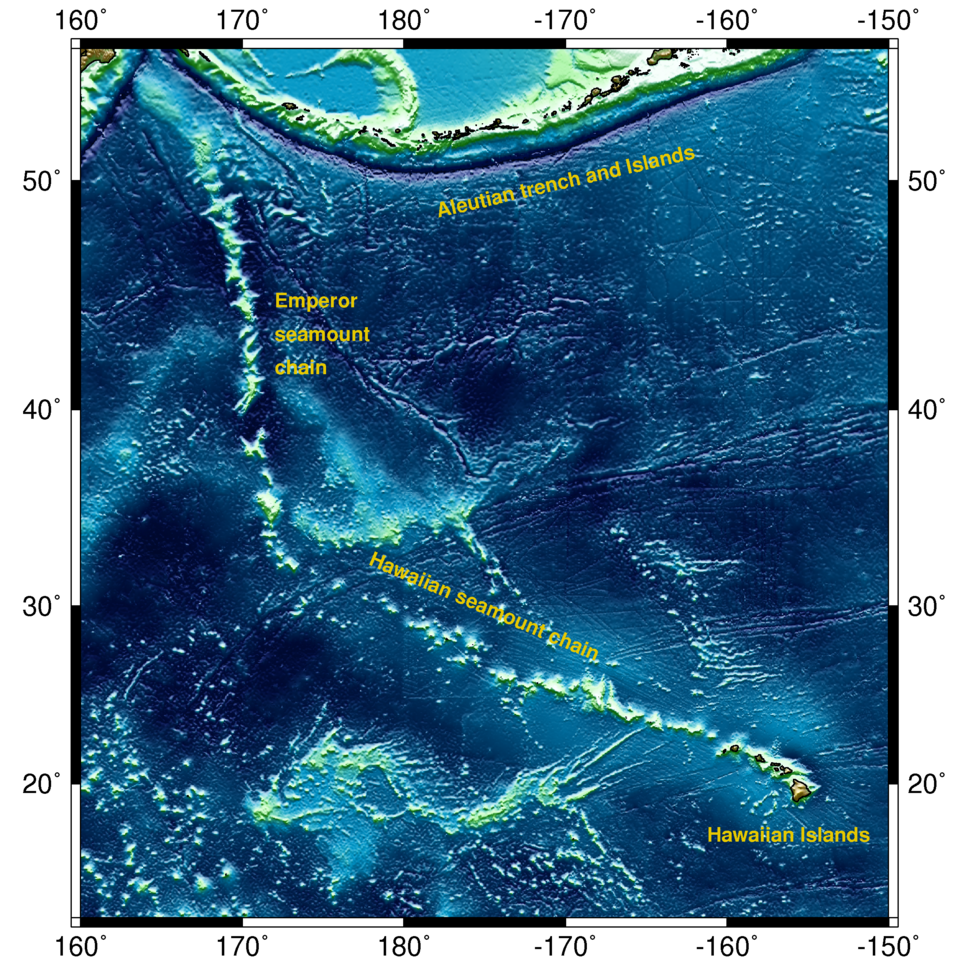
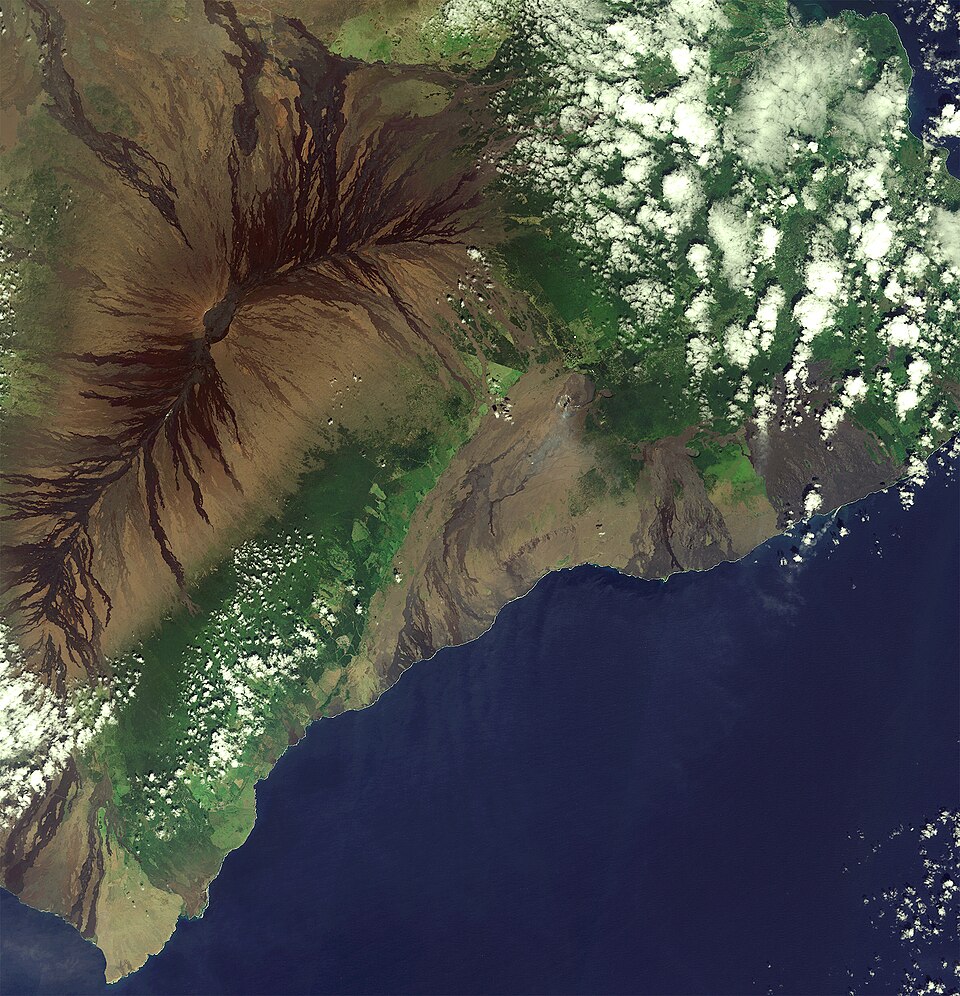
The Hawaiian-Emperor seamount chain is the type example of a hotspot track and the single most important line of evidence for the plume hypothesis. The chain stretches more than 6,000 kilometres across the North Pacific Ocean, from the active volcanoes of the Big Island of Hawaii in the southeast to the 82-million-year-old Meiji Seamount near the Aleutian Trench in the northwest. Radiometric dating of samples recovered by ocean drilling and dredging has established a remarkably continuous age progression along the chain: the volcanic rocks become systematically older with increasing distance from Kilauea, at a rate consistent with the Pacific Plate moving northwestward over a stationary melting source at approximately 7 to 9 centimetres per year.4

The chain exhibits a prominent bend of approximately 60 degrees, separating the older, north-trending Emperor Seamounts from the younger, northwest-trending Hawaiian chain. The age of volcanism at the bend has been dated to approximately 47 million years ago by 40Ar/39Ar geochronology of basalt samples from the Detroit and Daikakuji seamounts near the elbow.5 This bend was long interpreted as recording a dramatic change in Pacific Plate motion direction at that time, perhaps related to the India-Asia collision and the closure of the Tethys Ocean. More recent palaeomagnetic and geochronological studies have complicated this interpretation, suggesting that some of the apparent change reflects southward drift of the Hawaiian hotspot itself during the Emperor stage, implying that the plume was not perfectly stationary.5, 23 The current consensus holds that the bend reflects a combination of both a change in Pacific Plate motion and modest plume drift, though the relative contributions of each remain under investigation.
Age progression along the Hawaii-Emperor chain4, 5
| Volcanic feature | Age (Ma) | Distance from Kilauea (km) |
|---|---|---|
| Kilauea (Big Island) | 0 (active) | 0 |
| Maui (Haleakala) | ~1.0 | ~180 |
| Molokai | ~1.8 | ~280 |
| Oahu (Koolau) | ~2.6 | ~350 |
| Kauai | ~5.1 | ~520 |
| Nihoa | ~7.2 | ~780 |
| Midway Atoll | ~28 | ~2,400 |
| Bend (Daikakuji–Detroit) | ~47 | ~3,800 |
| Suiko Seamount | ~65 | ~4,800 |
| Meiji Seamount | ~82 | ~6,000 |
Seismic imaging of the mantle beneath Hawaii has revealed a broad low-velocity anomaly extending to at least 1,500 kilometres depth, consistent with a column of anomalously hot material rising through the mantle.22 The Hawaiian swell itself — a broad, elevated region of the ocean floor extending roughly 1,000 kilometres on either side of the island chain and standing about 1 kilometre above the surrounding seafloor — is interpreted as the dynamic topographic response to the buoyant plume material spreading beneath the lithosphere.22
The Iceland hotspot
Iceland occupies a unique position among hotspot volcanoes: it sits directly atop the Mid-Atlantic Ridge, where the North American and Eurasian plates are diverging at approximately 2 centimetres per year. The coincidence of a spreading ridge and a deep mantle plume produces anomalously thick oceanic crust — up to 40 kilometres in places, compared with the 6 to 7 kilometres typical of normal oceanic crust — and makes Iceland the only place on Earth where a mid-ocean ridge rises above sea level over a substantial area.21
Seismic tomographic studies beneath Iceland have imaged a cylindrical low-velocity anomaly extending from the surface to at least 400 kilometres depth, interpreted as a conduit of hot, partially molten mantle rock.21 Deeper imaging remains challenging because of resolution limits, but some global tomographic models trace the Icelandic anomaly into the lower mantle. The geochemistry of Icelandic basalts provides complementary evidence: elevated 3He/4He ratios, reaching 20 to 40 times the atmospheric ratio in some eruptions, suggest the involvement of a mantle source that has retained primordial helium not yet degassed by cycling through the mid-ocean ridge system — consistent with material rising from the deep, relatively undegassed lower mantle.11
Critics of the plume interpretation for Iceland, notably Foulger and Anderson, have argued that the anomalous volcanism and thick crust can be explained by the plate tectonic setting alone, without invoking a deep plume. In their view, the ridge itself provides a mechanism for enhanced melting, and compositional heterogeneities in the upper mantle — particularly recycled oceanic crust (eclogite) — can account for the geochemical signatures without requiring material from the core-mantle boundary.20 The Iceland hotspot thus remains one of the most actively debated examples in the broader plume controversy.
The Yellowstone hotspot
The Yellowstone volcanic system in northwestern Wyoming represents the most prominent continental hotspot. Unlike the oceanic Hawaiian chain, the Yellowstone track crosses continental lithosphere, producing a distinctive trail of silicic calderas and rhyolitic volcanism along the Snake River Plain of southern Idaho. The track records the progressive motion of the North American Plate southwestward over a stationary thermal anomaly at approximately 2.5 centimetres per year, with caldera-forming eruptions becoming younger from the 16-million-year-old McDermitt volcanic field near the Oregon-Nevada border to the most recent Yellowstone caldera eruptions at 2.1, 1.3, and 0.64 million years ago.18, 19
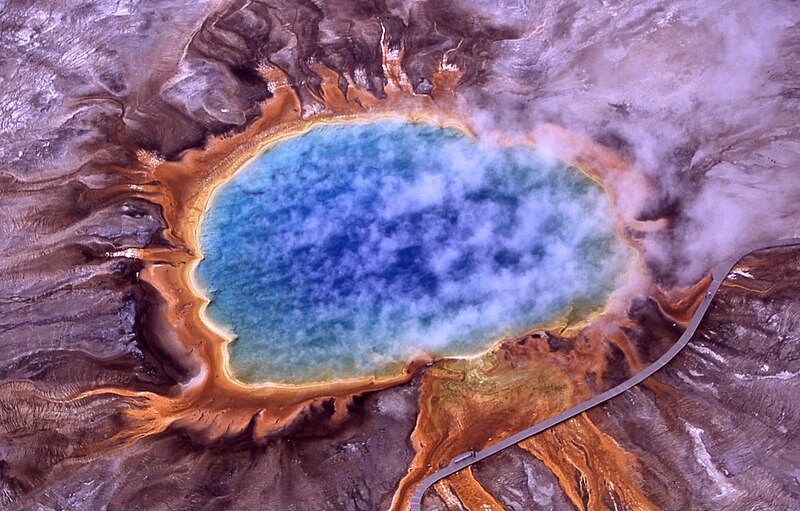

The Yellowstone system is underlain by a large crustal magma reservoir, imaged by seismic tomography as a zone of reduced seismic velocities extending from the shallow crust to depths of at least 60 kilometres. Beneath this, a broader lower-crustal to upper-mantle anomaly extends to several hundred kilometres depth.19 Whether this anomaly connects to a narrow whole-mantle plume or represents a more diffuse upper-mantle thermal feature remains disputed. The onset of Yellowstone-related volcanism at approximately 17 million years ago coincides closely in time and space with the eruption of the Columbia River Basalt Group, one of the youngest large igneous provinces. This temporal coincidence has been interpreted as evidence that the arrival of a plume head generated the flood basalt volcanism, while the subsequent hotspot track represents the continuing plume tail — consistent with the head-tail model predicted by fluid dynamics experiments.17, 24
Geochemical signatures of hotspot volcanism
One of the strongest arguments for deep mantle plumes comes from the distinctive geochemistry of ocean island basalts (OIB), which erupt at hotspot volcanoes and differ systematically from mid-ocean ridge basalts (MORB) in their isotopic compositions and trace-element abundances. MORB are relatively uniform in composition and are derived from the shallow, well-mixed, depleted upper mantle beneath spreading ridges. OIB, by contrast, display a much wider range of isotopic ratios in strontium, neodymium, lead, and hafnium, pointing to source regions that are chemically heterogeneous and have evolved in isolation from the upper mantle for billions of years.12
Geochemists have identified several distinct mantle components, or end-members, that contribute to the OIB isotopic array. HIMU (high-μ, where μ represents the 238U/204Pb ratio) sources are interpreted as ancient recycled oceanic crust that has been subducted into the deep mantle and stored there for one to two billion years. EM1 (enriched mantle 1) and EM2 (enriched mantle 2) components are attributed to recycled continental sediments or ancient subcontinental lithosphere, respectively. These components require isolation in reservoirs that are not efficiently sampled by mid-ocean ridge volcanism, consistent with storage in the deep mantle or at the core-mantle boundary — precisely the regions from which plumes are hypothesised to originate.12, 25
Helium isotopes provide particularly compelling evidence for deep mantle involvement. The ratio of 3He (primordial, not produced by radioactive decay) to 4He (produced continuously by uranium and thorium decay) in mantle-derived rocks serves as a tracer of mantle degassing history. MORB sources have relatively uniform 3He/4He ratios of approximately 8 times the atmospheric ratio (RA), reflecting a mantle that has been substantially degassed through billions of years of processing at mid-ocean ridges. Many hotspot lavas, particularly those from Hawaii, Iceland, and the Galapagos, have significantly higher ratios — up to 40 RA — indicating that their source retains a larger fraction of primordial helium and has not been as thoroughly processed, consistent with an origin in the less-degassed lower mantle.11
The plume debate


Despite its explanatory power, the mantle plume hypothesis has faced persistent criticism since the 1990s. The most prominent sceptics, including Don Anderson and Gillian Foulger, have argued that many features attributed to deep mantle plumes can be explained by processes operating entirely within the upper mantle and lithosphere, without requiring narrow conduits rising from the core-mantle boundary.9, 10
Anderson proposed that intraplate volcanism results from lateral temperature variations in the upper mantle, lithospheric architecture that focuses or permits melt extraction, and the presence of fusible material such as recycled eclogite in the shallow mantle. In this "plate" model, hotspots are not fixed deep-sourced features but instead reflect the upper mantle's response to plate tectonic stresses, pre-existing zones of weakness in the lithosphere, and compositional heterogeneity inherited from earlier subduction.9 Foulger extended these arguments in a comprehensive critique, noting that many proposed hotspots lack the characteristics predicted by the classical plume model: not all have age-progressive volcanic tracks, not all display the expected high 3He/4He ratios, and the number of proposed hotspots varies enormously depending on the criteria used, from roughly twenty in Morgan's original framework to more than fifty in broader catalogues.10
Proponents of the plume model respond that the classical model was never intended to account for every instance of intraplate volcanism, and that the strongest cases — Hawaii, Iceland, Réunion, Louisville — do exhibit the predicted age progressions, anomalous geochemistry, and tomographically imaged deep structures. They also note that laboratory experiments and numerical simulations consistently demonstrate that thermal boundary layers such as the core-mantle boundary will generate buoyant upwellings, making it physically implausible that no plumes exist at all.6, 17 The debate has been productive: it has sharpened the criteria for what constitutes a genuine plume signature, distinguished between "primary" plumes (deep-sourced, with strong geochemical and seismic support) and "secondary" hotspots (possibly upper-mantle in origin), and stimulated the development of higher-resolution seismic imaging techniques.
Seismic tomography evidence
The most direct test of the plume hypothesis is whether seismology can image the predicted narrow, hot conduits extending from the core-mantle boundary to the surface. Traditional seismic tomography, which inverts travel times of seismic body waves to reconstruct three-dimensional velocity variations in the mantle, has long detected broad low-velocity anomalies in the upper mantle beneath many hotspots. However, the resolution of these early studies was insufficient to determine whether the anomalies were narrow plume-like features extending into the lower mantle or broad, shallow structures confined to the upper few hundred kilometres.7
A significant advance came with the development of finite-frequency tomography, which accounts for the fact that seismic waves sample a volume of mantle around their geometric ray paths rather than infinitely thin lines. In 2004, Montelli and colleagues applied this technique to a global dataset and reported narrow low-velocity conduits in the lower mantle beneath several hotspots, including Hawaii, Easter Island, Samoa, and Tahiti, while other hotspots appeared to have anomalies confined to the upper mantle.7 This study was among the first to provide seismological evidence for a distinction between deep-sourced and shallow hotspots.
In 2015, French and Romanowicz used full-waveform inversion — a computationally intensive technique that models the complete seismic wavefield rather than just travel times — to image broad, low-velocity plume conduits extending from the core-mantle boundary to the surface beneath several major hotspots, including Hawaii, Iceland, Samoa, and several others. Their models showed that the plume conduits are wider than Morgan originally envisaged, with diameters of 600 to 1,000 kilometres in the lower mantle, tilted and deflected by mantle flow rather than standing as vertical columns.8 These results have strengthened the case that at least some hotspots are indeed fed by whole-mantle upwellings, even if the structures are broader and more complex than the narrow pipes of the classical model.
Resolution challenges persist. The heterogeneous distribution of seismic stations (concentrated on continents and sparse in oceans, precisely where many hotspots are located) limits imaging capability beneath oceanic hotspots. Ocean-bottom seismometer deployments, such as the PLUME experiment beneath Hawaii, have begun to address this gap, revealing a low-velocity anomaly beneath the Hawaiian swell that extends to at least the mantle transition zone at 660 kilometres and possibly deeper.22
Large igneous provinces and plume heads
Among the most dramatic consequences attributed to mantle plumes are large igneous provinces (LIPs) — vast accumulations of basaltic rock emplaced over geologically brief intervals, typically less than one to two million years. The plume head-tail model, developed by Campbell and Griffiths from laboratory fluid dynamics experiments in 1990, predicts that when a new plume first rises through the mantle and reaches the lithosphere, its leading portion expands into a large, mushroom-shaped head, 500 to 1,000 kilometres in diameter, that flattens against the base of the lithosphere and generates enormous volumes of melt. The subsequent narrow plume tail sustains a smaller, long-lived hotspot track.17
Several LIPs show temporal and spatial associations with the onset of hotspot tracks, supporting the head-tail model. The Deccan Traps, which erupted approximately 66 million years ago and produced an estimated 500,000 cubic kilometres of flood basalt across the Indian subcontinent, are interpreted as the plume head phase of the Réunion hotspot, whose present-day track runs from the Deccan through the Chagos-Laccadive Ridge and the Mascarene Plateau to the currently active volcanoes of Réunion Island.16 The Columbia River Basalt Group of the northwestern United States, emplaced at approximately 17 to 15 million years ago, is similarly linked to the early phase of the Yellowstone hotspot.24
The Siberian Traps, emplaced at approximately 252 million years ago, are the most voluminous continental flood basalt province and coincide precisely with the end-Permian mass extinction, the most severe biotic crisis in the fossil record. The eruption of an estimated two to three million cubic kilometres of basalt released enormous quantities of carbon dioxide, sulfur dioxide, and halogen gases that acidified the oceans, destabilised the global climate, and may have triggered the release of methane from subsurface clathrate deposits, compounding the environmental devastation.14, 15 The correlation between LIP emplacement and mass extinction is not limited to the Siberian Traps: statistical analyses have demonstrated that the majority of the Phanerozoic mass extinctions coincide in time with the emplacement of major LIPs, suggesting that the massive and rapid injection of volcanic gases into the atmosphere represents a recurring mechanism for severe environmental disruption.14
The geochemistry of flood basalts provides further evidence for plume involvement. Many LIP basalts, including those of the Siberian and Deccan Traps, contain olivine-hosted melt inclusions with compositions indicating that a significant fraction of the melt was derived from pyroxenite or eclogite rather than peridotite, consistent with a plume that entrained ancient recycled oceanic crust during its ascent through the mantle.13 This recycled component is predicted by the plume model, in which subducted slabs accumulate at the core-mantle boundary over geological time and are subsequently entrained by rising plumes, returning to the surface as a geochemically enriched signature in hotspot volcanism.12, 13
Synthesis and current understanding
After more than five decades of investigation, the scientific understanding of mantle plumes and hotspots occupies a position of broad but nuanced acceptance. The strongest cases for deep-sourced plumes — Hawaii, Iceland, Réunion, Louisville, and a handful of others — are supported by converging lines of evidence from age-progressive volcanic tracks, anomalous geochemistry including high 3He/4He ratios, whole-mantle tomographic imaging of low-velocity conduits, and associations with large igneous provinces at their inception.8, 11, 12 These primary plumes appear to originate at or near the core-mantle boundary, though their conduits are broader and more variable in geometry than Morgan's original model envisaged.
At the same time, the plume debate has clarified that not all hotspots require deep mantle plumes. Some volcanic centres attributed to hotspots may instead reflect upper-mantle processes such as edge-driven convection at the boundaries of thick continental keels, small-scale convective instabilities in the asthenosphere, or the melting of fusible heterogeneities in the shallow mantle. The dichotomy between deep, primary plumes and shallow, secondary hotspots is now widely recognised as a more accurate framework than either a universal plume model or a complete rejection of plumes.7, 10
The connection between plume heads and large igneous provinces links mantle dynamics to some of the most consequential events in Earth history. The temporal correlation between major LIPs and mass extinctions provides evidence that the deep mantle exerts a profound, if episodic, influence on surface environments and the biosphere.14 As seismic imaging resolution continues to improve, as ocean-bottom seismometer networks expand coverage of oceanic hotspots, and as geochemical techniques achieve finer discrimination of mantle source compositions, the structure and origin of individual plumes will come into sharper focus, refining a hypothesis that has reshaped understanding of how Earth's deep interior communicates with its surface.
References
Mantle plumes and flood basalts: enhanced melting from plume ascent and an eclogite component
Siberian Traps large igneous province: evidence for two flood basalt pulses around the Permo-Triassic boundary
Yellowstone plume head: postulated tectonic relations to the Vancouver slab, continental boundaries, and climate