Overview
- Magma forms through three mechanisms—decompression melting, flux melting, and heat transfer—each associated with distinct tectonic settings such as mid-ocean ridges, subduction zones, and mantle hotspots.
- Volcanic eruption style is controlled primarily by magma viscosity and dissolved gas content, ranging from the gentle effusive flows of Hawaiian shield volcanoes to the catastrophic Plinian columns of stratovolcanoes.
- Large igneous provinces, such as the Siberian Traps and Deccan Traps, released enough carbon dioxide and sulfur dioxide over geological timescales to alter Earth's climate and are implicated in two of the five major mass extinction events.
Volcanism is among the most powerful geological forces shaping Earth's surface, interior, and atmosphere. The eruption of magma—molten rock generated within the mantle and crust—transfers heat and material from deep within the planet to its surface, building mountains, creating new oceanic crust, and releasing gases that have shaped the composition of the atmosphere across geological time. Igneous processes, which encompass the formation, movement, and solidification of magma, are inseparable from the broader dynamics of plate tectonics and the long-term evolution of the planet.1, 2 Understanding how magma forms, why eruptions differ so dramatically in character, and what happens to lava and pyroclastic material after eruption provides the foundation for interpreting much of Earth's geological record.
How magma forms
Magma is not simply rock that has been heated until it melts. Under the pressures found deep within Earth, solid rock can remain solid even at temperatures exceeding 1,000°C. Melting requires either a reduction in pressure, the addition of volatile compounds such as water or carbon dioxide, or an extraordinary flux of heat. These three mechanisms correspond to the three principal tectonic settings where volcanism occurs.1
The most voluminous source of magma on Earth is decompression melting, which occurs at mid-ocean ridges. As tectonic plates diverge, hot mantle rock rises to fill the gap. Rising rock encounters progressively lower pressure, and since pressure is one of the main factors keeping rock solid, the reduction in pressure causes partial melting even without any increase in temperature. The resulting magma is rich in iron and magnesium and relatively poor in silica; geologists call this basaltic magma, and it forms the oceanic crust that covers roughly two-thirds of Earth's surface.1
At subduction zones, where one tectonic plate descends beneath another, a second mechanism dominates: flux melting. As the subducting oceanic slab descends into the hotter mantle, increasing temperature and pressure drive water and other volatiles out of hydrated minerals in the slab. These fluids migrate upward into the overlying mantle wedge, dramatically lowering the melting point of the surrounding rock. The result is magma that is more silica-rich and volatile-laden than basaltic magma from mid-ocean ridges—properties that have profound consequences for eruption style.2
A third mechanism, heat-transfer melting, operates at mantle plumes or hotspots, where columns of anomalously hot mantle material rise from deep within the mantle, possibly from the boundary between the mantle and the core. As these plumes impinge on the base of the lithosphere, excess heat melts the overlying rock. The Hawaiian Islands are the most studied example of hotspot volcanism on Earth; as the Pacific Plate migrates slowly northwestward over the stationary Hawaiian hotspot, each island represents a former volcanic center that has since moved off the heat source and become dormant.3
Magma differentiation and Bowen's reaction series
Once magma forms, it does not remain chemically static. As it cools slowly within a magma chamber, different minerals crystallize at different temperatures in a predictable sequence first described systematically by Canadian geologist Norman L. Bowen in 1922. The Bowen reaction series explains how a single parent magma can give rise to a range of magma compositions through the progressive removal of early-formed crystals from the melt.4
High-temperature minerals such as olivine and calcium-rich plagioclase crystallize first. If these crystals settle out of the magma, the remaining melt becomes enriched in silica, sodium, potassium, and other elements that were excluded from the early crystals. This process, known as fractional crystallization, can transform a basaltic magma into progressively more silica-rich compositions including andesite, dacite, and rhyolite. The progression matters greatly for volcanic hazard because silica-rich magmas are far more viscous than basaltic magmas; they trap dissolved gases more effectively and thus tend to erupt far more violently.4
Types of volcanoes
The shape of a volcano reflects the character of its magma and the style of eruptions that built it over time. Geologists recognize several major morphological types, each associated with characteristic tectonic settings and magma compositions.
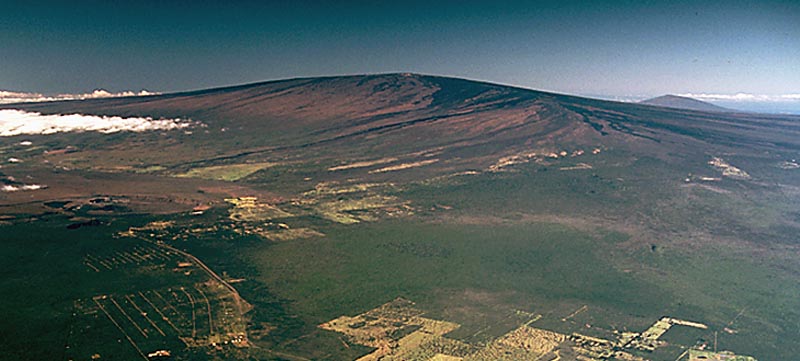

Shield volcanoes are broad, gently sloping structures built almost entirely from successive flows of low-viscosity basaltic lava. Because basaltic magma is fluid enough to flow great distances before solidifying, shield volcanoes accumulate a wide base relative to their height, resembling a warrior's shield laid flat on the ground. Mauna Loa and Kilauea in Hawaii are canonical examples; measured from the ocean floor, Mauna Loa is the largest volcano on Earth by volume and rises approximately 9 km from its base.3 Eruptions from shield volcanoes are typically effusive rather than explosive, producing lava fountains and rivers of molten rock rather than the violent ash columns associated with more silicic systems.
Stratovolcanoes, also called composite volcanoes, are steep-sided, symmetrical cones built from alternating layers of lava flows, pyroclastic deposits, and volcanic debris. They are associated with subduction zones, where flux melting produces andesitic to dacitic magmas with higher silica content and greater viscosity. This combination traps gases effectively, leading to periodic explosive eruptions interspersed with quieter effusive phases. Mount Fuji, Mount Rainier, and Mount Vesuvius are among the most familiar stratovolcanoes. Because they are large, steep, and located near population centers, they represent some of the greatest volcanic hazards on Earth.10
Cinder cones are the smallest and most numerous type of volcano. They form from the accumulation of fragments of solidified lava—called cinders or scoria—ejected during short-lived, moderately explosive eruptions. Cinder cones rarely exceed a few hundred meters in height, have steep sides at or near the angle of repose of loose pyroclastic material, and typically form in a single eruptive episode lasting weeks to years. Parícutin in Mexico, which grew from a farmer's field beginning in 1943, is a celebrated historical example.
Calderas are large, roughly circular depressions formed when a volcanic system collapses inward following the rapid withdrawal of magma from a subsurface chamber during a major eruption. They can span tens of kilometers and represent some of the most catastrophic events in the geological record. The Yellowstone Caldera in Wyoming, which measures roughly 55 by 72 km, is the surface expression of one of the world's largest known supervolcanic systems, underlain by a magma reservoir fed by a deep mantle plume.9
Eruption styles and the volcanic explosivity index
Volcanologists classify eruptions along a spectrum from gentle effusive activity to catastrophic explosive columns. The controlling variables are magma viscosity, volatile content, and the rate at which magma rises through the conduit. In 1982, Christopher Newhall and Stephen Self introduced the Volcanic Explosivity Index (VEI), a logarithmic scale running from 0 to 8 that ranks eruptions by the volume of ejected material and the height of the eruptive column. Each step on the scale represents a tenfold increase in erupted volume.5
The Volcanic Explosivity Index (VEI) with historical examples5
| VEI | Description | Column height | Ejecta volume | Example |
|---|---|---|---|---|
| 0 | Hawaiian | <100 m | <10,000 m³ | Kilauea (ongoing) |
| 1 | Hawaiian / Strombolian | 100–1,000 m | >10,000 m³ | Stromboli (ongoing) |
| 2 | Strombolian / Vulcanian | 1–5 km | >1,000,000 m³ | Galeras, 1992 |
| 3 | Vulcanian | 3–15 km | >10,000,000 m³ | Nevado del Ruíz, 1985 |
| 4 | Pelean / Sub-Plinian | 10–25 km | >0.1 km³ | Eyjafjallajökull, 2010 |
| 5 | Plinian | 10–35 km | >1 km³ | Mount St. Helens, 1980 |
| 6 | Plinian / Ultra-Plinian | 20–35 km | >10 km³ | Krakatoa, 1883; Pinatubo, 1991 |
| 7 | Ultra-Plinian | >35 km | >100 km³ | Tambora, 1815 |
| 8 | Mega-colossal | >35 km | >1,000 km³ | Toba, ~74,000 yr ago |
Hawaiian eruptions are the least explosive style, characterized by the effusion of fluid basaltic lava from fissures or summit vents. Lava fountains may reach hundreds of meters but pose their primary hazard through lava flow inundation rather than ballistic ejecta or ash. Strombolian eruptions, named for the persistently active Stromboli volcano off the coast of Sicily, involve rhythmic bursts of gas-charged magma from a central vent, producing incandescent bombs and limited ash fall. Vulcanian eruptions are more violent, generating dense clouds of ash and ballistic blocks from the explosive disintegration of a solidified plug of magma in the conduit. Plinian eruptions, the most energetic style, involve the sustained ejection of gas-rich magma at rates that sustain eruption columns tens of kilometers high, dispersing ash and sulfur dioxide across entire hemispheres.5
Notable historical eruptions
The historical and geological record preserves a range of eruptions that illustrate the spectrum of volcanic behavior and its consequences for human civilization and global climate.

The eruption of Mount Vesuvius in 79 CE is one of the most studied volcanic events in history, not least because it was described in eyewitness letters by Pliny the Younger and because it buried the Roman towns of Pompeii and Herculaneum under meters of pumice and pyroclastic density currents—fast-moving avalanches of hot gas and volcanic debris. Volcanological analysis of the deposits indicates an eruptive column that reached approximately 32 km, and pyroclastic density currents that descended the volcano's flanks at temperatures exceeding 300°C proved lethal to the inhabitants who had not already fled.10, 21
The 1883 Krakatoa eruption in Indonesia, rated VEI 6, generated the loudest sound ever recorded in the historical era, audible as far away as 4,800 km. The eruption triggered a caldera collapse that displaced sufficient seawater to generate tsunamis killing an estimated 36,000 people along the coasts of Java and Sumatra. Fine aerosols injected into the stratosphere produced vivid red sunsets worldwide and depressed global average temperatures by approximately 0.3°C in the years following the eruption.7
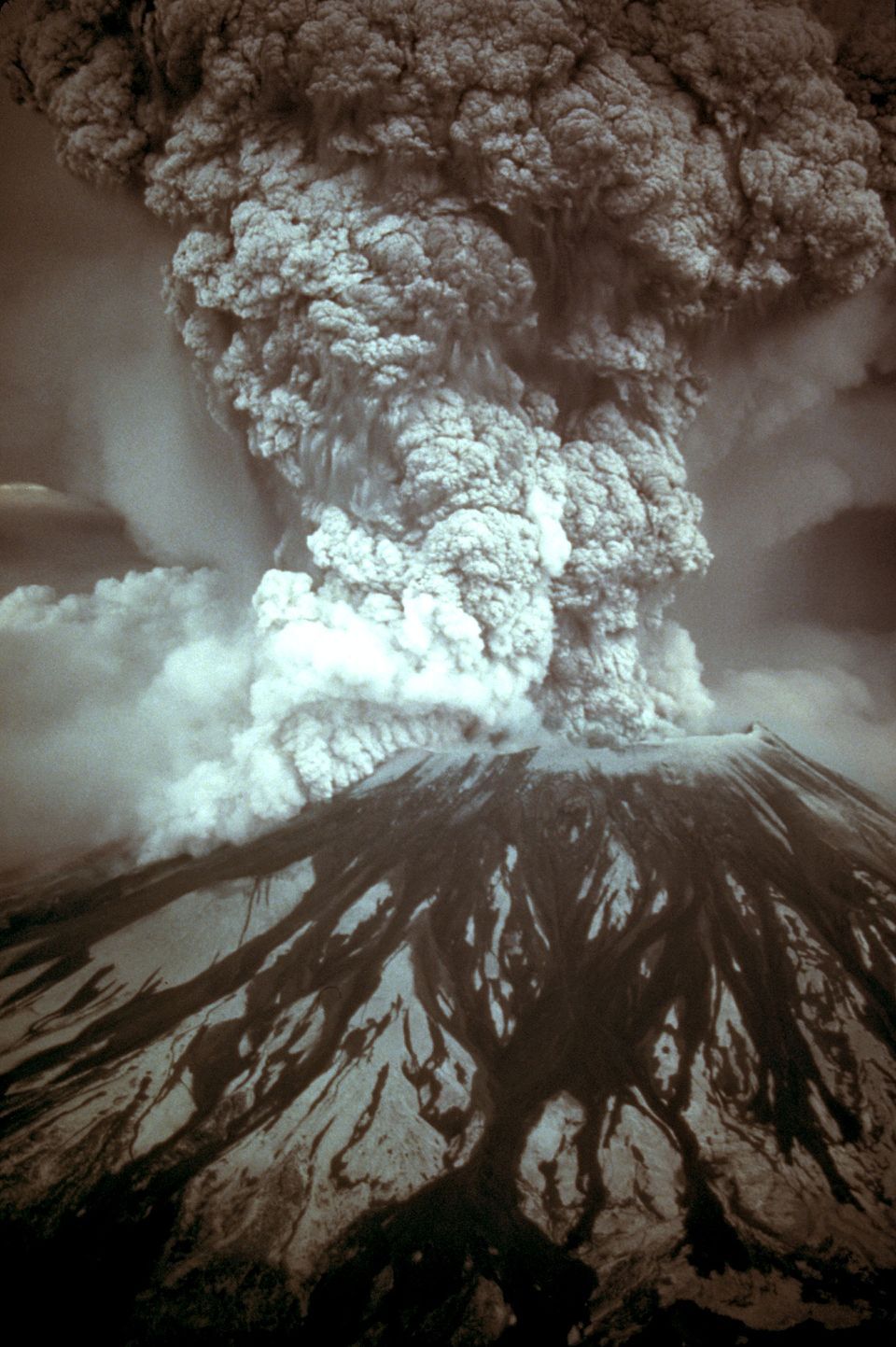
On the morning of May 18, 1980, Mount St. Helens in Washington State experienced the largest volcanic eruption in the recorded history of the contiguous United States. A magnitude 5.1 earthquake destabilized the volcano's bulging north flank, triggering the largest landslide in recorded history and releasing a lateral blast of superheated gas and debris that devastated 600 km² of forest within minutes. The subsequent Plinian eruption column rose 24 km and deposited ash across eleven states. The eruption killed 57 people and removed approximately 400 meters from the volcano's summit.6
The 1991 eruption of Mount Pinatubo in the Philippines was the largest eruption of the twentieth century and a landmark in volcanological hazard forecasting. Scientists from the Philippine Institute of Volcanology and Seismology and the U.S. Geological Survey successfully predicted the eruption's climax, enabling the evacuation of approximately 60,000 people from the surrounding area. The eruption injected an estimated 20 million tonnes of sulfur dioxide into the stratosphere, forming a global sulfate aerosol veil that cooled global average surface temperatures by roughly 0.5°C for two to three years.8, 14
Farther back in the geological record, the Toba super-eruption in Sumatra approximately 74,000 years ago represents the largest known explosive volcanic event of the past two million years, rated VEI 8. Toba ejected an estimated 2,800 km³ of magma and deposited thick ash across South Asia. The injection of sulfur dioxide into the stratosphere likely caused a volcanic winter lasting several years, and some researchers have proposed that the resulting climate deterioration created a population bottleneck in early modern human populations, though this hypothesis remains actively debated.11, 12
Volcanic hazards
Active volcanoes threaten surrounding populations through a diverse array of hazards, each with distinct physical characteristics and ranges of effect. Effective hazard assessment requires understanding which processes are likely given the tectonic setting and magma composition of a particular volcanic system.
Pyroclastic density currents, sometimes called pyroclastic flows, are the most lethal immediate hazard associated with explosive eruptions. These turbulent mixtures of hot gas, ash, and rock travel at speeds that can exceed 700 km/h and carry temperatures sufficient to incinerate everything in their path. Their high density relative to ambient air causes them to hug the terrain and flow into valleys, making escape nearly impossible once they begin. The 1902 eruption of Mont Pelée on Martinique generated a pyroclastic density current that killed approximately 30,000 people in the city of Saint-Pierre in minutes.21
Lahars are volcanic mudflows or debris flows that form when pyroclastic material or volcanic ash mixes with water, either from crater lakes, heavy rainfall, or the rapid melting of summit ice and snow during eruptions. Lahars can travel far beyond the immediate volcanic zone along river valleys, reaching populated areas hours or days after an eruption. The 1985 eruption of Nevado del Ruíz in Colombia generated lahars that buried the town of Armero and killed approximately 23,000 people, making it the deadliest volcanic disaster of the twentieth century.22
Volcanic ash fall poses hazards over much larger areas than pyroclastic flows or lahars. Fine ash particles remain suspended in the atmosphere for days to weeks and can be transported thousands of kilometers by high-altitude winds. Ash fall collapses roofs, contaminates water supplies, disrupts aviation, and causes respiratory illness. The 2010 Eyjafjallajökull eruption in Iceland, rated only VEI 4, generated an ash plume that closed European airspace for six days and disrupted approximately ten million travelers, demonstrating that even moderate eruptions can have profound socioeconomic consequences.23
Over longer timescales, lava flows from effusive eruptions can destroy infrastructure and agricultural land, though they typically advance slowly enough to allow evacuation. The emission of volcanic gases, particularly sulfur dioxide and hydrogen sulfide, creates acid rain and poses direct inhalation hazards in areas downwind of active vents.19
Igneous rock classification
All rocks that solidify from magma are classified as igneous, and they are divided into two fundamental groups based on where solidification occurs. Intrusive (or plutonic) igneous rocks crystallize slowly from magma that cools within the crust, allowing large mineral crystals to grow. The slow cooling gives minerals time to interlock, producing coarse-grained textures. Granite is the most common intrusive rock and forms the cores of many continental mountain ranges. Other intrusive rock types include gabbro, which is the coarse-grained equivalent of basalt, and diorite, the intrusive equivalent of andesite.4
Extrusive (or volcanic) igneous rocks form when magma erupts onto the surface and cools rapidly in contact with air or water. Rapid cooling does not permit large crystals to develop, so extrusive rocks are typically fine-grained or glassy in texture. Basalt, andesite, dacite, and rhyolite are the principal extrusive rock types, arranged in order of increasing silica content. Obsidian is a naturally occurring volcanic glass formed when rhyolitic lava cools so rapidly that no crystalline structure develops at all.4
Igneous rocks are additionally classified along a compositional spectrum from mafic to felsic. Mafic rocks such as basalt are rich in magnesium and iron-bearing minerals and have silica contents typically between 45 and 52 percent by mass. Felsic rocks such as rhyolite are dominated by silica and aluminum-rich feldspar, with silica contents exceeding 70 percent. Intermediate compositions—andesite and dacite—fall between these extremes. This compositional range tracks closely with the tectonic setting of magma generation: mafic magmas dominate at mid-ocean ridges and hotspots, while intermediate to felsic magmas are characteristic of subduction zone volcanoes.2, 4
Large igneous provinces and mass extinctions
At several intervals in Earth's history, magmatic activity has occurred on a scale dwarfing any individual volcano. Large igneous provinces (LIPs) are vast accumulations of magmatic rock, typically basaltic, emplaced over geologically brief intervals—usually less than a few million years—by mantle plumes or other mechanisms capable of delivering extraordinary volumes of melt to the crust. The largest known LIPs contain several million cubic kilometers of rock and have profoundly altered global climate and atmospheric chemistry.15, 16
The Siberian Traps, emplaced in Siberia approximately 252 million years ago, are closely correlated in age with the end-Permian mass extinction, the most severe biotic crisis in the fossil record, which eliminated an estimated 90 to 96 percent of all marine species and roughly 70 percent of terrestrial vertebrate species. The Siberian Traps erupted an estimated two to three million cubic kilometers of basalt over roughly one million years, releasing enormous quantities of carbon dioxide, sulfur dioxide, and halogen gases. The resulting acidification of the oceans, global warming, and ozone depletion are thought to have combined to drive the extinction, though the precise kill mechanisms remain an active area of research.15, 24
The Deccan Traps of India, which erupted approximately 66 million years ago coincident with the end-Cretaceous mass extinction, provide a more contested case. An estimated 500,000 km³ of lava flooded the Indian subcontinent in pulses spanning roughly a million years. The Deccan eruptions released carbon dioxide and sulfur dioxide that would have stressed ecosystems through global warming and acid rain. However, the end-Cretaceous extinction is most confidently attributed to the near-simultaneous Chicxulub asteroid impact. The relative contributions of the Deccan volcanism and the impact to the biological crisis continue to be investigated.16
Volume and extinction association of major large igneous provinces15, 16
Submarine volcanism and black smokers
The most voluminous volcanic activity on Earth occurs out of sight, on the ocean floor. Submarine volcanism along mid-ocean ridges is responsible for the continuous creation of new oceanic crust through seafloor spreading. The global mid-ocean ridge system, totaling approximately 65,000 km in length, is the single most active volcanic feature on the planet, erupting an estimated two to three cubic kilometers of basalt each year.17
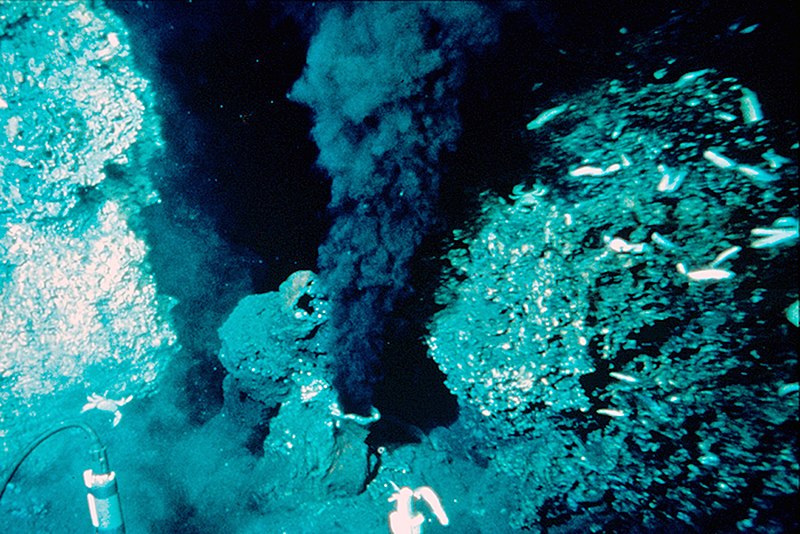

Where seawater infiltrates cracks in newly formed oceanic crust and circulates near hot magma chambers, it is superheated and chemically altered, leaching metals and sulfur compounds from the surrounding rock. This superheated, mineral-laden fluid returns to the seafloor through hydrothermal vent systems. At black smokers—named for the plumes of dark precipitate that billow from the vent openings—sulfide-rich fluid emerging at temperatures up to 400°C reacts with the cold ambient seawater to precipitate iron, copper, and zinc sulfide minerals, building chimneys that may reach several meters in height. These vent systems sustain chemosynthetic ecosystems in complete isolation from sunlight, fueled by the chemical energy of hydrogen sulfide, and have attracted considerable scientific interest as potential environments analogous to those where life may have first emerged on early Earth.17, 18
Recent research has suggested that periodic increases in mid-ocean ridge volcanism, driven by changes in sea level and the corresponding changes in pressure on the ocean floor, may modulate atmospheric CO⊂2; concentrations over timescales of tens of thousands of years, potentially influencing glacial-interglacial cycles. The carbon dioxide released by submarine volcanism constitutes a significant and historically underappreciated component of the long-term carbon cycle.17
Volcanic gases and the atmosphere
Volcanic outgassing has played a fundamental role in shaping the composition of Earth's atmosphere and oceans across geological time. Magma rising from the mantle carries dissolved gases—predominantly water vapor, carbon dioxide, and sulfur dioxide, with lesser amounts of hydrogen chloride, hydrogen fluoride, and hydrogen sulfide. As magma decompresses during ascent, these gases exsolve from the melt; at lower pressures near the surface, gas exsolution drives the explosive fragmentation of silicic magmas and contributes to the eruptive vigor of all volcanic systems.19
Over the first billion years of Earth's history, prolonged volcanic outgassing is thought to have been the primary source of Earth's secondary atmosphere, releasing the water vapor and carbon dioxide that were largely absent from the proto-Earth's thin primordial atmosphere after the energetic planetary accretion process. The water vapor condensed to form the early oceans, while carbon dioxide acted as a greenhouse gas that kept early Earth warm enough to maintain liquid water despite the fainter luminosity of the young Sun.20
On shorter timescales, explosive eruptions that inject sulfur dioxide into the stratosphere produce a pronounced but temporary cooling effect. Sulfur dioxide combines with water vapor to form sulfate aerosols that reflect incoming solar radiation back into space before it can warm the surface. The 1783–1784 Laki fissure eruption in Iceland, though effusive rather than explosive, released an estimated 120 million tonnes of sulfur dioxide over eight months, causing crop failures across Europe and contributing to a famine that killed approximately a quarter of Iceland's population.13 The episode illustrates that even non-explosive eruptions can have severe regional consequences when gas emissions are prolonged and voluminous.
Volcanic carbon dioxide, unlike the cooling effect of stratospheric sulfate aerosols, drives long-term warming on geological timescales. The CO⊂2; released during large igneous province emplacement accumulates in the atmosphere over hundreds of thousands of years, enhancing the greenhouse effect and raising global temperatures. This mechanism, combined with ocean acidification from dissolved CO⊂2; and direct toxicity from hydrogen sulfide and sulfur dioxide, is the primary pathway by which volcanic events such as the Siberian Traps drove mass extinction events.24, 25
References
Partial melting experiments on a lherzolite Iherzolite at 10 kbar: controls on the production and composition of basaltic liquids
Volcanic Explosivity Index (VEI): an estimate of explosive magnitude for historical volcanism
Siberian Traps large igneous province: evidence for two flood basalt pulses around the Permo-Triassic boundary and in the Middle Triassic, and contemporaneous granitic magmatism