Overview
- Kimberlites are rare, volatile-rich ultramafic igneous rocks that erupt explosively from depths of 150 to more than 700 kilometres in narrow carrot-shaped pipes, sampling and transporting fragments of the deep continental mantle to the surface.
- Diamonds in kimberlites are not products of kimberlite magmatism but xenocrysts — ancient crystals that formed in the cratonic mantle root over billions of years and are merely passengers in the rapidly ascending magma.
- Kimberlite pipes are almost exclusively confined to Archean and Paleoproterozoic cratons, where the lithospheric keel is thick enough and cold enough to extend into the diamond stability field, making the geographic distribution of economic diamond deposits a direct consequence of deep continental architecture.
Kimberlites are rare, volatile-rich ultramafic igneous rocks that erupt from greater depths than any other terrestrial magmas, ascending hundreds of kilometres through the continental lithosphere in narrow vertical conduits called pipes. They are the principal natural source of gem and industrial diamonds, and along the way they sample and preserve fragments of the deep mantle — cratonic peridotite, eclogite, and the rare suite of high-pressure minerals that exist nowhere at the surface except as inclusions in diamond. Although kimberlite eruptions account for a vanishingly small fraction of Earth's volcanic output, the rocks they produce are among the most studied in petrology because they offer the only direct access to mantle material from depths exceeding 150 kilometres.1, 14
The relationship between kimberlite and diamond is one of carrier and cargo. Diamonds form in the cratonic mantle keel over billions of years through processes essentially unrelated to the brief and violent kimberlite eruptions that bring them to the surface; the magma merely scavenges them from their host rocks during ascent and delivers them, intact, into the upper crust. The geographic distribution of economic diamond deposits is therefore controlled not by where kimberlites erupt but by which kimberlites happen to pass through lithosphere thick enough and cold enough to host the diamond stability field.5, 8
Definition and classification
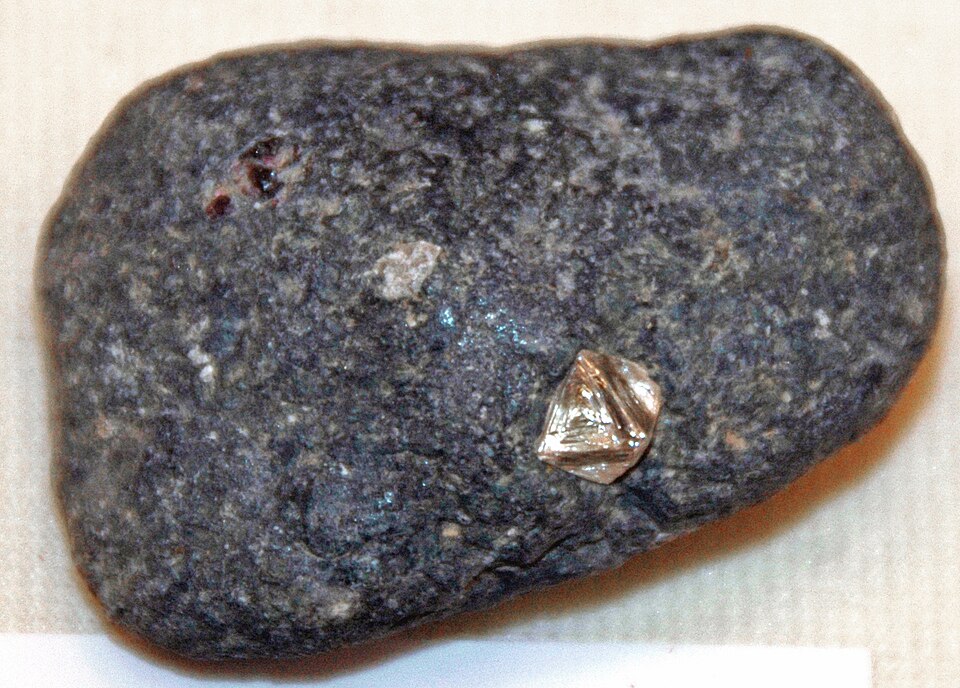
The name kimberlite was coined for the diamond-bearing rocks of the Kimberley district of South Africa, where the first economic diamond pipes were recognised in the 1870s. Mitchell's foundational 1986 monograph defined kimberlite as a volatile-rich (dominantly carbon-dioxide-rich) potassic ultramafic rock with a distinctive inequigranular texture: large rounded crystals or megacrysts of olivine (some derived from the mantle, some crystallised from the magma itself) set in a finer-grained groundmass containing some combination of olivine, phlogopite, calcite, serpentine, monticellite, perovskite, spinel, and apatite.1 The term ultramafic refers to the very high magnesium oxide (MgO) content of these rocks, which typically exceeds 12 weight percent and often reaches 25 to 30 weight percent — substantially higher than the magnesium content of basalt and reflective of a mantle source rich in olivine and orthopyroxene.1, 20
_(17440851983).jpg)
Petrologists distinguish two principal varieties of kimberlite. Group I kimberlite, sometimes called basaltic kimberlite, is dominated by olivine, calcite-bearing groundmass, and a relatively low potassium content; it constitutes most of the diamondiferous pipes worldwide and was originally defined from southern African examples such as the Kimberley, Wesselton, and Premier mines. Group II kimberlite, sometimes called orangeite or micaceous kimberlite, is richer in phlogopite mica and potassium, has a distinct trace-element and isotopic signature, and is restricted almost entirely to the Kaapvaal craton of southern Africa.1, 13 Most modern classifications now treat Group II rocks as belonging to the related but distinct orangeite family rather than as a subdivision of kimberlite proper, and recent reviews place both within a continuum of cratonic ultramafic-alkaline magmas that includes lamproites, ultramafic lamprophyres, and carbonatites.20
Kimberlite must also be distinguished from lamproite, a related but compositionally distinct potassium-rich ultramafic rock. Lamproites are richer in silica and potassium, contain leucite and Ti-rich phlogopite rather than calcite and serpentine, and form under a more reducing, water-dominated rather than CO2-dominated volatile regime.17, 20 The distinction matters economically as well as petrologically because lamproites can also host diamonds — the Argyle pipe of Western Australia, the world's leading producer of pink diamonds and historically a major industrial source, erupts a diamondiferous olivine lamproite into Proterozoic crust rather than a true kimberlite into Archean craton.17
Pipe architecture and emplacement
Kimberlite bodies have a characteristic three-part vertical structure that reflects the changing physical conditions of the magma as it nears the surface. At depth, narrow feeder dykes ascend through the lithosphere, in places only a few metres wide, transporting magma at high speed from the mantle source region. These dykes feed a steep, downward-tapering pipe known as the diatreme, typically 1 to 2 kilometres in vertical extent and a few hundred metres in diameter, in which the magma fragments explosively as dissolved volatiles exsolve. At the top, where the diatreme intersected the palaeo-surface, the eruption built a shallow maar-tuff ring or crater, which is rarely preserved because of subsequent erosion. The intact volcanic edifice was probably no taller than a few tens of metres.1, 2, 13
The carrot-shaped geometry that gives kimberlite pipes their popular nickname — broad at the surface, tapering to a narrow root zone at depth — is a consequence of explosive widening near the surface as the magma decompresses and fragments. Below about 1.5 to 2 kilometres depth, the pipe walls are essentially vertical and the conduit is filled with hypabyssal kimberlite emplaced as a coherent intrusive body. Above that depth, the explosive expansion of CO2 produces a fragmented, breccia-rich diatreme infill, and at the surface the eruption deposits pyroclastic kimberlite (tuffisitic kimberlite) within the maar crater.13, 20 South African petrologists recognise three rock facies corresponding to these zones — hypabyssal, diatreme, and crater — though the precise boundaries depend on the depth of erosion and the nature of the country rock through which the pipe has been excavated.1
Pipe diameters at the palaeo-surface range from less than 100 metres for small bodies to roughly 1.5 kilometres for the largest known examples; surface areas range over more than three orders of magnitude. The Premier (Cullinan) pipe in South Africa, with a surface area of about 32 hectares, was for many decades the largest known kimberlite pipe; the Mwadui pipe in Tanzania, at roughly 146 hectares, is now recognised as the largest single kimberlite body on Earth.13 Recent geochronological work indicates that the largest pipes such as Premier and Mwadui are not single instantaneous events but were assembled over magmatic episodes lasting hundreds of thousands to several million years, with multiple pulses of magma reactivating the same conduit and incrementally enlarging the diatreme.19
Ascent and eruption mechanism
The mechanism by which kimberlite magma traverses 150 to 250 kilometres of cool, rigid lithosphere in a brief geological instant is one of the central problems in volcanology. Conventional basaltic magmas rise slowly through the crust along propagating dykes at velocities of metres to tens of metres per hour, but kimberlite ascent must be far faster: diamonds, which are metastable at upper-mantle and crustal temperatures, would graphitise or be resorbed if the journey took more than a few hours.2, 3 Theoretical models and empirical constraints from indicator-mineral disequilibrium and xenolith preservation indicate that kimberlite magma ascends at velocities of several to tens of metres per second — that is, tens to hundreds of kilometres per hour — reaching the surface from its source region within hours to a few days.2, 3
Two complementary models account for the rapid ascent. Wilson and Head proposed in 2007 that kimberlite eruption is a runaway explosive process: a deep dyke propagates upward driven by a CO2-rich gas cap at its tip, and once the dyke breaches the surface a depressurisation wave travels back down the conduit, fragmenting the magma and accelerating the eruption to highly energetic, supersonic velocities in the upper kilometres.3 Russell and colleagues showed in 2012 that the parental kimberlite melt is probably a carbonatite — a carbonate-dominated, very low-viscosity liquid — that progressively assimilates orthopyroxene from the mantle wall rocks during ascent. The reaction between melt and orthopyroxene produces olivine and exsolves CO2, which lowers the magma's bulk density, increases its buoyancy, and drives a self-accelerating ascent through the lithosphere.4
The two models are not mutually exclusive: assimilation-driven buoyancy plausibly powers the deep ascent, while the gas-driven, fragmentation-controlled regime takes over in the upper few kilometres where decompression is most rapid. Both models help explain why kimberlite pipes are so volumetrically small — the largest known eruptions probably transported only a few cubic kilometres of magma — despite being among the most violent terrestrial volcanic events.2, 20 No kimberlite eruption has ever been observed in human history; the most recent known kimberlite, the Igwisi Hills cones in Tanzania, erupted only about 12,000 years ago and remain the only kimberlite volcano with a recognisable surface morphology.20
The diamond stability field
Diamond is a high-pressure polymorph of carbon that is stable only at pressures and temperatures above the graphite-diamond phase boundary determined experimentally by Bundy and others. At the temperatures of the cratonic mantle (roughly 900 to 1400°C), the boundary lies at pressures of about 4 to 5 gigapascals, corresponding to depths of approximately 130 to 150 kilometres beneath the surface.9 Below this depth, in the cool interior of a thick continental keel, carbon crystallises as diamond; above it, the same carbon would exist as graphite. The depth interval between the graphite-diamond boundary and the base of the lithosphere is called the diamond window, and its thickness is the single most important geological control on whether a given region can produce economic diamonds.5, 14
Approximate pressure–temperature conditions in the cratonic mantle and the diamond stability field9, 16
| Depth (km) | Pressure (GPa) | Cratonic geotherm T (°C) | Stable carbon polymorph | Mantle assemblage |
|---|---|---|---|---|
| 50 | ~1.5 | ~600 | Graphite | Spinel peridotite |
| 100 | ~3.0 | ~850 | Graphite | Garnet peridotite |
| 150 | ~4.5 | ~1050 | Diamond | Garnet peridotite |
| 200 | ~6.0 | ~1200 | Diamond | Garnet peridotite / eclogite |
| 250 | ~7.5 | ~1350 | Diamond (lithosphere base) | Garnet peridotite / eclogite |
| 410–660 | ~14–24 | ~1500–1700 | Diamond (transition zone) | Wadsleyite, ringwoodite, majorite |
For a typical Archean craton with a lithospheric thickness of 200 to 250 kilometres, the diamond window spans 50 to 100 kilometres of vertical extent, providing an enormous reservoir of mantle peridotite within which diamonds can crystallise and survive.16 Younger and thinner Phanerozoic lithosphere, by contrast, either does not extend into the diamond stability field at all or hosts only a narrow window near its base, and kimberlite pipes erupting through such terranes carry few or no diamonds. The relationship between lithospheric thickness and diamond fertility is direct enough that mantle xenoliths from kimberlite pipes have become one of the principal tools for mapping the present and past extent of cratonic keels worldwide.8, 16
How and when diamonds form
Diamonds in kimberlites are not produced by the kimberlite magmatic event. Radiometric dating of mineral inclusions trapped within diamonds during their growth has shown that the diamonds themselves are typically 1 to 3 billion years old — far older than their host kimberlites, which span ages from the Proterozoic to the Cenozoic and average a few hundred million years. The diamonds are thus xenocrysts, ancient crystals scavenged from their original mantle host rocks during eruption, while the kimberlite is merely the elevator that transports them.5, 15
Inclusion studies divide lithospheric diamonds into two principal suites based on the minerals they contain. The peridotitic or P-type suite, accounting for roughly 65 percent of inclusion-bearing diamonds, contains chrome-pyrope garnet, chrome diopside, olivine, and chromite — the assemblage of depleted mantle peridotite, the residue left behind after large degrees of melting in the Archean. The eclogitic or E-type suite, accounting for about 33 percent, contains pyrope-almandine garnet and omphacitic clinopyroxene with bulk compositions and oxygen-isotope signatures consistent with subducted oceanic crust that was driven into the mantle keel and trapped there.7 A third small group, the websteritic suite, contains assemblages intermediate between the other two and accounts for the remaining 2 percent.7
Re-Os dating of sulfide inclusions and Sm-Nd dating of silicate inclusions have produced a robust chronology of cratonic diamond formation. Peridotitic diamonds dominate the oldest population, with ages reaching beyond 3.3 billion years and a major peak around 2.9 to 3.1 billion years — coincident with the major phase of cratonic root formation in the late Archean. Eclogitic diamonds are mostly younger, with the oldest ages around 2.9 billion years and a secondary peak in the Proterozoic between 1.0 and 2.0 billion years; their younger ages and crustal isotopic signatures support a subduction origin.5, 6, 15 The implication is that diamond formation tracks the major events of continental assembly and growth, and that the cratonic keels have stored their diamond cargo for billions of years until kimberlite eruptions sampled them.6
Diamonds grow through reactions between carbon-bearing fluids or melts and the surrounding mantle minerals, with the carbon source typically interpreted as carbonate or methane in metasomatic fluids. The fluids that produce eclogitic diamonds carry isotopically light carbon consistent with subducted organic and carbonate sediment, supporting a recycling mechanism in which surface carbon is conveyed downward by subducting slabs, trapped beneath the cratonic keel, and stored as diamond for billions of years before being returned to the surface in a kimberlite eruption.6, 7
Superdeep diamonds and the transition zone
A small but scientifically important fraction of diamonds — perhaps 1 to 2 percent of inclusion-bearing stones globally — contain mineral inclusions that cannot have formed in the lithosphere at all. These superdeep or sublithospheric diamonds carry inclusions of majoritic garnet, calcium-silicate perovskite, ferropericlase, and (in rare instances) the high-pressure olivine polymorph ringwoodite, all of which are stable only at depths of 300 to 800 kilometres — that is, in the asthenosphere, the mantle transition zone, and the uppermost lower mantle.10, 18
The most spectacular evidence for the deep origin of these diamonds came in 2014, when Pearson and colleagues reported the first natural sample of ringwoodite ever found. The crystal was a 40-micrometre inclusion in a diamond from the Juina district of Brazil, and infrared spectroscopy revealed that it contained more than 1 weight percent water bound into its crystal structure.11 Because ringwoodite is the stable form of olivine only at pressures corresponding to 525 to 660 kilometres depth, the discovery provided the first direct mineralogical evidence that the mantle transition zone contains a substantial reservoir of water — a result with major implications for the deep water cycle and the long-term volatile budget of the planet.11
The very largest gem diamonds — the so-called CLIPPIR (Cullinan-like, Large, Inclusion-Poor, Pure, Irregular, and Resorbed) stones, which include the 3,106-carat Cullinan rough — are also superdeep. Smith and colleagues showed in 2016 that CLIPPIR diamonds contain rare metallic iron-nickel-carbon-sulfur inclusions, indicating that they crystallised from a metallic liquid in the deep mantle at depths of approximately 360 to 750 kilometres. The presence of metallic iron at these depths confirms that much of the deep mantle is highly reduced, an inference of fundamental importance for models of mantle redox state and the long-term cycling of carbon and oxygen between the surface and the interior.10, 18
Cratonic distribution and the diamond rule
The geographic distribution of kimberlite pipes is one of the most striking patterns in global volcanology. Of the more than 6,000 known kimberlite occurrences worldwide, the overwhelming majority lie within or directly adjacent to Archean cratons — the ancient nuclei of continental crust that have remained tectonically stable for more than 2.5 billion years. The empirical generalisation, known informally as Clifford's rule, holds that economic diamond deposits are restricted to kimberlites erupting through Archean crust at least 2.4 billion years old, and that diamondiferous kimberlites are essentially absent from younger terranes.8, 13
The geological reason for the rule is now well understood: only Archean cratons preserve the thick (200 to 250 kilometres or more), cold lithospheric keels in which the diamond window is sufficiently developed to host an economic diamond reservoir. Younger Proterozoic and Phanerozoic lithosphere is generally thinner and warmer, with little or no extension into the diamond stability field; kimberlites that ascend through it carry few diamonds even when the magma itself is mineralogically indistinguishable from a diamondiferous craton-hosted variety.8, 16 Statistical analysis of global kimberlite databases by Jelsma and others has shown that the proportion of diamondiferous kimberlite is roughly 38 percent on Archean terranes but drops to about 25 percent on Proterozoic terranes and lower still on younger crust, with grade and value typically falling more steeply than the proportion alone suggests.8
Within cratonic regions, kimberlites tend to cluster along lithospheric-scale lineaments — ancient suture zones, deep faults, or the margins of terrane boundaries — that probably exploit pre-existing structural weaknesses in the lithosphere as the magma ascends.8 The episodic global distribution of kimberlite eruption ages, with notable peaks in the late Cretaceous, mid-Proterozoic, and late Archean, suggests that kimberlite magmatism is also temporally linked to plate reorganisations and supercontinent cycles, perhaps reflecting periods of mantle upwelling or stress changes that allowed melts to penetrate the rigid cratonic lid.12, 20
Major kimberlite pipes and provinces
The diamond mining industry is built on a relatively small number of large, productive kimberlite pipes distributed across a handful of cratonic provinces. Their discovery histories span more than a century and trace the gradual extension of diamond exploration from southern Africa to Siberia to subarctic Canada.

The Premier (Cullinan) pipe, located about 40 kilometres east of Pretoria on the Kaapvaal craton, was discovered in 1902 and has produced gem diamonds continuously for more than a century. With a surface area of about 32 hectares, it is one of the largest individual kimberlite bodies in southern Africa. In 1905 the pipe yielded the 3,106-carat Cullinan rough, the largest gem-quality diamond ever found, which was subsequently cleaved into nine major stones now part of the British Crown Jewels.13 Geochronology by U-Pb dating of perovskite has placed the main explosive eruption age of the Premier pipe at approximately 1,153 million years — making it one of the older productive kimberlites in the world — and recent work has shown that the pipe was emplaced over a magmatically active interval lasting more than ten million years rather than as a single event.19
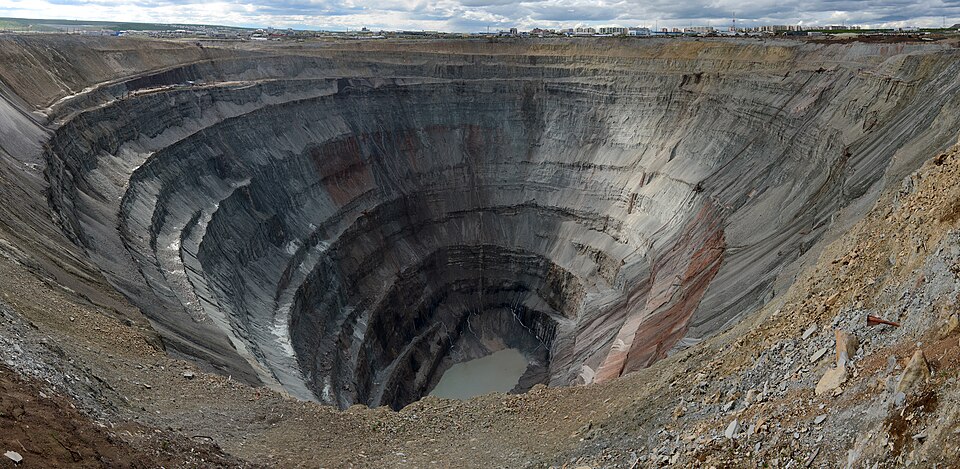
The Mir pipe in the Sakha Republic of Russian Yakutia was discovered on 13 June 1955 by Soviet geologists Yuri Khabardin, Ekaterina Elagina, and Viktor Avdeenko during the Amakinsky Expedition, breaking the southern African monopoly on diamond production. Mining began in 1957 under extreme subarctic conditions, and by the 1960s the Mir pipe was producing approximately 10 million carats per year, of which roughly 20 percent was gem grade. The open pit eventually reached 525 metres deep and 1,200 metres in diameter before being closed in 2001 in favour of underground mining.13
The nearby Udachnaya pipe, discovered just two days later on 15 June 1955 by Vladimir Shchukin and his team, is intruded into Lower Ordovician limestone and has been dated by U-Pb perovskite methods to a Late Devonian eruption age of approximately 367 million years. The Udachnaya open pit, opened in 1971 and closed in 2014 in favour of underground extraction, eventually became roughly 640 metres deep, the third-deepest open-pit mine in the world. Udachnaya has been particularly important to mantle science because it has yielded an unusually fresh suite of mantle xenoliths, including coarse garnet peridotites and rare unaltered hydrous samples that have been used to reconstruct the structure and history of the Siberian cratonic root.13
The discovery of the Lac de Gras kimberlite field in Canada's Northwest Territories transformed the global diamond industry in the 1990s. Geologists Charles Fipke and Stewart Blusson, after nearly a decade of indicator-mineral prospecting across the central Slave craton, located the first economic Canadian kimberlite at Point Lake in 1991, triggering one of the largest staking rushes in mining history. The Ekati mine, opened in 1998, became Canada's first producing diamond mine; it works a cluster of pipes 45 to 62 million years old emplaced into Archean granitoids and metasediments of the central Slave craton, most of them lying beneath shallow lakes.13 The nearby Diavik mine, opened in 2003, exploits a separate cluster of pipes within the same kimberlite field. Together with the Mwadui pipe in Tanzania, the Catoca pipe in Angola, the Orapa and Jwaneng pipes in Botswana, and the diamondiferous lamproites of the Ellendale and Argyle fields in Western Australia, these provinces account for the bulk of historical diamond production worldwide.13, 17
Age distribution of kimberlite eruptions
Improvements in U-Pb geochronology of perovskite, a common groundmass mineral in kimberlite, have allowed precise dating of the eruption ages of hundreds of kimberlite pipes worldwide. Perovskite crystallises directly from kimberlite magma and incorporates uranium and thorium readily, making it the geochronometer of choice for kimberlite emplacement. Compilations of these ages reveal that kimberlite magmatism has been strongly episodic over geological time, with major eruptive pulses concentrated in narrow time windows separated by relatively quiet intervals.12, 20
Selected major kimberlite provinces and their eruption ages12, 13, 19
| Pipe or province | Country / craton | Eruption age (Ma) | Notes |
|---|---|---|---|
| Premier (Cullinan) | South Africa / Kaapvaal | ~1153 | Source of the 3,106-ct Cullinan rough; multi-pulse emplacement |
| Kimberley cluster (incl. Wesselton) | South Africa / Kaapvaal | ~84–90 | Type locality; Group I and Group II kimberlites |
| Orapa, Jwaneng | Botswana / Kaapvaal-Zimbabwe | ~93 (Orapa) | Among the highest-value pipes in the world |
| Mwadui (Williamson) | Tanzania / Tanzania craton | ~52 | Largest known kimberlite by surface area (~146 ha) |
| Mir | Russia / Siberian craton | ~360 | Late Devonian; first major Russian discovery (1955) |
| Udachnaya | Russia / Siberian craton | ~367 | Source of unusually fresh mantle xenoliths |
| Ekati / Diavik (Lac de Gras) | Canada / Slave craton | ~45–62 | Discovered 1991; opened 1998 (Ekati), 2003 (Diavik) |
| Argyle (lamproite, not kimberlite) | Australia / Kimberley craton | ~1180 | Major pink diamond producer; closed 2020 |
| Igwisi Hills | Tanzania / Tanzania craton | ~0.012 | Youngest known kimberlite; preserved tuff cones |
The compilation reveals two principal observations. First, kimberlite eruption ages span nearly the entire continental record, from the Mesoarchean through the Holocene, and a single craton can host pipes of widely different ages — the Kaapvaal craton, for example, has been intruded by kimberlites at intervals from at least 1,800 million years ago through to the late Cretaceous. Second, despite this enormous time range, kimberlite magmatism is not uniformly distributed: pulses of activity in the late Cretaceous (roughly 80 to 110 million years ago, dominating the southern African and Botswana fields) and in the Devonian (roughly 350 to 380 million years ago, dominating the Siberian field) are particularly prominent.12, 20 These pulses appear to correlate broadly with periods of supercontinent breakup and major plate reorganisation, suggesting that the conditions favouring kimberlite ascent are at least partly controlled by global tectonic stress and large-scale mantle dynamics rather than purely by local magmatic processes.8, 12
Mantle xenoliths and the deep continental keel
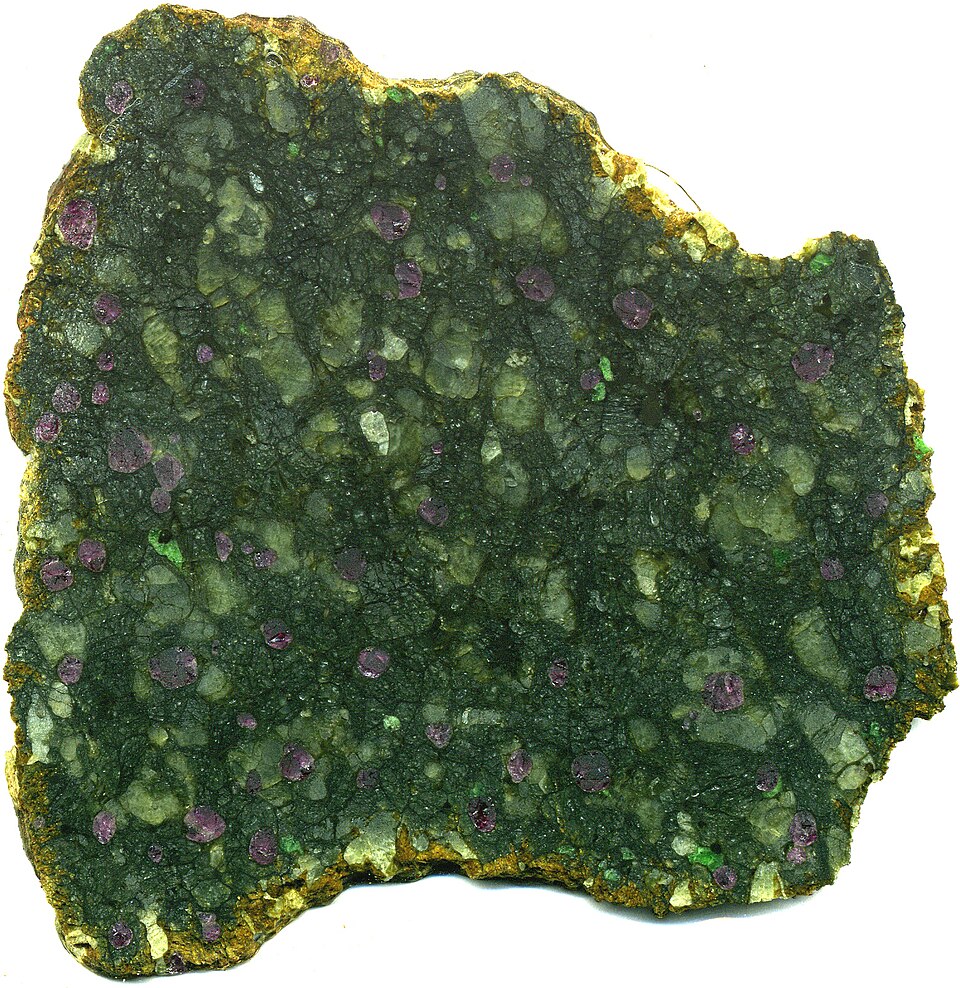
One of the most scientifically valuable aspects of kimberlite eruptions is their capacity to entrain and preserve mantle xenoliths — coherent, often centimetre- to metre-scale fragments of the rocks through which the magma ascended. Because the eruption is so rapid, these fragments do not equilibrate thermally or chemically with the host magma during ascent, and they arrive at the surface as essentially unmodified samples of the deep continental mantle. Kimberlite xenolith suites provide the only direct samples of mantle material from depths of more than 100 kilometres anywhere on Earth.1, 16
_1_(15001208861).jpg)
The dominant xenolith type in most kimberlite pipes is garnet peridotite — an olivine-rich rock containing chrome-pyrope garnet, chrome diopside, and orthopyroxene that represents the residue of melt extraction from the primitive mantle in the Archean. The compositions of coexisting minerals in these rocks can be used as geothermobarometers: the iron-magnesium exchange between garnet and clinopyroxene is sensitive to temperature, while the aluminium content of orthopyroxene is sensitive to pressure. Combining these temperature and pressure estimates from many xenoliths in a single pipe yields a palaeo-geotherm — a curve relating temperature to depth in the lithosphere at the moment of eruption — from which the thickness of the lithosphere can be inferred.16
Xenolith-derived geotherms beneath cratons such as Kaapvaal, Siberia, Slave, and West Africa consistently indicate lithospheric thicknesses of 200 to 250 kilometres and surface heat flows of 38 to 45 milliwatts per square metre — substantially colder and thicker than the lithosphere beneath younger continental terranes. The depleted compositions of the peridotites (low aluminium, low calcium, high magnesium) indicate that these rocks have lost large amounts of basaltic melt, consistent with formation as the residue of high-degree mantle melting in the Archean. The combination of low density (because of melt extraction) and high viscosity (because of dehydration during melting) explains the long-term stability of cratonic keels, which have resisted thermal and mechanical erosion for billions of years and remain attached to the overlying crust.16
In addition to garnet peridotite, kimberlite pipes also yield rarer but petrologically important xenolith types: eclogite (representing fragments of subducted oceanic crust trapped in the mantle keel), MARID-suite rocks (mica-amphibole-rutile-ilmenite-diopside, recording metasomatic enrichment of the mantle by passing fluids), and megacrysts of olivine, garnet, ilmenite, and clinopyroxene that crystallised from the kimberlite magma itself or from related deep melts. Together, these xenoliths and their constituent minerals provide a uniquely detailed record of the structure, composition, history, and metasomatic evolution of the cratonic mantle.1, 8
Mining and economic significance
Kimberlite has been the principal source of natural diamonds since the 1870s, when the recognition that the rich diamond placers of the Vaal River in South Africa traced upstream to a cluster of weathered carrot-shaped intrusions in the Kimberley district transformed diamond mining from a small-scale alluvial industry into a worldwide hard-rock enterprise. Diamond grades in productive kimberlite pipes typically range from a few tenths of a carat to a few carats per tonne of ore, with the highest-grade Russian and Botswanan pipes reaching grades several times this; even the richest pipes therefore process tens of millions of tonnes of rock per year to recover a few million carats of diamond.13
Modern open-pit kimberlite mining typically extracts the upper 300 to 600 metres of a pipe before transitioning to underground methods that follow the diatreme to depths exceeding 1 kilometre. Once excavated, the kimberlite ore is crushed, screened, and processed through dense-media separation, X-ray fluorescence sorting, and grease-table recovery to isolate diamonds, which constitute roughly one part per million by mass of the ore even in the richest pipes.14 The combination of low ore grade, high processing costs, and erratic distribution of large stones makes diamond mining a capital-intensive and geologically demanding industry, and the extreme rarity of viable kimberlite pipes — perhaps one in fifty known kimberlites is economic, and only a few hundred kimberlites worldwide have ever been mined for diamonds — means that exploration relies heavily on indicator-mineral geochemistry, magnetic and gravity surveys, and till-sampling techniques developed over more than a century.14
Beyond their economic role, kimberlite-hosted diamonds and the xenoliths that accompany them have become indispensable to deep-Earth science. Diamonds are the only natural samples of the mantle that incorporate trapped mineral inclusions strong enough to withstand the pressure changes of ascent without re-equilibration, and they therefore preserve mineralogical and isotopic information about depths and processes inaccessible by any other means. The discovery of hydrous ringwoodite in a Brazilian diamond, the recognition of metallic iron in CLIPPIR diamonds from southern Africa, and the dating of subducted carbon in eclogitic diamonds from Botswana have all transformed scientific understanding of the deep mantle in the past two decades.10, 11, 18 Without kimberlite eruptions to deliver them, none of this evidence would be available at the surface, and the deep continental mantle would remain effectively inaccessible to direct sampling by any technique. The geological accident that allows volatile-rich, low-viscosity, deep-sourced magmas to ascend through stable cratons in a matter of hours is therefore not merely a curiosity of igneous petrology but the single mechanism by which the planet's deep continental interior makes itself visible to observers at the surface.
References
Pressure-temperature phase and transformation diagram for carbon, updated through 1994
Re-Os isotope systematics of sulfide inclusions in diamonds: link between diamond and host kimberlite ages
Formation of Archaean continental lithosphere and its diamonds: the root of the problem
Premier evidence for prolonged kimberlite pipe formation and its influence on diamond transport from deep Earth