Overview
- The 1980 discovery of anomalous iridium concentrations at the Cretaceous-Paleogene boundary by the Alvarez team provided the first physical evidence that an extraterrestrial impact caused the end-Cretaceous mass extinction, a hypothesis confirmed by the identification of the approximately 180-kilometer-wide Chicxulub crater buried beneath Mexico's Yucatán Peninsula.
- The impact of an asteroid roughly 10 to 15 kilometers in diameter released energy equivalent to billions of nuclear weapons, triggering a cascade of kill mechanisms including a thermal pulse, global wildfires, a tsunami thousands of times more energetic than any in recorded history, prolonged darkness from stratospheric soot and dust, and severe ocean acidification.
- Scientific consensus, supported by a landmark 41-author review in 2010 and subsequent habitat modeling and geochronological studies, identifies the Chicxulub impact as the primary trigger of the end-Cretaceous extinction, with Deccan Traps volcanism playing a secondary or exacerbating role rather than serving as the principal cause.
On a day approximately 66 million years ago, an asteroid roughly 10 to 15 kilometres in diameter struck the shallow seas overlying what is now Mexico's Yucatán Peninsula, releasing more energy than any event in the last half-billion years of Earth history. The Chicxulub impact, as it is now known, excavated a crater approximately 180 to 200 kilometres in diameter, ejected hundreds of cubic kilometres of vaporized and molten rock into the atmosphere, and set in motion a cascade of environmental catastrophes that extinguished roughly 76 percent of all species on Earth.8, 10 The identification of this event—from a thin layer of anomalous iridium in Italian limestone to the discovery of the buried crater beneath a Caribbean coastline—ranks among the most consequential scientific detective stories of the twentieth century. It established that catastrophic extraterrestrial impacts are not merely theoretical possibilities but have demonstrably shaped the trajectory of life on this planet.
The Alvarez hypothesis
The scientific case for an asteroid impact as the cause of the end-Cretaceous mass extinction was assembled by an interdisciplinary team at the University of California, Berkeley, and published in Science in June 1980. The team was led by Nobel Prize-winning physicist Luis W. Alvarez and his son, geologist Walter Alvarez, with nuclear chemists Frank Asaro and Helen Michel. While studying a thin reddish-brown clay layer exposed at Gubbio, Italy—a layer that marks the precise boundary between the Cretaceous and Paleogene rock strata—the team measured concentrations of the element iridium that were approximately 30 times higher than in the limestone beds immediately above and below.1 Iridium is vanishingly rare in Earth's crust, where it occurs at concentrations of approximately 0.02 parts per billion, but it is far more abundant in certain classes of meteorites, particularly carbonaceous chondrites. The Alvarez team proposed that this geochemical anomaly represented the globally dispersed fallout from a massive asteroid impact, and they calculated from the total mass of iridium in the boundary layer that the impactor was approximately 10 kilometres in diameter.1
The hypothesis was initially met with considerable scepticism. Many palaeontologists favoured gradualist explanations for the end-Cretaceous extinctions, including sea-level regression, climate change, or massive volcanism. The notion that a single catastrophic event could reset the course of evolution struck some researchers as a return to discredited catastrophism. However, the geochemical evidence proved extraordinarily robust. Within a few years of the 1980 publication, the iridium anomaly was documented at more than 100 K-Pg boundary sites around the world—in marine sediments, continental deposits, and deep-sea cores from the Pacific, Atlantic, and Indian Oceans.8
Alongside the iridium, researchers identified additional signatures consistent only with hypervelocity impact. In 1984 and 1987, Bruce Bohor and colleagues reported grains of quartz bearing multiple sets of planar deformation features—microscopic lamellae produced only by shock pressures exceeding 5 to 10 gigapascals, far above anything achievable by volcanic or tectonic processes.2 These shocked quartz grains were found at K-Pg boundary sections across North America and Europe, requiring a global dispersal mechanism consistent with an extremely large impact.2 Additional impact markers identified at the boundary included microscopic spherules of glass formed by the rapid quenching of vaporized rock, nickel-rich spinel crystals of meteoritic origin, and microdiamonds produced by shock compression of carbon.9 Taken together, the boundary layer constituted a globally distributed forensic fingerprint of an impact of extraordinary violence.
Discovery of the crater
The Alvarez hypothesis made a specific, falsifiable prediction: somewhere on Earth there must be a buried impact crater of approximately 150 to 200 kilometres in diameter, formed at precisely 66 million years ago. That structure had, in fact, already been detected—though not recognised as an impact crater at the time.
.jpg)
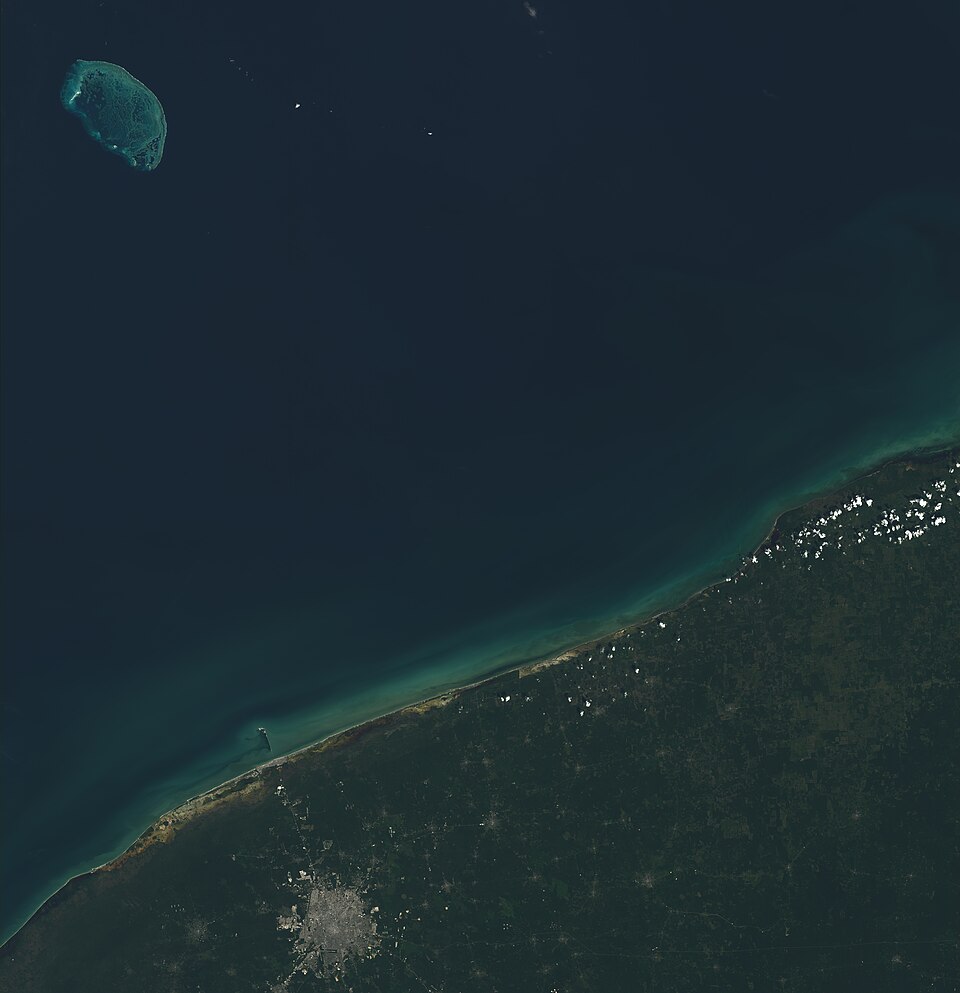
In 1978, geophysicist Glen Penfield, working for the Mexican state oil company Petróleos Mexicanos (Pemex), identified a large semicircular gravity and magnetic anomaly buried beneath approximately one kilometre of Cenozoic sediment on the Yucatán Peninsula and the adjacent Gulf of Mexico continental shelf. Penfield co-presented his findings with Antonio Camargo at a Society of Exploration Geophysicists conference in 1981, suggesting the structure might be an impact crater, but the presentation attracted little attention because the conference was poorly attended by impact specialists, many of whom were at a competing planetary science meeting that same week.4
The connection between Penfield's anomaly and the K-Pg extinction went unrecognised for nearly a decade. The link was finally made when geologist Alan Hildebrand, then a doctoral student at the University of Arizona, was independently searching for the predicted crater. A Houston science writer who had known of Penfield's earlier work put the two researchers in contact. In 1991, Hildebrand, Penfield, and colleagues published a formal description of the buried structure in Geology, naming it Chicxulub after a small village on the Yucatán coast near the crater's centre.3 Analysis of drill cores from Pemex exploration wells within the anomaly revealed impact melt rock, breccias containing shocked minerals, and radiometric ages—determined by argon-argon dating—that matched the K-Pg boundary.3 A subsequent study by Hildebrand and colleagues in Nature in 1992 characterised the crater's size more precisely, establishing a diameter of approximately 180 kilometres and confirming Chicxulub as the largest known Phanerozoic impact structure on Earth.5
Crater structure and the peak ring
Chicxulub is a complex, multi-ring impact crater buried beneath several hundred metres to over one kilometre of post-impact carbonate sediments. Geophysical surveys using seismic reflection, gravity, and magnetic data have revealed a concentric architecture consisting of an outer zone of normal faults extending to roughly 130 kilometres from the centre, an inner topographic rim at approximately 80 to 90 kilometres radius, and a prominent peak ring—an annular ridge of shattered and uplifted rock—at roughly 40 to 45 kilometres from the centre.5, 6 The peak ring rises 400 to 600 metres above the crater floor in its western and northwestern sectors and 200 to 300 metres in the northeast and east, giving the structure an asymmetry that later studies attributed to the oblique trajectory of the impactor.6, 10
Three-dimensional numerical simulations by Collins and colleagues, published in 2020, constrained the impact trajectory to a steeply inclined angle of 45 to 60 degrees from the horizontal, with the asteroid arriving from the northeast. This trajectory angle is significant because modelling indicates it would have maximised the volume of target rock ejected at velocities sufficient to engulf the planet, making the environmental consequences particularly severe.10 The simulations employed an impactor approximately 17 kilometres in diameter with an impact velocity of 12 to 20 kilometres per second, yielding an energy release on the order of 1024 joules—equivalent to roughly 10 billion Hiroshima-class nuclear weapons detonating simultaneously.10, 12
A landmark scientific drilling expedition provided direct physical access to the crater's interior. In April and May 2016, the International Ocean Discovery Program (IODP) and the International Continental Scientific Drilling Program (ICDP) jointly conducted Expedition 364, drilling a single borehole (Hole M0077A) into the peak ring at a location approximately 30 kilometres offshore the Yucatán coast. The expedition recovered core from 505 to 1,335 metres below the seafloor with approximately 99 percent recovery.6, 7 The cores revealed that the peak ring is composed of shocked and fractured granitic basement rocks—originally located at depths of 8 to 10 kilometres beneath the pre-impact surface—that were catastrophically uplifted, overturned, and emplaced in a matter of minutes during the crater's dynamic collapse. These granites are overlain by impact melt rock and suevite (a breccia containing glassy fragments of shock-melted rock), confirming the dynamic collapse model for peak-ring formation in large impact craters.6
The impact sequence
The Chicxulub impact unfolded as a rapid cascade of events spanning seconds to years, each inflicting progressively different forms of environmental damage. Expedition 364 core samples provided a stratigraphic record of the first day of the Cenozoic era, allowing researchers to reconstruct the sequence with remarkable temporal resolution.11
Within seconds of the asteroid's arrival, a shock wave propagated outward through the target rock at velocities exceeding the speed of sound, vaporising the asteroid and a comparable volume of the Yucatán's carbonate and evaporite platform. An ejecta curtain of molten and pulverised rock was launched on ballistic trajectories into the upper atmosphere and, for the most energetic fragments, into suborbital and orbital paths.12 Within minutes, the transient cavity—an initial bowl-shaped void roughly 30 kilometres deep—collapsed under gravity. The crater floor rebounded upward, overshot its equilibrium position, and formed a central uplift that itself collapsed outward, producing the peak ring observed in the geophysical and drilling data.6
Within approximately one hour, ocean water flooded the deep crater through a gap in the northeastern rim, depositing roughly 90 metres of breccia as a violent, debris-laden torrent. Charcoal fragments within this interval provide evidence that fires had already ignited on nearby land surfaces. A tsunami radiated outward from the impact site into the Gulf of Mexico and, within hours, into the open Atlantic and Pacific Oceans.11 Global simulations of this tsunami, published in 2022, estimated that its initial energy was up to 30,000 times greater than that of the devastating 2004 Indian Ocean tsunami. Underwater current velocities exceeded 20 centimetres per second along coastlines worldwide and were sufficient to scour and disturb seafloor sediments at distances exceeding 10,000 kilometres from the impact site.18
Over the following hours, ejecta that had been launched on high ballistic trajectories began re-entering the atmosphere at hypervelocity, heating the upper atmosphere to incandescence. The thermal radiation from this re-entry pulse has been estimated at intensities approaching 10 to 20 kilowatts per square metre at the surface—sufficient to ignite woody vegetation and generate widespread wildfires across much of the Americas and possibly farther afield.12, 13 Geochemical evidence for globally distributed charcoal at the K-Pg boundary, identified in boundary sections from multiple continents, confirms that wildfires burned on a continental scale in the immediate aftermath of the impact.13
Sequence of Chicxulub impact events and their timescales11, 12, 18
| Event | Timescale | Primary effects |
|---|---|---|
| Shock wave and crater excavation | Seconds | Vaporisation of target rock; transient cavity formation |
| Crater collapse and peak ring formation | Minutes | Uplift and collapse of crater floor; melt rock emplacement |
| Ocean flooding of crater | ~1 hour | Debris-laden surge deposits within the crater |
| Tsunami propagation | Hours to days | Seafloor scouring >10,000 km from impact; coastal inundation |
| Ejecta re-entry and thermal pulse | Hours | Global surface heating; ignition of wildfires |
| Impact winter onset | Days to weeks | Dust, soot, and aerosol injection; collapse of sunlight |
| Prolonged darkness and cooling | Months to years | Photosynthesis shutdown; global temperature drop |
| Ocean acidification | Thousands of years | Calcareous organism collapse; carbon cycle disruption |
The global K-Pg boundary layer
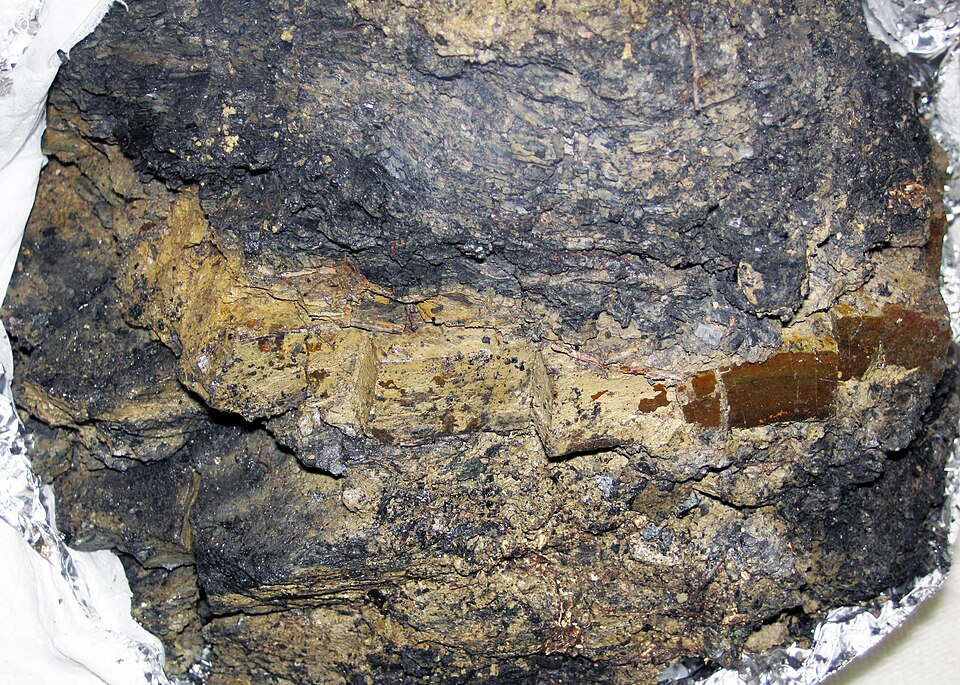
The physical evidence for the Chicxulub impact is preserved in a thin but remarkably consistent sedimentary layer found at K-Pg boundary sections worldwide. The composition and thickness of this layer vary systematically with distance from the impact site, a pattern that provides independent confirmation of Chicxulub as the source crater.9
_(34782334145).jpg)
At proximal sites within a few hundred kilometres of Chicxulub, the boundary interval consists of thick sequences of polymict breccia, impact melt rock, and tsunami deposits up to tens of metres thick. In the Gulf of Mexico region, out to approximately 2,500 kilometres, the boundary includes centimetre-thick layers of impact glass spherules (tektites) interbedded with tsunami-reworked sediments. At intermediate distances of 2,500 to 4,000 kilometres, a distinct tektite layer a few centimetres thick is preserved. At the most distal sites, beyond 4,000 kilometres and spanning every continent and ocean basin, the boundary is marked by a clay layer only 2 to 4 millimetres thick that is enriched in iridium and other platinum-group elements, and that contains a suite of impact-diagnostic minerals.9
The mineral and chemical constituents of the distal boundary layer include shocked quartz grains with multiple sets of intersecting planar deformation features; microkrystites—tiny crystalline spherules formed by condensation from the impact vapour plume; nickel-rich spinel crystals, which are a hallmark of meteoritic material that has been vaporised and recondensed in the atmosphere; and anomalous concentrations of iridium, osmium, and other siderophile elements.2, 9 The size distribution of shocked quartz grains decreases with distance from Chicxulub, consistent with ballistic transport and atmospheric settling from a single source, while the chemistry of spinel crystals varies between ocean basins in ways that reflect differences in atmospheric transport pathways.9 This globally coherent pattern of ejecta distribution constitutes one of the most compelling lines of evidence linking the boundary layer to a single, very large impact event at a specific location.
Kill mechanisms
The environmental consequences of the Chicxulub impact extended far beyond the immediate blast zone. The most biologically devastating effects were not the shock wave, the tsunami, or even the thermal pulse, but rather the prolonged disruption of Earth's climate system and the collapse of photosynthesis that followed.
The most consequential kill mechanism was the injection of vast quantities of light-blocking material into the stratosphere. Three classes of aerosol contributed: fine silicate dust pulverised from the target rock, soot from the combustion of organic-rich target sediments and from impact-triggered wildfires, and sulfate aerosols generated by the vaporisation of the Yucatán's sulfur-rich anhydrite and gypsum deposits.14, 15, 16 Climate modelling by Bardeen and colleagues in 2017 demonstrated that the injection of approximately 15,000 teragrams of soot into the upper atmosphere would have produced near-total darkness at the surface, suppressing photosynthesis for one to two years and driving surface temperatures below freezing at mid-latitudes for three to four years.14 A 2023 study by Senel and colleagues, using grain-size analysis of boundary sediments from North Dakota to constrain the dust particle size distribution, found that fine silicate dust (0.8 to 8 micrometres in diameter) had a longer atmospheric residence time than previously appreciated—approximately 15 years—and contributed to a global average surface temperature decline of as much as 15 degrees Celsius, with photosynthesis suppressed for nearly two years.15
The source of the stratospheric soot is itself significant. Kaiho and colleagues demonstrated in 2016 that the molecular composition of soot at the K-Pg boundary is inconsistent with forest fires alone and instead indicates that much of it originated from the combustion and ejection of organic-rich sedimentary target rocks at the impact site.19 Because the Chicxulub asteroid struck a marine coastal margin where thick sequences of organic-bearing sediments had accumulated, the impact vaporised and ejected an unusually large volume of climate-altering material. The team estimated that only about 13 percent of Earth's surface contained sufficient hydrocarbon-rich sediment to produce this effect, implying that the location of the impact was a critical factor in its lethality.19
Sulfate aerosol cooling operated on a somewhat longer timescale. Climate simulations by Brugger and colleagues in 2017 found that the release of sulfur dioxide from vaporised evaporite rocks drove global mean surface temperatures down by at least 26 degrees Celsius, with subfreezing annual average temperatures persisting for approximately three years. Full climate recovery required roughly 30 years.20 Proxy data from organic biomarkers in boundary sediments in the Netherlands confirm that sea-surface temperatures dropped sharply—by approximately 7 degrees Celsius—in the immediate aftermath of the impact, corroborating the modelling results.25
In the oceans, the impact triggered rapid and severe acidification. The vaporisation of the Yucatán's carbonate and anhydrite platform released enormous quantities of sulfur trioxide and carbon dioxide, which dissolved in seawater and lowered surface-ocean pH. Laboratory impact experiments by Ohno and colleagues showed that sulfur trioxide, not sulfur dioxide, dominated the vapour produced at impact velocities exceeding 10 kilometres per second, and that this sulfur trioxide would have combined rapidly with atmospheric water to form sulfuric acid, delivering acid rain to the surface within days.16 Boron isotope data from foraminifera spanning the K-Pg boundary, published by Henehan and colleagues in 2019, documented a surface-ocean pH decline of approximately 0.25 units within one thousand years of the impact—a geologically instantaneous acidification event with devastating consequences for calcareous marine organisms.17
Estimated global temperature change from Chicxulub aerosol components14, 15, 20
The Deccan Traps debate
Before and independently of the Alvarez hypothesis, some earth scientists had proposed that the end-Cretaceous extinctions were caused by massive volcanism—specifically, the eruption of the Deccan Traps, a vast flood basalt province covering much of west-central India. The Deccan eruptions produced well over one million cubic kilometres of basaltic lava and released enormous quantities of sulfur dioxide and carbon dioxide over a span of roughly 700,000 to 800,000 years straddling the K-Pg boundary.21, 22 The temporal coincidence of the eruptions with the extinction made the Deccan Traps an obvious candidate mechanism, and the debate between impact and volcanism as the primary cause consumed much of the palaeontological and geological community for three decades.
High-precision geochronology published in 2019 substantially clarified the relationship between Deccan volcanism and the impact. Two studies appeared simultaneously in Science using independent dating methods. Schoene and colleagues, employing uranium-lead dating of zircons from volcanic ash beds, concluded that the eruptions occurred in four discrete pulses, the largest of which approximately doubled the eruption rate in the 50,000 years following the Chicxulub impact, suggesting that seismic energy from the impact may have triggered a pulse of enhanced volcanic activity.21 Sprain and colleagues, using argon-argon geochronology, found a more continuous eruption pattern with approximately 75 percent of the total Deccan volume emplaced after the K-Pg boundary.22 Both studies agreed that the main eruptive phase lasted approximately 700,000 to 800,000 years and that significant volcanism both preceded and followed the impact.21, 22
The resolution of the debate has come not from geochronology alone but from ecological and geochemical studies that test the predictions of each hypothesis against the fossil and sedimentary record. In 2020, Chiarenza and colleagues used palaeoclimate and habitat suitability modelling to evaluate whether Deccan volcanism alone could explain dinosaur extinction. Their models showed that the long-term warming from Deccan carbon dioxide emissions actually increased the global extent of habitable dinosaur habitat, while only the impact winter scenario produced the wholesale elimination of suitable environments. Even the short-term cooling episodes attributable to Deccan sulfate aerosol pulses still permitted equatorial habitability, which impact-winter models did not.23
Also in 2020, Hull and colleagues published a comprehensive analysis of ocean temperature and carbon cycle records across the K-Pg boundary in Science. They found that most Deccan-related CO2 and SO2 degassing occurred in the latest Maastrichtian, causing a gradual warming of approximately 2 degrees Celsius before the boundary—but not mass extinction. The abrupt environmental perturbation at the boundary itself was attributable to the impact alone, with volcanism playing a role primarily in the post-impact recovery of the climate and carbon cycle rather than in the extinction itself.24
Selectivity of extinction
The Chicxulub impact did not kill indiscriminately. The patterns of survival and extinction across the K-Pg boundary reflect the specific nature of the kill mechanisms—above all the prolonged darkness and the collapse of photosynthesis-based food chains—and provide some of the strongest evidence that the impact scenario is correctly understood.8
Organisms most vulnerable were those dependent on continuous photosynthetic primary production. Non-avian dinosaurs, despite their 165-million-year dominance, were universally extinguished. Their large body sizes, high metabolic demands, and ultimate dependence on living plant matter left them acutely vulnerable to even a few months of darkness. In the oceans, planktonic foraminifera—the calcareous microorganisms that formed a critical base of the marine food web—suffered extinction rates approaching 90 percent, devastated by the twin assaults of darkness and ocean acidification.8, 17 Ammonites, the coiled cephalopods whose larvae fed on the very phytoplankton destroyed by the impact winter, were completely extinguished.8
The survivors shared traits that conferred resilience in a world without sunlight. Birds—the sole surviving dinosaur lineage—were small, potentially seed-eating animals capable of subsisting on dormant seeds and detritus-based food chains during the months of darkness. Crocodilians survived intact, buffered by their semi-aquatic habits, low metabolic rates, and ability to tolerate prolonged fasting in detritus-rich freshwater environments. Mammals, which were small, ecologically generalised, and probably omnivorous or insectivorous in the latest Cretaceous, endured the crisis and subsequently diversified explosively into the niches vacated by the non-avian dinosaurs.8 Freshwater ecosystems, sustained by inputs of terrestrial organic matter rather than by in situ photosynthesis, experienced far lower extinction rates than either terrestrial or open-marine systems. This pattern is consistent with models in which the primary kill mechanism was the interruption of photosynthesis rather than direct physical destruction.12, 14
Current scientific consensus
The scientific consensus on the cause of the end-Cretaceous mass extinction was articulated most comprehensively in a landmark 2010 review paper in Science, signed by 41 specialists spanning palaeontology, geochemistry, geophysics, and climate modelling. The panel reviewed two decades of accumulated evidence and concluded that the Chicxulub impact was the primary cause of the extinction, and that Deccan volcanism, while it may have stressed late Cretaceous ecosystems, was insufficient on its own to account for the abruptness, global reach, and taxonomic severity of the biological crisis at the K-Pg boundary.8 The decisive evidence was stratigraphic: the vast majority of species disappear from the fossil record synchronously with the iridium-bearing ejecta layer, not gradually over the longer timescale of Deccan volcanism.
Subsequent studies have reinforced and refined this consensus. The 2020 habitat modelling by Chiarenza and colleagues demonstrated that impact-winter conditions, but not Deccan volcanism scenarios, could eliminate dinosaur-habitable environments globally.23 Hull and colleagues' 2020 geochemical analysis confirmed that most Deccan-related climate perturbation preceded the extinction boundary and that the acute environmental crisis was caused by the impact.24 The 2023 dust modelling by Senel and colleagues provided new constraints on the duration and severity of the impact winter, demonstrating that fine silicate dust alone could sustain photosynthetic shutdown for nearly two years.15
The current understanding can be summarised as follows: the Chicxulub asteroid impact was the necessary and sufficient cause of the end-Cretaceous mass extinction. Deccan volcanism was a real and significant environmental perturbation that stressed ecosystems in the final million years of the Cretaceous and may have influenced the pace and pattern of post-extinction recovery, but it was neither the primary trigger of the extinction nor, based on current evidence, a necessary condition for it. The extinction was driven by the impact winter—months of near-total darkness and severe cooling that collapsed photosynthesis-based food chains worldwide—compounded by ocean acidification, thermal shock, and the physical destruction wrought by the tsunami and wildfires.8, 14, 15, 23, 24 The Chicxulub impact remains the only known event in Earth history in which a single geological instant reshaped the entire trajectory of terrestrial and marine life.
References
Shocked quartz in the Cretaceous-Tertiary boundary clays: evidence for a global distribution
Chicxulub crater: a possible Cretaceous/Tertiary boundary impact crater on the Yucatán Peninsula, Mexico
Drilling into the Chicxulub crater to understand the dynamics of large meteorite impacts
The Chicxulub asteroid impact and mass extinction at the Cretaceous-Paleogene boundary
On transient climate change at the Cretaceous-Paleogene boundary due to atmospheric soot injections
Production of sulphate-rich vapour during the Chicxulub impact and implications for ocean acidification
Rapid ocean acidification and protracted Earth system recovery followed the end-Cretaceous Chicxulub impact
Global climate change driven by soot at the K-Pg boundary as the cause of the mass extinction
Baby, it’s cold outside: climate model simulations of the effects of the asteroid impact at the end of the Cretaceous
U-Pb constraints on pulsed eruption of the Deccan Traps across the end-Cretaceous mass extinction
The eruptive tempo of Deccan volcanism in relation to the Cretaceous-Paleogene boundary
Rapid short-term cooling following the Chicxulub impact at the Cretaceous-Paleogene boundary