Overview
- Ice cores drilled from the Antarctic and Greenland ice sheets preserve a continuous archive of past climate stretching back 800,000 years, recording atmospheric composition, temperature, volcanic activity, and dust flux in annual to millennial resolution.
- Isotopic ratios of oxygen and hydrogen in the ice serve as thermometers for past temperature, while tiny air bubbles trapped during snow compaction preserve direct samples of ancient atmospheres, revealing that CO2 and temperature have risen and fallen in lockstep across glacial cycles.
- The pursuit of ice older than one million years — targeting 1.5 Ma or beyond — aims to resolve why glacial cycles shifted from 41,000-year to 100,000-year periodicity during the Mid-Pleistocene Transition, one of the central open questions in climate science.
Ice core paleoclimatology is the science of reconstructing past climates from cylinders of ice drilled vertically through polar ice sheets and high-altitude glaciers. Because snow accumulating on ice sheets compresses under its own weight into solid ice while trapping tiny bubbles of the ambient atmosphere, an ice core is simultaneously a physical archive of past precipitation and a chemical archive of past air. The longest continuous records, recovered from the East Antarctic plateau, now extend back 800,000 years and encompass eight full glacial-interglacial cycles.5, 6 These records have transformed the understanding of Earth's climate system by providing direct, high-resolution measurements of past temperature, atmospheric greenhouse gas concentrations, volcanic activity, dust loading, and the phasing of feedbacks that amplify orbital forcing into global climate change.25
History of ice core drilling
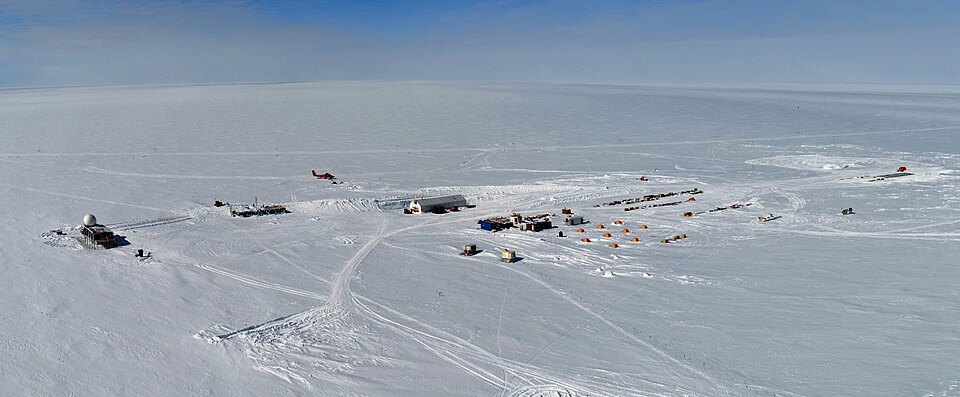

The scientific potential of polar ice as a climate archive was first realized in the 1950s and 1960s, when Willi Dansgaard demonstrated that the isotopic composition of precipitation varies systematically with temperature, establishing the theoretical basis for using ice as a paleothermometer.11 The first deep ice core to reach bedrock was drilled at Camp Century in northwestern Greenland between 1963 and 1966 by a team from the U.S. Army Cold Regions Research and Engineering Laboratory. The Camp Century core, 1,390 meters long, yielded a climate record spanning roughly 100,000 years and provided the first direct evidence that the isotopic composition of glacial ice varied in concert with known climatic changes.1, 2
Soviet scientists began drilling at Vostok Station on the high East Antarctic plateau in the 1970s. The Vostok core ultimately reached a depth of 3,623 meters in 1998, just above the surface of the subglacial Lake Vostok, and the climate record it produced — spanning approximately 420,000 years and four glacial-interglacial cycles — became one of the most influential datasets in climate science.4 The Vostok record demonstrated unambiguously that atmospheric CO2 and Antarctic temperature had varied in close parallel over hundreds of millennia, oscillating between roughly 180 parts per million during glacials and 280–300 ppm during interglacials.3, 4
Through the late 1980s and 1990s, two major Greenland drilling projects — the Greenland Ice Sheet Project 2 (GISP2) and the Greenland Ice Core Project (GRIP) — were completed within 30 kilometers of each other near Summit, the highest point of the Greenland ice sheet. Both cores reached bedrock at approximately 3,050 meters and yielded climate records extending more than 100,000 years into the past. The Greenland cores proved especially valuable for studying abrupt climate events, because the higher snowfall rate in Greenland produces annual layers thick enough to count individually, enabling sub-decadal resolution of rapid temperature oscillations during the last glacial period.7, 8
The landmark of twenty-first-century ice core science was the European Project for Ice Coring in Antarctica (EPICA), which drilled at two sites: Dome C on the East Antarctic plateau and Dronning Maud Land (EDML) in the Atlantic sector. The EPICA Dome C core, completed in 2004 at a depth of 3,270 meters, extended the continuous paleoclimate record to 800,000 years before present — doubling the temporal reach of the Vostok record and spanning eight full glacial-interglacial cycles.5 The North Greenland Eemian Ice Drilling project (NEEM), completed in 2012, recovered ice from the last interglacial (Eemian) period, approximately 130,000–115,000 years ago, revealing that the Greenland ice sheet survived that warm interval despite temperatures 8°C warmer than the preindustrial Holocene average.10
Major ice core drilling projects5, 9, 14
| Core | Location | Depth (m) | Age span | Key contribution |
|---|---|---|---|---|
| Camp Century | NW Greenland (77°N) | 1,390 | ~100 ka | First bedrock core; proved ice preserves climate signal |
| Vostok | East Antarctica (78°S) | 3,623 | ~420 ka | First record of CO2–temperature coupling over 4 glacial cycles |
| GRIP | Central Greenland (72°N) | 3,029 | ~125 ka | Detailed record of Dansgaard-Oeschger events |
| GISP2 | Central Greenland (72°N) | 3,054 | ~110 ka | High-resolution volcanic and dust chronology |
| EPICA Dome C | East Antarctica (75°S) | 3,270 | ~800 ka | Longest continuous record; 8 glacial cycles of CO2 and temperature |
| EDML | Dronning Maud Land (75°S) | 2,774 | ~150 ka | Atlantic-sector Antarctic counterpart to Dome C |
| NEEM | NW Greenland (77°N) | 2,540 | ~128 ka | Recovered Eemian interglacial ice from Greenland |
How ice cores preserve climate records
The formation of a climate archive in ice begins with the deposition of snow on the surface of an ice sheet. In the dry interior of Antarctica, annual accumulation may be as low as 2–3 centimeters of water equivalent, whereas in coastal Greenland it can exceed 50 centimeters. Freshly deposited snow is porous, with a density of roughly 300–350 kg/m³, and the interconnected air spaces between snow grains communicate freely with the overlying atmosphere.25
As new snow buries the older layers, the increasing overburden pressure causes the snow grains to compact, recrystallize, and sinter into a denser material called firn — granular ice with a density between roughly 550 and 830 kg/m³ in which the pore spaces are still partially interconnected. Air can still exchange with the atmosphere through the firn column, which means that the air at any depth in the firn is younger than the ice surrounding it. This age difference between the ice and the trapped gas, called the Δage, varies from a few decades at high-accumulation sites in Greenland to several thousand years at low-accumulation Antarctic sites.13, 25
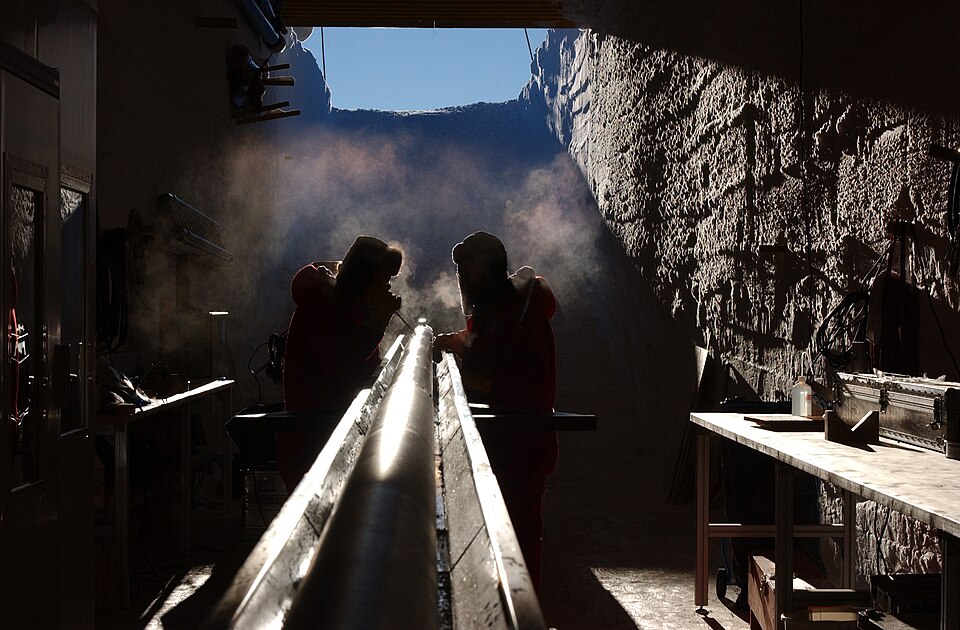

At a depth typically between 60 and 120 meters below the surface, the firn densifies to approximately 830 kg/m³, at which point the remaining air passages pinch off and the air is sealed into discrete bubbles. This transition, called pore close-off, marks the point at which the atmospheric sample is permanently isolated from the modern atmosphere. Below the close-off depth, the ice continues to densify under further compression, and at depths exceeding roughly 1,000 meters, the pressure is sufficient to convert the air bubbles into clathrate hydrates — crystalline cage structures in which gas molecules are enclosed within ice lattices rather than free bubbles.25
Isotopic proxies for temperature
The principal method for reconstructing past temperature from ice cores relies on the fractionation of stable isotopes of oxygen and hydrogen during the evaporation and condensation of water in the hydrological cycle. Natural water contains predominantly the lighter isotopes 16O and 1H, but a small fraction of molecules incorporate the heavier isotopes 18O and 2H (deuterium, written D). Because the heavier isotopologues (H218O, HDO) have slightly lower vapor pressures than ordinary water, they condense preferentially during each step of moisture transport from the ocean surface to the ice sheet interior. This process, called Rayleigh distillation, progressively depletes the remaining vapor of heavy isotopes as the air mass cools and loses moisture.11, 12
The degree of depletion is temperature-dependent: colder conditions produce stronger fractionation and more negative isotopic values in the precipitation. The isotopic composition of the ice is expressed as δ18O (the per-mille deviation of the 18O/16O ratio from a standard) or δD (the equivalent measure for deuterium). Dansgaard established in 1964 that modern precipitation exhibits a remarkably linear relationship between mean annual δ18O and mean annual temperature, with a slope of approximately 0.7‰ per °C.11 Applied to ice cores, this spatial calibration provides a first-order estimate of past temperature change, although more sophisticated approaches now combine δ18O with δD through a parameter called the deuterium excess (d = δD − 8 × δ18O), which is sensitive to the conditions at the moisture source region and can be used to correct for changes in ocean surface temperature and humidity.6, 12
The isotopic records from Antarctic ice cores show a glacial-interglacial temperature amplitude at the ice sheet surface of approximately 8–12°C, with the coldest conditions occurring at glacial maxima roughly 20,000 years apart and the warmest conditions during interglacials.4, 6 In Greenland, the isotopic record reveals not only the broad orbital-scale temperature variations but also the dramatic abrupt warming events — Dansgaard-Oeschger oscillations — in which local temperature increased by 8–16°C within decades during the last glacial period.7, 9
Greenhouse gas records from trapped air
The air bubbles sealed in ice cores provide the only direct measurements of past atmospheric composition prior to the era of instrumental monitoring, which began for CO2 with Charles David Keeling's Mauna Loa observatory in 1958. Extracting the ancient air requires crushing or melting a measured volume of ice in a vacuum line and analyzing the released gases by gas chromatography or laser spectroscopy. The three principal greenhouse gases measured in ice cores are carbon dioxide (CO2), methane (CH4), and nitrous oxide (N2O).3, 15
The Vostok record first revealed the sawtooth pattern of atmospheric CO2 across glacial cycles: concentrations fall to approximately 180 ppm during glacial maxima and rise to 280–300 ppm during interglacials, with the transitions broadly paralleling the isotopic temperature record.3, 4 The EPICA Dome C core extended this record through eight glacial cycles and confirmed that the CO2-temperature coupling is a persistent feature of Quaternary climate; at no point in the 800,000-year record did CO2 exceed 300 ppm — until anthropogenic emissions pushed concentrations above that threshold in the twentieth century.5, 14
Methane shows a similarly cyclic pattern, varying between roughly 350 parts per billion during glacials and 700 ppb during interglacials, with the variations driven primarily by changes in tropical and boreal wetland extent.15 Nitrous oxide varies between approximately 200 and 280 ppb over glacial cycles, modulated by changes in ocean denitrification and terrestrial soil emissions.15 The phasing of these gas records relative to the isotopic temperature signal has been central to understanding whether greenhouse gases lead or lag temperature change during glacial terminations. High-resolution analyses of the last deglaciation demonstrate that CO2 began to rise within centuries of the initial Antarctic warming but preceded the onset of global mean warming, consistent with CO2 acting as an amplifying feedback that globalizes the regional signal initiated by orbital forcing.13, 24
Dating ice cores: annual layers, volcanic markers, and cosmogenic isotopes
Establishing an accurate chronology for an ice core is essential for interpreting the climate signals it contains and for correlating records between cores. The highest-precision method is annual layer counting, which exploits the seasonal variation in the physical and chemical properties of the ice. In Greenland, where accumulation rates are high enough to produce annual layers several centimeters thick even at considerable depth, seasonal cycles can be identified in the isotopic ratio (δ18O), the dust concentration, the acidity, and the concentrations of chemical species such as ammonium, calcium, and sodium. The GISP2 and GRIP cores were dated by counting annual layers back to approximately 60,000 years before present, with an estimated uncertainty of roughly 1–2 percent.8, 16
In Antarctica, where accumulation rates are much lower, annual layers become too thin to resolve individually beyond the upper few hundred meters of a core. Deep Antarctic chronologies therefore rely on a combination of methods: orbital tuning (matching the isotopic record to the calculated astronomical insolation curves), identification of globally synchronous volcanic horizons, and the measurement of cosmogenic isotopes. Beryllium-10 (10Be), produced in the atmosphere by cosmic ray spallation of nitrogen and oxygen, is deposited on the ice sheet surface and preserved in the ice. Variations in the 10Be flux reflect changes in solar activity and geomagnetic field strength, providing tie points that can be correlated between ice cores and independently dated marine sediment records.19
Volcanic eruptions leave distinctive signatures in ice cores in the form of sulfuric acid spikes, which can be measured by electrical conductivity profiling or direct chemical analysis. Major eruptions such as Tambora (1815 CE), Laki (1783 CE), and the great unknown eruption of 1258 CE are recognized in multiple cores from both hemispheres and serve as precise chronological markers.17, 18 The volcanic record preserved in ice cores has itself become an important dataset for understanding the climatic impact of volcanism: the GISP2 core alone contains evidence for more than 850 individual volcanic events over the past 110,000 years.18
Dust, aerosols, and impurities
Ice cores preserve not only gases and isotopes but also particulate material — mineral dust, sea salt aerosols, biological particles, and anthropogenic pollutants — that was deposited on the ice sheet surface along with the snow. The concentration and composition of these impurities provide information about past atmospheric circulation, aridity, sea ice extent, and biological productivity.20
Mineral dust concentrations in Antarctic ice cores increase by a factor of 20–50 during glacial periods compared to interglacials, reflecting the expansion of arid source regions (principally Patagonia and Australia for Antarctic dust), stronger atmospheric transport, and reduced precipitation along the transport path.20 In Greenland, glacial-age dust originates primarily from the deserts of East Asia and is similarly enriched during cold intervals. The geochemical fingerprint of the dust — its strontium and neodymium isotope ratios, rare earth element patterns, and grain-size distribution — allows identification of the source region and provides independent evidence for changes in atmospheric circulation patterns between glacial and interglacial states.20
Sea salt concentrations in ice cores, measured through sodium and chloride ion concentrations, increase during glacial periods as well, reflecting the expansion of sea ice and the exposure of more of the sea-ice surface as a source of frost flowers and blown salt aerosol. The ratio of sea salt to mineral dust in Antarctic cores has been used to reconstruct past sea ice extent, which is a critical but poorly constrained boundary condition for climate models of glacial states.20
The key climate records
The EPICA Dome C record, the longest continuous ice core record, reveals the full sweep of late Quaternary climate variability at a resolution sufficient to resolve individual glacial-interglacial transitions. Across the 800,000-year record, the temperature proxy (δD) and atmospheric CO2 vary in persistent lockstep, with the amplitude and duration of warm interglacials changing notably around 430,000 years ago — before which interglacials were cooler and less distinct from the intervening glacials.5, 14 This observation is linked to the Mid-Pleistocene Transition, during which glacial cycles shifted from a dominant 41,000-year (obliquity) periodicity to a 100,000-year (eccentricity) periodicity, with progressively deeper glacial states and more dramatic terminations.5
The Greenland cores (GRIP, GISP2, NGRIP, and NEEM) complement the Antarctic records by providing exceptionally high-resolution climate histories of the North Atlantic region. The most striking feature of the Greenland records is the prevalence of Dansgaard-Oeschger events — abrupt warming episodes in which local temperature jumped by 8–16°C within a few decades, followed by gradual cooling over centuries to millennia. More than 25 such events have been identified during the last glacial period alone, with a characteristic spacing of roughly 1,470 years.7, 9 The NEEM core, drilled in northwestern Greenland, recovered disturbed but interpretable ice from the Eemian interglacial (~130,000–115,000 years ago), showing that Greenland surface temperatures during that warm period were approximately 8°C warmer than preindustrial values — yet the ice sheet, though reduced in volume, did not disappear entirely.10
The phasing relationship between the Greenland and Antarctic records has been a key finding of ice core science. During Dansgaard-Oeschger warmings in Greenland, Antarctic temperatures show a simultaneous gradual cooling, and vice versa — a pattern known as the bipolar seesaw. This antiphase relationship reflects the redistribution of heat by the Atlantic meridional overturning circulation: when deep-water formation strengthens in the North Atlantic, more heat is transported northward, warming Greenland and cooling the south, and when it weakens, heat accumulates in the Southern Ocean, warming Antarctica.7, 9, 25
CO2–temperature coupling across glacial cycles
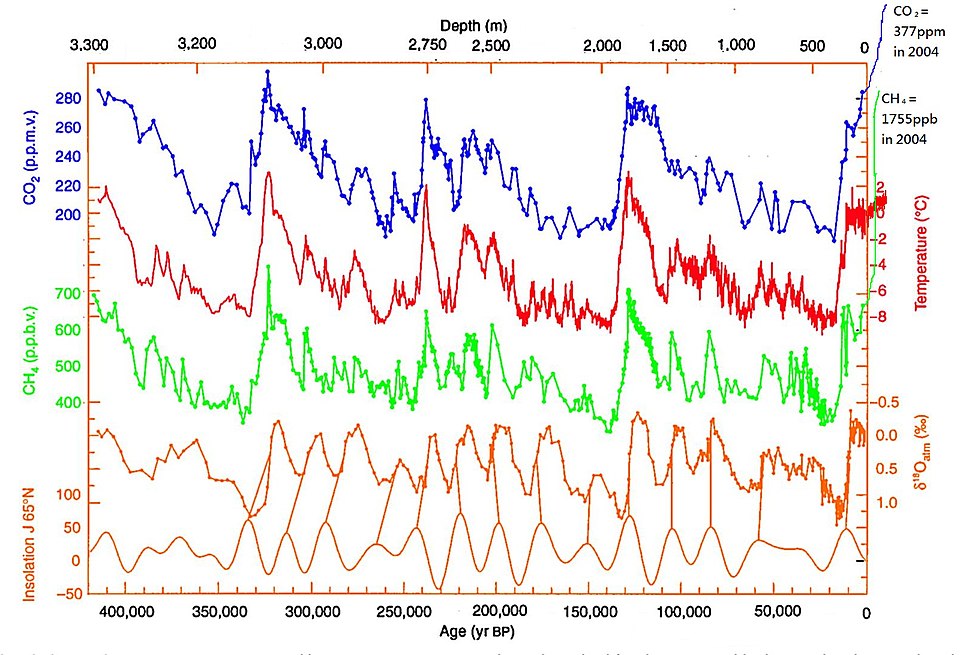

Perhaps the most consequential result of ice core paleoclimatology is the documentation of a tight, persistent coupling between atmospheric CO2 and global temperature across hundreds of thousands of years. The Vostok and EPICA records show that every glacial-interglacial transition involved a near-synchronous rise in CO2 from roughly 180 to 280 ppm and a warming of Antarctic surface temperature by 8–12°C.4, 5 The reverse sequence occurred during glacial inceptions: CO2 declined as Antarctic and global temperatures fell.14
The precise phasing between CO2 and temperature during deglaciations has been studied in detail. At the termination of the last ice age, approximately 18,000–11,000 years ago, high-resolution analyses show that Antarctic warming preceded the CO2 rise by roughly 800 ± 600 years, reflecting the initial role of orbital forcing in triggering Southern Hemisphere warming and consequent ocean outgassing.13 However, a global synthesis by Shakun and colleagues demonstrated that the CO2 rise preceded the onset of global mean surface temperature increase, because the initial Antarctic warming was a regional signal while the greenhouse forcing of rising CO2 drove the globally synchronous warming that followed.24 This phasing is consistent with CO2 acting as an essential amplifying feedback: orbital forcing initiates regional change, CO2 and other feedbacks globalize and amplify it, and the full glacial-interglacial temperature swing cannot be explained by orbital forcing alone.24, 25
Current frontiers: the pursuit of oldest ice
The 800,000-year EPICA record, while transformative, captures only the period after the Mid-Pleistocene Transition and does not extend into the era of 41,000-year obliquity-dominated glacial cycles that preceded it. Understanding why the dominant periodicity of ice ages changed — and what role atmospheric CO2 played in that transition — requires ice older than one million years. Several international projects are now pursuing this goal.21
The European Beyond EPICA – Oldest Ice project, funded by the European Commission, aims to recover a continuous ice core reaching 1.5 million years before present from a site called Little Dome C, approximately 40 kilometers from the EPICA Dome C drilling location. The site was selected after extensive radar surveys identified a region where ice near the bed remains undisturbed by basal melting and flow disturbances. Drilling began in the early 2020s, with the goal of reaching the target depth of approximately 2,730 meters.21 Radar surveys beneath Dome A, the highest point of the Antarctic ice sheet, have also identified potentially very old ice, with models suggesting basal ages of 1.0–1.5 million years.22
An alternative approach to recovering ancient atmospheric samples exploits blue ice areas — regions of the Antarctic ice sheet where ablation by wind and sublimation has removed the surface snow cover, exposing ancient ice at or near the surface. Because ice flow brings deep, old layers upward and toward the margin in these areas, horizontally exposed outcrops can preserve ice far older than any continuous core. In a landmark 2023 study, Yan and colleagues reported the discovery of 2.7-million-year-old ice at the Allan Hills blue ice area in East Antarctica — ice old enough to sample the atmosphere from well before the onset of Northern Hemisphere glaciation.23 The CO2 measurements from this ice suggest atmospheric concentrations near 300 ppm during the late Pliocene warm period, providing a direct constraint on the greenhouse gas levels that prevailed when Earth last had a climate substantially warmer than the preindustrial Holocene.23
The pursuit of oldest ice represents one of the most ambitious frontiers in paleoclimatology. A continuous core spanning 1.5 million years would, for the first time, provide direct atmospheric CO2 measurements across the Mid-Pleistocene Transition, testing hypotheses about whether a long-term decline in CO2 drove the shift from 41,000-year to 100,000-year glacial cyclicity. Combined with the fragmentary but remarkably ancient records from blue ice areas, these efforts promise to extend the direct atmospheric archive deep into the Pliocene and to sharpen the understanding of how greenhouse gas forcing, orbital geometry, and ice sheet dynamics interact to produce the ice ages that have shaped the modern world.21, 23
References
Climate and atmospheric history of the past 420,000 years from the Vostok ice core, Antarctica
High-resolution Greenland ice core data show abrupt climate change happens in few years
High-resolution carbon dioxide concentration record 650,000–800,000 years before present
Atmospheric methane and nitrous oxide of the late Pleistocene from Antarctic ice cores
The GISP2 δ18O climate record of the past 16,500 years and the role of the sun, ocean, and volcanoes
Dating of Greenland ice cores by flow models, isotopes, volcanic debris, and continental dust
Dust and sea salt variability in central East Antarctica (Dome C) over the last 45 kyrs