Overview
- Volcanic island arcs are curved chains of volcanoes formed above oceanic-oceanic subduction zones, where one oceanic plate descends beneath another and the water released from the sinking slab lowers the melting point of the overlying mantle wedge, generating magma that rises to build a volcanic chain on the overriding plate.
- The characteristic arcuate shape of island arcs arises from the geometry of a rigid plate bending into a spherical Earth, and the volcanic front is consistently positioned 100–150 kilometres above the surface of the descending slab, coinciding with the depth at which dehydration reactions release the fluids that trigger melting.
- Island arcs are primary sites of continental crustal growth, producing intermediate to felsic magmas through fractional crystallisation and crustal remelting that approximate the average composition of continental crust, and their eventual collision with continents has been a major mechanism of continental accretion throughout Earth history.
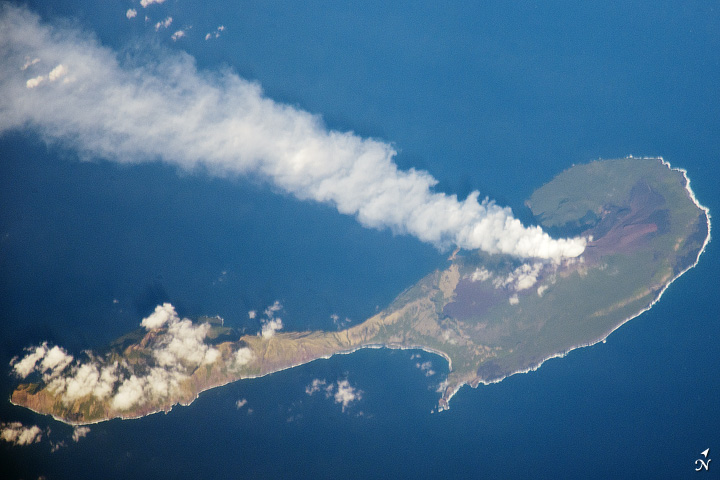
Volcanic island arcs are curved chains of volcanic islands that form above subduction zones where one oceanic tectonic plate descends beneath another. They are among the most dynamic and geologically productive features on Earth's surface, generating explosive volcanism, deep seismicity, and new crustal material at rates that make them primary engines of continental growth.1, 10 The distinctive arcuate geometry that gives island arcs their name is a consequence of the geometry of plate bending on a sphere: when a rigid plate begins to subduct along a straight line on a spherical surface, the resulting trench and parallel volcanic chain trace a curve, much as pushing a spoon into a tennis ball produces a curved indentation rather than a straight line.13 Island arcs are found throughout the Pacific basin — the Mariana, Aleutian, Tonga-Kermadec, and Izu-Bonin arcs are prominent examples — and in the Caribbean (Lesser Antilles) and eastern Mediterranean (Aegean arc), wherever ocean-ocean convergence drives subduction.

The Wadati-Benioff zone and slab geometry
The discovery that earthquakes beneath island arcs occur along inclined planes dipping from the trench toward the volcanic arc was one of the key observations leading to the theory of plate tectonics. Kiyoo Wadati first documented this phenomenon in the 1930s using earthquake data from beneath Japan, noting that hypocentres deepened systematically from the trench toward the continental interior along a plane dipping at roughly 30–60 degrees.3 Hugo Benioff independently described the same pattern in the 1950s using data from the Tonga and South American subduction zones.4 The inclined seismic zone — now called the Wadati-Benioff zone — was subsequently recognised as the expression of the subducting lithospheric plate itself, with earthquakes generated by brittle deformation and phase transformations within the cold, descending slab as it penetrates into the hotter mantle.1
The geometry of the Wadati-Benioff zone varies considerably among different subduction systems and has profound implications for the character of the volcanic arc above. Slab dip angles range from as shallow as 10–20 degrees (as beneath parts of the Aleutian and Cascadia arcs) to as steep as 70–80 degrees (as beneath the Mariana arc). Steeply dipping slabs tend to produce narrow volcanic arcs with well-developed back-arc basins behind them, while shallowly dipping slabs suppress back-arc extension and can produce broad zones of deformation and volcanism in the overriding plate.12 The maximum depth of seismicity within the Wadati-Benioff zone extends to approximately 670–700 kilometres in the most deeply subducting systems, corresponding to the top of the lower mantle, beyond which earthquakes cease — likely because the subducting slab becomes too warm for brittle failure, undergoes a phase transformation, or is assimilated into the surrounding mantle.1
The volcanic front of the arc — the line along which active volcanoes are concentrated — is remarkably consistent in its spatial relationship to the slab. Across most island arcs worldwide, the volcanic front lies above the point where the top of the descending slab reaches a depth of approximately 100–150 kilometres.5, 15 This depth corresponds to the conditions at which major dehydration reactions occur in the subducting oceanic crust and underlying mantle: the breakdown of hydrous minerals such as amphibole, chlorite, lawsonite, and serpentine releases water into the overlying mantle wedge, triggering partial melting. The uniformity of this relationship across diverse arc systems provides compelling evidence that slab dehydration is the primary control on the position of arc volcanism.6, 15
Arc magmatism and the calc-alkaline series
The magmatism of island arcs is fundamentally different from the magmatism of mid-ocean ridges in both composition and mechanism. At mid-ocean ridges, decompression melting of dry mantle peridotite produces tholeiitic basalt of remarkably uniform composition. At island arcs, the addition of water from the dehydrating slab into the mantle wedge lowers the solidus temperature of the peridotite, initiating melting at conditions that would otherwise produce no melt. This flux melting generates primary magmas that are hydrous, oxidised, and enriched in the elements preferentially transported by aqueous fluids — notably the large-ion lithophile elements (potassium, rubidium, barium, strontium) and the light rare earth elements — while being depleted in the high-field-strength elements (niobium, tantalum, titanium) that are retained in the residual slab minerals.2, 6
The distinctive geochemical signature of arc magmas is expressed petrologically in the calc-alkaline magma series, which dominates the volcanic output of mature island arcs and continental arcs alike.11 The calc-alkaline series is characterised by a relative enrichment in silica and alkali elements at a given degree of iron enrichment compared to the tholeiitic series, producing a progression from basalt through basaltic andesite and andesite to dacite and rhyolite. Andesite — the intermediate member of this series, with roughly 57–63 weight per cent silica — is the most volumetrically significant volcanic rock type in many island arcs, and its average composition is strikingly close to the estimated bulk composition of the continental crust as a whole.10, 11 This similarity has long been recognised as one of the strongest lines of evidence that island arc magmatism is a primary mechanism by which continental crust is generated from mantle material.
The differentiation of arc magmas from basaltic primary melts to the more evolved andesites, dacites, and rhyolites occurs through multiple processes operating at different levels within the arc crust. Fractional crystallisation — the progressive removal of early-crystallising minerals such as olivine, pyroxene, and plagioclase from a cooling magma body — drives the residual liquid toward higher silica contents. Assimilation of pre-existing arc crust by ascending magma contributes crustal material to the melt. In thick, mature arcs, remelting of earlier-formed mafic arc crust produces silicic magmas directly.2, 5 The combined effect of these processes is a net production of intermediate to felsic igneous rock that, over geological time, accumulates into thick arc crust approaching continental crustal composition and thickness.
Structural anatomy of an island arc system
A complete island arc system comprises several distinct structural elements arranged in a systematic spatial sequence from the trench to the back-arc region. Beginning at the seaward side, the sequence includes the trench, the accretionary prism or fore-arc, the volcanic arc itself, and the back-arc basin.9
The trench is the surface expression of the subduction zone — a narrow, elongate depression in the seafloor where the subducting plate bends downward and begins its descent into the mantle. Ocean trenches are the deepest features on Earth's surface: the Mariana Trench reaches 10,994 metres below sea level at the Challenger Deep, the Tonga Trench exceeds 10,800 metres, and the Philippine Trench, Kuril-Kamchatka Trench, and Kermadec Trench all exceed 10,000 metres.8, 18 The depth of a trench depends on the age and thermal state of the subducting plate (older, colder, denser plates produce deeper trenches) and the rate of sediment infilling.
The fore-arc region lies between the trench and the volcanic front. In many subduction zones, sediments scraped off the top of the subducting plate accumulate at the inner trench wall to form an accretionary prism — a wedge-shaped body of deformed and imbricated sedimentary and oceanic crustal material that grows progressively as subduction continues.9 Well-developed accretionary prisms are found in subduction zones where the incoming plate carries a thick sedimentary cover, such as the Makran subduction zone off Pakistan and the Barbados accretionary complex in the Lesser Antilles. In sediment-starved subduction zones such as the Mariana system, where the incoming Pacific plate is old and carries little sediment, the accretionary prism is minimal or absent, and the fore-arc may instead be characterised by tectonic erosion, in which material is removed from the base of the overriding plate and carried down with the slab.8, 16 The fore-arc also typically includes a fore-arc basin — a structural depression between the accretionary prism and the volcanic arc that accumulates sediment eroded from the arc volcanoes.
Behind the volcanic arc, many island arc systems develop back-arc basins — regions of extensional tectonics and, in some cases, active seafloor spreading that create new oceanic crust within the overriding plate. The Mariana Trough, the Lau Basin (behind the Tonga arc), the Sea of Japan, and the Philippine Sea are all back-arc basins at various stages of development.7 The driving mechanism for back-arc extension is attributed to the seaward retreat of the trench (trench rollback) as the subducting slab sinks gravitationally into the mantle, pulling the subduction hinge away from the overriding plate and inducing extension behind the arc. Back-arc basin basalts are compositionally intermediate between mid-ocean ridge basalts and arc basalts, reflecting a mantle source that has been variably influenced by slab-derived fluids.7
Major island arcs of the world
The Mariana arc, located in the western Pacific Ocean, is the type example of an intraoceanic island arc. It forms where the Pacific plate, the oldest and densest oceanic plate on Earth, subducts westward beneath the Philippine Sea plate. The extreme age of the subducting Pacific crust in this region — up to 170 million years old — produces a steeply dipping slab (approximately 60–80 degrees) and the deepest trench on the planet.8, 16 The Mariana arc is an immature arc system with relatively thin crust (approximately 20 kilometres), and its volcanic output is dominantly basaltic to basaltic andesitic. The active back-arc spreading centre in the Mariana Trough demonstrates that new oceanic crust is being created simultaneously behind the arc as the trench retreats eastward.16
The Aleutian arc extends approximately 3,000 kilometres from the Alaska Peninsula westward to the Kamchatka Peninsula, curving across the northern Pacific in a sweeping arc that separates the Pacific Ocean from the Bering Sea. The Pacific plate subducts northward beneath the North American plate along the Aleutian Trench at rates of 6–8 centimetres per year.19 The Aleutian arc displays a systematic eastward transition from purely oceanic arc character in the western Aleutians to continental arc character near the Alaska Peninsula, where the overriding plate includes continental crust. This transition is accompanied by a progressive change in magma composition from tholeiitic in the west to more strongly calc-alkaline in the east, reflecting the increasing role of thick continental crust in magma modification.19
The Tonga-Kermadec arc system in the southwestern Pacific is the fastest-converging plate boundary on Earth, with subduction rates exceeding 24 centimetres per year along parts of the Tonga Trench.18 This extremely rapid convergence produces intense seismicity, with the Tonga-Kermadec Wadati-Benioff zone generating more deep earthquakes (below 300 kilometres depth) than any other subduction system. The associated Lau back-arc basin is actively spreading, producing new oceanic crust at rates comparable to slow mid-ocean ridges.7
The Lesser Antilles arc, a chain of islands curving from the Virgin Islands south to Trinidad, marks the subduction of the Atlantic oceanic plate beneath the Caribbean plate. Unlike the Pacific arcs, the Lesser Antilles receives a substantial influx of sediment from the Orinoco River delta and the Amazon fan, producing one of the largest accretionary prisms in the world — the Barbados accretionary complex, which extends more than 300 kilometres east of the volcanic front.17 The volcanic islands of the Lesser Antilles include some of the most hazardous volcanoes in the Caribbean, including Soufriere Hills on Montserrat and Mount Pelée on Martinique, whose catastrophic 1902 eruption killed approximately 30,000 people.
Characteristics of selected island arc systems1, 7, 18
| Arc | Length (km) | Convergence rate (cm/yr) | Slab dip (°) | Trench depth (m) | Back-arc basin |
|---|---|---|---|---|---|
| Mariana | 2,500 | 3–4 | 60–80 | 10,994 | Mariana Trough |
| Aleutian | 3,000 | 6–8 | 30–60 | 7,679 | Bering Sea (inactive) |
| Tonga-Kermadec | 2,600 | 16–24 | 45–60 | 10,882 | Lau Basin |
| Lesser Antilles | 850 | 2–4 | 50–60 | 8,376 | Grenada Basin |
| Izu-Bonin | 1,100 | 4–6 | 45–70 | 9,780 | Shikoku Basin |
Japan as a transitional arc system
The Japanese islands occupy a transitional position between a purely oceanic island arc and a continental margin arc, providing an instructive example of the evolutionary continuum that island arcs may traverse. Japan sits at the convergence of four tectonic plates: the Pacific plate subducts westward beneath the Okhotsk plate along the Japan Trench, while the Philippine Sea plate subducts northwestward beneath the Eurasian plate along the Nankai Trough and the Ryukyu Trench.1 The resulting tectonic complexity produces one of the most seismically and volcanically active regions on Earth, with more than 100 active volcanoes and frequent large earthquakes including the magnitude 9.0 Tohoku earthquake of 2011.
The arc crust beneath Japan is substantially thicker than that of immature oceanic arcs such as the Marianas — approximately 30–35 kilometres beneath Honshu, comparable to normal continental crust in thickness if not entirely in composition.5 This thickened crust reflects the maturity of the Japanese arc system, which has been accumulating magmatic additions for tens of millions of years. The volcanic output includes the full calc-alkaline spectrum from basalt through rhyolite, with large caldera-forming eruptions producing voluminous silicic ignimbrites. The Sea of Japan, a well-developed back-arc basin that opened by rifting and seafloor spreading between approximately 25 and 15 million years ago, separates the arc from the Asian continental margin and illustrates the back-arc extensional regime that accompanies arc maturation.7
Japan's position as a mature arc approaching continental character makes it a key natural laboratory for understanding how island arcs evolve over time. The progressive thickening and compositional maturation of arc crust — from thin, mafic oceanic arc crust to thick, intermediate-composition crust approaching the continental average — is widely regarded as a fundamental mechanism of continental crustal growth, and the Japanese arc provides a snapshot of this process at an advanced stage.10, 20
Arc-continent collision and continental growth
The finite lifespan of oceanic plates ensures that island arcs are eventually carried by the conveyor of plate tectonics into collision with continental margins. When the oceanic plate separating an island arc from a continent is entirely consumed by subduction, the buoyant arc crust arrives at the trench and resists subduction, producing an arc-continent collision that sutures the arc onto the continental margin as a new accreted terrane.14 This process has been one of the primary mechanisms of continental crustal growth throughout Earth history, adding new volumes of intermediate-composition igneous rock to the continental margins in episodic pulses tied to the Wilson cycle of ocean basin opening and closing.14, 20
The geological record preserves abundant evidence of ancient arc-continent collisions. The Taconic orogeny of the Ordovician period involved the collision of an island arc with the eastern margin of Laurentia (ancestral North America), producing thrust sheets, mélanges, and volcanic sequences that now form part of the northern Appalachian mountain belt. The Palaeoproterozoic Trans-Hudson orogen in Canada records the collision of multiple arc terranes with the Superior and Rae-Hearne cratons approximately 1.8 billion years ago, constructing a large portion of the North American continent. In Southeast Asia, the ongoing collision of multiple arc and micro-continental fragments is actively building new continental crust in one of the most tectonically complex regions on the modern Earth.14
The contribution of island arcs to global continental growth has been quantified through geochemical mass balance calculations. Estimates suggest that subduction zone magmatism generates new arc crust at a rate of approximately 1.5–3.0 cubic kilometres per year globally, though not all of this material is ultimately preserved — a significant fraction is recycled back into the mantle through subduction erosion and sediment subduction.10, 20 The net rate of continental growth after accounting for recycling is estimated at approximately 0.5–1.5 cubic kilometres per year, with arc accretion being the dominant mechanism. The compositional similarity between bulk arc crust (approximately 57–60 weight per cent silica) and bulk continental crust (approximately 57–64 weight per cent silica) provides strong evidence that the continents have been built largely from the products of arc magmatism, accumulated and refined over billions of years of subduction zone activity.10, 20
Volcanic hazards and societal significance
Island arc volcanoes are among the most hazardous on Earth. The water-rich character of arc magmas promotes explosive eruptive styles: dissolved water in ascending magma exsolves as the pressure drops, producing gas bubbles that fragment the magma into pyroclastic debris and drive violent eruptions. The most explosive eruptions in recorded history have occurred at arc volcanoes, including the 1815 eruption of Tambora in the Sunda arc (the largest eruption of the past 500 years, which produced a global climate anomaly known as the "Year Without a Summer"), the 1883 eruption of Krakatoa (also in the Sunda arc), and the 1991 eruption of Mount Pinatubo in the Philippine arc, which injected approximately 20 million tonnes of sulphur dioxide into the stratosphere and cooled global temperatures by roughly 0.5 degrees Celsius for two years.5
The hazards associated with arc volcanism extend well beyond explosive eruptions. Pyroclastic flows — fast-moving currents of hot gas and volcanic debris — are the most lethal volcanic phenomenon, capable of travelling at speeds exceeding 100 kilometres per hour and temperatures above 300 degrees Celsius. Lahars — volcanic mudflows generated when pyroclastic material mixes with water from rain, melting snow, or crater lakes — can travel tens of kilometres from a volcano and bury entire communities. Volcanic tsunamis, triggered by submarine eruptions, caldera collapse, or pyroclastic flows entering the sea, pose particular threats to the coastal populations of island arc nations. The 2022 eruption of Hunga Tonga-Hunga Ha'apai in the Tonga arc generated a tsunami that affected coastlines throughout the Pacific basin and produced atmospheric pressure waves detected globally.18
Hundreds of millions of people live on or near island arcs. Japan alone has a population exceeding 125 million, and the Indonesian archipelago — much of which is built from the products of Sunda arc volcanism — is the world's fourth most populous country with approximately 275 million inhabitants. The Philippines, the Caribbean islands, and the Aleutian and Kuril chains all host populations directly exposed to the full spectrum of arc volcanic and seismic hazards. The monitoring and understanding of island arc volcanic systems is consequently not merely an academic exercise but a matter of direct societal importance, and the study of arc magmatism remains one of the most active and consequential areas of research in the geological sciences.5