Overview
- The australopithecines were a diverse group of small-brained, obligately bipedal hominins that dominated the African landscape from roughly 4.2 to 1.2 million years ago, spanning at least eight recognized species across eastern and southern Africa.
- The gracile australopithecines—including the famous 'Lucy' (A. afarensis) and the Taung Child (A. africanus)—had brains only modestly larger than those of chimpanzees yet walked fully upright, demonstrating that bipedalism preceded brain expansion by millions of years.
- The robust australopithecines of the genus Paranthropus evolved massive jaws, enormous molars, and sagittal crests for powerful chewing muscles, representing a specialized dietary lineage that coexisted with early Homo for over a million years before going extinct.
The australopithecines represent the most successful and diverse radiation of early hominins, spanning roughly three million years of African prehistory from about 4.2 to 1.2 million years ago. These small-brained but fully bipedal primates are known from dozens of sites across eastern and southern Africa and include at least eight recognized species divided into two broad groups: the gracile australopithecines of the genus Australopithecus and the robust australopithecines of the genus Paranthropus.1, 10 With brains only slightly larger than those of chimpanzees—ranging from roughly 370 to 550 cubic centimeters—the australopithecines demonstrate conclusively that upright walking evolved long before the major expansion of brain size that characterizes the genus Homo.1, 8
The australopithecine fossil record includes some of the most iconic specimens in all of paleoanthropology: the 3.2-million-year-old "Lucy" skeleton, the Laetoli footprint trackways, the Taung Child that first revealed Africa as the cradle of humankind, and the nearly complete "Little Foot" skeleton from Sterkfontein. These discoveries have shaped our understanding of human origins more profoundly than perhaps any other group of fossils.1, 5
The earliest australopithecines
Australopithecus anamensis, known from sites in Kenya and Ethiopia dating to 4.2–3.8 million years ago, is the earliest well-documented member of the genus.2 Tibial morphology demonstrates that A. anamensis was an obligate biped, while its cranial features remained notably primitive, including a projecting, ape-like face and a small brain of approximately 370 cubic centimeters, as revealed by the MRD cranium discovered in Ethiopia in 2016 and described in 2019.3 The MRD cranium also demonstrated that A. anamensis and its probable descendant A. afarensis overlapped in time by at least 100,000 years, challenging the prevailing view that one species simply transformed into the other through gradual anagenesis.3


Australopithecus afarensis, the best-known australopithecine, lived in East Africa from approximately 3.9 to 2.9 million years ago and is documented by hundreds of fossils from sites in Ethiopia and Tanzania.5 The "Lucy" skeleton (AL 288-1), discovered in 1974 at Hadar, Ethiopia, preserves roughly 40% of the skeleton and exhibits the angled femur, broad pelvis, and forward-positioned foramen magnum of a committed biped.5 The Laetoli footprints, dated to 3.66 million years ago and almost certainly made by A. afarensis, preserve unambiguous evidence of fully upright, human-like walking with an adducted big toe and no evidence of a midtarsal break—biomechanical features indistinguishable from those of modern humans.4
Southern African species
In southern Africa, Australopithecus africanus is known primarily from cave sites in the Cradle of Humankind near Johannesburg, dating to approximately 3.0–2.0 million years ago. The Taung Child, described by Raymond Dart in 1924, was the first australopithecine ever identified, though Dart's claim that it represented a bipedal human ancestor from Africa was rejected for decades by scientists who expected human origins in Europe or Asia.1 Subsequent discoveries at Sterkfontein, Makapansgat, and other sites vindicated Dart, revealing a species with a cranial capacity of roughly 420–510 cubic centimeters, a gracile build, and a suite of features intermediate between earlier hominins and the genus Homo.1, 10
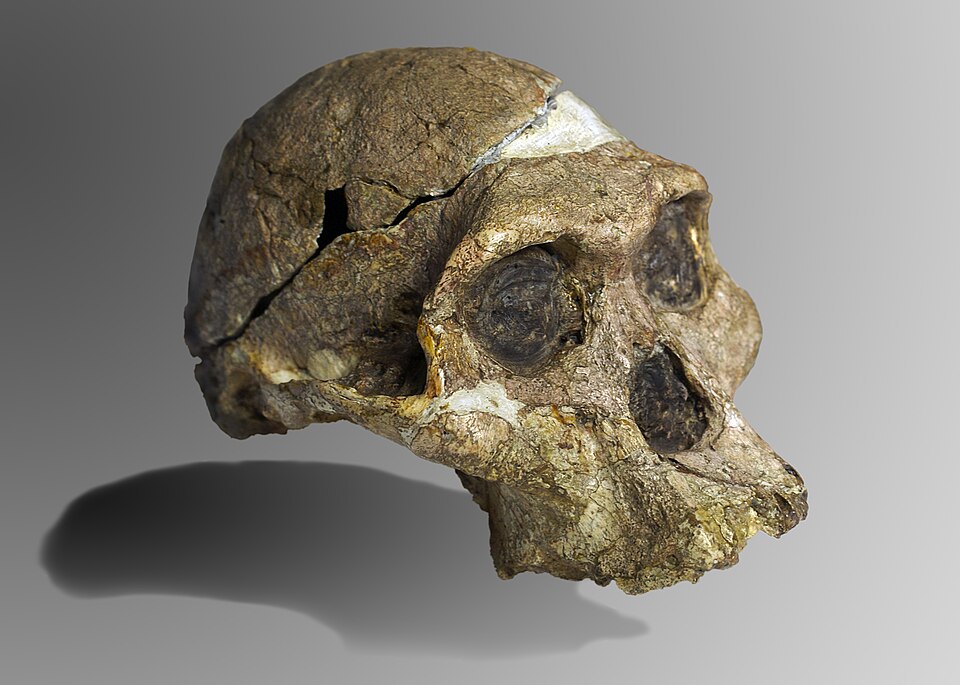

The australopithecines exhibited substantial sexual dimorphism, with males considerably larger than females in most species. In A. afarensis, body mass estimates suggest that males weighed roughly 45 kilograms while females averaged approximately 29 kilograms, yielding a dimorphism ratio comparable to that of modern gorillas and orangutans rather than modern humans.11, 12 This degree of size difference has been interpreted as evidence for a polygynous mating system, in which males competed physically for access to females, though some researchers have argued that the apparent dimorphism is inflated by small sample sizes and the difficulty of assigning isolated postcranial fossils to sex.11 In A. africanus and the robust species, dimorphism appears to have been similarly pronounced, suggesting that high levels of body size variation were a characteristic feature of the australopithecine radiation rather than an anomaly of any single lineage.1, 12
Later species such as Australopithecus garhi, discovered in Ethiopia and dated to approximately 2.5 million years ago, have been found in association with stone-tool-cut animal bones, suggesting that some australopithecines may have used tools for butchery before the appearance of the genus Homo.6 Australopithecus sediba, described in 2010 from the Malapa site in South Africa and dated to approximately 2.0 million years ago, displays a striking mosaic of australopithecine and Homo-like features in its brain, pelvis, hand, and foot, and has been proposed—controversially—as a direct ancestor of the genus Homo.7
The robust australopithecines
The genus Paranthropus comprises three species—P. aethiopicus, P. boisei, and P. robustus—that evolved a distinctive suite of cranial and dental specializations for processing mechanically demanding foods. These included massive jaws, enormous flat molars, thick enamel, sagittal crests for anchoring powerful temporalis muscles, and flared zygomatic arches to accommodate enlarged masseter muscles.1 The earliest known robust form, P. aethiopicus, appeared in East Africa by approximately 2.7 million years ago. P. boisei—nicknamed "Nutcracker Man" for its enormous molars—persisted in East Africa until about 1.2 million years ago, while P. robustus occupied southern Africa from roughly 2.0 to 1.5 million years ago.1, 10
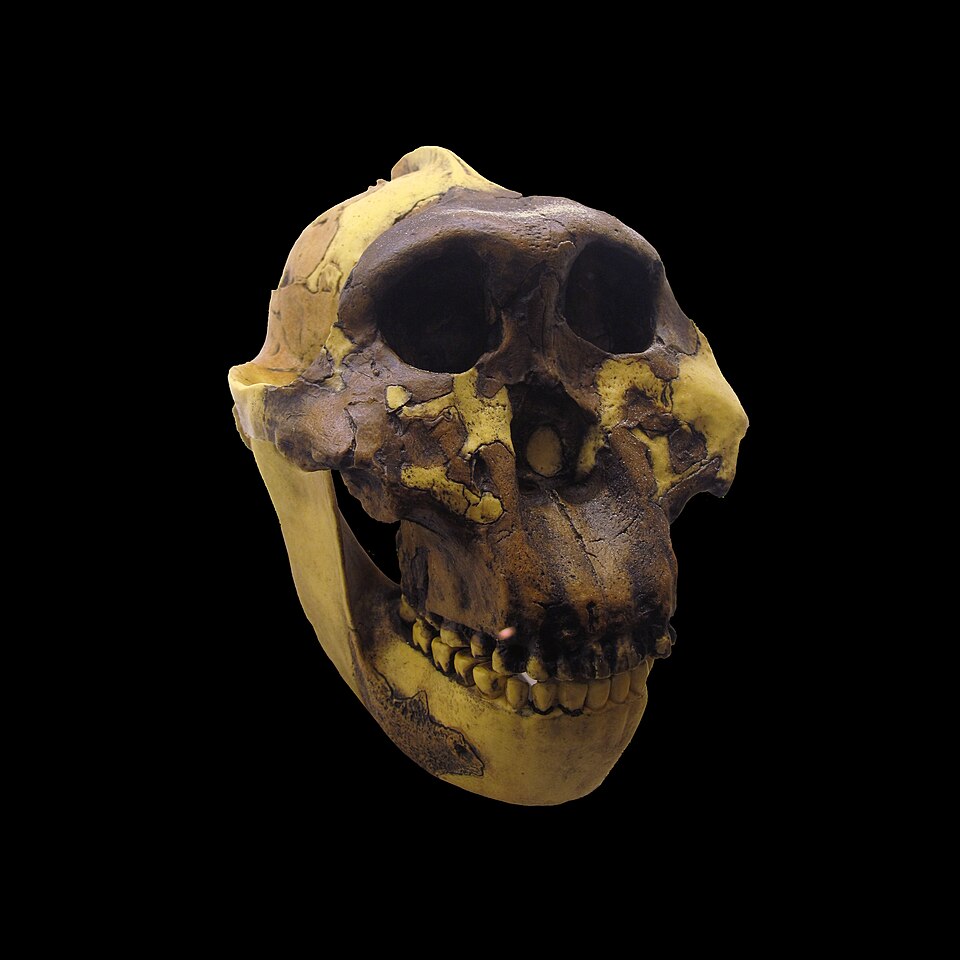

Carbon isotope analyses of P. boisei tooth enamel have revealed a diet dominated by C4 plants, most likely sedges and grasses, rather than the hard nuts and seeds once inferred from the species' powerful masticatory apparatus.9 The robust australopithecines coexisted with early Homo in Africa for over a million years, demonstrating that human evolution was not a linear succession but a branching tree with multiple contemporaneous lineages pursuing different ecological strategies. The Paranthropus lineage ultimately went extinct, likely because its dietary specialization left it vulnerable to the increasingly variable climates of the Pleistocene.1, 8
Comparison of species
Australopithecine species compared1, 5, 10
| Species | Date range | Brain size | Key features |
|---|---|---|---|
| A. anamensis | 4.2–3.8 Mya | ~370 cc | Earliest definite australopithecine |
| A. afarensis | 3.9–2.9 Mya | 380–500 cc | Lucy, Laetoli footprints |
| A. africanus | 3.0–2.0 Mya | 420–510 cc | Taung Child, gracile build |
| A. garhi | ~2.5 Mya | ~450 cc | Associated with early stone tools |
| A. sediba | ~2.0 Mya | 420–450 cc | Mosaic of Homo-like traits |
| P. aethiopicus | 2.7–2.3 Mya | ~410 cc | Earliest robust form |
| P. boisei | 2.3–1.2 Mya | ~500 cc | Massive jaws, “Nutcracker Man” |
| P. robustus | 2.0–1.5 Mya | ~530 cc | South African robust form |
Significance for understanding human evolution
The australopithecines occupy a pivotal position in the narrative of human evolution because they demonstrate that the defining features of the human lineage did not appear as a coordinated package. Bipedalism, the trait most clearly separating hominins from other apes, evolved millions of years before the marked brain expansion that characterizes the genus Homo. The australopithecines walked upright through African landscapes for more than three million years with brains scarcely larger than those of modern chimpanzees, overturning the once-dominant expectation that intelligence and bipedality co-evolved.1, 8
Moreover, the australopithecine radiation illustrates that hominin evolution was not a linear march from ape to human but a densely branching tree in which multiple species with different ecological strategies coexisted across the African continent. At several points between 3.0 and 1.5 million years ago, two or more hominin species lived side by side, occupying different niches defined by diet, habitat preference, and body size.1, 10 The extinction of the robust Paranthropus lineage and the survival of early Homo were likely shaped by the increasingly variable and unpredictable climates of the Pleistocene, which favoured the dietary and behavioural flexibility that characterised the genus Homo over the narrow ecological specialisation of the robust australopithecines.8
The diversity of the australopithecine radiation also challenges any simple, linear model of human ancestry. At numerous points in the Plio-Pleistocene, multiple australopithecine species coexisted, sometimes in overlapping geographic ranges, each pursuing different ecological strategies. The coexistence of gracile and robust forms with early Homo for over a million years demonstrates that human evolution was a branching process in which multiple evolutionary experiments were underway simultaneously, with no predetermined outcome favoring any particular lineage.8, 10
References
Laetoli footprints preserve earliest direct evidence of human-like bipedal biomechanics
Sexual dimorphism in Australopithecus afarensis revisited: How strong is the case for a human-like pattern of dimorphism?