Overview
- The first hominin dispersal out of Africa occurred by at least 1.85 million years ago, placing small-brained, Oldowan-equipped Homo erectus at Dmanisi in the Caucasus within perhaps 200,000 years of the species' origin in the Turkana Basin.
- The traditional view that large brains, tall bodies, and Acheulean technology were prerequisites for leaving Africa is contradicted by the Dmanisi evidence, which shows that the earliest emigrants were anatomically primitive and technologically simple.
- Homo erectus populations persisted in Java until approximately 108,000 years ago, making the species the longest-surviving member of the genus Homo and a contemporary of early Homo sapiens for a substantial portion of our own species' existence.
The dispersal of Homo erectus out of Africa stands as one of the most consequential events in the history of the genus Homo. At some point between 2.0 and 1.8 million years ago, populations ancestral to or representative of H. erectus moved out of the African continent and eventually colonized an enormous swath of the Old World, from the Caucasus to the Indonesian archipelago. This dispersal was not merely a geographic expansion; it was the first time in the evolutionary history of the hominin lineage that any member of the family ventured beyond the African continent, establishing populations that would persist on multiple continents for well over a million years.5, 13 The fossil and archaeological record documenting this journey is fragmentary and debated in its details, but its broad outlines are now well established, and the questions it raises — about what drove the expansion, what enabled it, and how these dispersing populations relate to later hominin evolution — remain among the most actively researched problems in paleoanthropology.

African origins
The story of the dispersal begins in Africa, where the earliest well-documented H. erectus fossils appear in the fossil record between approximately 2.0 and 1.8 million years ago. The Turkana Basin in East Africa, straddling the modern border of Kenya and Ethiopia, has yielded the most informative early specimens. The discovery of the Nariokotome skeleton (KNM-WT 15000) from West Turkana in 1984 provided the most complete early Homo skeleton known, belonging to a roughly 1.6-million-year-old adolescent male with fully modern body proportions: long legs, narrow hips, and a torso adapted for sustained bipedal locomotion over open landscapes.4 Equally important specimens have been recovered from the eastern shore of Lake Turkana and from Olduvai Gorge in Tanzania, where the stratigraphy of Beds I and II preserves a rich record of early Pleistocene hominin activity spanning from approximately 1.9 to 1.2 million years ago.8
These African H. erectus populations were associated with stone tool assemblages of the Oldowan tradition — simple cores, flakes, and choppers produced by direct percussion — and somewhat later with the more elaborate Acheulean industry, characterized by large bifacial handaxes and cleavers that required sustained shaping of both faces of a stone core.9 Whether the earliest emigrants carried the Acheulean or only the Oldowan with them became a major point of discussion after the Dmanisi discoveries, as described below. What is clear is that the African record documents a species already distinguished from its predecessors by substantially larger brain volumes, taller stature, reduced sexual dimorphism, and a body plan unmistakably oriented toward high-endurance terrestrial locomotion rather than the partially arboreal lifestyle of the australopithecines.4, 5
Dmanisi: the gateway out of Africa
The site of Dmanisi, a medieval fortress town in the Republic of Georgia set at the confluence of the Mashavera and Pinezauri rivers, has produced the oldest unambiguous evidence of hominins outside Africa. Excavations beginning in the 1990s beneath the medieval ruins revealed hominin fossils, faunal remains, and stone tools stratified within volcanic sediments dated by 40Ar/39Ar methods to approximately 1.85 to 1.77 million years ago.1, 2 Five crania, four mandibles, and extensive postcranial remains representing at least five individuals have been recovered, making Dmanisi the best-sampled single-locality early Homo assemblage in the world outside of the richest African sites.
The Dmanisi hominins are remarkable above all for what they are not. They are not the large-brained, tall-bodied, technologically sophisticated emigrants that earlier models of dispersal had predicted. Cranial capacities at the site span from 546 cubic centimeters in Skull 5 (specimen D4500) to approximately 730 cc in Skull 2, a range that would encompass variation from early Homo habilis to early H. erectus in Africa.1 Their body proportions, documented from a largely complete skeleton, indicate individuals of relatively short stature with limb proportions intermediate between earlier hominins and fully modern H. erectus from Africa.2 And their stone tools are Oldowan in character — simple flakes and cores with no evidence of the Acheulean bifaces that were long considered emblematic of H. erectus dispersal.15
The implications are difficult to overstate. A 2013 study by Lordkipanidze and colleagues demonstrating that the morphological variation among the five Dmanisi crania falls within the range expected for a single species argued that many of the named early African Homo species may simply represent variation within a single evolving lineage.1 More directly relevant to the dispersal question, the Dmanisi evidence dismantled the hypothesis that a cognitive or technological threshold was required before hominins could leave Africa. These were anatomically primitive individuals, equipped with the simplest stone tool kit available, yet they had crossed the entire Levantine corridor and penetrated the Caucasus to a latitude of approximately 41 degrees north.
The pace of dispersal and what enabled it
If the African origin of H. erectus is placed conservatively at 1.9 million years ago and the Dmanisi population dates to 1.85 million years ago, the time available for the journey from the Turkana Basin to the southern Caucasus — a straight-line distance of roughly 6,000 kilometers — was on the order of 50,000 years. Even if the actual emigration occurred closer to 1.8 million years ago, allowing perhaps 100,000 to 200,000 years for the crossing, the rate of spread implied is startlingly modest by any biological standard: on the order of tens of meters per year, or roughly 20 kilometers per human generation, assuming generation times of about 25 years.15 This is not a deliberate migration in any modern sense but the cumulative effect of normal home-range expansion by foraging bands moving incrementally across productive habitat over thousands of generations.
What enabled this expansion has been debated intensely and remains unresolved. Earlier hypotheses emphasized the role of the Acheulean handaxe as a technological key, the adoption of significant meat-eating as a caloric prerequisite, increased body size reducing the costs of long-distance movement, and the control of fire as a means of surviving cooler, more seasonal environments outside the tropics.12 Each of these proposals has been challenged. The Dmanisi hominins refute the Acheulean hypothesis directly: the earliest known emigrants had no handaxes. The fire hypothesis requires evidence of controlled fire use as early as 1.8 Ma, and while there are claims of burnt bones and ash from several early African sites, the most secure early fire evidence from Wonderwerk Cave dates to approximately 1.0 million years ago.12 The meat-eating hypothesis is supported by isotopic and cut-mark evidence from African sites but difficult to test directly at Dmanisi, where the faunal assemblage indicates access to large carcasses but the mechanism of acquisition remains unclear.
The most parsimonious conclusion from the Dmanisi evidence is that no single enabling innovation may have been necessary. The Pleistocene landscape connecting Africa to Eurasia through the Levant was not an impassable barrier but a productive savanna corridor that periodically opened during humid intervals. An omnivorous, socially cooperative, fully bipedal hominin with even rudimentary stone tools and a sufficiently flexible diet may have needed nothing more than those basic capacities to exploit the expanding grassland environments of the early Pleistocene, following game herds and seasonal resource patches northward and eastward without any deliberate intention of geographic range expansion.15, 14
Java and China: the eastern dispersal
The eastward extension of the H. erectus range eventually reached Southeast Asia and East Asia, documented by fossil assemblages that have been the subject of study since the late nineteenth century. In Java, the site of Sangiran in Central Java has produced over forty hominin specimens since formal excavations began in the 1930s, making it the richest single source of H. erectus material in the world. The Sangiran fossils span a substantial chronological range, with uranium-series and fission-track dates on associated sediments suggesting occupation from approximately 1.5 million years ago through the Middle Pleistocene.11 The Trinil locality, where Eugène Dubois recovered the original "Java Man" calvaria in 1891, documents a somewhat later population, and the Solo River sites of Ngandong and Sambungmacan have yielded crania representing the latest-surviving Javan population.
The terminal date for H. erectus in Java has been revised dramatically in recent years. A 2020 study by Rizal and colleagues applied uranium-series dating to bovid teeth and sediments directly associated with the Ngandong calvaria series, yielding ages of 117,000 to 108,000 years ago for the final occupation of the site.3 If confirmed, this makes the Ngandong population contemporaneous with early anatomically modern Homo sapiens in Africa and the Levant, and not far removed from the earliest modern humans in Asia. The implication is that H. erectus survived in the isolated refugium of Java long after its disappearance from mainland Asia and Africa, persisting for nearly 1.5 million years as a lineage in the Indonesian archipelago. No other member of the genus Homo has a documented temporal range approaching this duration.
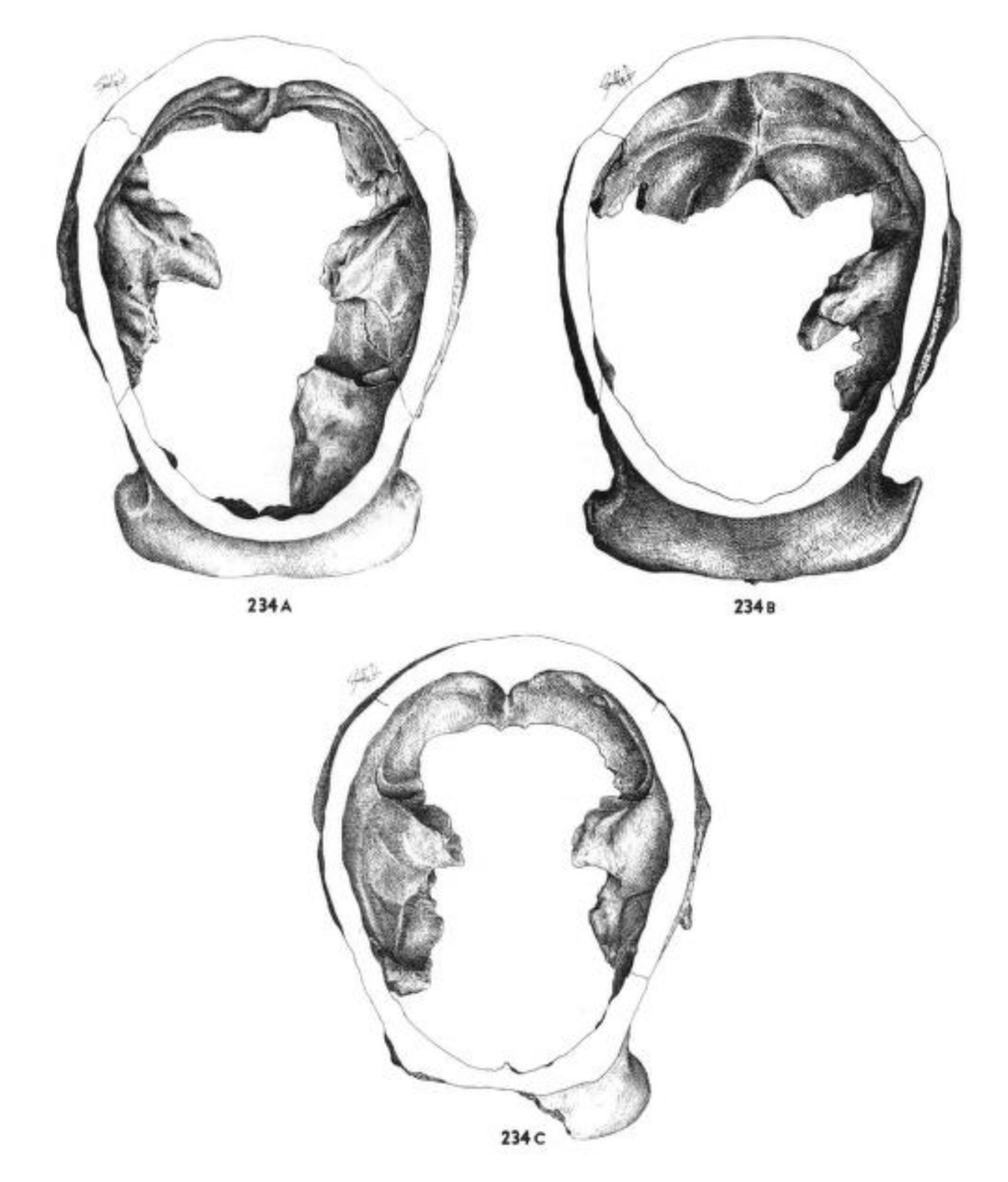
In China, the Zhoukoudian cave system near Beijing produced one of the most celebrated early hominin assemblages ever excavated. Between 1921 and 1937, Chinese and international researchers recovered the remains of at least forty individuals, dated to approximately 750,000 to 200,000 years ago, with the most intensively studied layers clustering around 500,000 years ago.7 The "Peking Man" fossils display cranial capacities ranging from roughly 850 to 1,225 cubic centimeters, substantially larger than the Dmanisi specimens and overlapping with the range of later H. erectus in Africa, consistent with the pattern of brain size increase documented across the species' temporal range.13 Additional Chinese localities, including Lantian (Gongwangling and Chenjiawo, ~1.15–0.65 Ma) and Yuanmou (~1.7 Ma, though the dating of Yuanmou remains contested), extend the known record of H. erectus in China substantially further back in time.5
The Acheulean frontier and the Movius Line
One of the most striking and long-discussed patterns in the archaeological record of the H. erectus dispersal is the near-absence of Acheulean handaxes from East and Southeast Asian sites, in sharp contrast to their abundance across Africa, the Levant, and Europe west of northern India. This geographic discontinuity was first formally described by the American archaeologist Hallam Movius in 1948, who drew a line from northern India through Southeast Asia separating a western Acheulean province from an eastern "chopper-chopping tool" province. The Movius Line, as it came to be known, has proven remarkably durable despite decades of scrutiny.8
Several explanations for this pattern have been proposed. The earliest and most influential held that the populations that colonized East Asia did so before the Acheulean had been invented in Africa, carrying only the Oldowan toolkit with them, and that subsequent Acheulean innovations never diffused eastward into already-established populations. This "early dispersal" hypothesis is broadly consistent with the Dmanisi evidence and with the oldest Chinese dates, but requires that gene flow and cultural transmission across the vast distances of the Old World were insufficient to spread the biface technology once it arose.8, 16 An alternative explanation proposes that East Asian H. erectus populations had access to abundant bamboo and other organic materials that served the same functional roles as stone handaxes, reducing selection pressure for biface manufacture — a hypothesis known as the "bamboo hypothesis." This remains plausible but inherently difficult to test archaeologically given the poor preservation of organic materials. A third possibility is that raw material availability in East Asia, where fine-grained cryptocrystalline stones suitable for biface production are less consistently available than in Africa, constrained the development of Acheulean-style tool production independent of any migration dynamic.16
Recent discoveries have complicated the picture without fully resolving it. A small number of purported handaxes have been reported from sites in South China and Korea, suggesting that the Movius Line may be more permeable than originally envisioned, but these finds remain contested and do not approach the frequency or quality of Acheulean assemblages from Africa or Europe.8 The balance of evidence continues to support a meaningful technological discontinuity between the two hemispheres of the H. erectus world, whatever its ultimate cause.
Multiple dispersal waves and population structure
The H. erectus dispersal is unlikely to have been a single, unidirectional event. Paleoclimatic reconstructions of the early and middle Pleistocene document repeated glacial-interglacial cycles that alternately opened and closed the Saharan and Levantine corridors connecting sub-Saharan Africa to Eurasia. During humid phases, these corridors would have facilitated the movement of both human populations and their prey; during arid phases, they would have contracted into refugia and potentially isolated populations from one another for tens of thousands of years at a time.14 This climatic pulsing suggests that what appears in the fossil record as a single dispersal event was more probably a series of expansions, retreats, and re-colonizations spread across hundreds of thousands of years.
The hypothesis of multiple dispersal waves was formalized by Lahr and Foley in 1994, who argued that the anatomical diversity observed among geographically separated H. erectus populations reflects not a single dispersal with subsequent local differentiation but several genetically distinct waves of African emigrants at different times, carrying different tool kits and representing different stages of anatomical evolution.14 Under this model, the Dmanisi population might represent a very early wave of emigrants with small brains and Oldowan tools, while a later wave carried Acheulean technology into the Levant and Europe but not into East Asia. The anatomically more derived African H. erectus of the middle Pleistocene might represent yet another expansion, contributing to the evolution of Homo heidelbergensis across Africa and Europe.13
The fossil evidence from the Iberian Peninsula adds a further dimension. Atapuerca's Gran Dolina site in Spain has yielded hominin remains assigned to Homo antecessor and dated to approximately 900,000 to 800,000 years ago, representing either a very early dispersal into western Europe or an independent lineage derived from an early H. erectus-like ancestor.10 Whatever the taxonomic status of H. antecessor, its existence demonstrates that the geographic range of early Pleistocene hominins extended to the Atlantic coast of Europe within a million years of the species' first appearance in the fossil record.
Evolutionary legacy
The dispersal of H. erectus out of Africa set the stage for the evolution of all later hominin diversity outside the continent. Regional populations of H. erectus persisting across Africa, Europe, and Asia provided the substrate from which subsequent hominin lineages differentiated during the middle Pleistocene. In Africa and Europe, later populations with larger brains and more derived cranial morphologies are grouped under Homo heidelbergensis, itself the probable ancestor of both Neanderthals in Europe and anatomically modern humans in Africa. The Denisovans, known primarily from ancient DNA recovered in Siberia, appear to represent a lineage that diverged from the Neanderthal stem in Asia, potentially tracing descent from H. erectus populations that had been isolated in eastern Eurasia for hundreds of thousands of years.
In East and Southeast Asia, the relationship between H. erectus and later hominins is more contentious. Multiregional evolution hypotheses, largely out of favor in their strong form, proposed that regional Asian H. erectus contributed substantially to the ancestry of modern East Asian and Australian populations through continuous gene flow across the Old World. Current genetic evidence, which has found no detectable H. erectus DNA in modern human genomes, argues against significant genetic continuity from the Java or Zhoukoudian populations to living humans. The Ngandong population, surviving until perhaps 108,000 years ago, appears to have left no genomic legacy in any known modern or archaic hominin.3 The island of Flores, isolated by deep water channels throughout the Pleistocene, may preserve a separate evolutionary outcome: the diminutive Homo floresiensis, whose ancestry is debated but may include a very early, small-bodied H. erectus-like colonizer that underwent insular dwarfism over hundreds of thousands of years of isolation.
The control of fire, whatever its precise chronology in the H. erectus range, represents perhaps the most consequential behavioral innovation associated with the species and its dispersal. Fire would have extended the habitable range of hominin populations into cooler latitudes, provided protection from predators, enabled the detoxification of plant foods through cooking, and restructured the social dynamics of hominin groups around centralized hearths. The stone tool traditions carried by H. erectus populations, from the Oldowan at Dmanisi to the Acheulean across Africa and western Eurasia, established the technological foundations on which later, more complex industries were built. In this sense, the dispersal of H. erectus was not merely the spread of a single species across a continent but the seeding of ecological and cultural experiments whose outcomes would ultimately produce the full diversity of later Pleistocene hominin life.
References
The Movius Line reconsidered: Perspectives from the Late Stone Age of the Middle Son Valley
Microstratigraphic evidence of in situ fire in the Acheulean strata of Wonderwerk Cave, Northern Cape province, South Africa
Homo erectus and Middle Pleistocene hominins: Brain size, skull form, and species recognition
Raw material constraints and Acheulean biface variability: Evidence from the East Asian periphery