Overview
- The genus Homo first appears in the fossil record approximately 2.8 million years ago in East Africa, coinciding with the earliest stone tools, and is distinguished from australopithecines by larger brains, smaller teeth, and increasingly sophisticated technology.
- Homo erectus, emerging by 1.9 million years ago, was the first hominin to achieve modern body proportions, produce Acheulean hand axes, control fire, and disperse out of Africa into Eurasia, marking a transformative shift in human evolution.
- The Middle and Late Pleistocene saw a proliferation of diverse Homo species across three continents, including the large-brained H. heidelbergensis, the enigmatic H. naledi, and the island-dwelling H. floresiensis and H. luzonensis, revealing that our genus was far more taxonomically diverse than once imagined.
The genus Homo—the group that includes all living humans and our closest extinct relatives—first appears in the fossil record approximately 2.8 million years ago in East Africa. The oldest specimen attributed to the genus is a partial mandible (LD 350-1) from the Ledi-Geraru site in Ethiopia's Afar region, which combines Homo-like features including reduced premolars and a more gracile jaw with some primitive traits linking it to Australopithecus afarensis.3 The emergence of Homo roughly coincided with the appearance of the oldest known stone tools of the Oldowan industry, dated to more than 2.58 million years ago at the same site, suggesting that tool manufacture and the evolutionary changes defining our genus were closely linked.2
Over the next two million years, the genus Homo diversified dramatically, producing species that ranged from small-brained toolmakers barely distinguishable from australopithecines to large-brained hunters who colonized every continent except Antarctica. The defining trends of the genus include progressive brain expansion, reduction in tooth and jaw size, development of increasingly sophisticated stone tool technologies, and geographic expansion out of Africa and across the Old World.1, 10 Yet these trends were neither uniform nor linear: some species reversed them, and several lineages with very different combinations of traits coexisted at the same time.7, 8
The earliest members
Homo habilis and Homo rudolfensis, dating from roughly 2.4 to 1.5 million years ago, are the earliest widely recognized members of the genus. H. habilis, first described from Olduvai Gorge in Tanzania in 1964, had a brain of approximately 510–680 cubic centimeters—roughly 50% larger than that of the average australopithecine—and is associated with the Oldowan stone tool tradition.1, 10 H. rudolfensis, known primarily from the large-brained cranium KNM-ER 1470 discovered at Koobi Fora, Kenya, had a flatter face and larger brain (~750 cc) but is represented by fewer specimens and remains poorly understood.10
Whether these species truly belong in the genus Homo or should be reassigned to Australopithecus is one of the most actively debated questions in paleoanthropology. Both species retained many primitive postcranial features, including relatively long arms and curved finger bones suggestive of continued arboreal activity, features more typical of australopithecines than of later Homo.1, 10 The debate reflects the fundamental difficulty of drawing a genus boundary within a continuously evolving lineage: the transition from australopithecine to Homo was not a single event but a gradual, mosaic process.10
Homo erectus and the first dispersal
The emergence of Homo erectus by approximately 1.9 million years ago marked a transformative shift in human evolution. With a brain roughly twice the size of an australopithecine's (ranging from roughly 550 to 1,250 cc across its temporal and geographic range), modern limb proportions, a barrel-shaped thorax, and a committed terrestrial locomotion pattern, H. erectus represented a fundamentally new kind of hominin.4, 1 The "Turkana Boy" skeleton (KNM-WT 15000), a nearly complete adolescent from Kenya dated to 1.6 million years ago, revealed a body plan essentially indistinguishable from that of modern humans in its overall proportions, though with a brain still considerably smaller than ours.4
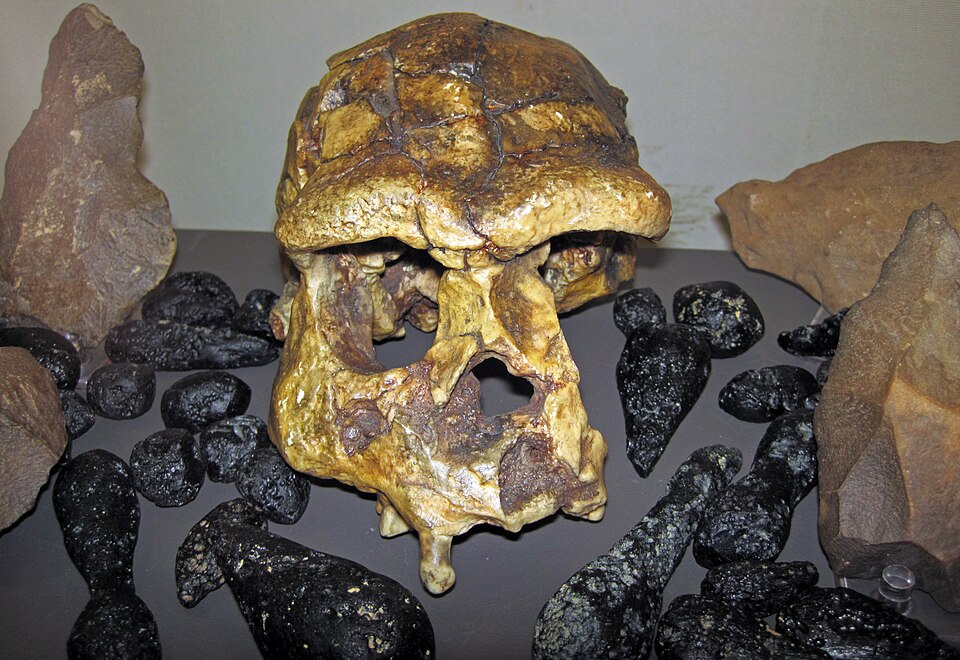

Homo erectus was the first hominin to disperse out of Africa. The 1.77-million-year-old fossils from Dmanisi, Georgia, represent the earliest known hominins outside the African continent, and their extreme morphological variation has prompted some researchers to question whether several supposedly separate early Homo species might actually represent a single, highly variable lineage.5 By 1.5 million years ago, H. erectus populations had reached Southeast Asia and China. The species is also associated with the Acheulean stone tool industry—characterized by large, symmetrical hand axes—which first appears in the record by 1.76 million years ago, as well as the earliest evidence for controlled use of fire.6, 1 H. erectus persisted in insular Southeast Asia until at least 108,000 years ago, making it the longest-surviving species in the genus.1
Middle Pleistocene diversity
The Middle Pleistocene (roughly 800,000 to 130,000 years ago) saw a proliferation of large-brained Homo species across Africa and Eurasia. Homo heidelbergensis, known from sites in Africa, Europe, and possibly Asia between approximately 700,000 and 200,000 years ago, had brain volumes approaching the modern human range (1,100–1,400 cc) and is widely regarded as the likely last common ancestor of Neanderthals, Denisovans, and Homo sapiens.9 The taxonomy of this group is actively debated, with some researchers proposing the name Homo bodoensis to replace what they consider a poorly defined taxon.10
.jpg)
.jpg)
Homo antecessor, known from the Gran Dolina cave at Atapuerca, Spain, dates to approximately 800,000–900,000 years ago and displays a strikingly modern-looking midface. Ancient protein analysis published in 2020 placed it as a closely related sister lineage to the clade containing Neanderthals, Denisovans, and modern humans, rather than a direct ancestor of any of them.10 These Middle Pleistocene species document a period of rapid brain expansion, increasing behavioral complexity, and geographic diversification that set the stage for the emergence of Homo sapiens.1, 9
Enigmatic late survivors
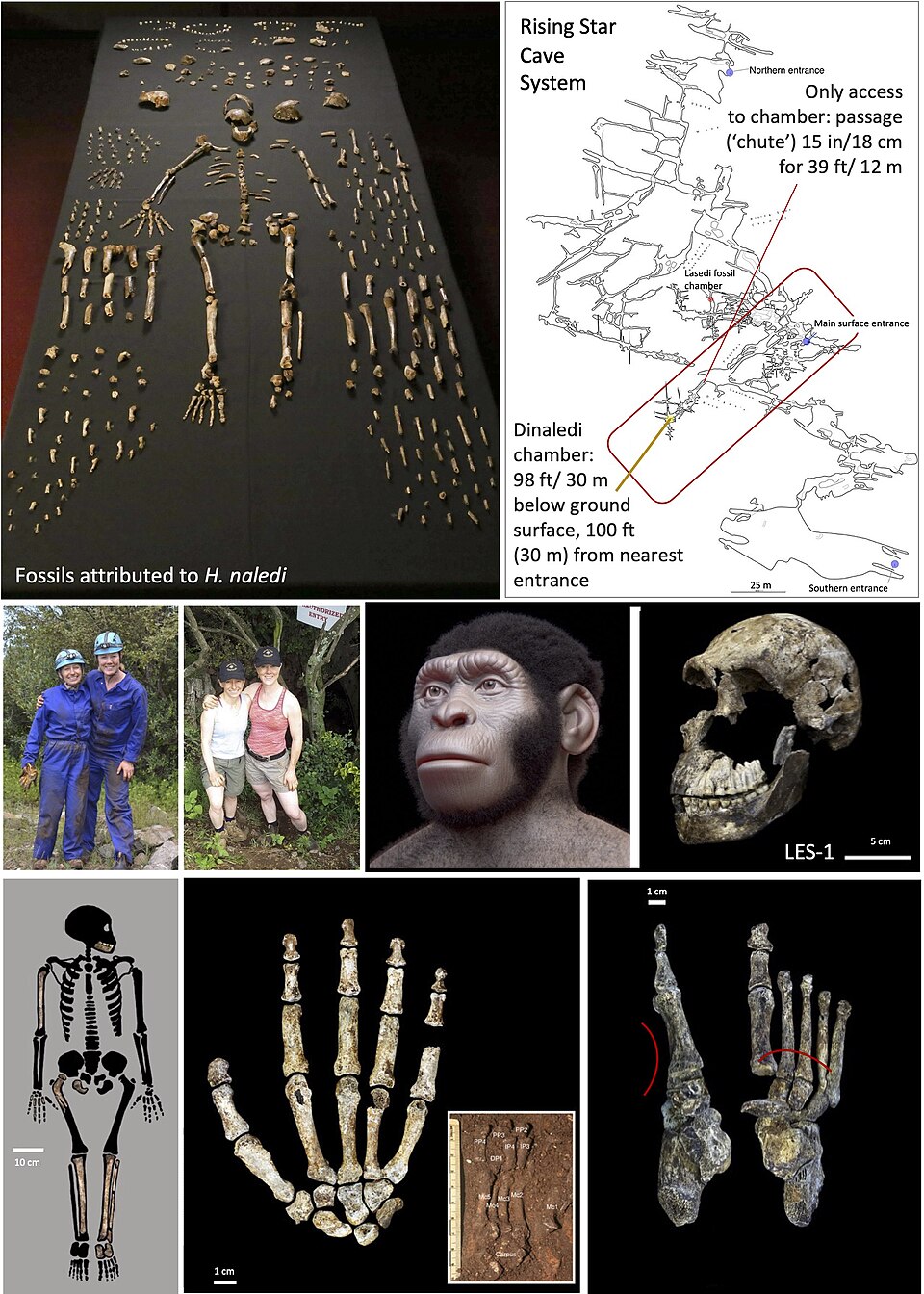
Homo naledi, discovered in 2013 in the Rising Star Cave system in South Africa, upended expectations about the relationship between brain size and behavioral complexity. Despite having a brain only one-third the size of a modern human's (465–610 cc), H. naledi lived just 236,000–335,000 years ago—contemporaneous with early Homo sapiens—and may have practiced deliberate body disposal in a remote cave chamber, a behavior previously associated only with large-brained hominins.7

In island Southeast Asia, Homo floresiensis and Homo luzonensis demonstrate that isolated environments could drive dramatic evolutionary divergence within our genus. H. floresiensis, from the island of Flores in Indonesia, stood roughly one meter tall with a brain volume of about 380 cubic centimeters—smaller than that of any australopithecine—yet produced stone tools and hunted cooperatively until at least 50,000 years ago.8 H. luzonensis, described in 2019 from Callao Cave in the Philippines, displays a mosaic of primitive and derived features confirming that a second distinct island hominin species evolved independently in the region.8 These species reveal that the genus Homo was far more diverse and ecologically flexible than a simple narrative of linear progress toward modern humans would suggest.1, 10
Defining the genus
The question of what defines the genus Homo has no universally accepted answer, and the boundary between late australopithecines and earliest Homo remains one of the most actively debated issues in paleoanthropology. Bernard Wood and Mark Collard argued in a widely cited 1999 paper that the genus Homo should be defined by a package of derived features including obligate bipedalism with modern body proportions, reduced sexual dimorphism, commitment to a high-quality diet, and a brain-to-body ratio significantly above the australopithecine range.10 Under this strict definition, H. habilis would be excluded from the genus, since it retains many australopithecine-grade postcranial features. Others have argued for a more inclusive definition that emphasizes brain expansion and association with stone tool technology as the defining criteria, even if body proportions remain primitive.1
The difficulty of drawing a sharp genus boundary reflects the reality that the transition from australopithecine to Homo was gradual and mosaic. Different anatomical systems evolved at different rates: brain size began increasing before body proportions modernized, and stone tool use appears in the record before any clear Homo fossils. The genus Homo is thus best understood not as a category defined by a single diagnostic trait but as a cluster of evolving lineages that progressively accumulated the features — large brains, reduced dentition, modern limb proportions, and sophisticated technology — that would eventually characterize modern humans.1, 10