Overview
- Olduvai Gorge in northern Tanzania preserves a nearly continuous two-million-year sedimentary sequence (Beds I through IV) that has yielded some of the most important hominin fossils ever discovered, including the Paranthropus boisei type specimen OH 5 and the Homo habilis type specimen OH 7.
- Excavations led by Mary and Louis Leakey from the 1930s through the 1980s established the gorge as a foundational site for understanding human evolution, documenting the transition from Oldowan to Acheulean stone tool technology and revealing that multiple hominin species coexisted in East Africa.
- Modern landscape archaeology and high-resolution dating have transformed Olduvai from a fossil quarry into a laboratory for reconstructing the environments, diets, and behaviors of early hominins across a critical period of evolutionary change.
Olduvai Gorge is a steep-sided ravine in the eastern Serengeti Plain of northern Tanzania, situated within the Ngorongoro Conservation Area approximately 45 kilometers from the Ngorongoro Crater.1 Stretching roughly 48 kilometers in length and reaching depths of up to 100 meters, the gorge cuts through a sequence of Plio-Pleistocene sediments that span nearly two million years of Earth history, from approximately 2.0 million years ago to roughly 15,000 years before present.6 Over the course of the twentieth century, excavations at Olduvai produced a succession of hominin fossil discoveries that fundamentally reshaped understanding of human evolution, including the type specimens of Paranthropus boisei and Homo habilis, and provided the archaeological framework for defining the Oldowan and tracking the emergence of the Acheulean stone tool tradition.1, 2 The gorge is inseparable from the careers of Louis and Mary Leakey, whose decades of fieldwork there established East Africa, rather than Asia, as the geographical focus of human origins research.18
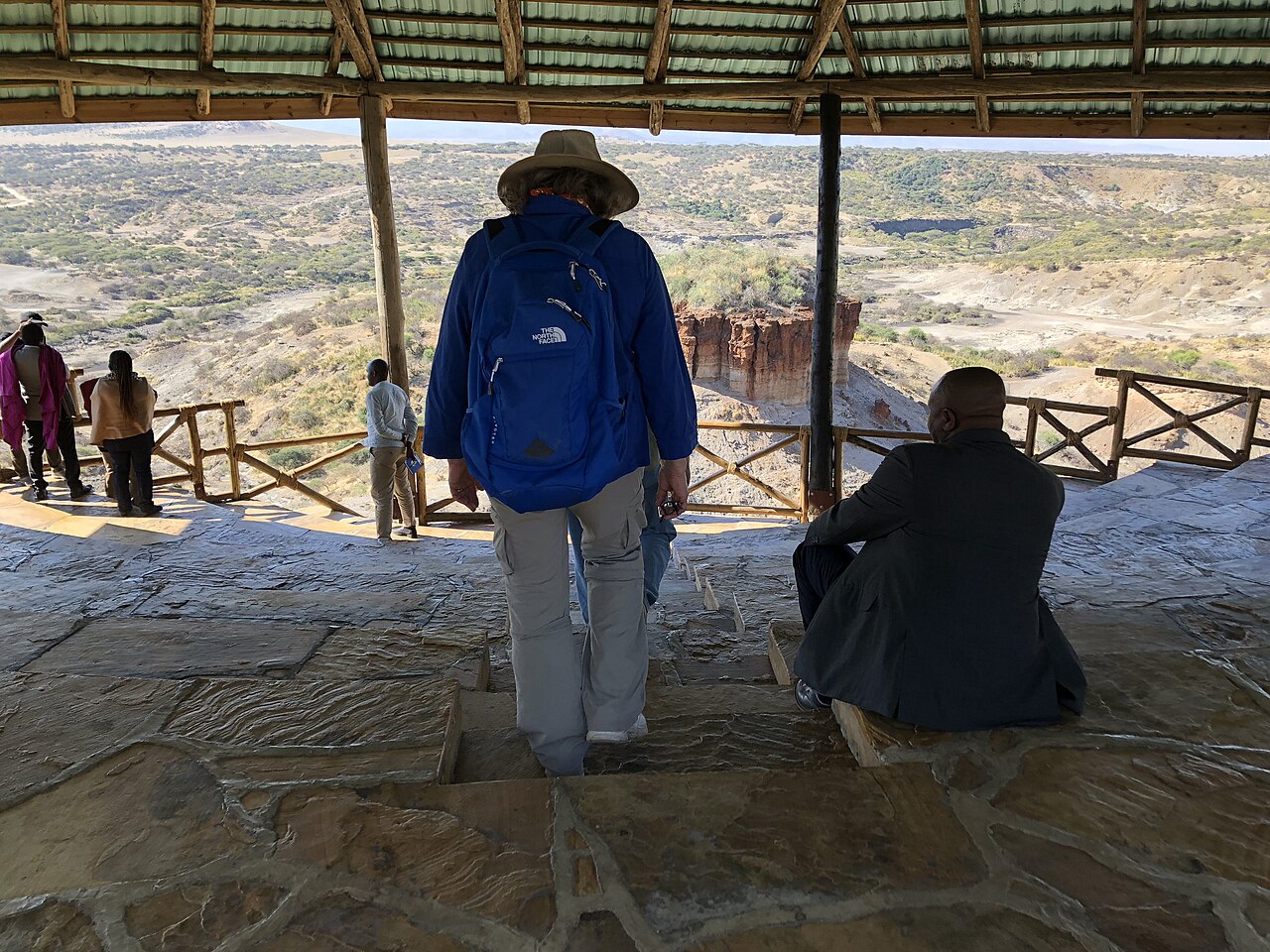

Geological setting
Olduvai Gorge owes its existence to the tectonic forces that created the East African Rift System. The gorge is incised into the margin of the Olbalbal Depression, a fault-bounded basin on the volcanic highlands between the Ngorongoro volcanic complex to the east and the granite-gneiss inselbergs of the Serengeti to the west.6 The gorge itself was formed relatively recently, within the last 500,000 years, when a seasonal river cut down through the accumulated lake, fluvial, and volcanic sediments that had been deposited over the preceding 1.5 million years, exposing them in a natural cross-section of extraordinary clarity.6
The geological foundation of the gorge is the Naabi Ignimbrite, a welded volcanic tuff dated to approximately 2.038 million years ago that forms the basement upon which all subsequent deposits accumulated.6, 16 Above this basement, the geologist Richard Hay, who spent decades mapping the gorge's stratigraphy, recognized a succession of distinct depositional units that he designated Beds I through IV, plus the overlying Masek, Ndutu, and Naisiusiu Beds.6 Each bed is separated from its neighbors by unconformities or by distinctive volcanic marker tuffs that serve as chronological anchors, permitting the precise stratigraphic placement of fossils and artifacts throughout the sequence.6
The sedimentary environments shifted dramatically over this two-million-year interval. Bed I, deposited between approximately 2.0 and 1.79 million years ago, accumulated primarily in and around a saline-alkaline lake that occupied the central basin, with fluvial and alluvial sediments along its margins.6, 16 Bed II, spanning from about 1.79 to 1.2 million years ago, records a transition from lacustrine to more fluvial conditions as the lake contracted and streams became more prominent agents of deposition.6 Beds III and IV, deposited between roughly 1.2 million and 600,000 years ago, reflect increasingly arid conditions with predominantly fluvial and aeolian sedimentation.6 The interbedded volcanic tuffs throughout the sequence, originating from eruptions of Ngorongoro and other nearby volcanoes, have proved invaluable for radiometric dating, particularly through argon-argon and potassium-argon methods applied to the tuff layers by Alan Deino and colleagues.16
The gorge's sedimentary record is not merely a passive repository of fossils but a dynamic archive of environmental change. Lake level fluctuations, volcanic ashfalls, river channel migrations, and tectonic movements all left imprints in the sedimentary record, creating a palimpsest of ancient landscapes that modern researchers can reconstruct with increasing precision.6, 11 This environmental context is essential for understanding why hominins were drawn to the Olduvai basin: the lake and its margins provided water, plant resources, and aggregations of herbivores in a landscape otherwise dominated by open, seasonally dry savanna.11
Discovery and the Leakey legacy
The gorge first came to European scientific attention in 1911 when a German entomologist, Wilhelm Kattwinkel, stumbled upon it while chasing butterflies across the Serengeti. He collected fossil bones from the exposed sediments and brought them back to Berlin, where they attracted the interest of the geologist Hans Reck, who led an expedition to Olduvai in 1913 and recovered a near-complete modern human skeleton from the upper beds.1 Reck's skeleton, later determined to be an intrusive burial of relatively recent age, was initially misinterpreted as evidence of great antiquity for Homo sapiens, but the fossil fauna he collected demonstrated that the gorge contained deposits of genuine Pleistocene age.1
Louis Leakey first visited Olduvai in 1931, accompanied by Reck, and immediately recognized the potential of the site. Over the following three decades, Leakey and his wife Mary conducted periodic excavation campaigns, recovering stone tools and fragmentary hominin remains but struggling with limited funding and the site's remote location.1, 18 The breakthrough came on 17 July 1959, when Mary Leakey discovered a robust hominin cranium eroding from the surface of Bed I at the locality known as FLK (Frida Leakey Korongo). This specimen, catalogued as OH 5 (Olduvai Hominid 5), was initially named Zinjanthropus boisei by Louis Leakey, who believed it represented a new genus distinct from the South African robust australopiths.3 The name honored Charles Boise, a benefactor of the Leakey research. The specimen is now classified as Paranthropus boisei, the type specimen of the species, and remains one of the most complete robust australopith crania ever found.3
The discovery of OH 5 transformed the fortunes of the Olduvai project. It attracted international media attention and, crucially, the financial support of the National Geographic Society, which funded large-scale excavations at the gorge for decades thereafter.18 With consistent funding, the Leakeys were able to employ larger teams and conduct systematic excavations across multiple localities, producing a cascade of discoveries that reshaped the field of paleoanthropology.1
Mary Leakey was the principal excavator and the meticulous recorder of the archaeological evidence. Her volumes on the Olduvai excavations, published between 1971 and 1994, remain essential references for the stratigraphy, stone tool assemblages, and faunal remains of the gorge.2, 14 While Louis was the more publicly visible figure and often the author of the taxonomic papers announcing new species, it was Mary who directed the excavations, established the stratigraphic framework, and analyzed the stone tools with a rigor that set the standard for East African archaeology.18 Her five-volume monograph series on Olduvai Gorge is among the most comprehensive site reports in the history of paleoanthropology.2
Key hominin fossils
Olduvai Gorge has produced more than sixty catalogued hominin specimens spanning at least four species across nearly two million years. The numbering system uses the prefix OH (Olduvai Hominid) followed by a sequential number, a convention established by the Leakeys that continues to this day.9
OH 5, the Paranthropus boisei cranium discovered by Mary Leakey in 1959, is characterized by massive masticatory apparatus including enormous molars, thick enamel, and prominent sagittal and nuchal crests for the attachment of powerful chewing muscles.3 The cranial capacity of OH 5 is approximately 530 cubic centimeters, within the range of other robust australopiths.3, 9 Louis Leakey initially interpreted OH 5 as the maker of the stone tools found at FLK, but subsequent discoveries at the same stratigraphic level of a different, more gracile hominin led him to reconsider this attribution.3, 4
That more gracile hominin was represented by OH 7, a partial juvenile skeleton discovered in 1960 at FLK NN (FLK North North), a locality just meters from the OH 5 site and in the same stratigraphic interval of upper Bed I.4 OH 7 consists of portions of a mandible, parietal bones, and hand bones, and became the type specimen of Homo habilis, named by Leakey, Tobias, and Napier in 1964.4 The name, meaning "handy man," reflected the assumption that this was the hominin responsible for the Oldowan stone tools found throughout Bed I. The cranial capacity of OH 7, estimated at roughly 680 cubic centimeters from reconstructed parietals, placed it above the australopith range and within what the authors proposed as the lower boundary of the genus Homo.4, 8 The naming of Homo habilis was controversial from the outset, with many researchers arguing that the specimens fell within the range of variation of Australopithecus or that the material was too fragmentary to justify a new species.8
OH 9, discovered in 1960 in upper Bed II, is a partial cranium attributed to Homo erectus.10 With a cranial capacity of approximately 1,067 cubic centimeters and thick cranial vault bones, OH 9 represents one of the largest-brained early Homo erectus specimens known from Africa.10 Its stratigraphic position in Bed II, dated to approximately 1.4 million years ago, places it well above the Bed I deposits that yielded H. habilis and P. boisei, consistent with the temporal succession from smaller-brained to larger-brained Homo species in the gorge.10, 7
Selected hominin fossils from Olduvai Gorge9, 10
| Specimen | Bed | Age (Ma) | Species | Key elements |
|---|---|---|---|---|
| OH 5 | I | ~1.75 | Paranthropus boisei | Near-complete cranium (type specimen) |
| OH 7 | I | ~1.75 | Homo habilis | Mandible, parietals, hand bones (type specimen) |
| OH 8 | I | ~1.75 | Homo habilis | Nearly complete foot |
| OH 9 | II | ~1.4 | Homo erectus | Partial cranium (~1,067 cc) |
| OH 12 | IV | ~0.6–0.8 | Homo erectus | Cranial fragments |
| OH 13 | II | ~1.5 | Homo habilis | Mandible, maxilla, cranial fragments |
| OH 24 | I | ~1.8 | Homo habilis | Crushed cranium ("Twiggy") |
| OH 62 | I | ~1.8 | Homo habilis | Partial skeleton (small body size) |
The discovery of OH 62 in 1986, a partial skeleton attributed to Homo habilis, added another dimension to the story. This specimen, described by Tim White and Donald Johanson, was unexpectedly small-bodied, with limb proportions more similar to australopiths than to later Homo, raising questions about the degree of postcranial modernity in early members of the genus.9 A partial Paranthropus boisei skeleton from Bed II, reported by Domínguez-Rodrigo and colleagues in 2013, further demonstrated that multiple hominin lineages coexisted at Olduvai for hundreds of thousands of years, each presumably occupying a distinct ecological niche within the Olduvai paleo-landscape.12
Stone tool technology and the Oldowan-Acheulean transition
Olduvai Gorge holds a special place in the history of stone tool studies because it provided the type assemblages for the Oldowan industrial complex, named after the gorge itself, and documented the transition to the Acheulean with exceptional stratigraphic resolution.2, 5 The Oldowan, as defined by Mary Leakey from the Bed I and lower Bed II assemblages, is characterized by simple core tools, particularly choppers and polyhedrons, produced by striking flakes from cobbles of lava, quartzite, and other locally available raw materials.2 Leakey's detailed typological classification of these tools, presented in her 1971 monograph, remained the standard reference for Oldowan technology for decades.2
The flakes removed during chopper production were themselves functional tools, and subsequent research by Nicholas Toth demonstrated through experimental replication and use-wear analysis that the sharp-edged flakes were probably the primary objective of Oldowan knapping, with the cores being by-products rather than the intended end products.5 This insight reframed the interpretation of the earliest stone tool assemblages: rather than viewing them as collections of designed implements, researchers began to understand them as the residues of a generalized flake-production strategy aimed at creating sharp cutting edges.5
The transition from the Oldowan to the Acheulean, marked by the appearance of large bifacial tools such as handaxes and cleavers, occurs in the upper portion of Bed II at Olduvai. Recent argon-argon dating by Diez-Martín and colleagues has placed this transition at approximately 1.4 million years ago at Olduvai, broadly contemporaneous with the appearance of Acheulean technology elsewhere in East Africa.7 The transition was not abrupt; for a considerable span of Bed II, Oldowan and Acheulean assemblages occur at different localities within the gorge, suggesting either that different hominin species maintained distinct technological traditions or that a single population used different tool kits in different functional contexts.7, 11
Mary Leakey recognized this coexistence and termed the late Oldowan assemblages in Bed II the "Developed Oldowan," a category she distinguished from both the classic Oldowan of Bed I and the Acheulean on the basis of tool types and proportions.2 Whether the Developed Oldowan represents a genuine cultural tradition distinct from the Acheulean, or merely the Acheulean without its bifacial component due to raw material constraints or activity-specific tool selection, remains debated.5, 11 The gorge's lengthy sequence nevertheless makes it the single most informative locality for studying the tempo and mode of this fundamental technological transition.11
Faunal assemblages and paleoecology
The faunal remains from Olduvai Gorge provide a rich record of the mammalian communities that shared the landscape with early hominins. Bed I and lower Bed II have yielded extensive collections of bovid (antelope), suid (pig), equid (horse), and proboscidean (elephant) fossils, along with carnivores, hippopotamuses, crocodiles, and a diverse array of smaller mammals and reptiles.1, 6 The assemblages have been instrumental in reconstructing the paleoenvironmental context of hominin evolution at the site.11
The bovid fauna is particularly diagnostic of past environments because different bovid tribes are associated with different habitats. Analysis of the Bed I fauna indicates a mosaic environment surrounding the central lake, with open grasslands on the basin margins, wooded areas along watercourses, and wetland habitats adjacent to the lake itself.6, 11 This environmental mosaic appears to have been a key factor in attracting hominins to the Olduvai basin, as it concentrated diverse resources, including water, plants, and prey animals, within a relatively small area.11
The archaeofaunal assemblages, the animal bones found in direct association with stone tools at archaeological sites within the gorge, have been at the center of a long-running debate about early hominin subsistence behavior. Mary Leakey interpreted the concentrations of stone tools and animal bones at FLK and other Bed I sites as "living floors," places where hominins brought food to a central location for processing and consumption.2 This interpretation was challenged in the 1980s by Lewis Binford, who argued that the bone accumulations were primarily the work of carnivores and that hominins were marginal scavengers rather than active hunters.17
Detailed taphonomic studies by Manuel Domínguez-Rodrigo and colleagues have attempted to resolve this debate through systematic analysis of bone surface modifications. Cut marks produced by stone tools and tooth marks produced by carnivore gnawing leave distinct signatures on bone surfaces, and the relative frequency and anatomical distribution of these marks can indicate whether hominins or carnivores had primary access to carcasses.17 At the FLK Zinj site, Domínguez-Rodrigo found that cut marks on limb bones were frequently superimposed on pristine bone surfaces with no underlying carnivore damage, suggesting that hominins had early access to fleshed carcasses rather than scavenging from carnivore kills.17 Whether this access came through active hunting, confrontational scavenging, or opportunistic acquisition of naturally deceased animals continues to be debated, but the simple passive-scavenger model has largely been abandoned.11, 17
The faunal turnover documented through the Olduvai sequence also contributes to understanding of broader evolutionary patterns. The transition from Bed I to Bed II corresponds to a period of significant environmental change across East Africa, with increasing aridity and expansion of open grasslands at the expense of wooded habitats.6, 13 This environmental shift is reflected in changes in the bovid community, with grazing-adapted species becoming more prominent relative to browsers through time, and may have been a selective pressure driving the evolution and diversification of the genus Homo in East Africa.13
Landscape archaeology and site formation
Beginning in the late twentieth century and accelerating in the twenty-first, research at Olduvai has shifted from the excavation of individual sites toward a landscape-scale approach that seeks to understand how hominins used space across the ancient basin. This approach, championed by researchers including Domínguez-Rodrigo, integrates geological, paleontological, and archaeological data to reconstruct not just what hominins did at a particular spot, but how their activities were distributed across the landscape in relation to resources, hazards, and other ecological variables.11
The Olduvai Landscape Paleoanthropology Project (OLAPP), initiated in the early 2000s, applied this approach systematically to the Bed I and Bed II exposures. By excavating multiple sites within the same stratigraphic interval and mapping artifact and bone densities across continuous trenches, the project demonstrated that archaeological material is distributed more continuously across the paleo-landscape than the traditional focus on high-density sites had suggested.11 What Mary Leakey had identified as discrete living floors increasingly appear to be high-density patches within a broader, lower-density scatter of cultural material, suggesting that hominins were active across large areas of the lake margin rather than being confined to a few favored campsites.11
Site formation processes, the natural and cultural mechanisms by which archaeological deposits are created, modified, and preserved, have received particular attention at Olduvai because the gorge's complex depositional history means that the spatial patterns observed in excavation may not directly reflect the spatial patterns of past hominin behavior.11 Water transport can move bones and artifacts from their original locations, creating accumulations that mimic deliberate hominin activity. Volcanic ashfalls can rapidly bury and preserve behavioral evidence, acting like geological snapshots. Tree root activity, burrowing animals, and sediment compaction can displace objects vertically within deposits after burial.6, 11 Understanding these processes is essential for distinguishing genuine behavioral signals from geological artifacts, and Olduvai, with its well-studied geology and long history of excavation, has served as a proving ground for site formation theory in African archaeology.11
The application of Geographic Information Systems (GIS) to Olduvai's spatial data has enabled new analyses of hominin land use. By plotting the locations of archaeological sites against reconstructed paleoenvironmental variables such as distance to the lake shore, proximity to fresh water sources, vegetation type, and topographic position, researchers have identified patterns suggesting that early hominins preferentially occupied ecotonal settings, the boundaries between different habitat types, where resource diversity is typically highest.11 This finding aligns with ecological models that predict generalist foragers should concentrate their activities at habitat interfaces to maximize access to diverse food resources.11
Recent research and continuing significance
Twenty-first-century research at Olduvai has brought new technologies and new questions to a site that has been under investigation for nearly a century. High-precision argon-argon dating by Deino and colleagues has refined the chronological framework for Bed I, resolving ambiguities in the earlier potassium-argon dates and providing tighter constraints on the ages of key hominin and archaeological localities.16 The revised dates have, among other things, confirmed that the FLK Zinj site, where OH 5 was discovered, dates to approximately 1.84 million years ago, making it one of the oldest well-documented archaeological sites in East Africa.16
Sedimentary ancient DNA (sedaDNA) analysis, applied to Olduvai sediments by Bibi and colleagues, has opened an entirely new window into the paleoenvironment. By extracting and sequencing degraded DNA preserved in the sediments themselves, researchers have identified plant and animal taxa that left no macrofossil traces, providing a more complete picture of the biological communities that surrounded early hominins at the gorge.15 This technique is still in its early stages of application at Olduvai, but it holds the potential to reveal aspects of the paleoecology that are invisible through traditional paleontological methods.15
Stable isotope analysis of hominin teeth and associated fauna has provided direct evidence of diet and habitat use. Carbon isotope ratios in tooth enamel reflect the proportion of C3 (trees, shrubs, and forbs) versus C4 (tropical grasses and sedges) resources in an individual's diet, while oxygen isotopes provide information about water sources and aridity.11 Studies of the Olduvai fauna have documented a progressive shift toward C4-dominated diets through the Bed I to Bed II interval, consistent with the expansion of grasslands inferred from geological and faunal evidence.11
The Olduvai Gorge Coring Project, which extracted deep sediment cores from the basin floor, has provided continuous paleoenvironmental records that complement the discontinuous record exposed in the gorge walls. These cores capture climate signals at higher resolution than the archaeological exposures and have revealed rapid, high-amplitude environmental fluctuations during the period of hominin occupation, lending support to models that link hominin evolution to climatic variability rather than to any single environmental trend.11
Olduvai Gorge remains an active research locality where new discoveries continue to emerge. The site's designation as a UNESCO World Heritage component (as part of the Ngorongoro Conservation Area) has helped to protect it from development, although erosion, tourism-related damage, and the need for improved conservation infrastructure remain ongoing concerns.11 As the type locality for both the Oldowan industrial complex and Homo habilis, and as the site that produced the iconic Paranthropus boisei cranium OH 5, Olduvai holds a unique place in the history and continuing practice of paleoanthropology. No other site in Africa, and arguably no other site in the world, has contributed as much to the understanding of the first two million years of human evolution.1, 11
Stratigraphic summary
The stratigraphic sequence at Olduvai Gorge provides one of the most complete records of Plio-Pleistocene environmental and cultural change in East Africa. Richard Hay's geological framework, refined by subsequent workers, divides the sequence into a series of named beds, each with characteristic depositional environments, faunal assemblages, and archaeological signatures.6
Bed I, the oldest unit resting on the Naabi Ignimbrite basement, spans from approximately 2.0 to 1.79 million years ago and is dominated by lacustrine sediments from the paleo-lake Olduvai, interbedded with volcanic tuffs including the prominent Tuff IF and Tuff IB marker horizons.6, 16 The hominin fauna of Bed I includes both Paranthropus boisei and Homo habilis, and the stone tool assemblages are exclusively Oldowan.2 Bed II, extending from roughly 1.79 to 1.2 million years ago, records the contraction and eventual disappearance of the lake, a shift to more fluvial depositional environments, and the first appearance of Acheulean technology alongside continuing Oldowan (or Developed Oldowan) assemblages.6, 7 The hominin record of Bed II includes Homo erectus (OH 9) as well as continuing Paranthropus boisei and possibly late-surviving Homo habilis.9, 10
Beds III and IV, spanning approximately 1.2 to 0.6 million years ago, are less extensively exposed and have yielded fewer fossils, but they document the establishment of the Acheulean as the sole stone tool tradition in the gorge and record increasingly arid environmental conditions.6 The Masek Beds, deposited between roughly 600,000 and 400,000 years ago, preserve evidence of continued Acheulean occupation in an environment similar to the modern semi-arid Serengeti.6 The Ndutu Beds, dating to approximately 400,000 to 32,000 years ago, and the Naisiusiu Beds, from roughly 22,000 to 15,000 years ago, bring the sequence into the Late Pleistocene and record the presence of Middle Stone Age and Later Stone Age technologies, respectively.6
Together, this stratigraphic sequence transforms Olduvai Gorge from a collection of isolated fossil finds into a continuous narrative of human evolution set against a backdrop of dynamic environmental change. Few sites anywhere in the world offer a comparable combination of chronological depth, stratigraphic resolution, and richness of both biological and cultural evidence.6, 11
References
Stratigraphy, geochronology and geological context of Pleistocene sediments at Olduvai Gorge, Tanzania
New radiometric ages for the FLK North and Deinotherium sites and their bearing on the Oldowan-Acheulean transition in Olduvai Gorge, Tanzania
First partial skeleton of a 1.34-million-year-old Paranthropus boisei from Bed II, Olduvai Gorge, Tanzania
Landscape paleoecology and megafaunal extinction in southeastern Africa's Late Pleistocene
Use of sedimentary ancient DNA as a new tool for understanding the ecology of past environments at Olduvai Gorge
Disentangling early stone age palimpsests: determining the functional independence of hominid- and carnivore-derived portions of archaeofaunas