Overview
- Human infants are extraordinarily costly to raise — large brains, prolonged helplessness, and interbirth intervals far shorter than those of other great apes — creating a provisioning burden that a single mother cannot bear alone, a problem the cooperative breeding hypothesis resolves by positing that humans evolved in a system of shared infant care among multiple caregivers.
- The grandmother hypothesis, developed by Kristen Hawkes and colleagues from observations of Hadza foragers, proposes that post-menopausal women who foraged for grandchildren enabled mothers to wean offspring earlier and resume reproduction sooner, explaining the evolution of menopause and the unusually long post-reproductive lifespan unique to humans among primates.
- Cooperative breeding appears to have shaped distinctly human cognitive traits: because infants raised by multiple caregivers must solicit provisioning from non-maternal adults, selection favored heightened social cognition, shared intentionality, and communicative flexibility well beyond what is observed in any other ape.
Of all the primates, the human infant is the most helpless and the most expensive. Born with a brain only a quarter the size it will eventually reach, a newborn Homo sapiens cannot cling, cannot walk, and cannot feed itself — and will remain largely dependent on adult provisioning for the better part of a decade.1 Yet modern human mothers wean their infants far earlier, and resume reproduction far sooner, than any other great ape. A chimpanzee mother spaces births four to five years apart; a gorilla mother may wait six or seven years between offspring. Human hunter-gatherer mothers, by contrast, have interbirth intervals of roughly three years, and in some populations significantly less — even while nursing children who remain metabolically dependent long after weaning.3 The arithmetic of this situation is stark: a mother cannot simultaneously gestate, nurse, carry, and feed multiple young children on her own foraging while also provisioning the large-brained older juveniles who have not yet mastered the skills needed to feed themselves. Something else must be happening.

That "something else" is the subject of the cooperative breeding hypothesis, one of the most provocative and well-supported frameworks in contemporary evolutionary anthropology. The hypothesis, developed most fully by the primatologist and anthropologist Sarah Blaffer Hrdy, holds that Homo sapiens is a cooperatively breeding species: a species in which infants are routinely cared for, provisioned, and protected not only by their biological mothers but by a network of additional caregivers — grandmothers, fathers, older siblings, aunts, unrelated group members — collectively described as alloparents.1 On this view, the distinctive features of human life history, cognition, and sociality are not incidental but deeply intertwined, all emerging from the same ancestral transition to shared care that solved the problem of the costly, helpless infant.
The problem: an extraordinarily costly infant
To understand why cooperative breeding is such an attractive explanation for human evolution, it helps to appreciate precisely how anomalous human reproduction is among primates. The expansion of the hominin brain created what has been called an "obstetric dilemma": the fetal head is so large relative to the maternal pelvis that humans are born at an earlier developmental stage than other primates, necessitating a prolonged period of post-natal brain growth and total helplessness.4 A newborn chimpanzee, though needy, has a brain that is already roughly 40 percent of its adult volume; a newborn human brain is only about 25 percent of its eventual size, and reaches 90 percent only around age five or six.4 Throughout this long developmental trajectory, the child consumes an enormous quantity of calories and care.
The embodied capital model developed by Hillard Kaplan, Kim Hill, Jane Lancaster, and Magdalena Hurtado places these caloric demands in evolutionary context.5, 6 On their account, the extended human juvenile period is not merely a developmental constraint but an adaptive investment: children spend years learning the complex extractive foraging and hunting skills that, once mastered in adulthood, yield caloric returns far exceeding anything a simpler primate forager could achieve. A Ache hunter in his prime returns approximately ten times more calories per day than he consumes, subsidizing not only his own children but younger and older relatives as well.6 This high-skill, high-return foraging ecology is only possible because of an extended period of learning — but that extended juvenile period is itself costly, creating a net caloric deficit in offspring that persists for years longer than in any other ape. Mothers alone cannot bridge this deficit while simultaneously reproducing at the intervals the fossil and demographic evidence suggests our ancestors maintained.6
The comparison with other great apes makes the puzzle vivid. A chimpanzee mother is her infant’s sole caregiver throughout the four to five year interbirth interval; paternal and allomaternal contributions to infant care are negligible.1 She can afford this because her infant is weaned on to relatively simple, widely available foods that juveniles can quickly learn to harvest for themselves. The human situation is categorically different. Hunter-gatherer data consistently show that children do not become net food producers until their mid-teens, and that juvenile caloric deficits are subsidized by older individuals, including but not limited to mothers.6, 8 The sum of the evidence points inescapably to the conclusion that human reproductive success has always depended on a network of investors, not on a mother-infant dyad operating in isolation.
The cooperative breeding hypothesis
Hrdy’s cooperative breeding hypothesis, developed across a series of papers and consolidated in her 2009 book Mothers and Others, synthesizes demographic, primatological, and anthropological evidence into a coherent evolutionary account.1 The core claim is simple: humans evolved in a context in which infants were provisioned and cared for by multiple individuals beyond the biological mother, and this shared care system was the precondition that made human life history — short interbirth intervals, long juvenile periods, large brains, and long post-reproductive lifespans — simultaneously possible. Without alloparental support, human reproductive rates would be constrained to the slower schedule of other great apes; with it, human mothers can invest heavily in each offspring while still reproducing at an accelerated pace relative to their primate relatives.
Ethnographic evidence from contemporary hunter-gatherer societies provides strong support for the hypothesis. Studies of the Efe foragers of the Democratic Republic of Congo, conducted by Paula Ivey and colleagues, documented that Efe infants are handled by an average of eight different individuals in the first weeks of life, and that non-maternal caregivers account for nearly 40 percent of infant-holding time.16 Among the Ache of Paraguay, children are provisioned by multiple adults beyond their parents, and food sharing within the band ensures that children receive adequate nutrition even when their own parents are unable to provide.10 Karen Kramer’s comparative review of alloparental contributions across diverse societies concluded that allomaternal care is not an occasional supplement but a consistent and quantitatively significant fraction of total infant care in foraging populations worldwide.3
Interbirth intervals in great apes and human foragers1, 3
The cooperative breeding hypothesis is importantly distinct from the pair-bonding and male-provisioning model that has also been influential in human evolutionary theory. The pair-bonding model, sometimes called the "nuclear family" hypothesis, holds that the central innovation in hominin evolution was the formation of long-term male-female bonds in which fathers provisioned mothers and offspring, enabling the increased energetic investment in large-brained children.12, 18 Hrdy does not deny that pair bonds and male provisioning are real and important features of human reproductive behavior, but she argues that father provisioning alone is insufficient to explain the demographic data, and that the pattern of alloparental investment in foraging societies is too widespread, too quantitatively significant, and too consistent to be secondary.1 On the cooperative breeding account, pair bonds evolved within a prior alloparenting system, not as the founding innovation that made everything else possible. Bernard Chapais has argued for a position intermediate between the two views, suggesting that pair bonds and cooperative breeding co-evolved and are mutually reinforcing rather than competing explanations.18
The grandmother hypothesis
Of all the alloparents who contribute to infant care in human societies, the one whose evolutionary significance has been most extensively theorized is the post-menopausal grandmother. The grandmother hypothesis, developed by Kristen Hawkes, James O’Connell, and colleagues from their fieldwork with Hadza foragers of northern Tanzania, proposes that grandmothering was the key innovation that enabled the characteristic features of human life history: early weaning, short interbirth intervals, long childhood, and an unusually long post-reproductive lifespan that has no clear parallel among non-human primates.2, 8
The initial impetus for the hypothesis came from a puzzle in Hawkes and O’Connell’s Hadza fieldwork. When they examined the foraging returns of Hadza women by age, they found that older post-menopausal women were among the most productive foragers in the group, digging tubers at rates that exceeded those of younger women burdened by nursing infants or pregnancy.8 More importantly, the foraging output of grandmothers was closely correlated with the nutritional status and growth rates of their grandchildren — particularly their daughter’s children — in periods when mothers had recently given birth and were nutritionally constrained by lactation.8 Grandmothers were not merely present; they were functionally provisioning the next generation, and their contributions had measurable effects on child survival and maternal reproductive rates.
From these observations, Hawkes and colleagues developed a formal evolutionary argument. In most mammals, and in all other great apes, females continue to reproduce until near the end of their lives; there is no period of extended post-reproductive survival equivalent to the human female menopause.13 From a standard life-history perspective, the cessation of reproduction in middle age appears paradoxical: why would natural selection favor individuals who stop producing their own offspring before they are physiologically compelled to do so? The grandmother hypothesis resolves this paradox by invoking indirect fitness. A post-menopausal woman who devotes her foraging effort to provisioning grandchildren can increase their survival probability and accelerate her daughters’ reproductive rate to a degree that may generate more copies of her genes in the next generation than continuing to reproduce on her own would achieve.2, 13 If the returns to grandmothering are sufficiently high, selection will favor earlier menopause, longer post-reproductive survival, and the physiological investment in remaining healthy and productive well into old age — a package of traits that plausibly accounts for the human pattern of longevity unique among primates.
The Hadza data provided the empirical foundation, and subsequent research has extended the evidence base considerably. Studies of historical populations in Finland, Canada, and Japan — using parish records and censuses that allow transgenerational analyses of reproductive outcomes — have consistently found that the presence of a maternal grandmother is associated with improved grandchild survival and increased maternal fertility, an effect that weakens or reverses for paternal grandmothers in some populations, potentially reflecting patterns of matrilocal residence and certainty of genetic relatedness.13 Mathematical modeling by Hawkes and colleagues demonstrated that the observed human female longevity pattern, combined with the cessation of reproduction at menopause, could evolve from a chimpanzee-like ancestor under grandmothering selection pressures within plausible evolutionary timescales, requiring no special genetic or developmental innovations beyond the extension of existing somatic maintenance mechanisms.19
Comparative evidence: callitrichid primates
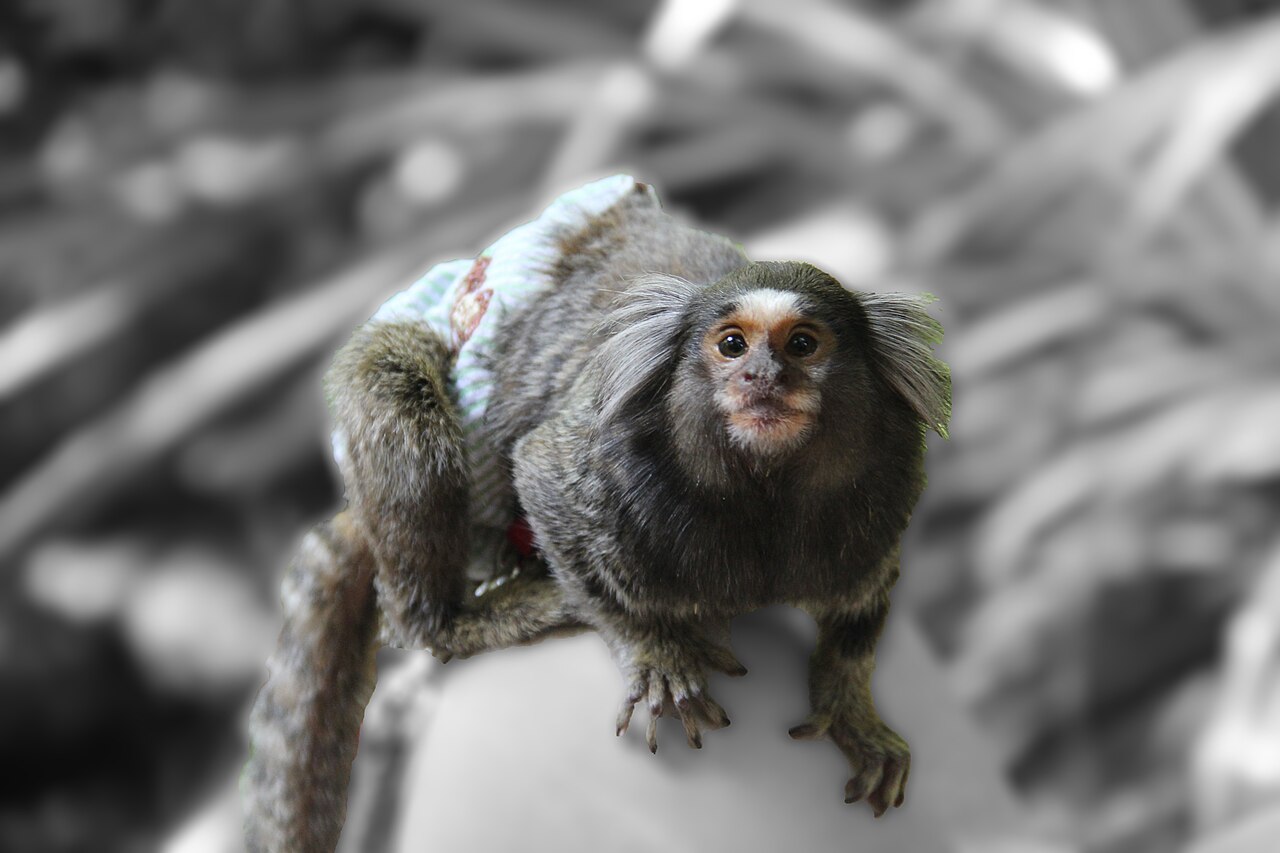
Among non-human primates, cooperative breeding is rare but not unknown. The most thoroughly studied cases occur in the callitrichid primates — marmosets and tamarins — small New World monkeys that routinely give birth to twins and rely heavily on paternal and alloparental care for infant survival. In common marmosets (Callithrix jacchus) and cotton-top tamarins (Saguinus oedipus), infant carrying, provisioning, and protection are shared among fathers, older siblings, and unrelated group members, with the biological mother often carrying the infants for only a minority of the time in the first weeks after birth.7, 17 These species are obligate cooperative breeders: without alloparental assistance, infant mortality rises dramatically and reproductive success falls sharply.9
Karin Isler and Carel van Schaik have used the callitrichid case to build a broader comparative argument about the relationship between allomaternal care and brain size evolution across primates.9 They proposed what they called the "island rule for brain evolution" or more formally the cooperative breeding and brain size model: species with higher levels of allomaternal care show larger relative brain sizes, because alloparenting reduces the energetic cost borne by the mother per offspring, freeing resources for larger-brained infants that could not be sustained on maternal investment alone.9 Their comparative analysis of 128 primate species found a significant positive relationship between allomaternal provisioning and relative brain size, supporting the view that cooperative breeding was not merely a behavioral strategy but a key enabling condition for the evolution of large brains across the primate order, with its fullest expression in humans.9
Judith Burkart and van Schaik have extended this argument to the domain of cognition, testing the prediction that cooperatively breeding primates should show higher levels of proactive prosociality — the spontaneous motivation to share food, information, and assistance with others, without requiring specific prompting or reciprocal reward.11 In a comparative study spanning fourteen primate species, they found that cooperatively breeding species — marmosets, tamarins, and humans — consistently showed higher rates of spontaneous prosocial behavior in standardized tests than non-cooperative breeders such as chimpanzees and gorillas, even when the tasks were matched for difficulty and motivational factors were controlled.11 This pattern suggests that the motivational architecture underlying human generosity and cooperation may be a derived feature of the cooperative breeding system, not a uniquely human cognitive innovation unconnected to reproductive strategy.
Cooperative breeding, theory of mind, and language
The most far-reaching implication of the cooperative breeding hypothesis concerns the evolution of distinctly human cognition. Hrdy has argued that infants raised in a cooperative breeding system face a qualitatively different social environment from infants raised in the mother-only great ape system, and that this difference in developmental environment creates a powerful and novel selection pressure for advanced social intelligence.1 A chimpanzee infant, whose care is essentially monopolized by its mother, has little need to read the intentions, emotional states, or attentional foci of non-maternal adults; what matters is the mother’s behavior and the immediate competitive social hierarchy. A human infant raised by a committee of potential caregivers faces a far more cognitively demanding problem: it must assess the willingness and capacity of multiple individuals to provide care, solicit help from individuals who are not instinctively motivated to provision it, and modulate its communicative behavior to elicit responses from caregivers with varying degrees of investment in its welfare.1, 7
Hrdy proposes that this selection pressure produced what she calls "intersubjective engagement" — the capacity to monitor and respond to the emotional and attentional states of others, to seek eye contact, to follow gaze, and to engage in joint attention with non-maternal caregivers — as foundational adaptations that preceded and enabled the later evolution of full theory of mind and language.1 The comparative data are consistent with this view. Human infants from the first months of life engage in levels of mutual gaze, social referencing, and proto-communicative behavior that are qualitatively different from those of infant chimpanzees raised in comparable social environments; the difference is not simply one of degree but appears to reflect a distinct motivational system oriented toward eliciting care from multiple potential partners.7, 15
Michael Tomasello’s research program on shared intentionality provides a complementary framework. Tomasello and colleagues have documented that human children, but not chimpanzees, spontaneously engage in joint attention — the triadic sharing of attention to an external object between self and other — and that this capacity is the developmental foundation for cultural learning, language, and cooperative problem-solving.15 Tomasello has argued that shared intentionality, and the "we" intentionality it makes possible, is the signature cognitive adaptation of the human lineage, enabling cumulative cultural evolution and the construction of complex social institutions.14 From Hrdy’s perspective, the proximate mechanism that selected for shared intentionality was precisely the cooperative breeding context: infants who could effectively recruit multiple caregivers survived at higher rates, and recruiting multiple caregivers required reading and responding to the mental states of non-maternal adults in ways that a simpler ape social intelligence did not need to accomplish.1
The implications for the evolution of language are significant. If the first steps toward human-style communicative flexibility — gaze following, pointing, intentional vocalization directed at specific individuals — were selected for in the context of infant solicitation of alloparental care, then the roots of language lie not in adult male cooperation in hunting or territorial defense, as some accounts have proposed, but in the communicative demands placed on infants and caregivers in a shared-care system.1, 7 This would align the cooperative breeding hypothesis with the social brain hypothesis at a deeper level than either framework alone implies: both point to social relationships as the primary driver of human cognitive evolution, but the cooperative breeding account grounds that claim in the specific and quantifiable dynamics of infant care rather than in the more diffuse demands of group living.
The embodied capital model and the extended juvenile period
The embodied capital model of Kaplan, Hill, Lancaster, and Hurtado provides a complementary account of why the extended juvenile period — the long childhood during which human offspring remain dependent — was adaptive in the first place, and how it was rendered economically feasible by cooperative provisioning.5, 6 On this model, the human life history pattern can be understood as an investment strategy: humans invest more heavily in each offspring, delaying reproduction and extending the learning period, because the skills acquired during that extended period yield extremely high returns in adulthood. The relevant "embodied capital" includes not just learned foraging skills but knowledge of social relationships, ecological patterns, tool manufacture, and the complex social negotiation skills required to function in a large cooperative group.
The Ache of Paraguay provide the best-studied quantitative example of this dynamic.6, 10 Among Ache foragers, children under ten years of age produce roughly 10–15 percent of their own caloric needs; adolescents gradually increase their net production, but do not reach caloric self-sufficiency until around age 18 for females and somewhat later for males.6 Adult male hunters, by contrast, produce caloric surpluses that exceed their own consumption by roughly a factor of two, enabling them to provision not only their own children but other members of the band through food-sharing norms. The multi-decade period of caloric deficit during childhood is the price paid for the skill acquisition that makes adult productivity possible — but that price is only payable because alloparents, not the mother alone, absorb the cost of the juvenile dependency period.6, 10
The embodied capital model does not necessarily require cooperative breeding in its strong form; in principle, fathers and mothers together could provision the extended juvenile period without broader alloparental networks. But the demographic data from foraging societies consistently show that paternal provisioning, while real and significant, is insufficient on its own to account for the observed reproductive rates and child survival rates, particularly in populations where male mortality is high or where pair bonds are not lifelong.3, 6 The broader network of kin and non-kin alloparents documented in ethnographic studies appears to function as a form of buffering, ensuring that children receive adequate provisioning even when any single investor fails. This robustness of the alloparenting network to the loss of any individual caregiver is itself consistent with the interpretation that humans evolved in a system where child survival was distributed across multiple investors rather than dependent on a single dyadic bond.
Prosociality and broader implications
The cooperative breeding hypothesis has implications that extend beyond the narrow question of infant care. If Hrdy and Burkart are correct that the motivational and cognitive architecture underlying human prosociality evolved in the context of cooperative breeding, then many of the features that distinguish human social life from that of other apes — spontaneous food sharing, teaching, empathy, and the willingness to cooperate with strangers — are best understood as elaborations of a caregiving psychology whose original function was the provisioning of infants.7, 11 The prosocial behavior of humans toward non-kin, which is puzzling from the perspective of classical kin selection and reciprocal altruism, becomes less mysterious if the motivational substrate that generates it was designed by selection for a context — infant care — in which the relationship between caregiver and recipient is not straightforwardly reciprocal and involves substantial investment in individuals of varying degrees of relatedness.
Burkart and colleagues tested this prediction comparatively and found that cooperatively breeding primates show higher baseline prosociality toward group members regardless of kinship, while non-cooperative breeders are much more selective.11 This result is consistent with the hypothesis that cooperative breeding selects for a generalized prosocial motivational system, not merely for targeted investment in close kin. In humans, this generalized prosociality was subsequently elaborated, extended, and culturally scaffolded into the complex institutions of economic exchange, norm enforcement, and large-scale cooperation that characterize Homo sapiens at scales no other primate approaches.14
The cooperative breeding hypothesis thus connects some of the most distinctive features of human biology and behavior — menopause, longevity, short interbirth intervals, extended childhood, theory of mind, language, and generalized prosociality — within a single coherent evolutionary framework, anchored to the quantifiable demographic consequences of infant care systems. It remains an active and contested area of research, with ongoing debate about the relative contributions of grandmothers versus fathers, the timing of the cooperative breeding transition in hominin evolution, and the precise cognitive mechanisms by which alloparenting experience generates the social intelligence that distinguishes humans from other apes. What is not seriously contested is the central premise: no mother is an island. The evolution of our species, from the oldest hominin to every child alive today, was a cooperative project from the start.
References
Hadza women's time allocation, offspring provisioning, and the evolution of long postmenopausal life spans
Pair bonds, social structure, and male provisioning in the context of cooperative breeding