Overview
- Denisova Cave in the Altai Mountains of southern Siberia is the only known site where three distinct hominin groups — Denisovans, Neanderthals, and modern humans — all lived at different times, and where a first-generation hybrid individual (Denisova 11, 'Denny') with a Neanderthal mother and Denisovan father was identified through ancient DNA.
- A single finger bone fragment (Denisova 3), discovered in 2008 and sequenced in 2010, revealed an entirely new hominin lineage — the Denisovans — known almost exclusively from genetic evidence, demonstrating that ancient DNA can identify populations invisible in the morphological fossil record.
- Pioneering work on sediment DNA at Denisova Cave has shown that hominin genetic material can be recovered directly from cave deposits even in the absence of identifiable fossils, opening a new frontier in paleoanthropology.
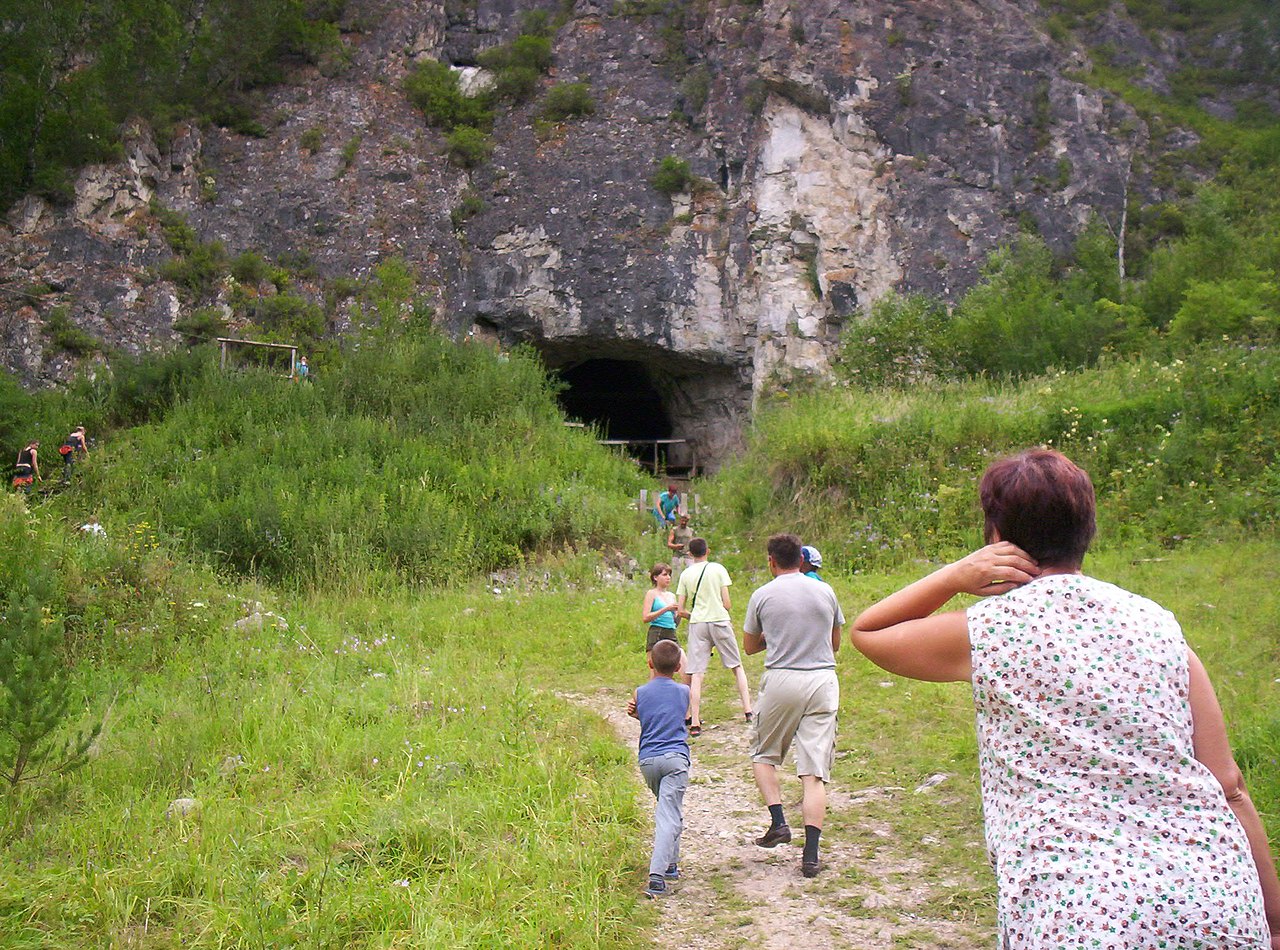
Denisova Cave is a limestone cavern situated in the foothills of the Altai Mountains in southern Siberia, Russia, at an elevation of approximately 700 meters above sea level near the confluence of the Anui River and its tributary the Karakol.15 The cave consists of a central chamber and two side galleries, the South Gallery and the East Gallery, with a total floor area of roughly 270 square meters.15 Despite its modest size, Denisova Cave has produced discoveries of outsized significance for the study of human evolution. It is the type locality for the Denisovans, a group of archaic hominins identified almost entirely through ancient DNA analysis, and the only site in the world where fossil or genetic evidence of three distinct hominin populations — Denisovans, Neanderthals, and anatomically modern humans — has been found within the same depositional sequence.3, 4, 7 The cave has also yielded the genome of a first-generation hybrid between a Neanderthal and a Denisovan, providing the most direct evidence yet obtained that these archaic groups interbred when they came into contact.5

Discovery history
Denisova Cave has been known to local populations for centuries; its Russian name derives from Denis, an eighteenth-century hermit who reportedly lived in the cave, and the local Altai people knew it as Aju-Tasch, meaning "bear rock."15 Scientific investigation began in the 1970s when Soviet archaeologist Nikolai Ovodov conducted initial surveys and recovered Pleistocene faunal remains. Systematic archaeological excavation commenced in 1982 under the direction of Anatoly Derevianko and Mikhail Shunkov of the Institute of Archaeology and Ethnography of the Siberian Branch of the Russian Academy of Sciences, and the site has been excavated nearly continuously since then.15
For more than two decades, Denisova Cave was known primarily for its rich archaeological sequence, which includes Middle Palaeolithic, Initial Upper Palaeolithic, and Upper Palaeolithic cultural layers spanning from at least 300,000 to approximately 20,000 years ago.7, 8 The cave also yielded a small number of fragmentary hominin fossils, but these were too incomplete for confident morphological identification. The site's true significance only became apparent in 2010, when genetic analysis of a tiny finger bone fragment transformed it into one of the most important paleoanthropological sites in the world.3
The finger bone, designated Denisova 3, was discovered in 2008 by archaeologist Alexander Tsybankov in Layer 11.2 of the East Gallery.3 It was a distal phalanx of the fifth finger, belonging to a juvenile individual, and was unremarkable in appearance — a small fragment that might easily have been discarded or overlooked at many other excavations. It was sent to the Max Planck Institute for Evolutionary Anthropology in Leipzig, where Svante Pääbo's ancient DNA laboratory had developed techniques capable of extracting and sequencing DNA from highly degraded bone.3 The cold, stable conditions of Denisova Cave had preserved the bone's molecular content to an extraordinary degree, and what emerged from the sequencing was entirely unexpected.3
The Denisovan genome
The initial analysis of Denisova 3, published by Johannes Krause and colleagues in March 2010, focused on the mitochondrial DNA. The results were startling: the mtDNA sequence differed from both modern humans and Neanderthals by roughly twice the amount that modern humans and Neanderthals differ from each other, suggesting that the Denisova 3 individual belonged to a hominin lineage that had diverged from the common ancestor of modern humans and Neanderthals approximately one million years ago.3 This was, genetically speaking, neither a Neanderthal nor a modern human, but something else entirely — a previously unknown branch of the hominin family tree.3
Later in 2010, David Reich and colleagues published an analysis of the nuclear genome extracted from the same bone. The nuclear DNA told a somewhat different story from the mitochondrial DNA: rather than being equally divergent from both Neanderthals and modern humans, the nuclear genome showed that the Denisova 3 individual was more closely related to Neanderthals than to modern humans, with the two archaic lineages sharing a common ancestor that had split from the modern human lineage roughly 400,000 to 800,000 years ago.4 The Denisovan and Neanderthal lineages themselves had subsequently diverged from each other, but more recently than either had diverged from modern humans.4
Perhaps the most consequential finding of the 2010 nuclear genome study was the detection of Denisovan genetic contributions to living human populations. By comparing the Denisovan genome to genomes of present-day people from around the world, Reich and colleagues found that Melanesian and Australian Aboriginal populations carry approximately 4 to 6 percent Denisovan ancestry, indicating that modern humans interbred with Denisovans at some point after leaving Africa but before reaching the islands of Southeast Asia and Oceania.4, 11 Subsequent studies have detected lower levels of Denisovan admixture in other Asian and Native American populations, painting a complex picture of interbreeding between modern humans and Denisovans across a broad geographical range.11
In 2012, Matthias Meyer and colleagues published a high-coverage genome sequence from Denisova 3, achieving a depth of coverage (~30×) comparable to that routinely obtained from modern human DNA samples.2 This high-quality genome enabled detailed analysis of Denisovan population history, revealing evidence of very low genetic diversity consistent with a small effective population size, and provided a reference sequence against which other Denisovan specimens and admixed modern human populations could be compared.2
Stratigraphy and chronology
The depositional sequence at Denisova Cave has been a subject of intensive study and some controversy, owing in part to the complexity of the cave's formation processes and in part to the difficulty of applying multiple dating methods to the same deposits. The sediments fill three interconnected spaces — the Main Chamber, the East Gallery, and the South Gallery — each with its own stratigraphic sequence that must be correlated through shared marker layers.7, 8
Two comprehensive dating studies published in 2019, by Katerina Douka and colleagues and by Zenobia Jacobs and colleagues, applied optical dating of sediment grains, radiocarbon dating of bone and charcoal, and uranium-series dating of bone to establish a detailed chronological framework.7, 8 Jacobs and colleagues dated the basal sediments in the Main Chamber to approximately 300,000 years ago, establishing the earliest evidence of hominin occupation of the cave.8 Denisovan DNA has been detected in sediment layers dating from roughly 250,000 to at least 50,000 years ago, indicating a remarkably long span of intermittent occupation by this hominin group.8, 16
Neanderthal remains and DNA are concentrated in layers dating between approximately 193,000 and 97,000 years ago, with the most securely dated Neanderthal fossil (Denisova 5, a proximal toe phalanx that yielded a high-coverage genome) from a layer optically dated to roughly 120,000 years ago.1, 8 Evidence of modern human presence, in the form of Upper Palaeolithic artifacts and a few fragmentary remains, appears in layers dating to approximately 45,000 to 40,000 years ago.7
Chronological framework for hominin occupation at Denisova Cave7, 8
| Approximate age (ka) | Hominin group | Evidence type | Gallery |
|---|---|---|---|
| ~300–250 | Denisovan | Sediment DNA, artifacts | Main Chamber |
| ~193–97 | Neanderthal | Fossils, nuclear DNA | East & South Gallery |
| ~170–50 | Denisovan | Fossils (Denisova 3), DNA | East & South Gallery |
| ~90 | Denisovan × Neanderthal hybrid | Fossil (Denisova 11) | East Gallery |
| ~45–40 | Homo sapiens | Artifacts, fragmentary remains | Main & East |
The chronological overlap between Denisovans and Neanderthals in the cave sequence raises the question of whether these groups were present simultaneously or alternated their use of the cave over millennia. The dating resolution is generally insufficient to determine whether they coexisted in the strict sense, but the detection of both Denisovan and Neanderthal mitochondrial DNA in the same sediment layer in at least one instance suggests that their occupations were at minimum temporally close.6, 8
Denny: the hybrid individual
The most extraordinary single discovery from Denisova Cave is arguably Denisova 11, a small bone fragment from the East Gallery that was identified as belonging to a first-generation hybrid individual — a person whose mother was a Neanderthal and whose father was a Denisovan. Published by Viviane Slon and colleagues in 2018, this finding remains the most direct evidence of interbreeding between archaic hominin groups ever documented.5
The specimen was initially identified among a collection of undiagnostic bone fragments through collagen peptide fingerprinting (ZooMS), a technique that can distinguish hominin bone from animal bone based on the protein sequence of collagen. DNA extraction and sequencing then revealed that the specimen carried roughly equal proportions of Neanderthal and Denisovan ancestry, consistent with a first-generation offspring rather than a member of a hybrid population with mixed ancestry from a more distant past.5
Further analysis showed that Denisova 11's Neanderthal mother was genetically more closely related to Neanderthals from western Europe (specifically, the Vindija Cave Neanderthals from Croatia) than to the Neanderthal whose genome had been sequenced from Denisova Cave itself (Denisova 5).5 This implied that Neanderthal populations were migrating between western Europe and the Altai region, maintaining some level of gene flow across enormous distances. The father's Denisovan genome, meanwhile, showed traces of Neanderthal ancestry further back in his lineage, indicating that interbreeding between the two groups was not a single event but a recurring phenomenon.5
The discovery was nicknamed "Denny" by the media, and it captured public attention as a vivid illustration of the complex web of interactions between hominin groups in the Pleistocene.17 For geneticists, Denny demonstrated that the admixture signals detected in modern human genomes and in other archaic specimens were not mere statistical abstractions but reflected real biological events involving real individuals.5
Sediment DNA
Denisova Cave has been a proving ground for one of the most transformative methodological advances in recent paleoanthropology: the recovery of ancient hominin DNA directly from cave sediments, without requiring identifiable fossils. Published by Slon and colleagues in 2017, the initial sediment DNA (sedaDNA) study at Denisova demonstrated that mitochondrial DNA from both Neanderthals and Denisovans could be isolated from sediment samples throughout the cave's stratigraphic sequence, even from layers that had not yielded any hominin fossils.6
The technique works because hominins, like all organisms, shed DNA into their environment through decomposing tissue, excretions, shed cells, and other biological residues. In the cold, alkaline conditions of limestone caves, this environmental DNA can be preserved for tens or even hundreds of thousands of years, adsorbed onto mineral particles in the sediment.6 By developing protocols to extract, amplify, and sequence these trace amounts of DNA while minimizing contamination from modern human DNA, Pääbo's group demonstrated that sediment could serve as a source of genetic information about past hominin occupants even in the complete absence of bone.6
A subsequent and more comprehensive sediment DNA study by Benjamin Vernot and colleagues in 2021 extended this approach to recover nuclear DNA, not just mitochondrial DNA, from Denisova Cave sediments. Nuclear sedaDNA provided far more detailed information about population relationships and genetic diversity than mitochondrial DNA alone, and the study identified multiple genetically distinct Denisovan populations that had occupied the cave at different times.16 This level of resolution, distinguishing between different populations of the same archaic group from sediment alone, was unprecedented and demonstrated the enormous potential of the technique for future research.16
The sediment DNA approach has since been extended beyond Denisova Cave to sites across Eurasia, including El Sidrón in Spain, Chagyrskaya Cave in Russia, and Galería de las Estatuas in Atapuerca, Spain, in each case revealing hominin genetic signatures in deposits that had yielded few or no identifiable hominin fossils.16 At Denisova itself, the stratigraphic resolution of sediment DNA has proved finer than that achievable with fossils alone, enabling researchers to track the turnover of hominin populations through time with a detail that was previously impossible. Vernot and colleagues identified at least two genetically distinct Denisovan populations separated by tens of thousands of years within the cave sequence, as well as evidence of Neanderthal population replacement, in which genetically distinct Neanderthal groups occupied the cave at different times.16
The implications for the field are far-reaching. Thousands of caves and rock shelters around the world contain Pleistocene sediments that have never yielded identifiable hominin fossils but may contain recoverable hominin DNA. Sediment DNA analysis has the potential to reveal the presence of hominins at sites where they are otherwise archaeologically invisible, to detect population turnover and admixture events that left no morphological trace, and to extend the geographical range of known hominin groups far beyond the rare sites where fossilized bone has been preserved.6, 16
Artifacts and material culture
The archaeological sequence at Denisova Cave spans from the Middle Palaeolithic through the Upper Palaeolithic, with cultural layers that have been attributed, with varying degrees of confidence, to the hominin groups known to have occupied the cave.15 The lower layers (corresponding broadly to the period before 50,000 years ago) contain Middle Palaeolithic stone tool assemblages characterized by Levallois core reduction technology and Mousterian-type scrapers, technologies that are broadly associated with Neanderthals across western Eurasia but that at Denisova could also have been produced by Denisovans, as both groups were present during this period.15
A particularly notable artifact is a chloritolite bracelet fragment recovered from Layer 11 of the South Gallery, associated with deposits tentatively attributed to Denisovans and dated to approximately 40,000 to 50,000 years ago.12 The bracelet shows evidence of drilling, grinding, and polishing techniques more typically associated with much later Neolithic cultures, and if the Denisovan attribution is correct, it would represent an unexpectedly sophisticated level of personal ornamentation for an archaic hominin group.12 However, the association between the bracelet and the Denisovans specifically, rather than modern humans who may have been present in the region at the time, remains uncertain.7
The Initial Upper Palaeolithic (IUP) layers at Denisova Cave, dating to approximately 45,000 to 40,000 years ago, contain blade-based stone tool assemblages and bone artifacts that represent a technological tradition found across a broad swath of central and eastern Eurasia.7 At other sites such as Bacho Kiro Cave in Bulgaria, IUP assemblages have been directly associated with early modern human remains and genomes showing recent Neanderthal admixture, suggesting that the IUP may represent the material culture of the first modern human populations to colonize Eurasia.10 At Denisova, however, the question of who made the IUP tools remains open, as the fragmentary hominin remains from these layers have not yet yielded sufficient genetic material for definitive identification.7
Environmental reconstruction
The sediments and faunal remains from Denisova Cave provide a detailed record of environmental conditions in the Altai Mountains over the past 300,000 years. Pollen analysis of the cave sediments reveals alternating intervals of forest and steppe vegetation, reflecting the glacial-interglacial climate cycles that drove environmental change across northern Eurasia throughout the Middle and Late Pleistocene.8, 15
During warm interglacial periods, the Altai foothills supported mixed coniferous and broadleaf forests, and the cave's faunal assemblages include forest-adapted species such as deer, wild boar, and bear. During colder glacial intervals, the landscape was dominated by open steppe and tundra-steppe, with faunal assemblages characterized by cold-adapted species including woolly mammoth, woolly rhinoceros, bison, and horse.15 The cave's location at the interface between the Siberian taiga and the Central Asian steppe made it particularly sensitive to climate fluctuations, and the faunal succession records multiple cycles of environmental change over the duration of hominin occupation.15
The cave's microclimate has been crucial for the preservation of ancient DNA. Temperatures inside Denisova Cave remain relatively stable year-round, averaging approximately 0°C, and the limestone bedrock provides alkaline buffering that retards DNA degradation.2 These conditions explain why DNA preservation at Denisova is exceptionally good compared to most archaeological sites, enabling the extraction of high-quality genomes from specimens tens of thousands of years old and the recovery of environmental and hominin DNA from sediments approaching 300,000 years in age.2, 6
The question of how different hominin groups used the cave and its surroundings in relation to climate remains an active area of investigation. One hypothesis is that Denisovans were better adapted to cold continental environments and occupied the cave primarily during glacial periods, while Neanderthals, expanding eastward from their core range in western Eurasia during warmer intervals, used the cave during interglacials. The chronological evidence, however, does not yet support such a clean partition, and the pattern of occupation appears more complex than simple environmental determinism would predict.8, 14
Broader significance
Denisova Cave has fundamentally altered the understanding of human evolution in several respects. First, it demonstrated that the hominin family tree in the Middle and Late Pleistocene was more complex than previously appreciated, with at least three distinct lineages — modern humans, Neanderthals, and Denisovans — coexisting and interacting across Eurasia.4, 17 Before the Denisova 3 finger bone was sequenced, the existence of the Denisovan lineage was completely unsuspected; no morphological analysis of any fossil had ever hinted at a third Eurasian hominin group contemporary with Neanderthals and modern humans.3
Second, the cave provided the clearest evidence that these hominin groups did not merely coexist but interbred, with the discovery of Denny demonstrating that hybridization occurred between specific individuals, not just statistically between populations.5 The genetic legacy of this interbreeding persists in living human populations: Denisovan-derived genes in modern Melanesians and Tibetans include variants that appear to have been selectively advantageous, such as the EPAS1 allele that facilitates high-altitude adaptation in Tibetan populations.11
Third, the methodological innovations developed at and applied to Denisova Cave, including ultra-short fragment ancient DNA extraction, sediment DNA analysis, and collagen peptide fingerprinting for hominin identification, have created new tools that are now being applied at sites around the world.6, 16 The cave has served as a laboratory for pushing the boundaries of what ancient biomolecules can reveal about the past, and the techniques proven there have become standard in the field.16
Finally, Denisova Cave has raised as many questions as it has answered. The Denisovans remain almost entirely unknown morphologically; apart from the Denisova 3 finger bone, a few isolated teeth (which are unusually large), and a possible cranial fragment, no diagnostic skeletal material has been recovered.9, 17 The geographical range of the Denisovans, the nature of their adaptations, their cultural capabilities, and the circumstances of their extinction are all questions that depend on future fossil discoveries and further advances in ancient DNA technology. For now, Denisova Cave remains the primary window into a hominin group that was hidden in plain sight for over a century of paleoanthropological research, revealed only when the tools of molecular biology were brought to bear on a fragment of bone small enough to hold between two fingers.3, 17
The ongoing excavations at Denisova Cave, directed by Shunkov and an international team of collaborators, continue to produce new fossil fragments, new sediment DNA data, and new archaeological material that incrementally fills in the picture of hominin life in the Altai Mountains over the past 300,000 years. The cave's relatively stable microclimate makes it an ideal natural laboratory for the preservation of ancient biomolecules, and as extraction and sequencing technologies continue to improve, it is likely that Denisova will yield still more surprises. The history of the site suggests that the most transformative discoveries often come from the least morphologically informative specimens — a finger bone, a tooth, a sliver of long bone — because it is the molecular information preserved within those fragments, not their outward form, that reveals the most about the hidden diversity of our evolutionary past.2, 16, 17
Denisova Cave also serves as a cautionary tale about the limits of morphological taxonomy in paleoanthropology. For more than a century, the classification of fossil hominins relied almost entirely on skeletal and dental anatomy, and the assumption was that morphology reliably reflected evolutionary relationships. The Denisovan discovery demonstrated that an entire branch of the hominin family tree could exist, diverge, persist for hundreds of thousands of years, interbreed with other lineages, and go extinct without leaving a morphological signature distinctive enough to be recognized from fragmentary fossils.3, 4 How many other such "cryptic" lineages may exist in the hominin fossil record, undetectable by traditional methods, is a question that can only be answered by the systematic application of ancient DNA and protein analysis to the thousands of unidentified bone fragments that sit in museum collections around the world.17
References
Age estimates for hominin fossils and the onset of the Upper Palaeolithic at Denisova Cave
Denisova admixture and the first modern human dispersals into Southeast Asia and Oceania