Overview
- Dmanisi, Georgia, has yielded hominin fossils dated to approximately 1.77–1.85 million years ago, making them the oldest known human ancestors found outside Africa and establishing that Homo left its continent of origin far earlier, and with far smaller brains and bodies, than previously assumed.
- Five skulls recovered from a single stratigraphic horizon display a range of morphological variation so extreme that, found at different sites, they would likely have been assigned to multiple species — a finding that challenges the validity of Homo habilis, Homo rudolfensis, and early Homo erectus as separate biological taxa.
- The 2013 description of Skull 5 (D4500), the most complete early Homo skull ever recovered, prompted a landmark argument by David Lordkipanidze and colleagues that all early Homo diversity may belong to a single evolving lineage, fundamentally reshaping models of hominin taxonomy and out-of-Africa dispersal.
On a ridge above the confluence of the Mashavera and Pinezauri rivers in the Kvemo Kartli region of southern Georgia, a medieval fortress town called Dmanisi conceals one of the most consequential fossil sites in the history of paleoanthropology. The town itself was a flourishing mercantile center on the Silk Road during the ninth through fourteenth centuries, its ruins still visible above the surrounding plateau. But beneath the medieval deposits, within a stratum of volcanic basalt and sedimentary accumulations laid down approximately 1.77 to 1.85 million years ago, lay the bones of human ancestors that would overturn received wisdom about when, how, and with what cognitive equipment the hominin lineage first departed the African continent.9, 10
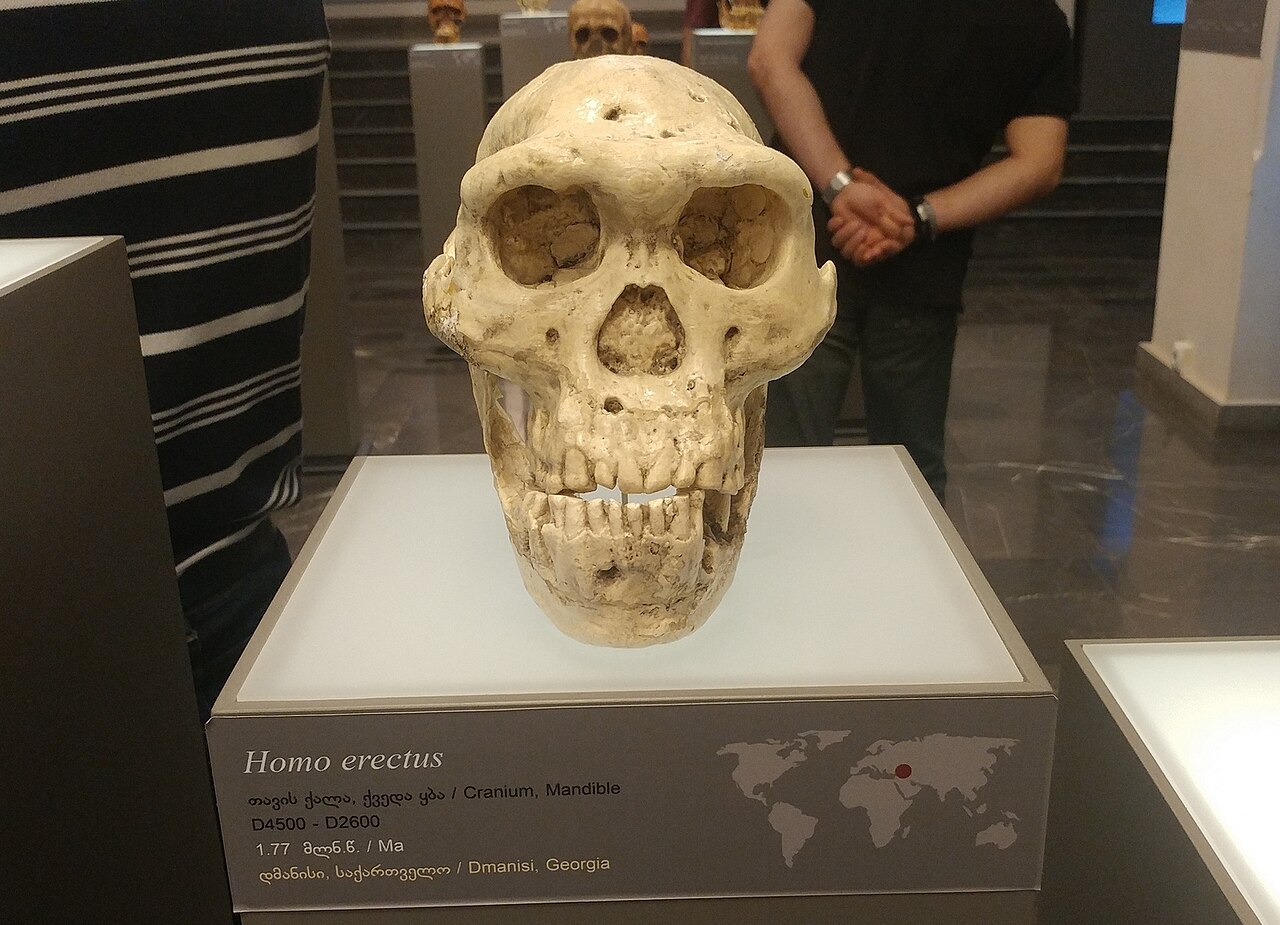

Systematic excavation at Dmanisi began in 1983 under the direction of Georgian palaeontologist Leo Gabunia, initially focused on the abundant fauna of the Plio-Pleistocene deposits. The site had been known to harbour animal fossils since the 1930s, but the discovery of Oldowan stone tools in 1984 signalled that hominins had been present. It was not until 1991 that the first hominin fossil came to light: a mandible, designated D211, with a suite of features placing it firmly within the genus Homo.5, 6 Over the following three decades, an extraordinary series of crania, mandibles, and postcranial elements accumulated from the site, culminating in the 2013 description of Skull 5, the most complete early Homo skull ever recovered, and an argument that rewrote the taxonomy of the earliest members of our genus.1
Site geology and dating
The Dmanisi sediments belong to the Barakloba Formation, a sequence of fluvio-lacustrine clays, silts, and volcanic tuffs that accumulated in a small basin on the Mashavera river terrace. The hominin-bearing layer sits directly atop a basalt flow that has been dated by the potassium-argon method to 1.85 million years ago, providing a hard lower bound for the age of the fossils. Above the fossiliferous sediment, a second basalt flow yields a date of approximately 1.76 million years ago. Magnetostratigraphic analysis, which exploits the fact that the Earth's magnetic field reverses polarity at known intervals, confirms that the fossil layer falls within the Olduvai subchron, a period of normal geomagnetic polarity that ran from approximately 1.78 to 1.95 million years ago.9 Together, these independent chronometric methods bracket the age of the fossils at roughly 1.77 to 1.85 million years, making them the oldest known hominin remains outside of Africa by a substantial margin.
The geological context is unusual in that all five skull-bearing individuals appear to have been deposited within the same stratigraphic horizon, likely within a few thousand years of one another. This temporal compression is scientifically valuable: it means the morphological variation among the specimens reflects individual and possibly age-related or sex-related variation within a single population rather than evolutionary change over time.1, 9 The fossils are associated with a rich accumulation of animal bones, many bearing cut marks and evidence of percussion, suggesting the site served as a repeated activity location, possibly near a water source, where hominins processed carcasses obtained by hunting or scavenging.14
Faunal context and environment
The fauna recovered alongside the hominins at Dmanisi provides a detailed picture of the Early Pleistocene environment and illuminates the ecological setting of the first out-of-Africa dispersal. The assemblage is dominated by large herbivores including an extinct giant cheetah (Acinonyx pardinensis), saber-toothed cats (Megantereon and Homotherium), a giant ostrich (Struthio dmanisiensis), bovids, cervids, and the extinct rhinoceros Stephanorhinus etruscus.14 Several of these taxa belong to a biogeographic assemblage known as the Villafranchian, a characteristic fauna of the European Early Pleistocene that had migrated from Africa during a period of faunal exchange beginning around two million years ago. The presence of this fauna at Dmanisi is not coincidental: the hominins were likely part of the same wave of dispersal that carried large carnivores and their prey northward out of Africa as open grasslands expanded during episodes of global cooling.
The palaeoenvironmental reconstruction based on pollen, faunal composition, and sediment analysis suggests that Dmanisi was surrounded by a mosaic of open grasslands, shrublands, and gallery forests along river corridors, broadly similar to the East African savanna environments in which early Homo had already been living for hundreds of thousands of years.14 The elevation of the site, roughly 1,000 meters above sea level, means that winters would have been markedly cooler than in tropical Africa, raising questions about whether these early emigrants possessed the cultural or behavioral means, such as fire, clothing, or food storage, to cope with seasonal cold. No convincing evidence for fire use has been identified at Dmanisi, suggesting the hominins managed without it, perhaps by exploiting sheltered microhabitats or by drawing on a sufficiently rich diet of animal protein.2
The five skulls
Five crania have been recovered from the Dmanisi fossil layer, each assigned a specimen number prefixed with "D." They differ from one another in ways that, in any other context, would strongly suggest biological diversity rather than individual variation within a single group.
Skull 1 (D2280), recovered in 1999, is a relatively complete calvaria with a cranial capacity of approximately 775 cubic centimeters and pronounced supraorbital tori.5, 6 Skull 2 (D2282), also found in 1999 and originally reported together with D2280, has the largest braincase of the five individuals at roughly 650 cubic centimeters by some estimates and up to 730 cc by others, with a more gracile face and less extreme brow ridging.5 Skull 3 (D2700), described in 2002, is smaller and more lightly built, with a cranial capacity near 600 cubic centimeters; it was found in association with a mandible (D2735) and has been tentatively identified as a younger individual, possibly female.7 Skull 4 (D3444), published in 2005 and 2006, is among the most biologically remarkable fossils ever recovered from a Pleistocene site. This individual had lost every tooth except one long before death, with the alveolar bone extensively resorbed, indicating survival for years in a completely or near-completely edentulous state.3, 4
The fifth skull (D4500, with associated mandible D2600), reported by Lordkipanidze and colleagues in 2013, completed the assemblage and provided the catalyst for a major reinterpretation of early Homo taxonomy. Its cranial capacity of approximately 546 cubic centimeters is the smallest of the five and falls at the lower end of the range for Homo habilis. Combined with a large, heavily built face and a massive mandible with large, robust teeth, it created a combination of features not previously documented in a single early Homo individual: a very small brain paired with a very large and prognathic face.1
Skull 5 and the taxonomy of early Homo
The significance of Skull 5 extended well beyond its own morphology. By analyzing all five Dmanisi crania together and comparing the variation among them to variation within documented samples of modern humans, chimpanzees, and other great apes, Lordkipanidze and colleagues demonstrated that the spread of brain sizes and facial architectures at Dmanisi was no greater than that routinely observed within a single living primate species.1 This finding had a direct implication for the African fossil record: if five individuals from a single site, living at the same time, could differ from one another as much as D4500 differs from D2282, then the morphological differences used to justify the separation of Homo habilis, Homo rudolfensis, and African early Homo erectus into distinct species might simply be capturing normal within-species variation rather than genuine biological discontinuities.
The 2013 Science paper, authored by Lordkipanidze and a team of Georgian, American, and European researchers, argued explicitly that the simplest interpretation of the available evidence was that all of this early Homo diversity represented a single, geographically widespread, and morphologically variable species. Under this view, the proliferation of species names applied to early Pleistocene Homo fossils reflects a methodological artifact: the specimens were found at different times, in different places, by different researchers who lacked a simultaneous view of the full range of variation. Seen together through the lens of Dmanisi, the divisions dissolve.1, 9
The argument was not universally accepted. Critics noted that the African fossils span a far greater time range than the Dmanisi sample, making it harder to disentangle temporal change from individual variation, and that some morphological features distinguishing H. habilis from early H. erectus appear more consistent than would be expected under a single-species model.12 The 2015 re-analysis of the H. habilis type specimen OH 7 by Fred Spoor and colleagues found that, when correctly reconstructed, OH 7 is more primitive and more distinct from early H. erectus than previously appreciated, suggesting that at least some species boundaries in early Homo may be real.12 The debate has not been resolved. What Dmanisi established beyond reasonable doubt is that early Homo was far more variable than the pre-2013 literature acknowledged, and that any taxonomy of the group must grapple seriously with that variation.11, 15
The toothless elder and the evidence for social care
Skull 4 (D3444) deserves particular attention for what it reveals about the social lives of the Dmanisi hominins. The individual had lost all but a single tooth, and the degree of alveolar resorption visible on the maxilla and mandible indicates that this tooth loss occurred years, not weeks, before death.3 A completely or nearly toothless hominin living in the Early Pleistocene faced a profound nutritional challenge. The Dmanisi diet, inferred from the faunal assemblage and cut-marked bones, included significant quantities of meat, likely obtained from medium and large ungulates. Processing raw meat without teeth is possible but extremely difficult; the consumption of plant foods that require pulping or grinding is similarly impaired. The individual must have subsisted on soft foods, either naturally soft items such as marrow, brain tissue, or overripe fruit, or on food that was mechanically processed by other group members and shared.
This inference, that D3444 survived through a period of significant disability only with the assistance of other group members, constitutes some of the earliest evidence for what researchers call prosocial behavior or alloparental care extended to non-juvenile individuals in the hominin lineage.3, 4 Earlier evidence for altruistic behavior toward the disabled or infirm among hominins is disputed; the Dmanisi case is unusually clear because the anatomical evidence of long-term survival without teeth is unambiguous. Whether this reflects a genetically encoded capacity for group-level cooperation, a cognitively mediated choice to care for a known individual, or simply opportunistic food sharing around carcass processing sites remains a matter of interpretation, but the survival itself is documented in bone.
The Oldowan toolkit and the absence of Acheulean technology
The lithic assemblage at Dmanisi is exclusively Oldowan in character, comprising simple cores, flakes, and occasional retouched pieces knapped from locally available basalt, andesite, and quartzite.10 No Acheulean bifaces or hand axes have been identified at the site, a finding that was initially surprising given that early Acheulean assemblages appear in the African record at roughly 1.76 million years ago and are associated with some African early Homo erectus populations of comparable age. The absence of Acheulean technology at Dmanisi likely reflects the fact that the hominins who reached Georgia were, in toolmaking terms, at an Oldowan level of skill, and that the Acheulean tradition either had not yet developed in the population ancestral to the Dmanisi hominins or had not yet spread to this region.
This finding carries a significant theoretical implication. Prior to the Dmanisi discoveries, a dominant model in paleoanthropology held that the first out-of-Africa dispersal was enabled, or even driven, by the cognitive and technological advances associated with Acheulean tool manufacture and an expanded diet based on systematic big-game hunting: in short, that you needed a large brain and sophisticated tools to leave Africa. The Dmanisi hominins falsified this model. With brain sizes as small as 546 cubic centimeters and a simple Oldowan toolkit, they had already reached the southern Caucasus.2, 13 The implication is that whatever cognitive or behavioral threshold was required for the first intercontinental dispersal, it was lower than previously assumed, and was crossed by hominins that would, by the standards of the African fossil record, be considered relatively unimpressive.
The lithic raw material exploitation at Dmanisi shows some degree of selectivity, with hominins transporting certain stone types over distances of several kilometers, suggesting a capacity for anticipatory planning and landscape knowledge, but the overall technological repertoire is conservative.10 The site provides no evidence of composite tools, hafting, or any procedure requiring more than a few knapping steps. When set against the behavioral complexity implied by the survival of D3444, the simplicity of the toolkit is a reminder that behavioral sophistication and technological sophistication need not scale together in early Homo.
Body size and the dispersal threshold
The postcranial remains from Dmanisi, including vertebrae, ribs, limb bones, and foot elements representing at least four individuals, have provided a portrait of the body plan of the first known Eurasian hominins.2 The Dmanisi individuals were small by the standards of later Homo erectus. Estimated body masses range from approximately 40 to 50 kilograms, and stature estimates fall in the range of 145 to 166 centimeters, overlapping with the lower end of the size range for Homo habilis and substantially below the much larger Nariokotome Boy (KNM-WT 15000) from Kenya, which is roughly contemporaneous. The limb proportions are essentially modern in their lower-limb length relative to body size, indicating fully committed bipedalism with a gait and stride length broadly comparable to that of living humans.2
The combination of small body, small brain, simple toolkit, and successful long-distance dispersal overturned the so-called "costly dispersal" hypothesis, which held that the metabolic demands of long-distance movement required the elevated energy processing made possible only by large bodies and dietary intensification. The Dmanisi evidence is instead consistent with a model in which habitual bipedalism, even at modest body size, provided sufficient locomotor efficiency for extended range expansion, and in which a flexible, omnivorous diet exploiting a variety of animal and plant resources was adequate to sustain dispersing populations across the heterogeneous environments between East Africa and the Caucasus.13, 16
Implications for dispersal models and hominin taxonomy
The Dmanisi fossils have reshaped two foundational questions in paleoanthropology: why did hominins leave Africa when they did, and how many species were there in early Homo? On the first question, the site demonstrates that the out-of-Africa dispersal was not a single punctuated event tied to a specific technological or cognitive threshold but rather a gradual range expansion that was well underway before 1.8 million years ago, likely facilitated by the same ecological corridor expansions that drove coeval dispersals of Villafranchian fauna from Africa into Eurasia.16 Hominins, on this view, were participating in a broader biogeographic phenomenon rather than executing a uniquely human act of exploration.
On the question of taxonomy, Dmanisi introduced a powerful empirical constraint. Any scheme that assigns multiple species names to early Pleistocene Homo fossils must now demonstrate that the morphological differences among those fossils exceed the variation documented at Dmanisi within what is unambiguously a single population. That is a considerably higher evidentiary bar than the field operated under before 2013.1, 11 Some researchers have responded by arguing that the Dmanisi hominins themselves are not Homo erectus sensu stricto but rather a primitive, pre-erectus form more closely related to African early Homo, in which case Dmanisi might represent an early and ultimately terminal branch of the Homo tree rather than the direct ancestor of later Eurasian H. erectus. This question, whether Dmanisi is ancestral to or merely contemporaneous with the Asian H. erectus lineage, remains open and awaits either additional fossils from intermediate geographic locations or advances in ancient protein or DNA recovery from Early Pleistocene material, which has not yet proved feasible at the ages involved.15, 17
What is not in doubt is that Dmanisi occupies a unique position in the human fossil record. No other site offers a simultaneous window onto the full range of morphological variation within a single Early Pleistocene hominin population, a complete biomechanical portrait of the first known Eurasian hominins, direct evidence of prosocial behavior, and a dated stratigraphic context that anchors the entire assemblage in deep time with exceptional precision. For a discipline accustomed to building models of human evolution from scattered, isolated specimens recovered across thousands of kilometers and millions of years, the concentrated richness of Dmanisi represents something genuinely rare: a moment when the deep past becomes, briefly and vividly, legible.1, 9
References
Earliest Pleistocene hominid cranial remains from Dmanisi, Republic of Georgia: taxonomy, geological setting, and age
New hominin calvaria from Dmanisi (Georgian Caucasus) dated to the beginning of the Pleistocene
Age of the early Homo from Dmanisi inferred from magnetostratigraphic data and palaeontological data
Reconstructed Homo habilis type OH 7 suggests deep-rooted species diversity in early Homo
The faunal assemblages from the Barakloba Formation (Lower Pleistocene) of Dmanisi, Georgia