Overview
- Stable carbon isotope ratios (δ13C) preserved in fossil tooth enamel reveal whether hominins consumed C3 resources (fruits, leaves, browse) or C4 resources (tropical grasses, sedges), documenting a major dietary shift among East African hominins beginning around 3.5 million years ago.
- Nitrogen isotope ratios (δ15N) from bone collagen, when preserved, indicate trophic level and can distinguish herbivores from omnivores and carnivores, providing evidence that Neanderthals occupied a high trophic position comparable to top predators.
- Isotopic evidence has revealed unexpected dietary diversity among contemporary hominin species, with Paranthropus boisei consuming predominantly C4 foods despite its massive grinding dentition, and Australopithecus sediba eating primarily C3 forest foods unlike other South African australopiths.
Stable isotope analysis of fossil bones and teeth has become one of the most powerful tools for reconstructing the diets of extinct hominins. Because the isotopic composition of biological tissues reflects the isotopic composition of ingested foods, preserved skeletal material can provide direct chemical evidence of what an individual ate during its lifetime, independent of the indirect evidence provided by tooth morphology or associated faunal remains.9 Carbon and nitrogen isotope ratios are the most commonly applied systems in hominin paleodietary research, with carbon isotopes preserved in tooth enamel capable of surviving millions of years and nitrogen isotopes in bone collagen providing trophic-level information for younger specimens where collagen is preserved.9, 13

Carbon isotopes and the C3/C4 distinction
The foundation of carbon isotope paleodietary analysis rests on the difference between the two main photosynthetic pathways used by plants. C3 plants, which include nearly all trees, shrubs, fruits, and temperate grasses, discriminate strongly against the heavier carbon isotope (13C) during photosynthesis, producing tissues with δ13C values typically between –22‰ and –33‰.9 C4 plants, which include tropical grasses and sedges, discriminate less and have δ13C values between –10‰ and –14‰.9 These isotopic signatures are incorporated into the tissues of animals that eat the plants, and in tooth enamel the carbon isotope ratio is offset by approximately +14‰ relative to diet due to metabolic fractionation.9 Because enamel is composed of hydroxyapatite, a highly crystalline mineral that resists diagenetic alteration, δ13C values from fossil tooth enamel can reliably preserve dietary information over millions of years.9, 10
In African hominin paleoecology, the C3/C4 distinction is particularly informative because it broadly maps onto habitat type: C3 resources dominate closed, wooded, or forested environments, while C4 grasses dominate open savannas and grasslands.10 An animal consuming primarily C3 foods was likely foraging in wooded or forest-margin habitats, while one with a strong C4 signal was exploiting open grassland resources, either by eating C4 grasses and sedges directly or by consuming animals that fed on them. The interpretive framework has been refined by studies of modern analogues, including Sponheimer and Lee-Thorp's work on African mole rats showing that C4 signals can arise from underground storage organs of C4 plants, not only from grasses consumed above ground.1, 9, 10
Australopith diets
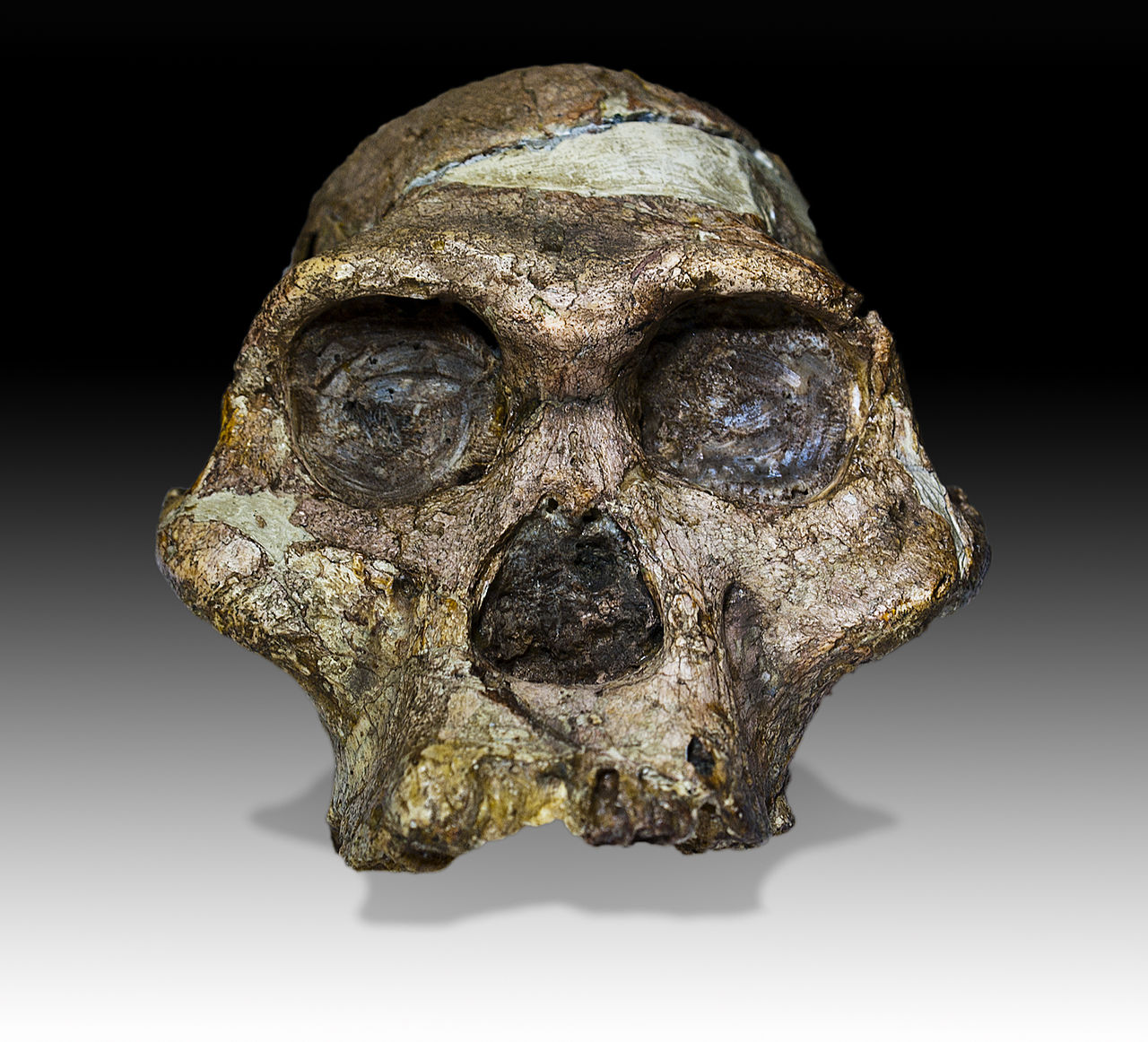
Isotopic studies have revealed unexpected dietary complexity among the australopiths. The first application of stable carbon isotopes to an australopith was Sponheimer and Lee-Thorp's 1999 analysis of Australopithecus africanus enamel from the Sterkfontein and Makapansgat sites in South Africa, which revealed a surprising amount of C4 input into the diet, averaging roughly 25–35% of dietary carbon.2 This was unexpected because the dental morphology of Au. africanus, with its relatively thin enamel and generalized molar shape, had been interpreted as consistent with a largely frugivorous C3 diet. The isotopic data suggested that these hominins were either eating C4 grasses and sedges directly, consuming animals that fed on C4 vegetation, or some combination of both.2, 13
A major C3-to-C4 dietary shift is documented in the East African hominin record beginning around 3.5 million years ago, with evidence from Chad extending the pattern to central Africa as early as 3.0 million years ago.3 Cerling and colleagues' comprehensive 2013 analysis of Turkana Basin hominins demonstrated that early australopiths such as Australopithecus afarensis (3.0–3.7 Ma) had diets dominated by C3 resources, similar to modern chimpanzees, but that by 2.0 million years ago virtually all East African hominins had incorporated substantial amounts of C4 resources.5 This shift parallels the expansion of C4 grasslands across eastern and southern Africa during the Plio-Pleistocene, suggesting that hominins were adapting to increasingly open environments by exploiting new food resources.5, 10
Perhaps the most striking isotopic result concerns Paranthropus boisei, the "robust" australopith of East Africa known for its massive jaws and enormous flat molars. Cerling and colleagues found that P. boisei had the most C4-dominated diet of any known hominin, with δ13C values indicating that approximately 77% of dietary carbon came from C4 sources.4 This result was initially surprising because the species' powerful masticatory apparatus had been interpreted as an adaptation for crushing hard objects like nuts and seeds. The isotopic evidence instead suggests a diet centered on C4 grasses or sedges, tough but not necessarily hard foods that required extensive chewing but not powerful crushing.4, 13 In contrast, the South African robust australopith Paranthropus robustus showed much greater isotopic variability, with individuals ranging from predominantly C3 to predominantly C4 diets, suggesting a more flexible foraging strategy.11
The dietary outlier among australopiths is Australopithecus sediba, whose approximately 2.0-million-year-old teeth from Malapa, South Africa, yielded δ13C values indicating a diet composed almost entirely of C3 resources, with a dietary profile more similar to savanna chimpanzees than to any other known australopith.6 Phytolith and plant fragment analysis of dental calculus confirmed the consumption of bark, fruits, and other woodland resources, suggesting that Au. sediba occupied a wooded ecological niche at a time when most other hominins in the region had shifted toward more open-habitat foods.6
Nitrogen isotopes and trophic level
Nitrogen isotope ratios (δ15N) provide complementary information about trophic position. With each step up the food chain, δ15N increases by approximately 3–5‰ due to the preferential excretion of the lighter isotope (14N) in urea.7 Herbivores thus have higher δ15N values than the plants they consume, and carnivores have higher values still. However, nitrogen isotope analysis requires preserved collagen, which degrades within tens to hundreds of thousands of years depending on burial conditions, limiting the technique's application to relatively young hominin fossils, primarily Neanderthals and late Pleistocene Homo sapiens.7, 8
Nitrogen isotope studies of Neanderthals have consistently placed them at a very high trophic level. Richards and Trinkaus' 2009 analysis of Neanderthal bone collagen from multiple European sites found δ15N values comparable to those of contemporary top carnivores such as wolves and hyenas, indicating that animal protein dominated the Neanderthal diet.8 Bocherens and colleagues' detailed study of the Saint-Cesaire Neanderthal from France confirmed this pattern, finding δ15N values elevated well above those of associated herbivores and consistent with a diet in which large herbivore meat provided the majority of dietary protein.7 These results contrast with isotopic evidence from Upper Paleolithic modern humans in the same regions, who generally show somewhat lower δ15N values and evidence for a broader dietary spectrum including freshwater fish, small game, and plant resources, suggesting a more diversified subsistence strategy.8
Strontium, calcium, and emerging isotope systems
Beyond carbon and nitrogen, other isotope systems are providing new dimensions of dietary and ecological information. Strontium isotope ratios (87Sr/86Sr) vary with local geology and can be used to track landscape use, since an animal's tooth enamel records the strontium signature of the region where it lived during the period of tooth formation. Copeland and colleagues applied this technique to Australopithecus africanus and Paranthropus robustus from the Sterkfontein Valley, finding that larger individuals (presumed male) ranged more widely than smaller individuals (presumed female), a pattern consistent with female philopatry and male dispersal, similar to the social organization of modern chimpanzees.14
Calcium isotope ratios (δ44/42Ca) represent a newer approach with the potential to overcome some limitations of carbon and nitrogen isotopes. Because calcium fractionates predictably through trophic levels and is preserved in enamel apatite (unlike nitrogen, which requires collagen), calcium isotopes can provide trophic-level information even for very old specimens. Martin and colleagues' 2020 study applied calcium isotopes to Turkana Basin hominins, finding evidence consistent with the carbon isotope picture of early Homo occupying a higher trophic position than contemporary australopiths.15 The integration of multiple isotope systems, combining carbon, nitrogen, strontium, calcium, and oxygen data from the same specimens, is increasingly providing a multi-dimensional picture of hominin paleoecology that captures not only what hominins ate but where they lived, how far they ranged, and how they partitioned resources with coexisting species.9, 12, 13