Overview
- Allosaurus fragilis was the dominant apex predator of the Late Jurassic Morrison Formation of western North America, reaching body lengths of 8.5 to 12 metres and body masses of 1,000 to 2,000 kilograms, making it the most common large theropod in one of the best-sampled dinosaur ecosystems.
- Biomechanical analyses suggest that Allosaurus employed a distinctive ‘hatchet attack’ feeding strategy, using powerful neck musculature to drive its upper jaw downward into prey like an axe, rather than relying on a crushing bite force like later tyrannosaurids.
- The Cleveland-Lloyd Dinosaur Quarry has yielded the remains of at least 46 individual Allosaurus specimens, making it the densest concentration of Jurassic theropod fossils in the world and a key source of information about allosaurid anatomy, growth, and population biology.
Allosaurus is a genus of large allosaurid theropod dinosaur that lived during the Late Jurassic period, approximately 155 to 145 million years ago, in what is now western North America and possibly southern Europe and eastern Africa. First named by Othniel Charles Marsh in 1877 on the basis of a fragmentary specimen from the Morrison Formation of Colorado, Allosaurus has since become one of the most thoroughly studied theropod dinosaurs in the fossil record, known from dozens of partial to substantially complete specimens that collectively provide a detailed picture of its anatomy, growth, feeding mechanics, and palaeoecology.1, 2 The type species, Allosaurus fragilis, was the dominant apex predator of the Morrison Formation ecosystem, and a second species, Allosaurus jimmadseni, was formally described in 2020 from the lower portion of the same formation, extending the genus's stratigraphic range and documenting evolutionary change within the allosaurid lineage through the Late Jurassic.3
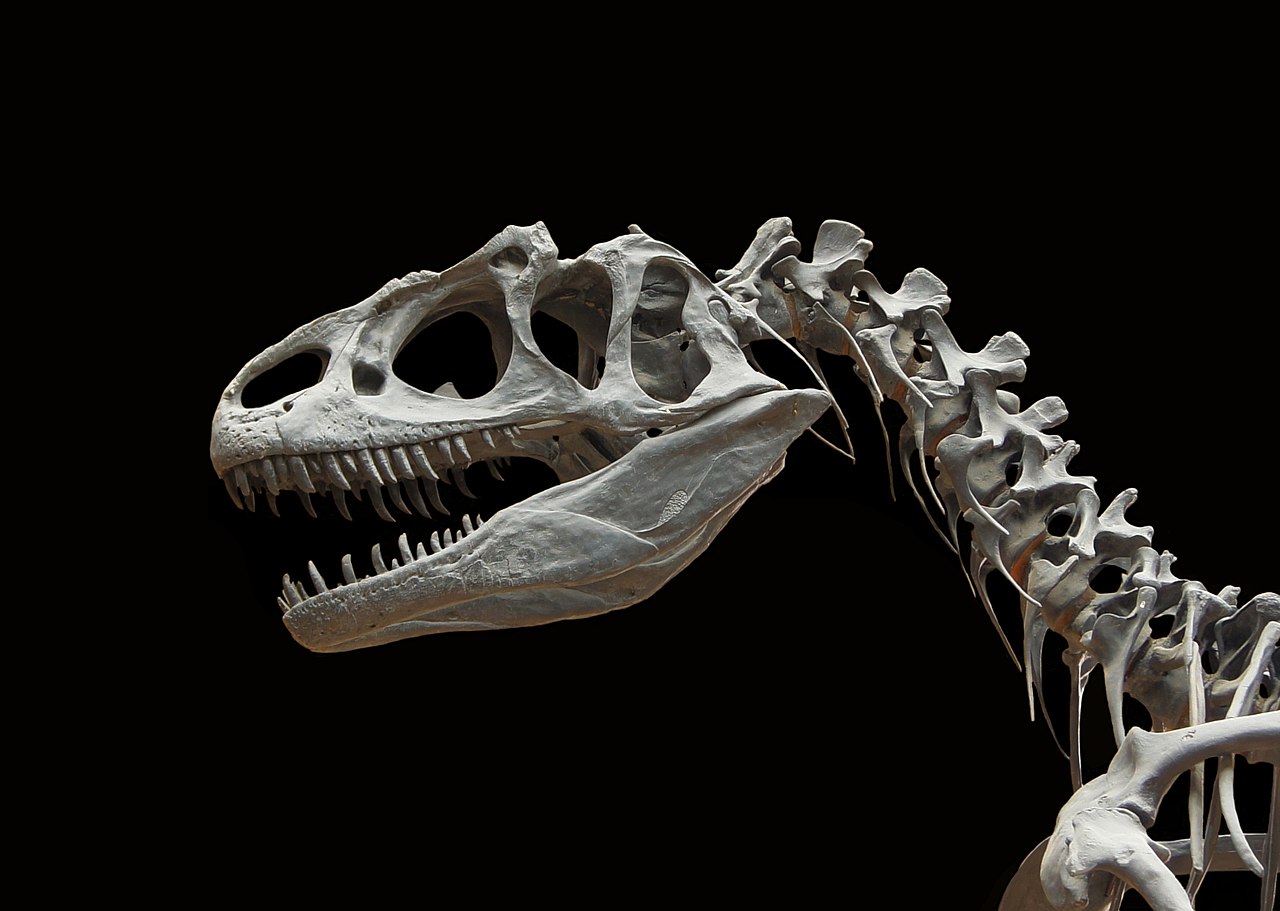

With an estimated body length of 8.5 to 12 metres and a body mass of 1,000 to 2,000 kilograms in the largest individuals, Allosaurus was the largest common predator in the Jurassic ecosystems of North America, coexisting with an extraordinary array of herbivorous dinosaurs including the giant sauropods Diplodocus, Apatosaurus, Brachiosaurus, and Camarasaurus, as well as the plated stegosaur Stegosaurus and the ornithopod Camptosaurus. The ecological role of Allosaurus in this fauna — as the primary consumer of the most diverse large-herbivore community in the Mesozoic — has made it a central subject of research on Jurassic predator-prey dynamics and theropod feeding biology.2, 13
Discovery and taxonomy
The genus Allosaurus was established by Othniel Charles Marsh in 1877, during the peak of the "Bone Wars" rivalry between Marsh and Edward Drinker Cope. The holotype specimen (YPM 1930) consisted of a fragmentary skeleton including vertebrae recovered from the Morrison Formation near Cañon City, Colorado. Marsh chose the name Allosaurus ("different lizard") to reflect the distinctive concave shape of the vertebral centra, which differed from those of other large theropods known at the time. In the same year, Cope described Epanterias amplexus from a fragmentary specimen that most workers now consider to be a large individual of Allosaurus fragilis, though this synonymy has been debated.1, 13
The taxonomic history of Allosaurus has been complicated by the fragmentary nature of many early specimens and the tendency of nineteenth-century workers to erect new genera and species for every distinguishable specimen. Several generic names, including Antrodemus, Creosaurus, and Labrosaurus, were at various times applied to material now generally referred to Allosaurus. Madsen's 1976 monograph on the osteology of Allosaurus, based primarily on the extensive collections from the Cleveland-Lloyd Dinosaur Quarry, established the definitive anatomical description of the genus and stabilised its taxonomy, confirming Allosaurus fragilis as the valid type species and synonymising Antrodemus valens with it.2
In 2020, Chure and Loewen described Allosaurus jimmadseni as a second valid North American species, based on a nearly complete skull and partial skeleton (DINO 11541) from the lower portion of the Morrison Formation in Dinosaur National Monument, Utah. A. jimmadseni is distinguished from A. fragilis by a suite of cranial features including a more gracile lacrimal horn, a broader and more flattened facial profile, and differences in the shape of the jugal and postorbital. Importantly, A. jimmadseni occurs in stratigraphically lower (older) deposits than A. fragilis, suggesting an evolutionary succession within the genus through the Late Jurassic, analogous to the Triceratops horridus-to-T. prorsus transition in the Hell Creek Formation.3
Anatomy and body plan
The skeleton of Allosaurus exhibits the classic body plan of a large, bipedal theropod predator: a large skull armed with serrated teeth, a relatively short but muscular neck, powerful hindlimbs, and comparatively short but robust forelimbs bearing three-fingered hands with large, recurved claws. The skull of A. fragilis is proportionally large relative to body size, measuring approximately 80 to 90 centimetres in length in adult individuals, and is lightly constructed relative to its dimensions, with extensive pneumatic cavities (sinuses) that reduce its mass while maintaining structural integrity. The skull architecture is characterised by large antorbital fenestrae, laterally compressed and serrated teeth, and prominent lacrimal horns — low, rugose bony crests above and in front of each eye that may have supported keratinous ornamental structures in life.2, 5
The teeth of Allosaurus are laterally compressed, recurved, and bear fine serrations (denticles) on both the anterior and posterior carinae. The premaxillary teeth are smaller and more D-shaped in cross-section, while the maxillary and dentary teeth are larger, more blade-like, and clearly adapted for slicing through flesh. The tooth count in A. fragilis is typically 5 premaxillary, 14 to 17 maxillary, and approximately 14 to 17 dentary teeth per side. The teeth were replaced continuously throughout life, as in all non-avian theropods, and shed teeth are among the most common Allosaurus fossils in the Morrison Formation.2
The forelimbs of Allosaurus are more robust and proportionally longer than those of later large theropods such as tyrannosaurids, and the three-fingered hands bore large, strongly recurved ungual claws measuring up to 15 centimetres along the outer curve. The first digit (thumb) was the largest and most robustly constructed, and the claws were clearly adapted for grasping and raking prey. The significance of the forelimbs as offensive weapons has been a recurring theme in discussions of Allosaurus feeding strategy, as the combination of powerful arms and large claws provides a complement to the jaw-based feeding apparatus that was not available to the reduced-armed tyrannosaurids of the Cretaceous.2, 13
The hindlimbs are powerfully built, with a femur-to-tibia ratio indicating moderate cursorial ability. The femur in large adults measured approximately 80 to 90 centimetres in length, and the three-toed foot bore robust but not unusually elongate metatarsals. Trackway evidence from Morrison Formation sites indicates that Allosaurus walked with a stride length of approximately 2 to 3 metres at a normal gait, consistent with a large-bodied predator capable of sustained walking but probably not high-speed pursuit running over long distances.13, 16
Feeding biomechanics
The feeding strategy of Allosaurus has been the subject of several influential biomechanical studies that have revealed a mode of prey dispatch fundamentally different from that of the later, bite-force-dominated tyrannosaurids. The most widely discussed model is Bakker's 1998 "hatchet attack" hypothesis, which proposed that Allosaurus used its skull as a slashing weapon, driving the upper jaw downward into the flank of a prey animal with the force generated by the powerful neck and dorsal musculature. In this model, the teeth functioned as a saw blade or axe edge, slicing through flesh and creating deep, debilitating wounds through repeated strikes rather than a single crushing bite.4
Rayfield and colleagues' 2001 finite element analysis of the Allosaurus skull provided quantitative support for a version of this hypothesis. Their computer models demonstrated that the skull of Allosaurus was mechanically optimised for resisting dorsoventral (up-and-down) loading rather than the lateral or torsional forces that would be generated by a powerful bite applied to a struggling prey animal. The skull structure distributed stress efficiently along the tooth row and through the nasal and lacrimal bones during a downward strike, but was relatively weak under lateral bending or twisting. The estimated bite force at the teeth was moderate — approximately 2,000 to 3,500 newtons — substantially weaker than that of Tyrannosaurus rex but sufficient for slicing flesh when combined with the kinetic energy of a strike powered by the massive neck muscles.6
This feeding model has important implications for the prey of Allosaurus. A slash-and-bleed strategy would be effective against large, thick-skinned prey such as sauropods, which could not be killed by a single bite but could be disabled by multiple slashing wounds that caused blood loss and shock. The abundance of sauropods in the Morrison Formation — Diplodocus, Apatosaurus, Brachiosaurus, Barosaurus, and Camarasaurus all coexisted with Allosaurus — provides an ecological context in which a specialised slashing predator would have been highly successful. Bite marks matching the tooth spacing of Allosaurus have been identified on sauropod bones from several Morrison Formation sites, confirming that these giant herbivores were consumed by Allosaurus whether through active predation, scavenging, or both.6, 17 The role of the powerful forelimbs in the feeding sequence remains uncertain, but it is plausible that Allosaurus used its large hand claws to grip or anchor itself against the flanks of large prey while delivering strikes with its skull, combining the offensive capabilities of both its forelimbs and jaws in a coordinated attack that would have been unavailable to the reduced-armed tyrannosaurids that evolved tens of millions of years later.2, 6
Big Al and the Cleveland-Lloyd Quarry
Two sources of Allosaurus material have been particularly important for advancing understanding of this genus: the specimen known as "Big Al" (MOR 693) and the Cleveland-Lloyd Dinosaur Quarry in central Utah. Big Al, discovered in 1991 in the Morrison Formation of the Bighorn Basin, Wyoming, is a subadult Allosaurus fragilis approximately 87 percent complete by element count, making it one of the most complete large theropod skeletons ever found. The specimen measures approximately 8 metres in total length and represents an animal that was not yet fully grown at the time of death.8
What makes Big Al especially valuable is its extensive pathology. Hanna's 2002 detailed palaeopathological analysis identified nineteen separate injuries and infections across the skeleton, including fractured ribs, a broken foot bone (a pathological third pedal phalanx), and evidence of osteomyelitis (bone infection) in several elements. Several of the injuries show signs of healing, indicating that the animal survived them for weeks to months before eventually succumbing. The pattern of injuries paints a vivid picture of the physical hazards faced by a Jurassic apex predator: broken bones from falls or prey encounters, infected wounds from bite injuries, and chronic skeletal stress from a life of violent predatory activity.9
The Cleveland-Lloyd Dinosaur Quarry, located in Emery County, Utah, is a Lagerstätte of a very different kind from the Messel Pit but equally important for theropod palaeontology. The quarry has yielded the remains of at least 46 individual Allosaurus specimens, accounting for approximately 75 percent of all identifiable dinosaur material from the site, with the remaining 25 percent including Stegosaurus, Camarasaurus, Ceratosaurus, and other Morrison Formation taxa. The overwhelming dominance of a single predatory species at Cleveland-Lloyd is anomalous — in a normal ecological assemblage, predators are far rarer than herbivores — and has prompted numerous taphonomic hypotheses to explain the unusual concentration.2, 11
Gates's 2005 taphonomic study proposed that the Cleveland-Lloyd site represents a predator trap, analogous to the La Brea Tar Pits of Pleistocene California, in which herbivorous dinosaurs became mired in soft, perhaps marshy or muddy substrate, and their distress attracted predatory and scavenging Allosaurus, which in turn became trapped themselves. The high proportion of predators is explained by the repeated attraction of Allosaurus to trapped herbivores over an extended period, with the sequential accumulation of predator carcasses gradually producing the predator-dominated bone assemblage observed today.12 Alternative hypotheses for the Cleveland-Lloyd concentration include a drought-related mass mortality event in which a shrinking waterhole concentrated both predators and herbivores, and a toxic spring model in which volcanic gases or mineral-laden water killed animals that drank from a contaminated source. The predator trap model remains the most widely accepted, but the true depositional history of the quarry may involve a combination of mechanisms operating over an extended period of sediment accumulation.11, 12
Growth rates and population biology
The growth dynamics of Allosaurus have been investigated through bone histology, using the same methodology of counting lines of arrested growth (LAGs) in long bone cross-sections that has been applied so productively to Tyrannosaurus rex and other theropods. Bybee, Lee, and Lamm's 2006 study sampled long bones from multiple Allosaurus specimens of different body sizes from the Cleveland-Lloyd Quarry and constructed a growth curve that revealed important differences from the growth pattern observed in later tyrannosaurids.7
The growth curve indicates that Allosaurus grew more slowly than Tyrannosaurus rex at comparable ontogenetic stages, reaching maximum growth rates of approximately 150 kilograms per year during the adolescent growth spurt, compared to approximately 770 kilograms per year for T. rex. However, Allosaurus sustained its growth over a longer period, reaching skeletal maturity at approximately 22 to 28 years of age. The maximum lifespan is estimated at approximately 25 to 28 years based on the most mature individuals in the Cleveland-Lloyd sample, though the sample may not include the very oldest individuals of the population.7
Growth rate comparison: Allosaurus vs. Tyrannosaurus7
The large Cleveland-Lloyd sample also provides information about population structure. The assemblage includes individuals ranging from small juveniles to large adults, and the size-frequency distribution is skewed toward subadult and young adult size classes, with very large adults relatively rare. This pattern is broadly consistent with what would be expected for a long-lived predator with high juvenile and subadult mortality, and it mirrors the survivorship pattern observed in Tyrannosaurus rex populations from the Hell Creek Formation, suggesting that the general life-history strategy — high fecundity, heavy juvenile mortality, and relatively few individuals surviving to maximum size — may have been conserved across large theropods separated by over 80 million years of evolution.7, 12
Palaeopathology and life hazards
The extensive palaeopathological record of Allosaurus, documented most thoroughly in the Big Al specimen but also observable across many Cleveland-Lloyd individuals, provides an unusually detailed window into the physical hazards faced by large Jurassic predators. In addition to the injuries catalogued in Big Al, other Allosaurus specimens display healed rib fractures, gastralia (belly rib) breaks, and stress fractures in the metatarsals, indicating that skeletal trauma was a routine consequence of the predatory lifestyle. Several specimens also exhibit pathological bone growths consistent with osteomyelitis, tendon avulsions, and osteoarthritis in the vertebral column, suggesting that chronic pain and reduced mobility were common in older individuals.9
The pattern of injuries in Allosaurus has been interpreted in the context of its feeding biomechanics. If the hatchet-attack model is correct, and Allosaurus struck at large sauropod prey with its head, then the repeated impacts of skull against hide and bone would have generated substantial forces along the neck and dorsal vertebral column, potentially explaining the high incidence of vertebral pathology observed in the Cleveland-Lloyd sample. Rib fractures may have resulted from kicks or tail blows from struggling prey, while metatarsal stress fractures could reflect the cumulative strain of supporting a one-to-two-tonne body during rapid pursuit and direction changes. The overall picture is of an animal that paid a considerable physical price for its role as the Morrison Formation's dominant predator, with few individuals reaching old age without accumulating a substantial burden of healed injuries.6, 9
Comparisons with modern large predators support this interpretation. Studies of wild African lions have documented high rates of skeletal trauma, dental breakage, and chronic infection resulting from encounters with large prey species such as buffalo and giraffe. The palaeopathological profile of Allosaurus is broadly consistent with what would be expected for a predator that regularly attacked prey species substantially larger than itself — the Morrison Formation sauropods ranged from approximately 5,000 kilograms (Camarasaurus) to over 30,000 kilograms (Brachiosaurus), dwarfing even the largest Allosaurus.9, 13
Allosauroid relationships and Jurassic ecosystems
Allosaurus is the type genus of Allosauridae, a family within the larger clade Allosauroidea, which also includes Carcharodontosauridae, Metriacanthosauridae, and Neovenatoridae. Phylogenetic analyses by Carrano, Benson, and Sampson in 2012 recovered a well-resolved topology in which Allosauridae is the sister group to the remaining Allosauroida (Carcharodontosauria), with the split between the two lineages occurring in the Middle Jurassic. This phylogenetic position places Allosaurus as a relatively basal member of a broader radiation of large-bodied theropods that dominated apex predator niches across much of Gondwana and Laurasia during the Jurassic and Early to mid-Cretaceous.14, 18
The carcharodontosaurid descendants of the allosauroid lineage evolved to even greater sizes than Allosaurus during the Early and mid-Cretaceous, producing some of the largest terrestrial predators that ever lived, including Giganotosaurus of South America (approximately 12 to 13 metres in length), Carcharodontosaurus of North Africa, and Mapusaurus of Patagonia. Brusatte and colleagues' 2010 study demonstrated that allosauroids as a group persisted far longer than previously recognised, with neovenatorids surviving into the latest Cretaceous in at least some regions, though they were progressively replaced by tyrannosaurids as apex predators in the Northern Hemisphere during the Late Cretaceous.14
The Morrison Formation ecosystem in which Allosaurus lived is one of the most thoroughly documented Jurassic ecosystems in the world. Spanning an enormous geographic area across the western United States, from Montana and the Dakotas to New Mexico and Arizona, the Morrison Formation records a semi-arid to seasonally dry landscape of river floodplains, lakes, and open woodland during the Late Jurassic (approximately 155 to 148 Ma). The fauna is dominated by an extraordinary diversity of sauropod dinosaurs, including Diplodocus, Apatosaurus, Brachiosaurus, Barosaurus, and Camarasaurus, which together represent the most diverse sauropod community known from any single formation. These giant herbivores formed the primary prey base for Allosaurus and several other predatory theropods including Ceratosaurus, Torvosaurus, and Marshosaurus, though Allosaurus was by far the most abundant large predator, outnumbering all other theropods in most Morrison Formation fossil assemblages.10, 13
The geographic range of Allosaurus may have extended beyond North America. Fragmentary allosaurid material has been reported from the Late Jurassic of Portugal (the Lourinhã Formation), and a European species, Allosaurus europaeus, was described from Portuguese material in 2006, though its referral to Allosaurus rather than a closely related but distinct genus remains debated. Additional allosaurid material from the Tendaguru Formation of Tanzania suggests that allosaurids were present in eastern Africa during the Late Jurassic, consistent with the broad geographic distribution expected for a successful predatory lineage in a world where North America, Europe, and Africa were still partially connected via land bridges or separated by narrow seaways. The potential intercontinental distribution of Allosaurus or its close relatives underscores the cosmopolitan nature of Late Jurassic tetrapod faunas and the importance of dispersal routes in shaping Mesozoic predator-prey communities.13, 18
The coexistence of multiple large-bodied theropods in the Morrison Formation raises questions about ecological niche partitioning. Allosaurus, Ceratosaurus, and Torvosaurus differ in body size, skull shape, and dental morphology, suggesting that they targeted different prey types or employed different feeding strategies. Ceratosaurus, with its more blade-like teeth and more gracile build, may have specialised on smaller prey or employed a different hunting strategy than Allosaurus, while the larger and more robust Torvosaurus (the second-largest Morrison Formation predator at approximately 10 metres) may have targeted larger or more heavily armoured prey. The detailed niche relationships among these coexisting predators remain an active area of research, but the overall picture is one of a complex, multi-tiered predator guild sustained by the enormous biomass of the Morrison sauropod fauna.13, 15
The success of Allosaurus as the dominant Morrison Formation predator is reflected in its numerical abundance relative to other theropods. In most well-sampled Morrison Formation quarries, Allosaurus specimens outnumber those of all other large theropods combined by a ratio of approximately 3:1 or greater, a dominance that persisted across the formation's geographic extent from Montana to New Mexico. This pattern suggests that Allosaurus was not merely one member of a diverse predator guild but was the ecologically dominant apex predator of the Late Jurassic in North America, a position analogous to that occupied by Tyrannosaurus rex in the latest Cretaceous Hell Creek ecosystem some 80 million years later. The evolutionary and ecological parallels between these two great predators — separated by vast stretches of geological time but each dominating their respective ecosystems as the apex consumer — illustrate the repeated convergence on a similar ecological strategy among large theropod dinosaurs across the Mesozoic.2, 13
References
Cranial anatomy of Allosaurus jimmadseni, a new species from the lower part of the Morrison Formation
The skull of Allosaurus fragilis revisited: anatomy, cranial pneumaticity, and taxonomy
Allometric growth in the long bones of Allosaurus and the implications for dinosaur growth rate determination
A new clade of archaic large-bodied predatory dinosaurs (Theropoda: Allosauroidea) that survived to the latest Mesozoic
Rates of dinosaur limb evolution provide evidence for a Cretaceous adaptive radiation
Bite marks on large theropod bones: evidence of predator-prey interactions in the Jurassic